
NEW
Font size
 Worksheets
Unit 5A Early Medieval Europe
Total questions: 26
Worksheet time: 13mins
Which of the following best describes the feudal system?
A centralized government where the king has all the power
A political system based on the exchange of land for loyalty and service
An economic system that promotes free trade between nations
A form of democracy where all people have equal rights
In the feudal system, what role did the vassals play?
They served as rulers over kings
They received land in exchange for military service and loyalty
They worked the land for no pay
They were responsible for protecting the serfs only
What was the primary reason manorialism developed as an economic system in medieval Europe?
The need for self-sufficiency due to constant warfare and weak central government
The desire for extensive trade networks between villages
The influence of new scientific farming methods
The establishment of international trade routes
In manorialism, what was the role of serfs?
They were free peasants who owned their land
They were landowners who provided knights for protection
They worked the land for the lord in exchange for protection and a place to live
They acted as judges and governed the manor's territory
Which of these factors contributed to the rise of feudalism in medieval Europe?
The need for organized armies to defend against frequent invasions
The development of centralized kingdoms with powerful rulers
The spread of Renaissance ideas focused on individual rights
The absence of a need for protection or local defense
The primary purpose of the Magna Carta when it was created in 1215 was to:
Limit the power of the king and protect barons' rights
Establish a new religion in England
Create a new system of taxation
Expand the king's territories
Which important political idea did the Magna Carta introduce?
The idea that the king must obey the law
The concept of a king ruling with absolute power
The belief that laws should be based on the ruler's wishes alone
The notion that only nobles have rights
How did the Magna Carta impact the development of modern democracy?
It emphasized the importance of equality for all citizens
It set the precedent that rulers are not above the law
It removed the need for any governing bodies or councils
It granted voting rights to all male citizens
Which of the following rights was established by the Magna Carta?
The right to bear arms
The right to a fair trial and due process
The right to free speech
The right to vote for the king
The Magna Carta inspired future legal documents, including which of the following?
The United Nations Charter
The U.S. Constitution and Bill of Rights
The Declaration of the Rights of Women
The English Bill of Rights of 1689
Which event led to the permanent division between Roman Catholicism and Eastern Orthodoxy?
The Reformation
The Great Schism
The Council of Trent
The signing of the Magna Carta
In medieval Europe, what role did the Roman Catholic Church play in society?
It was primarily focused on supporting military campaigns
It was a unifying institution, providing religious guidance and social services
It focused only on political power without any social influence
It discouraged education and the preservation of knowledge
Which of the following best describes the power of the pope in medieval Europe?
The pope held significant influence over both religious and political matters
The pope's role was strictly limited to religious ceremonies
The pope had no authority over kings or political leaders
The pope had authority only within the city of Rome
What was a major political difference between Roman Catholicism and Eastern Orthodoxy?
Roman Catholicism allowed emperors to appoint church leaders, while Eastern Orthodoxy did not
Eastern Orthodoxy placed the emperor as the head of the church, while Roman Catholicism was led by the pope
Roman Catholicism required all clergy to be married, while Eastern Orthodoxy did not
Eastern Orthodoxy rejected the authority of all religious leaders
Which of the following best characterizes the "Dark Ages" in Europe?
A time of cultural flourishing and strong centralized governments
A period marked by feudalism, limited education, and frequent invasions
An era of global trade and scientific innovation
A period of absolute peace and widespread economic prosperity
What does the term "excommunication" mean in the context of the medieval Roman Catholic Church?
A ban on trade between Christian kingdoms
The removal of a person from the Church and denial of its sacraments
A council meeting of bishops to discuss church policies
A declaration of war against non-Christian territories
What was the significance of the Code of Justinian in the Byzantine Empire?
It created the first democratic government in history
It unified and preserved Roman laws, was a foundation for later legal systems
It established a new religion in the empire to replace Christianity
It restricted the emperor’s power by creating a constitutional monarchy
What was Thomas Aquinas known for in medieval Europe?
Advocating for the separation of church and state
Combining Christianity with Greek philosophy from Aristotle
Leading military campaigns during the Crusades
Developing the first set of written legal codes for the Church
Why was Constantinople significant to the Byzantine Empire?
It was the birthplace of Roman law and culture
It was a center of trade between Europe and Asia
It was the first city to adopt Christianity as its official religion
It served as the capital of the Holy Roman Empire
How did missionaries contribute to the spread of Christianity in medieval Europe?
By leading armies to conquer non-Christian territories
By converting people through preaching and education
By translating Christian texts only for nobles and rulers
By forcing entire populations to adopt Christianity through laws
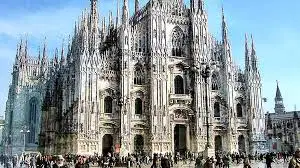
Is this architecture Gothic or Romanesque?
Gothic
Romanesque

Is this architecture Gothic or Romanesque?
Gothic
Romanesque
How did the Crusades contribute to the end of medieval Europe?
They unified all European kingdoms under one ruler
They weakened the power of the Church; increased trade
They strengthened feudalism by creating more manors
They stopped the spread of new technologies in Europe
What was a major effect of the Black Death on medieval European society?
It led to the establishment of new universities across Europe
It caused a dramatic population decline, weakening the feudal system
It increased the power of kings and nobles over the Church
It improved living conditions for peasants through better healthcare
Which of the following is a shared impact of the Crusades, the Black Death, and the Hundred Years' War on medieval Europe?
They increased the influence of the Church
They all contributed to the decline of feudalism
They caused the population of Europe to grow rapidly
They strengthened the power of local lords over monarchs
What was Joan of Arc’s role in the Hundred Years’ War?
She led the English armies to victory over France
She inspired French troops as a leader and claimed to have visions from God
She negotiated a peace treaty between England and France
She became the queen of France after leading a successful rebellion

