
NEW
Font size
 Worksheets
Political Ideology and Belief
Total questions: 20
Worksheet time: 40mins
Which of the following is NOT a core value of United States political culture?
Legal equality
Political equality
Economic equality
Freedom of religion
Freedom of speech
Which of the following is the best example of the core value of limited government?
Interest groups lobbying the government to influence legislation on a particular issue
The media covering a confirmation hearing for a potential Supreme Court justice
Citizens voting to elect a new member of the United States Congress
The United States Constitution delegating specific powers to Congress
In May of 2015, a federal appeals court ruled that the National Security Agency’s collection of Americans’ phone records was in violation of the USA PATRIOT Act. Which of the following core values are involved in the national debate regarding the surveillance program referred to in this scenario?
Liberty versus stability and order
Majority rule versus minority rights
States’ rights versus federal authority
Common good versus freedom of expression
A person loses his job and refuses to accept any government assistance to get back on his feet, instead relying on savings and seeking a new job immediately. Which of the following core values would this person most relate to?
Rule of law
Free enterprise
Individualism
Equality of opportunity
Which of the following public policies is best supported by the notion of free enterprise?
The government subsidizing the cost of milk
Congress passing legislation bailing out the automobile industry
Taxpayers funding a national high-speed railway service
After a review, the Federal Trade Commission approving a corporate merger of cable providers
Which of the following scenarios best reflects the process of political socialization?
An individual takes a civics course in school and develops opinions about politics.
Members of Congress increasingly vote the same way as other members of their party.
A group is able to attract new members by offering access to a broad network of people.
As media choices increase, individuals expand their media consumption to new sources.
When a child’s parents both identify strongly with the same political party, the child will most likely
identify with the opposing party
identify with the parents’ party
have a low sense of political efficacy
become an independent rather than a party identifier
become alienated from the political system
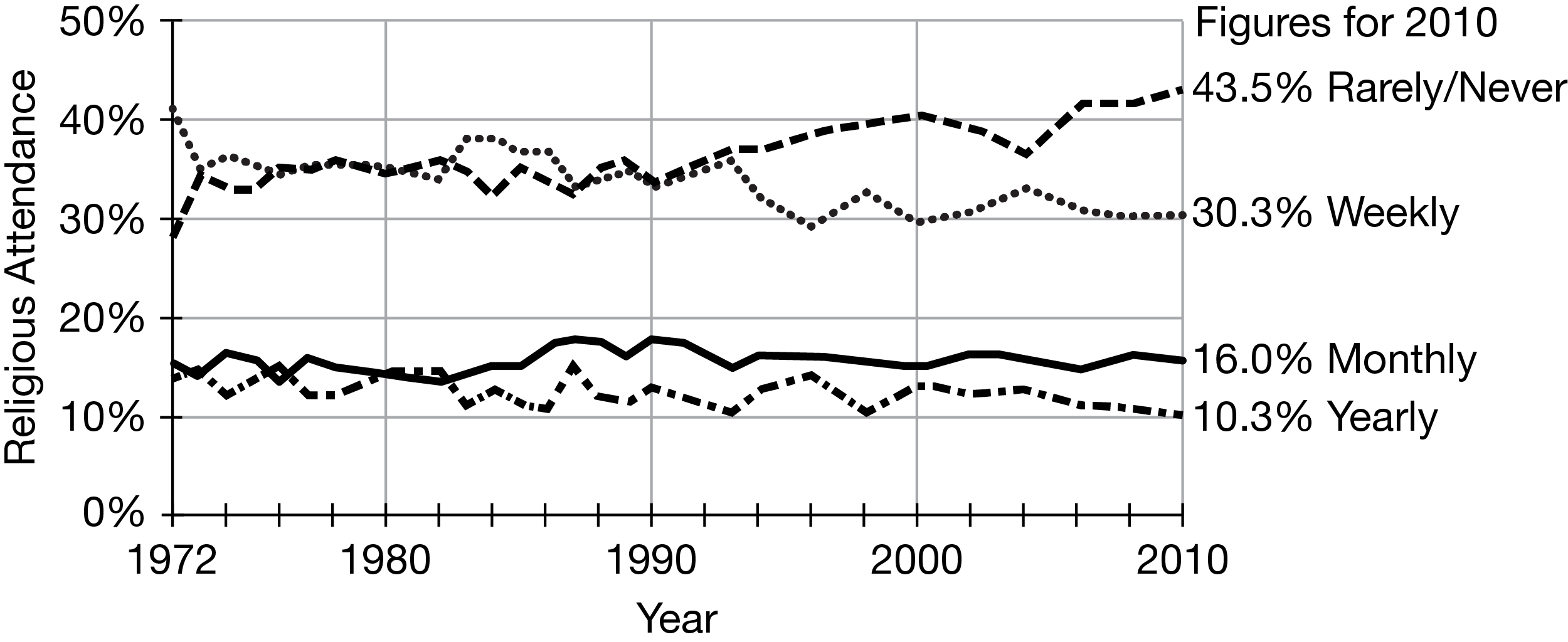
Which of the following is true about church attendance based on the line graph?
About 30% of people surveyed in 2010 rarely or never attend church.
About 26% of people surveyed in 2010 attended church once a month or less.
About 16% of people surveyed in 2010 attend church about once a year.
About 54% of people surveyed in 2010 attended church once a year or less.
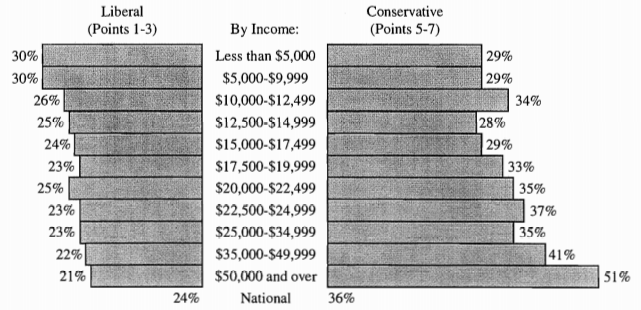
The graph above supports which of the following statements?
People with higher incomes are more likely to think of themselves as conservative than are those with lower incomes.
Americans with incomes under $10,000 are twice as likely to think of themselves as liberal than as conservative.
A majority of people whose incomes fall between $10,000 and $50,000 think of themselves as conservative.
No income group contains more people who think of themselves as liberal than people who think of themselves as conservative.
People with higher incomes are less likely to think of themselves as either liberal or conservative than are those with lower incomes.
Political socialization is the process by which
the use of private property is regulated by the government
governments communicate with each other
public attitudes toward government are measured and reported
political values are passed to the next generation
children are trained for successful occupations

Which of the following best describes a trend in the data?
The older the respondents, the more likely they are to identify as patriotic.
Generation X respondents are more likely to be politically active than the Baby-Boomer respondents.
Baby Boomer respondents are the most likely to consider themselves self-reliant.
The younger the respondents, the more likely they are to identify as religious and moral.
One of the principal effects of 9/11 was instilling in Americans a fear that their personal security was at greater risk than ever before. Many aspects of the post-9/11 world are indeed new, but the fear it evokes echoes that felt by prior generations. At times the country has met those fears while still holding fast to its core democratic principles. Other times, fear has overruled American principles, especially the protection of individual freedoms. The most important legacy of the American experience following 9/11 will not be the novelty of fear, but rather how well the country copes with that fear while adhering to its constitutional framework.
Given how searing the 9/11 experience was, it is sometimes hard to remember that prior generations of Americans didn’t always sleep soundly either. Pearl Harbor is an often-cited example, but it joins many other moments of intense fear in U.S. history. During the 40-plus years of the Cold War, American school children practiced “duck and cover” drills the way today’s kids might practice school lock-downs. As a teenage in the 1980s, I joined Sting in hoping we could avert a nuclear holocaust if “the Russians love their children, too.”
With the collapse of the Soviet Union, other threats in the United States soon appeared: the 1993 World Trade Center bombing, the 1995 Oklahoma City bombing, and the 1996 Atlanta Olympic Park bombing, to name just a few. During the 1990s, some in the military liked to refer to the United States as a “homeland sanctuary;” after 9/11, many talk about the end of that sanctuary.
True, the country has experienced fewer external threats to its population than have most other nations. But it’s a misconception to think that the American sense of external threat is new.
-Kathleen Hicks, “What Will Americans Do About Their Fear of Terrorism?” The Atlantic Monthly, 2016.
Which of the following best explains how the passage relates to the political process?
Attacks on United States soil can mobilize the public to act and demand changes to the public policy process.
Public opinion plays an important role in the development of new security measures to protect the United States from internal and external threats.
There are important political and cultural events that can cause the development of lasting political beliefs across groups of people in society.
Citizens judge political leaders on how they react to the internal and external threats faced during their time in office.
One of the principal effects of 9/11 was instilling in Americans a fear that their personal security was at greater risk than ever before. Many aspects of the post-9/11 world are indeed new, but the fear it evokes echoes that felt by prior generations. At times the country has met those fears while still holding fast to its core democratic principles. Other times, fear has overruled American principles, especially the protection of individual freedoms. The most important legacy of the American experience following 9/11 will not be the novelty of fear, but rather how well the country copes with that fear while adhering to its constitutional framework.
Given how searing the 9/11 experience was, it is sometimes hard to remember that prior generations of Americans didn’t always sleep soundly either. Pearl Harbor is an often-cited example, but it joins many other moments of intense fear in U.S. history. During the 40-plus years of the Cold War, American school children practiced “duck and cover” drills the way today’s kids might practice school lock-downs. As a teenage in the 1980s, I joined Sting in hoping we could avert a nuclear holocaust if “the Russians love their children, too.”
With the collapse of the Soviet Union, other threats in the United States soon appeared: the 1993 World Trade Center bombing, the 1995 Oklahoma City bombing, and the 1996 Atlanta Olympic Park bombing, to name just a few. During the 1990s, some in the military liked to refer to the United States as a “homeland sanctuary;” after 9/11, many talk about the end of that sanctuary.
True, the country has experienced fewer external threats to its population than have most other nations. But it’s a misconception to think that the American sense of external threat is new.
-Kathleen Hicks, “What Will Americans Do About Their Fear of Terrorism?” The Atlantic Monthly, 2016.
The passage is most related to which of the following concepts?
Political partisanship
Political socialization
Political ideology
Political polling

Which generation group is most likely to oppose a protest of national symbols or ceremonies?
Silent
Boomer
Generation X
Millennial
Which of the following best describes how the generations view themselves in regards to the idealistic trait?
Millennial respondents are the least likely to consider themselves idealistic.
Each group is less likely to identify as idealistic as they get older.
Baby-Boomer respondents are more likely to consider themselves idealistic than Generation X respondents.
Silent Generation respondents are the most likely to consider themselves idealistic.
One of the principal effects of 9/11 was instilling in Americans a fear that their personal security was at greater risk than ever before. Many aspects of the post-9/11 world are indeed new, but the fear it evokes echoes that felt by prior generations. At times the country has met those fears while still holding fast to its core democratic principles. Other times, fear has overruled American principles, especially the protection of individual freedoms. The most important legacy of the American experience following 9/11 will not be the novelty of fear, but rather how well the country copes with that fear while adhering to its constitutional framework.
Given how searing the 9/11 experience was, it is sometimes hard to remember that prior generations of Americans didn’t always sleep soundly either. Pearl Harbor is an often-cited example, but it joins many other moments of intense fear in U.S. history. During the 40-plus years of the Cold War, American school children practiced “duck and cover” drills the way today’s kids might practice school lock-downs. As a teenage in the 1980s, I joined Sting in hoping we could avert a nuclear holocaust if “the Russians love their children, too.”
With the collapse of the Soviet Union, other threats in the United States soon appeared: the 1993 World Trade Center bombing, the 1995 Oklahoma City bombing, and the 1996 Atlanta Olympic Park bombing, to name just a few. During the 1990s, some in the military liked to refer to the United States as a “homeland sanctuary;” after 9/11, many talk about the end of that sanctuary.
True, the country has experienced fewer external threats to its population than have most other nations. But it’s a misconception to think that the American sense of external threat is new.
-Kathleen Hicks, “What Will Americans Do About Their Fear of Terrorism?” The Atlantic Monthly, 2016.
The experience of those who lived through 9/11 needs to create which of the following outcomes, according to the author of the passage?
Citizens should not let their fear of another terror attack override the country’s ability to adhere to the civil liberties protections outlined in the Constitution.
Citizens need to acknowledge that the 9/11 attack was a unique event and work to develop a new strategy to combat future terror attacks.
Citizens have to be willing to sacrifice some civil liberties in order to protect the country from future terrorist attacks.
Citizens can rely on the government to develop plans to protect them in the event of a future attack on the United States.
An important change in political culture since 1950 is that United States citizens have become
more likely to believe that their actions can influence government policy
more trusting of nongovernmental institutions and leaders
less trusting of governmental institutions and leaders
less supportive of school integration
less likely to think of themselves as ideologically moderate
Of the following, the most important role in the political socialization of children is played by
their peer groups
their places of worship
the family
the media
the school
The Supreme Court addressed the admissions policy of the University of Michigan Law School in Grutter v. Bollinger (2003). Justice Sandra Day O’Connor wrote for the court, “in the context of its individualized inquiry into the possible diversity contributions of all applicants, the Law School's race-conscious admissions program does not unduly harm nonminority applicants.” The primary issue of controversy in the Grutter v. Bollinger decision involves
national supremacy
judicial review
selective incorporation
affirmative action
Which of the following applications of affirmative action would the United States Supreme Court likely consider unconstitutional?
A company actively recruits women and minorities in its hiring practices for a federal contract.
A state university refuses acceptance of any new applicants from a specific race.
A university values racial diversity on its campus and considers race as one of many factors when considering applicants to its freshman class.
The United States Department of Transportation hires a contractor with a history of hiring and promoting minorities and women for the construction of an interstate highway.

