
 Worksheets
Final Exam Review
Total questions: 177
Worksheet time: 2hrs 4mins
What is a reactant in a chemical reaction?
The new substance formed by a chemical reaction
The starting substance of a chemical reaction
The substance that speeds up a chemical reaction
The substance that stops a chemical reaction
What is a product in a chemical reaction?
The starting substance of a chemical reaction
The substance that speeds up a chemical reaction
The new substance formed by a chemical reaction
The substance that stops a chemical reaction
What is a balanced chemical equation?
An equation with more reactants than products
An equation with more products than reactants
An equation with the same number of each type of atom on both sides
An equation with different numbers of atoms on each side
What does the symbol (s) represent in a chemical equation?
Solid
Liquid
Gas
Aqueous solution
What does the symbol (aq) represent in a chemical equation?
Solid
Liquid
Gas
Dissolved in water
What is one of the signals that a chemical reaction has occurred?
No change in color
Solid formation
No change in temperature
No change in state
What must be checked to ensure a chemical equation is balanced?
The color of the reactants
The state of matter
The number of atoms on both sides
The temperature of the reaction
What does a balanced chemical equation ensure?
Energy will transfer from reactants to products
Equal volume of reactants and products
Equal number of molecules
Equal number of atoms of each type
What is not a part of the systematic approach to balancing equations?
Writing unbalanced equations
Changing subscripts
Balancing by trial and error
Checking atom balance
Why is it important to balance chemical equations?
To satisfy the law of conservation of mass
To make the equation look neat
To change the properties of reactants
To increase the reaction speed
What does the coefficient in a chemical equation represent?
The speed of the reaction
The temperature at which the reaction occurs
The relative number of molecules
The type of chemical bond
Which of the following is a key idea in balancing chemical equations?
Use only even numbers for coefficients
Balance by changing the chemical formulas
Balance by trial and error
Use only odd numbers for coefficients
What is the role of coefficients in a chemical equation?
To indicate the phase of the substance
To show the relative amounts of reactants and products
To change the chemical identity
To denote the temperature of the reaction
What is the purpose of writing the formulas of reactants and products in a chemical equation?
To change the chemical properties
To create an unbalanced equation
To start the balancing process
To remove unnecessary elements

(a) Fe(s) + (b) Cl2(g) → (c) FeCl3(s)
Balance the equation by adding coefficients.

Balance this equation:
(a) Fe + (b) O2 --> (c) Fe2O3
In 3P2O5, there are (a) phosphorus (P) atoms and (b) oxygen (O) atoms.

Number of C: (a)
Number of H: (b)
Number of O: (c)
4CF2Cl3
carbon
4
fluorine
8
chlorine
12
Balance the following reaction:
(a) C + (b) H2 → (c) C3H8
Say how many atoms of oxygen are in each of the following.
2
NaNO2
4
2NaNO2
8
2Mg(NO2)2
Two clear chemicals combine. The solution turns yellow and gets cold. What evidence suggests that a chemical change took place?
There is no evidence.
The solution turned yellow.
The solution got cold.
The solution both turned yellow and got cold.
Which of the following is NOT an indicator (evidence) of a chemical reaction?
Precipitate formation
Light being produced
Change in state of matter
Change in temperature
How are fireworks an example of chemical reactions?
The chemicals do not change as they explode.
They are made of chemicals.
Heat, light, and sound are given off.
Fireworks are not examples of chemical reactions.
What is the force that holds two or more atoms together and makes them function as a unit?
Bond energy
Ionic bonding
Bond
Covalent bonding
What are some of the general properties of gases that distinguish them from liquids and solids?
Gases have a definite shape and volume.
Gases are incompressible.
Gases have high density.
Gases have no definite shape.
Gases are compressible.
What is the SI unit of pressure?
Pascal
Bar
PSI
Torr
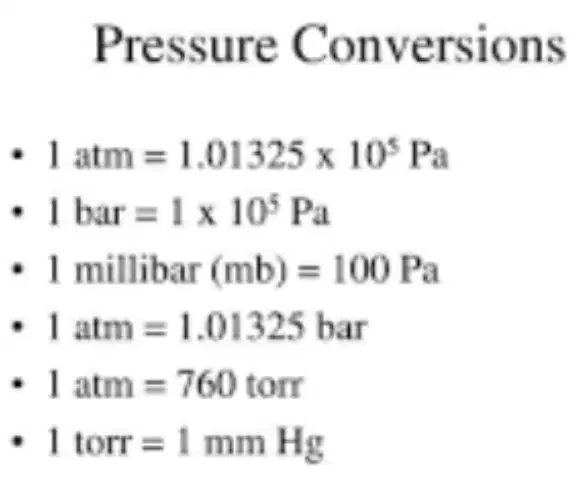
Convert 1.20 atm to units of mm Hg, torr, and pascals.
1.20 atm is equivalent to 912 mm Hg, 912 torr, and 121,000 pascals.
1.20 atm is equivalent to 900 mm Hg, 900 torr, and 120,000 pascals.
1.20 atm is equivalent to 920 mm Hg, 920 torr, and 122,000 pascals.
1.20 atm is equivalent to 930 mm Hg, 930 torr, and 123,000 pascals.
Boyle’s law for gases tells us that:
The pressure of a gas is inversely proportional to its volume at constant temperature.
The pressure of a gas is directly proportional to its volume at constant temperature.
The pressure of a gas is inversely proportional to its temperature at constant volume.
The pressure of a gas is directly proportional to its temperature at constant volume.
What does Charles’s law tell us about how the volume of a gas sample varies as the temperature of the sample is changed?
The volume of a gas is directly proportional to its temperature.
The volume of a gas is inversely proportional to its temperature.
The volume of a gas remains constant as temperature changes.
The volume of a gas is independent of its temperature.
What temperature scale is defined with its lowest point as the absolute zero of temperature?
Kelvin scale
Celsius scale
Fahrenheit scale
Rankine scale
What is absolute zero in Celsius degrees?
-273.15°C
0°C
-459.67°C
273°C
What does Avogadro’s law tell us about the relationship between the volume of a sample of gas and the number of molecules the gas contains?
Avogadro's law states that the volume of a gas is directly proportional to the number of molecules, at constant temperature and pressure.
Avogadro's law states that the volume of a gas is inversely proportional to the number of molecules, at constant temperature and pressure.
Avogadro's law states that the volume of a gas is independent of the number of molecules, at constant temperature and pressure.
Avogadro's law states that the volume of a gas is directly proportional to the temperature, at constant pressure.
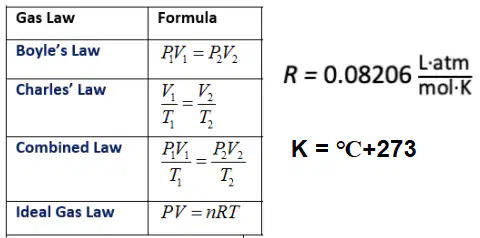
What equation would you use to solve this?
A sample of gas in a 10.0-L container exerts a pressure of 565 mm Hg. Calculate the pressure exerted by the gas if the volume is changed to 15.0 L at constant temperature.


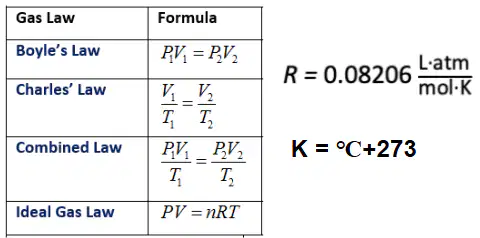
A sample of gas in a 10.0-L container exerts a pressure of 565 mm Hg. Calculate the pressure exerted by the gas if the volume is changed to 15.0 L at constant temperature.
(a) mm Hg
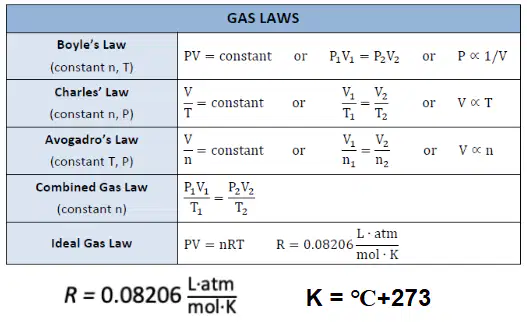
What equation would you use to solve this?
A sample of gas in a 5.00-L container at 35.0 °C is heated at constant pressure to a temperature of 70.0 °C at constant pressure. Determine the volume of the heated gas.
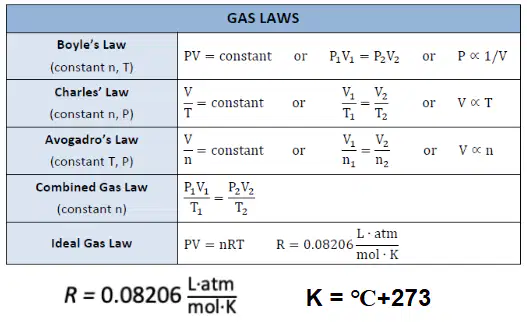
A sample of gas in a 5.00-L container at 35.0 °C is heated at constant pressure to a temperature of 70.0 °C at constant pressure. Determine the volume of the heated gas.
_. (a) L
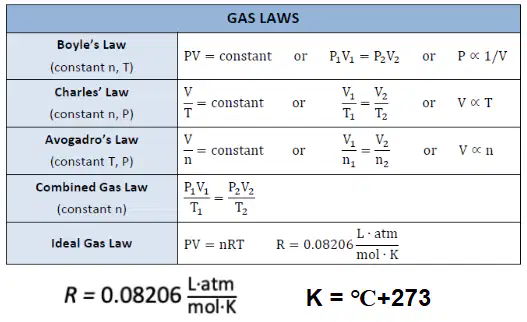
What equation would you use to solve this?
A sample of gas at 24 °C occupies a volume of 3.45 L and exerts a pressure of 2.10 atm. The gas is cooled to –12 °C, and the pressure is increased to 5.20 atm. Determine the new volume occupied by the gas.
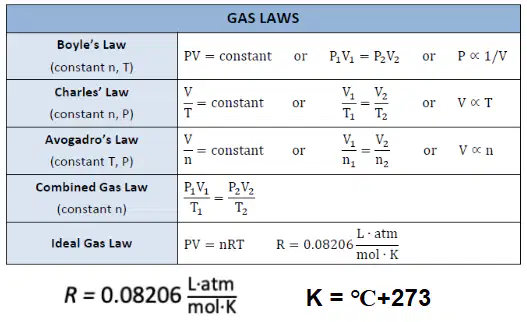
A sample of gas at 24 °C occupies a volume of 3.45 L and exerts a pressure of 2.10 atm. The gas is cooled to –12 °C, and the pressure is increased to 5.20 atm. Determine the new volume occupied by the gas.
_. (a) L
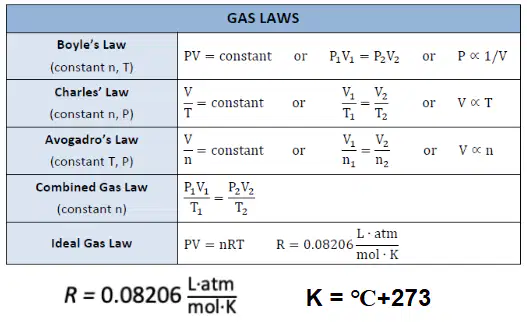
What equation would you use to solve this?
A 4.50-mol sample of a gas occupies a volume of 34.6 L at a particular temperature and pressure. What volume does 2.50 mol of the gas occupy at these same conditions of pressure and temperature?
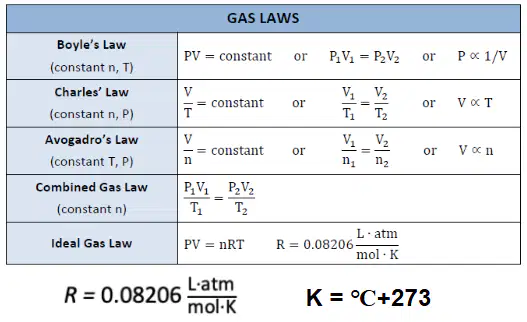
A 4.50-mol sample of a gas occupies a volume of 34.6 L at a particular temperature and pressure. What volume does 2.50 mol of the gas occupy at these same conditions of pressure and temperature?
(a) ._ L
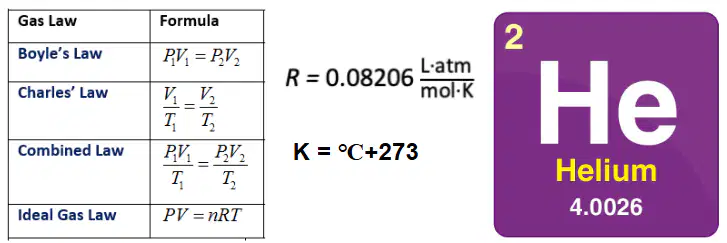
What equation would you START WITH to solve this?
What mass of helium gas exerts a pressure of 1.20 atm in a volume of 5.40 L at a temperature of 27 °C?
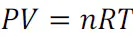
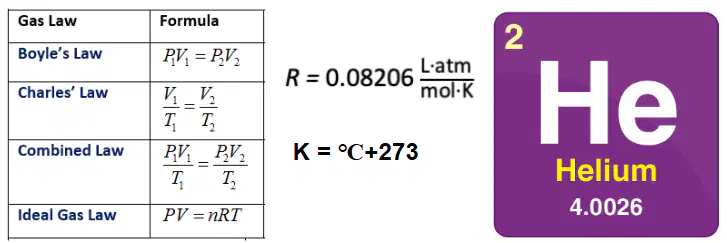
What mass of helium gas exerts a pressure of 1.20 atm in a volume of 5.40 L at a temperature of 27 °C?
_. (a) g
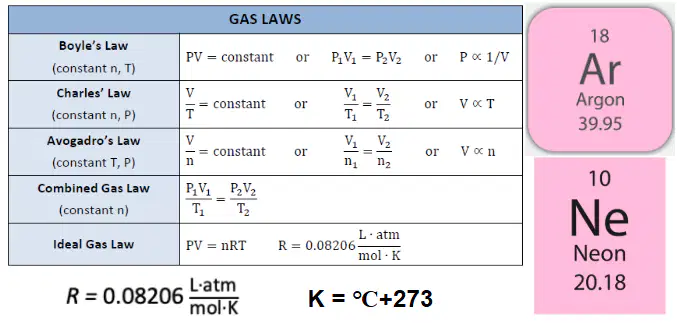
A 2.50-g sample of neon gas is added to a 5.00-g sample of argon gas in a 10.0-L container at 23 °C. Calculate the total pressure of the mixture.
_. (a) atm
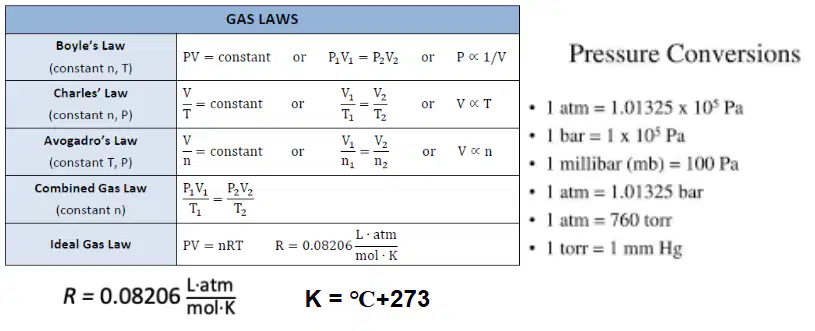
A sample of oxygen gas is collected over water at 27 °C. The total pressure is 0.95 atm, and the water vapor pressure at 27 °C is 26.7 torr. Determine the partial pressure of the oxygen gas collected.
(a) torr
What does a barometer measure?
Temperature
Humidity
Atmospheric pressure
Volume
What is another name for torr?
Pascal
(Pa)
Millimeters of mercury
(mm Hg)
Atmosphere
(atm)
Newton per square meter
(N/m2)
How many mm Hg is equivalent to one standard atmosphere?
500 mm Hg
760 mm Hg
990 mm Hg
800 mm Hg
What is the SI unit of pressure?
(equal to one newton per square meter)
Atmosphere
Torr
Pascal
Bar
According to Boyle’s Law, what happens to the pressure of a gas when the volume increases at constant temperature?
Pressure increases
Pressure decreases
Pressure remains the same
Pressure doubles
What temperature is defined as absolute zero?
0 degrees Celsius
–273 degrees Celsius
–100 degrees Celsius
100 degrees Celsius
Which law states that the volume of a gas is directly related to its temperature at constant pressure?
Boyle’s Law
Charles’s Law
Avogadro’s Law
Dalton’s Law
What does Avogadro’s Law state?
Volume is inversely proportional to pressure
Volume is directly proportional to temperature
Equal volumes of gases contain the same number of particles
Total pressure is the sum of partial pressures
What is the universal gas constant (R) in L·atm/K·mol?
8.314
0.08206
101.325
760
In the ideal gas law (PV = nRT), what does 'n' represent?
Pressure
Volume
Moles of gas
Temperature
Ptotal = P1 + P2 + P3 + ...
Dalton's Law of Partial Pressures
Boyle's Law
Combined Gas Law
Avogadro's Law
What is an ideal gas?
A gas that does not exist
A gas that obeys PV = nRT
A gas at high pressure
A gas at low temperature
What is the combined gas law?
PV = nRT
P1V1/T1 = P2V2/T2
P + V = T
V = bT
What is partial pressure?
Total pressure in a container
The pressure exerted by a single gas in a mixture
The pressure when gas volumes are equal
None of the above
What does Dalton’s Law of Partial Pressures state?
Total pressure is the sum of all gas volumes
Total pressure is the sum of partial pressures of individual gases
Total pressure equals pressure of one gas
Gas volume is independent of temperature
What is the molar volume of an ideal gas at standard temperature and pressure?
1 liter
22.42 liters
10 liters
8.24 liters
What conditions define standard temperature and pressure (STP)?
0 degrees Celsius and 1 atm
0 Kelvin and 1 atm
0 degrees Celsius and 760 mm Hg
100 degrees Celsius and 1 atm
What does the kinetic molecular theory assume about gases?
Gases are composed of large particles
Gases are always at high pressure
Gases consist of tiny particles in constant motion
Gases do not exert pressure
Which of the following is true according to Boyle's law?
Volume increases as pressure increases
Pressure decreases as volume increases
Temperature and volume are inversely related
Pressure and temperature are independent
What is the relationship described by Charles's law?
Pressure is inversely proportional to volume
Volume is directly proportional to temperature
Pressure is directly proportional to volume
Volume is independent of temperature
Which law can be expressed as PV = k?
Ideal Gas Law
Boyle's Law
Charles's Law
Dalton’s Law
How does the volume of a gas change when temperature increases at constant pressure?
Volume decreases
Volume stays the same
Volume increases
Volume doubles
What happens to the behavior of real gases at high pressures and low temperatures?
They behave ideally
They do not behave ideally
They become solids
They expand indefinitely
According to the combined gas law, if the temperature of a gas decreases while keeping the volume constant, what happens to the pressure?
Pressure increases
Pressure decreases
Pressure remains the same
Pressure cannot be determined
In the ideal gas equation, which unit should T be in?
Torr
Pascal
Celsius
Kelvin
g/mol
Categorize the densities of solids liquids and gases
Solid
Liquid
Gas
Categorize the compressibility of solids liquids and gases
Solid
Liquid
Gas
Categorize the characteristics of water
colorless
odorless
freezes at 0°C
boils at 100°C
tasteless
bluish color
acidic taste
chlorine smell
boils at 100 K
freezes at 0 K
Which is greater?
(if moles and pressure are constant)
energy needed to boil water
energy needed to melt ice
Choose which would be 'changes in state'.
liquid to gas
gas to solid
solid to liquid
atom to molecule
low pressure gas to
high pressure gas
In order to melt or vaporize a substance, which forces might need to be overcome?
London dispersion forces
Dipole-Dipole forces
Hydrogen bonding
Covalent bonding
Ionic Bonding
The forces that must be overcome to vaporize a liquid are
Intermolecular
Intramolecular
Define molar heat of fusion and molar heat of vaporization. Choose the correct option.
Molar heat of fusion is the energy per mole required to change a substance from solid to liquid at constant temperature, and molar heat of vaporization is the energy per mole required to change it from liquid to gas at constant temperature.
Molar heat of fusion is the energy per mole required to raise the temperature of a solid, and molar heat of vaporization is the energy per mole required to vaporize a gas.
Molar heat of fusion and vaporization both refer to the energy changes during chemical reactions.
Molar heat of fusion is the energy released during solidification, and molar heat of vaporization is the energy absorbed during condensation.
The heat of fusion of aluminum is 3.95 kJ/g. Determine the molar heat of fusion of aluminum, given its molar mass is approximately 26.98 g/mol.
107 kJ/mol
96.5 kJ/mol
30.93 kJ/mol
6.83 kJ/mol
Although London forces exist among all molecules, for what type of molecule are they the only major intermolecular force?
Nonpolar molecules
Polar molecules
Covalent molecules
Ionic molecules
Metals
Equilibrium vapor pressure of a liquid is defined as the pressure exerted by its vapor in equilibrium with the liquid. How is it related to the strength of intermolecular forces?
It is higher for liquids with weaker intermolecular forces.
It is higher for liquids with stronger intermolecular forces.
It is independent of the intermolecular forces.
It depends solely on temperature and not on intermolecular forces.
What is the vapor pressure of water at 100.0 °C ?
1 atm
0.5 atm
2 atm
it depends on the elevation
The term crystalline solid is defined as:
A solid in which particles are arranged in a regular pattern.
A solid with no fixed shape or volume.
A solid where the particles are arranged randomly throughout.
A solid that melts at a very high temperature.
Which two are true of ALL alloys?
metallic properties
composed of two metals
contain a mixture of elements
corrosion resistant
A sample of boiling water remains at the same temperature even though heat is continually added to it.
Where does the heat energy go?
The water absorbs heat to increase its potential energy.
The heat energy is used to change the water from liquid to gas.
The heat energy decreases the vapor pressure inside the liquid.
The water loses energy due to evaporation.
boiling point (a) with an increase in altitude because atmospheric pressure (b)
How do the strengths of dipole–dipole forces compare with the strengths of
typical covalent bonds?
Dipole–dipole forces are significantly weaker than covalent bonds.
It depends on the atoms or molecules involved
Dipole–dipole forces are significantly stronger than covalent bonds.
Dipole–dipole forces and covalent bonds have comparable strengths.
Which condition must exist for hydrogen bonding to happen?
hydrogen bonded to a very electronegative atom
hydrogen is bonded to carbon
any polar covalent bond is present
two hydrogens must be present in each molecule
The boiling point of a liquid is related to the atmospheric pressure because
Increased atmospheric pressure requires higher energy to vaporize the liquid.
Decreased atmospheric pressure requires higher energy to vaporize the liquid.
Increased atmospheric pressure lowers the energy needed for vaporization.
Atmospheric pressure does not affect the boiling point.
Which of the following pair of crystalline solid and the interparticle forces holding its particles together is correctly matched?
NaCl – Ionic solid, held together by electrostatic forces
Diamond – Metallic solid, held together by the sea of electrons
Copper – Covalent network solid, held together by directional covalent bonds
Dry Ice (CO2) – Ionic solid, held together by ionic bonds
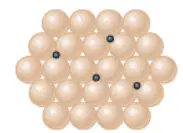
Categorize the alloys
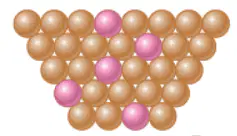
brass
steel
What instrument would be best to use in an experiment to demonstrate vapor pressure?
manometer
barometer
pressure cooker
anemometer
Define a solution.
A homogeneous mixture of two or more substances.
A heterogeneous mixture of two or more substances.
A pure substance.
A compound.
How does a molecular solid such as sugar dissolve in water?
portions of sugar molecules are attracted to water molecules
sugar molecules form covalent bonds with water molecules
sugar molecules form ionic bonds with water molecules
sugar molecules split into separate ions to dissolve in water
How does an ionic solute such as NaCl dissolve in water?
portions of NaCl crystals for hydrogen bonds with water molecules
NaCl crystals form covalent bonds with water molecules
NaCl crystals form ionic bonds with water molecules
NaCl crystals split into separate ions to dissolve in water
What are three ways to increase the rate of dissolution of a solute?
heat the solution
stir the solution
increase the surface area of the solute
increase the number of solute particles
Match the following statements correctly with a saturated solution, an unsaturated solution, and a supersaturated solution?
contains as much solute as can dissolve at a
particular temperature
saturated solution
contains less solute
than can dissolve at a particular temperature
unsaturated solution
more solute is dissolved than is normally possible at a particular
temperature
supersaturated solution
Match the terms to the definitions
(mass of solute) × 100%
(mass of solution)
Percent by mass
(or mass percent)
the number of moles of solute per liter of solution
Molarity
the number of equivalents per liter of solution
Normality
One equivalent of an acid can furnish (a) of (b) ions.
One equivalent of a base can furnish (c) of (d) ions.
The normality of a solution is defined as
equivalents of solute
liter of solution
equivalents of solvent
liter of solution
moles of solute
liter of solution
moles of solvent
liter of solution
A 12.5-g sample of glucose (C₆H₁₂O₆) is dissolved in 225 g of water. Calculate the percent by mass of glucose in the solution.
4.8%
5.3%
6.3%
5.8%
A chemist prepares some standard solutions for use in the lab using 500.0-mL volumetric flasks to contain the solutions. If the following masses of solutes are used, calculate the resulting molarity of a solution with 4.865 g NaCl. (The molar mass of NaCl is 58.44 g/mol)
0.167 M
0.132 M
0.244 M
0.929 M
Suppose that each of the following solutions is diluted by adding the indicated amount of water. Calculate the new concentrations of
255 mL of 3.02 M HCl with 375 mL water added
1.22 M HCl
2.02 M HCl
0.98 M HCl
1.50 M HCl
Calculate the volume (in milliliters) of
0.271 M HCl
that would be required to neutralize
36.2 mL of 0.259 M NaOH
34.6 mL
36.2 mL
33.0 mL
35.0 mL
What volume of
0.242 M H2SO4
can furnish the same number of moles of H+ ions as
41.5 mL of 0.118 M HCl
10.1 mL
9.45 mL
20.3 mL
5.05 mL
Calculate the normality of the following solution: 0.204 M HCl
0.204 N
0.102 N
0.408 N
0.306 N
Calculate the normality of the following solution: 0.328 M H2SO4
0.656 N
0.328 N
1.312 N
0.164 N
What volume of 0.10 M Ba(NO3)2 solution is required to react completely with 100.0 mL of 0.50 M NaCl solution to form BaCl2(s)?
250.0 mL
200.0 mL
500.0 mL
100.0 mL
The term colligative property refers to a property of a solution that depends only on the
number of solute particles
chemical nature of the solute
solvent characteristics
the number and type of solute particles
Define a solution.
A homogeneous mixture of two or more substances.
A heterogeneous mixture of two or more substances.
A pure substance.
A compound.
How does a molecular solid such as sugar dissolve in water?
portions of sugar molecules are attracted to water molecules
sugar molecules form covalent bonds with water molecules
sugar molecules form ionic bonds with water molecules
sugar molecules split into separate ions to dissolve in water
How does an ionic solute such as NaCl dissolve in water?
portions of NaCl crystals for hydrogen bonds with water molecules
NaCl crystals form covalent bonds with water molecules
NaCl crystals form ionic bonds with water molecules
NaCl crystals split into separate ions to dissolve in water
What are three ways to increase the rate of dissolution of a solute?
heat the solution
stir the solution
increase the surface area of the solute
increase the number of solute particles
Match the following statements correctly with a saturated solution, an unsaturated solution, and a supersaturated solution?
contains as much solute as can dissolve at a
particular temperature
saturated solution
contains less solute
than can dissolve at a particular temperature
unsaturated solution
more solute is dissolved than is normally possible at a particular
temperature
supersaturated solution
Match the terms to the definitions
(mass of solute) × 100%
(mass of solution)
Percent by mass
(or mass percent)
the number of moles of solute per liter of solution
Molarity
the number of equivalents per liter of solution
Normality
One equivalent of an acid can furnish (a) of (b) ions.
One equivalent of a base can furnish (c) of (d) ions.
The normality of a solution is defined as
equivalents of solute
liter of solution
equivalents of solvent
liter of solution
moles of solute
liter of solution
moles of solvent
liter of solution
A 12.5-g sample of glucose (C₆H₁₂O₆) is dissolved in 225 g of water. Calculate the percent by mass of glucose in the solution.
4.8%
5.3%
6.3%
5.8%
A chemist prepares some standard solutions for use in the lab using 500.0-mL volumetric flasks to contain the solutions. If the following masses of solutes are used, calculate the resulting molarity of a solution with 4.865 g NaCl. (The molar mass of NaCl is 58.44 g/mol)
0.167 M
0.132 M
0.244 M
0.929 M
Suppose that each of the following solutions is diluted by adding the indicated amount of water. Calculate the new concentrations of
255 mL of 3.02 M HCl with 375 mL water added
1.22 M HCl
2.02 M HCl
0.98 M HCl
1.50 M HCl
Calculate the volume (in milliliters) of
0.271 M HCl
that would be required to neutralize
36.2 mL of 0.259 M NaOH
34.6 mL
36.2 mL
33.0 mL
35.0 mL
What volume of
0.242 M H2SO4
can furnish the same number of moles of H+ ions as
41.5 mL of 0.118 M HCl
10.1 mL
9.45 mL
20.3 mL
5.05 mL
Calculate the normality of the following solution: 0.204 M HCl
0.204 N
0.102 N
0.408 N
0.306 N
Calculate the normality of the following solution: 0.328 M H2SO4
0.656 N
0.328 N
1.312 N
0.164 N
What volume of 0.10 M Ba(NO3)2 solution is required to react completely with 100.0 mL of 0.50 M NaCl solution to form BaCl2(s)?
250.0 mL
200.0 mL
500.0 mL
100.0 mL
The term colligative property refers to a property of a solution that depends only on the
number of solute particles
chemical nature of the solute
solvent characteristics
the number and type of solute particles
Which statement correctly compares the Arrhenius and Brønsted–Lowry definitions of acids and bases?
Arrhenius: Acids produce H+ ions in water, bases produce OH- ions.
Arrhenius: Acids produce OH- ions in water, bases produce H+ ions.
Brønsted–Lowry: Acids are proton donors, bases are proton acceptors.
Brønsted–Lowry: Acids are proton acceptors, bases are proton donors.
A conjugate acid–base pair in the Brønsted–Lowry model consists of two species that:
differ by one proton (H+)
have the same number of protons
are both acids
are both bases
differ by one hydroxide ion (OH-)
Which of the following are the balanced chemical equations showing HCl and H2SO4 behaving as Brønsted–Lowry acids in water?
HCl + H2O → H3O+ + Cl-
H2SO4 + H2O → H3O+ + HSO4-
HCl + H2O → H2O + Cl-
H2SO4 + H2O → H2O + SO42-
HCl + H2O → HClO + H2
H2SO4 + H2O → H2SO3 + H2O2
The strength of an acid is related to the position of its ionization equilibrium in that:
the stronger the acid, the more the equilibrium lies to the right, indicating greater ionization.
the stronger the acid, the more the equilibrium lies to the left, indicating less ionization.
the strength of the acid does not affect the position of equilibrium.
the weaker the acid, the more the equilibrium lies to the right, indicating greater ionization.
Which of the following shows the correct dissociation (ionization) equations for HNO3 in water?
HNO3 + H2O →
H3O+ + NO3-
HNO3 + H2O →
H2O+ + HNO3-
HNO3 + H2O →
H2O2 + HNO2-
HNO3 + H2O →
H3O- + NO3+
Water is considered an amphoteric substance because it can:
act only as an acid
act only as a base
act as both an acid and a base
neither donates nor accepts protons
At 25 °C, what are the values of [H+], and [OH-] in pure water?
They both equal 1.0×10⁻¹⁴
They both equal 1.0×10⁻⁷M
[OH-] = 1.0×10⁻⁷M
[H+] = 1.0×10⁻¹⁴M
[H+] = 1.0×10⁻⁷M
[OH-] = 1.0×10⁻¹⁴M
In an acidic solution, [H+] is (a) [OH-].
In a basic solution, [H+] is (b) [OH-].
The pH scale is defined as:
pH = -log[H+]
pH = [H+]
pH = log[H+]
pH = -[H+]
Match the pH scales to the correct terms
pH = 7
Neutral
pH < 7
Acidic
pH > 7
Basic
When the pH of a solution changes by one unit, by what factor does the hydrogen ion concentration change in the solution?
2
1
10
100
log [H+]
pOH is defined as:
pOH = -log[OH-]
pOH = -log[H+]
pOH = log[OH-]
pOH = log[H+]
A buffered solution is important because it:
resists changes in pH
increases the rate of chemical reactions
prevents the formation of acids and bases
removes all impurities from solutions
Write the conjugate acid of SO32- .
HSO3-
SO32-
SO42-
H2SO3
Write the conjugate acid of F-.
HF
H2F
FOH
H2O
Write the conjugate acid of CH3COO-.
CH3COOH
CH4
HCOOH
CH3OH
Write the conjugate base of the following acid: H2SO4
HSO4−
HSO42-
H3O+
SO32-
Write the conjugate base of the following acid: H2CO3
HCO3−
CO32-
H2CO3−
HCO2−
For the following, calculate the indicated quantity: [H+]=4.01×10⁻³M; pH = ?
pH = 2.397
pH = 3.397
pH = 1.397
pH = 4.397
For the following, calculate the indicated quantity: [OH−]=7.41×10⁻⁸M; pOH = ?
7.130
6.870
8.210
5.920
Calculate the pH and pOH values for the following solution: 0.00141 M HNO3
pH = 2.85
pOH = 11.15
pH = 3.85
pOH = 10.15
pH = 1.85
pOH = 12.15
pH = 4.85
pOH = 9.15
Calculate the pH and pOH values for the following solution: 2.13×10⁻³MNaOH
pOH = 2.67
pH = 11.33
pOH = 11.33
pH = 2.67
pOH = 3.67
pH = 10.33
pOH = 1.33
pH = 12.67
A 25.0-mL sample of 0.50 M HCl is titrated to the endpoint with 12.4 mL of NaOH. Calculate the concentration of the NaOH solution.
1.01 M NaOH
0.25 M NaOH
0.51 M NaOH
2.01 M NaOH
pH and pOH for a given solution are related by which of the following equations at 25°C?
pH + pOH = 7
pH + pOH = 10
pH + pOH = 14
pH + pOH = 1
Equal amounts of an acid and a base react completely, forming a salt and water. The pH of the resulting solution is checked, and rather than its being neutral, the solution is found to have a pH of 6.1. Using what you know about strong acids and bases, which of the following best categorizes the reacting acid and base?
Strong acid and strong base
Strong acid and weak base
Weak acid and strong base
The collision model for chemical reactions explains that what must "collide" for a reaction to occur?
Atoms or molecules
Electrons
Neutrons
Protons
Activation energy is defined as:
The minimum amount of energy required to start a chemical reaction.
The energy released during a chemical reaction.
The total energy of the reactants.
The maximum amount of energy required to start a chemical reaction.
A catalyst is a substance that increases the rate of a chemical reaction without itself undergoing any permanent chemical change. What do we call a biologic catalyst?
Enzyme
Hormone
Vitamin
Substrate
A reaction "has reached a state of chemical equilibrium" when:
the concentrations of reactants and products are equal
the forward and reverse reaction rates are equal
the reaction has stopped completely
all reactants have been converted to products
The equilibrium position in a chemical reaction refers to:
The point where the concentrations of reactants and products remain constant.
The point where all reactants are completely converted to products in a chemical reaction.
The initial concentrations of reactants and products.
The maximum rate of reaction.
Homogeneous and heterogeneous equilibria differ in which of the following ways?
The phases of reactants and products.
The temperature of reactants and products.
The enthalpy of formation of reactants and products.
The concentration of reactants and products.
Le Chatelier’s principle states that if a system at equilibrium is disturbed, the system will:
Remain unchanged
Shift to counteract the disturbance
Speed up the reaction
Stop the reaction completely
Write the equilibrium constant expression for the following reaction: H2(g) + Br2(g) ⇌ 2HBr(g)
Kc = [H2][Br2][HBr]2
Kc=[HBr]2[H2][Br2]
Kc = [HBr][H2]2[Br2]2
Kc = [H2][Br2][HBr]
Write the equilibrium constant expression for the following reaction: SO2Cl2(g) ⇌ SO2(g) + Cl2(g)
[SO2][Cl2]
[SO2Cl2]
[SO2Cl2]
[SO2][Cl2]
[SO2Cl2][SO2][Cl2]
1
[SO2][Cl2][SO2Cl2]
Write the expression for Ksp for the following sparingly soluble salt: ZnS
Ksp = [Zn2+][S2−]
Ksp = [ZnS]
Ksp = [Zn2+]/[S2−]
Ksp = [Zn2+]2[S2−]2
Write the expression for Ksp for the following sparingly soluble salt: HgCl2.
Ksp=[Hg+2][Cl−]2
Ksp = [Hg2+][Cl-]
Ksp = [Hg2+][Cl2]
Ksp=[Hg+][Cl−]2
Do all collisions between molecules result in the breaking of bonds and the formation of products? Why?
Yes, all collisions result in bond breaking and product formation.
No, only collisions with proper orientation and energy result in product formation.
Yes, as long as molecules collide, products are always formed. from colliding reactants.
No, collisions never result in bond breaking or product formation.
How does the collision model account for the observation that higher concentrations and higher temperatures tend to make reactions occur faster?
By increasing the number of effective collisions.
By decreasing the activation energy required for the reaction.
By increasing the activation energy required for the reaction.
By reducing the energy of the reactant molecules.
An increase in temperature for a reaction affects the number of collisions that possess energy greater than Ea by:
Decreasing the number of such collisions
Not affecting the number of such collisions
Increasing the number of such collisions
Eliminating all such collisions
A catalyst speeds up a reaction by:
Increasing the activation energy (Ea) of the reaction.
Decreasing the activation energy (Ea) of the reaction.
Changing the enthalpy of the reaction.
Consuming itself in the reaction.
Equilibrium is a dynamic state because:
the forward and reverse reactions continue to occur at equal rates.
no reactions are occurring at equilibrium.
the concentrations of reactants and products are always changing.
energy is not conserved at equilibrium.
Which of the following changes will shift the equilibrium position of the reaction
2SO2(g) + O2(g) ⇌ 2SO3(g)
to the right?
Adding SO2(g) to the system
Removing SO2(g) from the system
Using a very efficient catalyst
Reducing the volume of the container drastically
Dissolving a slightly soluble salt to form a saturated solution is an equilibrium process because:
the rate of dissolution equals the rate of precipitation.
all the salt dissolves completely.
no ions are present in the solution.
the solution becomes supersaturated.
Silver chloride (AgCl) dissolves in water to give a solution containing 6.3 × 10⁻⁶ mol solute per liter at 10 °C.
Calculate Ksp for AgCl at this temperature.
4.0 × 10⁻¹¹
1.2 × 10⁻⁸
6.0 × 10⁻⁷
2.2 × 10⁻¹⁰
Which of the following changes will shift the equilibrium position in favor of additional products in a chemical system?
Increasing the concentration of a reactant
Removing one of the products
Increasing the temperature for an endothermic reaction
Increasing the temperature for an exothermic process
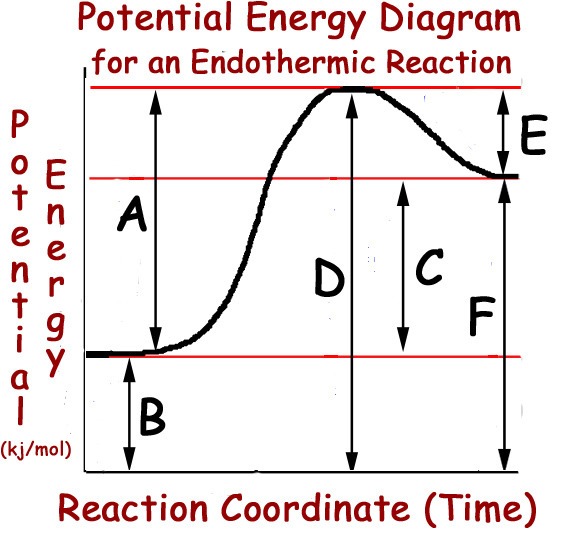
A + B ⟺ C + D + heat
If energy is added to the reaction, the reaction will run in the (a) direction.
N2 (g) + 3 H2 (g) <−> 2 NH3 (g)
If the pressure in the system is increased, the reaction will __________________.

What is the activation energy for the forward reaction?
80 kcal
40 kcal
20 kcal
60 kcal

