
 Worksheets
Unit 154: Light Vehicle Maintenance and Repair Principles Quiz
Total questions: 95
Worksheet time: 48mins
Which of the following topics is specifically mentioned as part of Unit 154?
Light vehicle steering, suspension and braking
Heavy vehicle transmission systems
Motorcycle engine repair
Marine vehicle maintenance
What is one of the main functions of a vehicle's suspension system?
To maintain the contact between the tyres and the road surface
To increase the speed of the vehicle
To reduce fuel consumption
To enhance the sound system
How does the suspension system contribute to vehicle handling?
By providing steering stability and good handling when turning
By increasing engine power
By reducing the size of the vehicle
By improving air conditioning
What does the suspension system support above the springs?
The weight of the vehicle's components (sprung weight)
The fuel tank only
The exhaust system only
The tyres only
How does the suspension system ensure passenger comfort?
By absorbing and dampening shock
By providing extra seating
By increasing the speed of the vehicle
By reducing the size of the tyres
Which of the following is considered a main component of a vehicle's suspension system?
Tyres, and the air inside them
Engine block
Radiator
Exhaust pipe
What type of springs are included in the main components of suspension systems?
Metal and air types
Plastic and rubber types
Wood and ceramic types
Foam and gel types
What type of struts are listed as a main component in suspension systems?
MacPherson types
Double wishbone types
Leaf spring types
Torsion bar types
What is the function of suspension control arms in a vehicle?
For track and location
For engine cooling
For fuel injection
For exhaust emission
Which of the following bars are included in the main components of suspension systems?
Anti-roll bars: front and rear
Stabilizer bars: left and right
Support bars: top and bottom
Guide bars: inner and outer
Which rod is mentioned as a main component of the suspension system?
Panhard Rod
Connecting Rod
Push Rod
Tie Rod
What is the purpose of linkages in a suspension system?
To connect suspension components
To cool the engine
To increase fuel efficiency
To reduce emissions
What is the function of bushes in a suspension system?
To locate, absorb and control movement in components
To lubricate the engine
To filter the air
To store fuel
What do joints provide in a suspension system?
Movement and stability
Electrical power
Fuel delivery
Cooling
Which of the following is included in the main components of a suspension system for monitoring and control?
Electronic sensors and controls
Manual levers and switches
Hydraulic pumps only
Mechanical timers
What does the term "Bump" refer to in vehicle suspension terminology?
Wheel moving upwards
Wheel moving back down
Vehicle swinging side to side
Front of vehicle moving downwards when braking
Which term describes the wheel moving back down in suspension?
Camber
Rebound
Squat
Dive
What is "Camber" in the context of vehicle suspension?
Angle of the steering swivel axis from vertical looking from the side
Wheel angle from vertical looking from the front of the vehicle
Front and rear vehicle up and down movement
Rear of vehicle moving downwards when accelerating hard
The angle of the steering swivel axis from vertical, looking from the side, is known as:
Pitch
Yaw
Castor
Dive
Which term refers to the up and down movement of the front and rear of a vehicle as it travels?
Pitch
Squat
Camber
Rebound
What does "Yaw" describe in vehicle dynamics?
Vehicle swinging side to side from an imaginary vehicle centre point
Front of vehicle moving downwards when braking
Rear of vehicle moving downwards when accelerating hard
Wheel moving upwards
When the front of a vehicle moves downwards during braking, this is called:
Squat
Dive
Pitch
Camber
What is the term for the rear of a vehicle moving downwards when accelerating hard?
Dive
Yaw
Squat
Rebound
What does the term "Toe" refer to in vehicle suspension?
Angle of the wheels, inwards or outwards when looking from the front
Mass of the components above the springs
Continuous spring movements up and down after bump movement
An imaginary line running through the centre of the vehicle
What is described by the "Swivel pin/king pin angle" in vehicle suspension?
Angle of the swivel pins when looking from the front
Mass underneath the springs
Continuous spring movements up and down after bump movement
Angle of the wheels, inwards or outwards when looking from the front
What does "Oscillations" mean in the context of vehicle suspension?
Continuous spring movements up and down after bump movement
Mass of the components above the springs
Angle of the wheels, inwards or outwards when looking from the front
An imaginary line running through the centre of the vehicle
In vehicle suspension terminology, what is "Thrust"?
An imaginary line running through the centre of the vehicle; front to back
Mass underneath the springs
Angle of the swivel pins when looking from the front
Continuous spring movements up and down after bump movement
What is "Sprung weight" in a vehicle?
Mass of the components above the springs: vehicle body etc.
Mass underneath the springs: wheels, hubs, etc.
Angle of the wheels, inwards or outwards when looking from the front
Continuous spring movements up and down after bump movement
What does "Unsprung weight" refer to in vehicle suspension?
Mass underneath the springs: wheels, hubs, etc.
Mass of the components above the springs: vehicle body etc.
Angle of the swivel pins when looking from the front
An imaginary line running through the centre of the vehicle
What is the primary function of the wishbone suspension in a vehicle's front suspension system?
To maintain track width and decrease tyre wear.
To increase engine power.
To improve fuel efficiency.
To reduce brake wear.
What material is the wishbone in the front suspension usually made from?
Mild steel pressing
Aluminum alloy
Plastic composite
Carbon fiber
What is fitted to the front suspension to support the weight of the vehicle body?
A coil spring
A hydraulic pump
A brake disc
A steering rack
What component is used in the wishbone suspension to control spring oscillations?
A damper
A gear lever
A radiator
A fuel injector
What is the purpose of bump and rebound stops in the front suspension system?
To prevent excessive wheel movements
To increase tire pressure
To lubricate the suspension
To cool the brakes
What is a key characteristic of a torsion bar spring used in front suspension systems?
It is a straight metal bar and not coiled.
It is always made of rubber.
It is a coiled metal spring.
It is filled with hydraulic fluid.
Where is one end of a torsion bar spring typically attached in a vehicle's front suspension?
To the wishbone or lower control arm
To the steering wheel
To the exhaust system
To the brake caliper
Which of the following is NOT an advantage of torsion bar suspension?
Provides trim and ride height adjustment
Is compact and low down
Increases vehicle weight significantly
Often found in 4x4 vehicles and formula racing cars
How is the other end of a torsion bar spring fixed to the chassis?
By an adjustable spline or bracket assembly
By welding it directly to the frame
By using a rubber mount only
By attaching it to the steering column
Which type of vehicles commonly use torsion bar front suspension?
4x4 vehicles and many formula racing cars
Bicycles and motorcycles
Heavy trucks only
Boats and ships
What is one of the most common types of suspension used in light vehicles?
McPherson strut
Leaf spring
Torsion bar
Air suspension
What components are combined into a single unit in a McPherson strut?
Coil spring and damper
Leaf spring and shock absorber
Torsion bar and control arm
Air bag and compressor
What is used for the lower strut mounting in a McPherson strut suspension?
Ball swivel joint
Rubber bushing
Leaf spring
Hydraulic piston

The lower connection to the chassis in a McPherson strut system can be a:
Wishbone or track control arm
Leaf spring
Torsion bar
Air bag

What is commonly used in executive and prestige vehicles instead of a metal spring for front suspension?
Air spring
Leaf spring
Coil spring
Torsion bar
What material is an air spring typically made from?
Rubber
Metal
Plastic
Wood
What is the main function of the air in an air spring suspension system?
Acts as the spring by compressing
Cools the brakes
Lubricates the suspension
Powers the vehicle
How can the ride height be adjusted in an air suspension system?
By driver control to increase or decrease air pressure in the bellows
By changing the tires
By adding more oil to the engine
By adjusting the steering wheel
What device delivers air to the air spring in an air suspension system?
Electric motor compressor
Hydraulic pump
Manual pump
Fuel injector
What is the purpose of the accumulator in an air suspension system?
To store the air
To store fuel
To store oil
To store coolant
What does each spring in an air suspension system have for maintaining ride height?
Height level control device
Brake pad
Shock absorber
Steering damper
What is the primary function of dampers in a vehicle's suspension system?
To slow down spring movement and reduce spring oscillations
To increase the speed of the vehicle
To control the steering direction
To provide power to the engine
How is the energy from spring oscillations released in a damper?
As heat from the damper
As electrical energy
As sound
As light
What controls active dampers in a vehicle?
An ECU (Electronic Control Unit)
The steering wheel
The brake pedal
The fuel injection system
What must hydraulic oil pass through inside a damper to slow down spring movement?
Small controlled holes and valves
Large open chambers
Rubber seals
Metal plates

What can active dampers do that traditional dampers cannot?
Vary the damping rate depending on driving modes
Increase the vehicle's speed
Change the color of the suspension
Reduce tire wear automatically
How can dampers be checked for proper operation in a vehicle?
By pressing down on the vehicle’s corner and releasing, then observing the bump and rebound motion
By checking the tire pressure
By measuring the engine temperature
By inspecting the exhaust system
What is the correct number of oscillations for a damper check over about two seconds?
1–2 movements
5–6 movements
10–12 movements
0 movements
Which of the following should always be checked at regular intervals in a vehicle’s suspension system?
Oil leaks, security connections, and corrosion
Tire color
Radio functionality
Air conditioning level
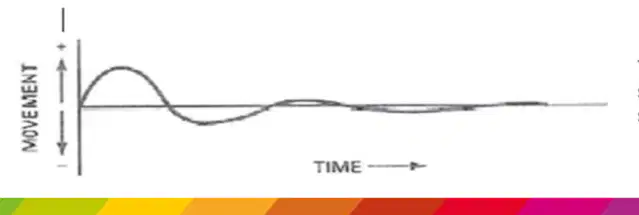
What does the lower diagram in the image illustrate?
The action of a damped spring where the damper stops the suspension from bouncing
The action of an undamped spring where the suspension continues to bounce
The action of a tire under pressure
The action of a broken spring
What is the primary function of the leaf spring in a vehicle's suspension system?
To absorb shocks and maintain vehicle stability
To increase engine power
To improve fuel efficiency
To reduce tire wear
What are the rolled ends of the master leaf in a leaf spring called?
Eyes
Clamps
Shackles
Bolts
What is the purpose of the central clamp in a leaf spring assembly?
To hold all the leaves together
To lubricate the leaves
To connect the spring to the tire
To increase the spring's flexibility
What do rebound clips prevent in a leaf spring suspension system?
The leaf spring from failing during a rebound
The spring from rusting
The spring from overheating
The spring from bending permanently
What is the function of the leaf spring shackle?
To allow the spring to change length on bump and rebound
To tighten the spring
To lubricate the spring
To connect the spring to the wheel
What is the main advantage of independent suspension in vehicles?
It allows both wheels to move together as one unit.
It increases the tilting effect during bumps.
It allows wheels to move independently, maintaining better contact with the road.
It reduces comfort for occupants.
What is a typical characteristic of non-independent suspension?
Each wheel moves independently from the other.
It uses a beam axle that can cause a tilting effect during bumps.
It provides more comfort for occupants.
It keeps both wheels flat on the road at all times.
Which type of suspension is generally more comfortable for vehicle occupants?
Non-independent suspension
Beam axle suspension
Independent suspension
Live axle suspension
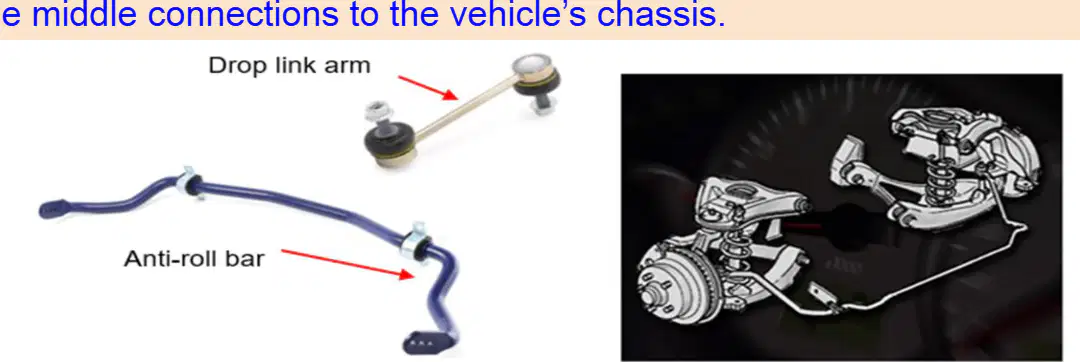
What is the primary function of an anti-roll bar in a vehicle's suspension system?
To resist the twisting force and keep the opposite wheel as level as possible during cornering
To increase the speed of the vehicle
To reduce the friction between the tires and the road
To provide power to the engine
Where do the ends of the anti-roll bar typically connect in a vehicle?
To the lower suspension arms
To the steering wheel
To the vehicle’s roof
To the exhaust system
What does the resistance in the anti-roll bar help to reduce?
The vehicle body roll angle
The engine temperature
The tire pressure
The fuel consumption
What is sometimes used to connect the ends of the anti-roll bar to the suspension arms?
Link arms
Brake pads
Shock absorbers
Drive shafts
What is the main purpose of connecting the final drive to the vehicle’s chassis in an independent rear axle suspension?
To reduce unsprung weight
To increase vehicle speed
To improve fuel efficiency
To enhance braking power
Which type of control arms are connected to the rear hubs in an independent rear axle suspension to stop fore and aft movement?
Wishbone control arms
Trailing arms
Leaf springs
Torsion bars
In an independent rear axle suspension, what are the two possible configurations for the struts?
Combined coil spring and hydraulic damper, or separate coil spring and damper
Combined leaf spring and shock absorber, or separate leaf spring and damper
Combined torsion bar and hydraulic damper, or separate torsion bar and damper
Combined air spring and hydraulic damper, or separate air spring and damper
What is the function of wishbone control arms in an independent rear axle suspension?
To stop fore and aft movement of the rear hubs
To increase engine power
To reduce tire wear
To improve fuel economy
Which of the following is NOT a component mentioned in the independent rear axle suspension description?
Leaf spring
Wishbone control arms
Coil spring
Hydraulic damper
Which component is responsible for maintaining fore and aft movement in a non-independent rear axle?
Control arms
Panhard rod
Top strut rods
Shock absorber
What is the function of the Panhard rod in a non-independent rear axle?
Lateral side-to-side movement
Fore and aft movement
Controlling axle twist
Absorbing shocks
Which component is used to control axle twist in a non-independent rear axle?
Top strut rods
Control arms
Panhard rod
Coil spring
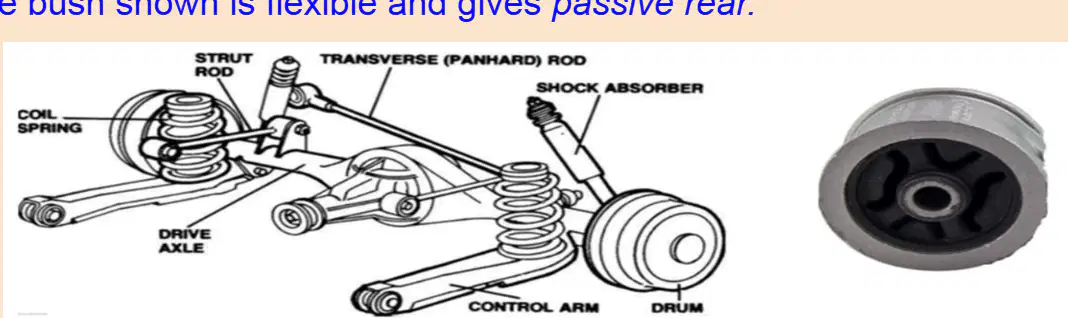
What characteristic does the bush shown in the diagram provide?
It is flexible and gives passive rear.
It is rigid and prevents movement.
It increases axle twist.
It absorbs shocks.
What is the main function of the steering system in a vehicle?
To control the vehicle’s direction at all driving speeds.
To increase the speed of the vehicle.
To provide power to the wheels.
To reduce fuel consumption.
Which system works in harmony with the steering system to provide turning movement at the wheels?
Suspension system
Braking system
Cooling system
Exhaust system
Why does the steering system need to provide feedback to the driver?
To give drivability and ensure the steering is easy to turn, with a feel for the road and vehicle stability.
To increase the speed of the vehicle.
To reduce engine noise.
To improve fuel efficiency.
Which of the following is NOT a requirement of the steering system?
A method to increase engine power
Safety in operating and during collisions
A method to collapse the steering shaft away from the driver and absorb impact
A method to provide steering assistance proportional to all vehicle speeds
What does the steering system need to ensure for the wheels to roll straight ahead without scrubbing?
Alignment is correct and true rolling motion is maintained
The engine is running smoothly
The brakes are applied
The headlights are on
What is a key benefit of electric power steering compared to traditional engine-driven power steering?
no power loss from the engine when assistance is not needed driving in straight lines
increased fuel consumption
requires more maintenance
less responsive steering
Which system can electric power steering be used with to enhance vehicle automation?
Autonomous driving and lane assist systems (ADAS)
Manual transmission systems
Hydraulic braking systems
Air conditioning systems
How does electric power steering interact with a vehicle's electronic systems?
It is linked to the vehicle's can-bus system and shares steering sensor information
It only operates independently of all other systems
It disables the vehicle's electronic systems
It requires manual data entry for sensor information
What can EOBD diagnostic equipment do in relation to electric power steering?
Identify faults and support alignment re-calibration
Increase engine power
Reduce tire wear
Improve fuel efficiency directly
What does the electric power steering motor act directly on?
The steering column or rack
The brake pedal
The accelerator pedal
The fuel injector
Why is a steering angle sensor still required in electric power steering systems?
To inform the ECU of the angles being turned by the steering wheel
To control the speed of the vehicle
To monitor tire pressure
To adjust the fuel mixture
What must be done after any adjustment to the vehicle’s Toe setting in an electric power steering system?
A system recalibration
A brake fluid change
A tire rotation
A battery replacement
What will happen if the electric power steering system is not recalibrated after a Toe adjustment?
EPS lamps will inform the driver of a fault
The engine will stop running
The headlights will turn off
The air conditioning will fail
What are possible consequences of failing to recalibrate the electric power steering system after a Toe adjustment?
MOT test failure and lane assist/autonomous driving problems
Increased fuel efficiency
Improved braking performance
Enhanced audio quality
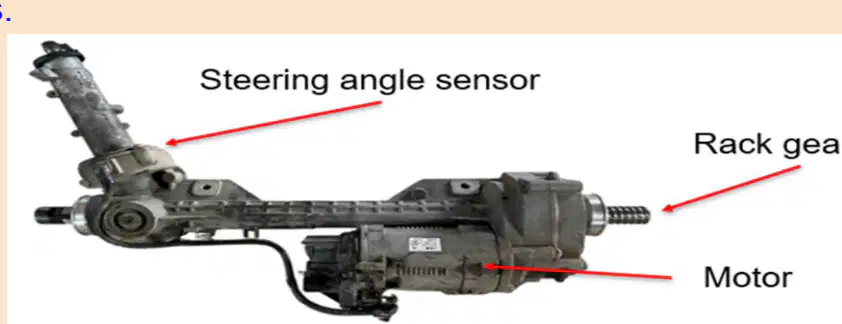
Which component is used to inform the ECU of the angles being turned by the steering wheel?
Steering angle sensor
Rack gear
Motor
Brake sensor

