
 Worksheets
ASE A4 Suspension Quiz
Total questions: 35
Worksheet time: 18mins
A driver says that the front end of his car vibrates up and down while traveling at most road speeds. Technician A says that too much runout of the front wheels could be the cause. Technician B says that static out-of-balance of the front wheels could be the cause. Who is right?
Technician A only
Technician B only
Both A and B
Neither A or B
A customer complains that a vehicle wanders on a bumpy road and needs continual driver correction to stay straight. What could be wrong?
Excessive negative front caster
Insufficient front toe
Rear or front bump steer
All of the above
When checking a tire, a technician finds it to have too much radial (up and down) runout. Technician A says to rotate the tire and wheel assembly on the mounting studs to correct the problem. Technician B says to rotate the tire on the wheel assembly to attempt to bring the runout within specifications. Who is right?
Technician A only
Technician B only
Both A and B
Neither A or B
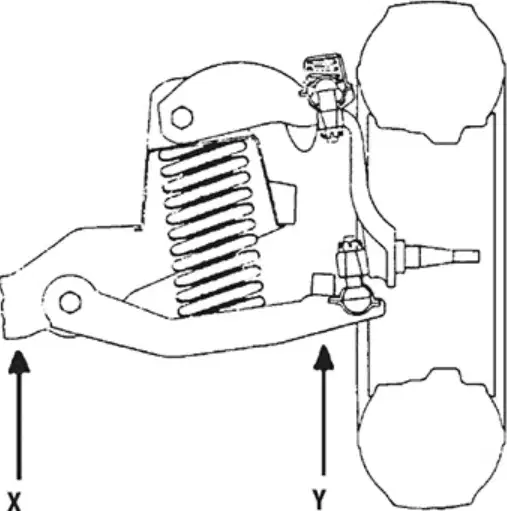
The suspension shown below is being checked for ball joint wear. Technician A says the inspection can be made with the front end supported at point X. Technician B says that the inspection can be performed with the front end supported at point Y. Who is right?
Technician A only
Technician B only
Both A and B
Neither A or B
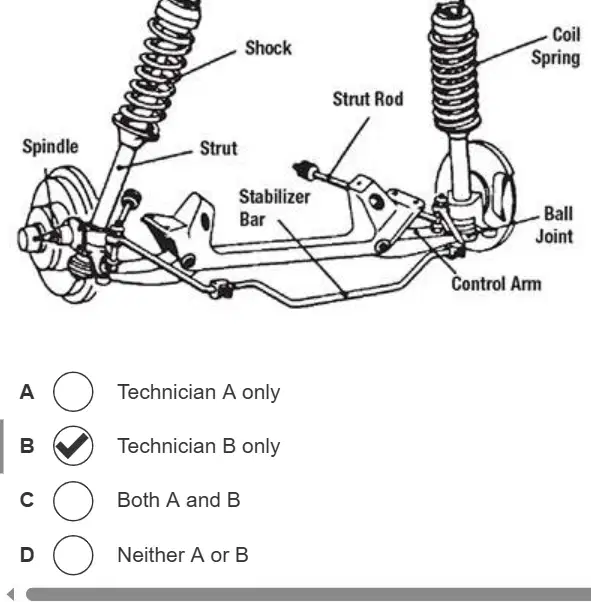
The ball joints on the MacPherson strut-type suspension are being replaced. Technician A says that a coil spring compressor should be installed before separating the control arm and the spindle. Technician B says that the wheel alignment should be checked after the ball joints have been replaced. Who is right?
Technician A only
Technician B only
Both A and B
Neither A or B
A customer complains of excessive body roll. Which of the following is the MOST likely cause?
Broken stabilizer bar link
Worn ball joint
Weak coil spring
Leaking shock absorber
Technician A says that the ride height of a vehicle is always adjustable. Technician B says that the ride height of a vehicle can only be adjusted on certain models. Who is right?
Technician A only
Technician B only
Both A and B
Neither A nor B
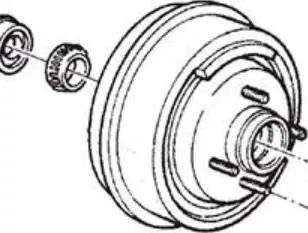
Technician A says that the wheel bearings shown below can be adjusted by tightening the nut while turning the hub, and then backing off the nut part of a turn. Technician B says the end-play in the bearings shown above can be checked using a dial indicator. Who is right?
Technician A only
Technician B only
Both A and B
Neither A or B
Tire cupping is most likely caused by:
Worn shock absorbers
Wheel imbalance
Loose tie-rod ends
All of the above
Which of the following is most likely to be lubricated and sealed by the manufacturer?
Tapered roller bearings
Plain bearings
Ball bearings
A tire on an alloy wheel is being balanced. Technician A says that clip-on weights should be used. Technician B says that tape on weights should be used. Who is right?
Technician A only
Technician B only
Both A and B
Neither A nor B
A customer is purchasing new front tires for her front-wheel drive vehicle. Technician A says the best way to balance the tires is to mount them on the vehicle and use an on-axle spin balancer. Technician B says the best way to balance the tires is to balance them on a spin balancing machine prior to installation. Who is right?
Technician A only
Technician B only
Both A and B
Neither A nor B
A medium-duty light truck is on the alignment rack. Technician A points out that there is no arch at all in the rear leaf springs and says this indicates that the springs are either worn out or broken. Technician B says that this is a normal on newer trucks and is not a cause for concern. Who is right?
Technician A only
Technician B only
Both A and B
Neither A nor B
A vehicle just had new stabilizer bar links and bushings installed. Technician A says that the wheels need to be straight-ahead with the front end supported before tightening the link’s fasteners. Technician B says the vehicle should be resting level on its wheels at its normal ride height before the link’s fasteners are tightened. Who is right?
Technician A only
Technician B only
Both A and B
Neither A nor B
Technician A says that dynamic wheel balancing can be accomplished with a bubble balancer. Technician B says that static wheel balancing requires a spin balancer. Who is right?
Technician A only
Technician B only
Both A and B
Neither A nor B
All of the following can cause incorrect vehicle ride height EXCEPT:
A. A broken leaf spring shackle
B. A fatigued coil spring
C. Incorrectly adjusted torsion bars
D. Worn shock absorbers
Technician A says that lubricant can be used to help seat a tire on a wheel rim. Technician B says that if necessary, it is OK to exceed the maximum tire pressure rating to seat the bead, as long as pressure is reduced immediately afterward. Who is right?
Technician A only
Technician B only
Both A and B
Neither A nor B
Shock absorbers are being installed in the rear of a rear-wheel drive solid axle vehicle with coil springs. Technician A says the axle must be supported before the shocks are removed. Technician B says that the coil springs must be compressed with a spring compressor. Who is right?
Technician A only
Technician B only
Both A and B
Neither A nor B
Technician A says that all vehicles with strut-type front suspension require that the strut be removed to replace the front coil springs. Technician B says that the coil spring should be compressed before removal from an SLA-type front suspension. Who is right?
Technician A only
Technician B only
Both A and B
Neither A nor B
All of the following are methods used by manufacturers to attach ball joints to control arms EXCEPT:
Riveted on
Welded on
Threaded on
Pressed on
All of the following are true of torsion bars EXCEPT:
They serve the same function as coil springs.
They are interchangeable from side-to-side.
They can be used to adjust ride height.
Which of the following causes for ball joint replacement could also require steering knuckle replacement?
Torn dust boot
Worn ball and socket
Wear indicator below surface
Broken ballstud
All of the following are sensors in an electronically controlled suspension system EXCEPT:
A. Wheel speed sensor
B. Wheel position sensor
C. Vehicle speed sensor
D. Height sensor
An upper control arm is being removed from a late model vehicle with SLA suspension. Technician A says that the lower arm should be supported with a jack stand close to the ball joint. Technician B says that the coil spring must be compressed with a spring compressor. Who is right?
Technician A only
Technician B only
Both A and B
Neither A nor B
A vehicle pulls to the right during braking. Technician A says that the problem is in the brake system, and the pull is most likely due to brake fluid on the linings or a seized caliper piston. Technician B says that the pull could be caused by worn right side strut rod bushings. Who is right?
Technician A only
Technician B only
Both A and B
Neither A nor B
All of the following are true statements regarding tapered wheel bearings EXCEPT:
The bearings and outer races must be replaced as an assembly.
They must be adjusted after installation.
Used bearings must be reinstalled on their original races.
They are mostly used on drive axles.
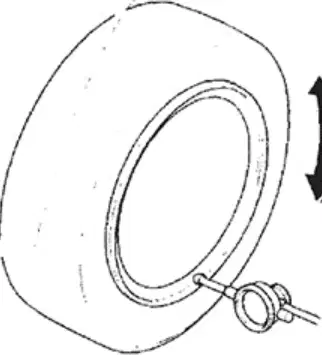
Technician A says the measurement shown below will be incorrect if the wheel bearings are loose. Technician B says if the measurement shown above is excessive, it could be due to a bent wheel hub. Who is right?
Technician A only
Technician B only
Both A and B
Neither A nor B
Technician A says an indirect measurement Tire Pressure Monitoring System (TPMS) uses wheel speed sensors to measure tire pressure. Technician B says a direct measurement TPMS uses tire pressure sensors to measure tire pressure. Who is right?
Technician A only
Technician B only
Both A and B
Neither A nor B
When replacing an integral hub/bearing assembly on a front wheel drive vehicle, all of the following must be removed EXCEPT:
A. Brake rotor
B. Brake caliper
C. Steering knuckle
D. Wheel
All four tires on a vehicle with an indirect TPMS are below inflation specification by an equal amount and the TPMS warning light did not illuminate. Technician A says the wheel speed sensors should be checked. Technician B says that all four sensors could not be bad and that the problem is with the TPMS control module. Who is right?
Technician A only
Technician B only
Both A and B
Neither A nor B
A customer had new tires installed on his car 6000 miles ago and now wants them rotated. The owner's manual says the rear tires should be crossed when brought to the front and the front tires brought to the rear on the same side. All tires have arrows on the sidewalls. Which of the following is the proper service procedure?
A. Follow the instructions in the owner's manual.
B. Move the back tires to the front and the front tires to the back, but leave them on the same side.
C. Dismount the rear tires from the wheels, flip them, and reinstall them on the wheels before moving them to the other side of the car.
Either B or C
During a road test, a customer’s car nose dives badly during braking, and also has a vibration and seems to ‘float’ at highway speeds. When the vehicle is inspected, the tread on several tires appears choppy and scalloped, but the suspension components appear OK. Technician A says the symptoms are caused by worn shock absorbers. Technician B says new tires and an alignment will correct the problem. Who is right?
Technician A only
Technician B only
Both A and B
Neither A nor B
Technician A says that a vehicle with a TPMS can be identified by looking for a TPMS indicator on the instrument panel during the Key On Engine Off bulb check. Technician B says that all vehicles with TPMS have metal tire valve stems and this feature can be used as an identifier. Who is right?
Technician A only
Technician B only
Both A and B
Neither A nor B
Electronically controlled suspension systems use all of the following EXCEPT:
A. Electronic leveling systems that maintain the vehicle’s ride height
B. GPS location device that determines road surface conditions
C. Shock absorbers that use a permanent magnet electrical motor that provides active or damping force
D. A control module that changes shock absorber damping based on road conditions
A vehicle is equipped with an electronic/electrically controlled suspension system. Technician A says that the best way to check for air leaks in the adaptive pneumatic air suspension is to see if the vehicle sags to one side. Technician B says that failures in electronic/electrically controlled suspension systems usually set a DTC or turn on a warning in the instrument panel. Who is right?
Technician A only
Technician B only
Both A and B
Neither A nor B

