
NEW
Font size
 Worksheets
TCI Chapter 22- Civil War Quiz
Total questions: 23
Worksheet time: 14mins
What event marked the beginning of the Civil War?
The signing of the Declaration of Independence
The Confederate bombardment of Fort Sumter
The Battle of Gettysburg
The Emancipation Proclamation
Which states were known as the 'border states' during the Civil War?
Virginia, Arkansas, Tennessee, North Carolina
Delaware, Maryland, Kentucky, Missouri, West Virginia
California, Nevada, Oregon, Washington
New York, Pennsylvania, New Jersey, Connecticut
What did the Confederate States of America establish?
A new nation
A new economic system
A new religion
A new language
What is the definition of a civil war?
A war between two countries.
A war within a single country between different groups.
A war fought at sea.
A war involving multiple continents.
What was the purpose of the Emancipation Proclamation?
To declare the end of the Civil War
To free slaves in the Confederate states
To announce a new president
To establish a new constitution
Which legal principle ensures that a person cannot be held in prison without being charged with a crime?
Double jeopardy
Habeas corpus
Eminent domain
Due process
What was the main weakness of the South's economy?
Over-reliance on technology
Lack of manufacturing
Agriculturally based economy
Dependence on foreign trade
What did Lincoln relate the preservation of the Union to?
The ideals of the American Revolution
The end of slavery
The expansion of the United States
The economic growth of the North
What was the impact of the Battle of Bull Run on President Lincoln and his generals?
They were encouraged by the victory.
They realized that ending the war would not be easy.
They decided to surrender.
They planned a retreat.
What was the second step of the Anaconda Plan?
To negotiate with European countries
To gain control of the Mississippi River
To recruit more soldiers
To attack the Confederate capital
What was the main goal of Lee's invasion of the North in 1863?
To capture Washington, D.C.
To convince the North to seek peace
To destroy Union supply lines
To recruit more soldiers
What did the Union's control of the Mississippi River prevent?
Northern invasions
Southern trade with Europe
Southern movement of men and supplies
Northern blockades
What did many soldiers find difficult to resist, even if it meant deserting their units?
Orders from their generals
Pleas from their families to come home
The temptation to join the Union army
The opportunity to travel abroad
What issue did the men of the Massachusetts 54th protest?
Lack of training
Unequal pay
Poor equipment
Harsh conditions
What did the African American regiments contribute to during the Civil War?
The Confederate cause
The Union's victory
Neutral peace efforts
The abolition of slavery
In May 1864, how many men did General Grant invade Virginia with?
50,000 men
75,000 men
100,000 men
150,000 men
What did General Lee say to his officers when surrounded by Grant's soldiers?
"We must fight to the last man."
"There is nothing left for me to do but go and see General Grant, and I would rather die a thousand deaths."
"We will retreat and regroup."
"We should negotiate peace immediately."
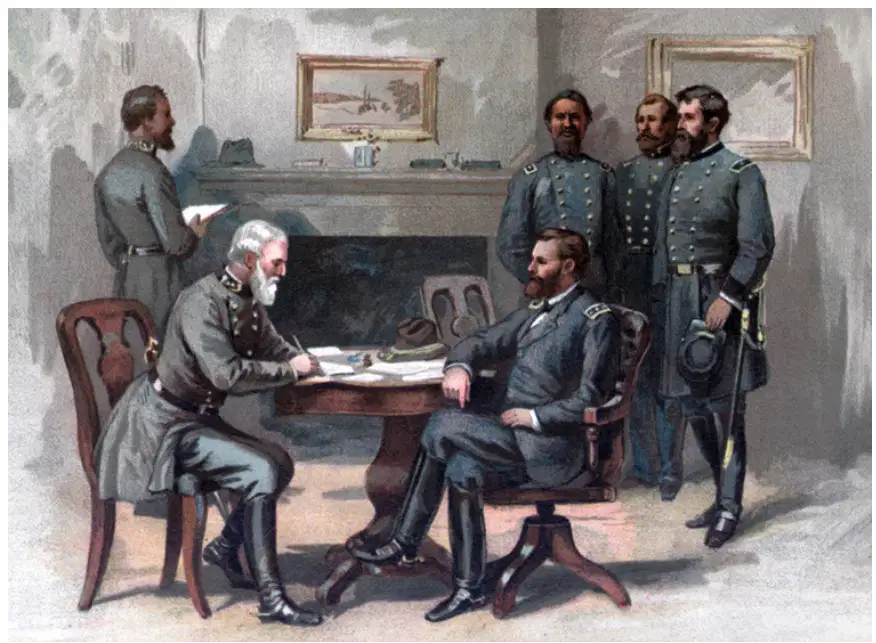
Where did the surrender of the Confederate army take place?
Gettysburg
Appomattox Court House
Richmond
Antietam
What was the significance of the Todd family to Lincoln?
They were his political advisors.
They were his wife's family and had divided loyalties.
They were his childhood friends.
They were his financial supporters.


