
 Worksheets
Review: Solar System, Asteroids, Comets, and Meteors
Total questions: 25
Worksheet time: 13mins
Name
Class
Date
1.
What are the areas of gas on the surface on the sun that are cooler than the area around them?
a)
Solar Wind
b)
Solar Flare
c)
Prominence
d)
Sunspot
2.
Which layer of the Sun's atmosphere is the layer that we can always see?
a)
corona
b)
photosphere
c)
chromosphere
d)
core
3.
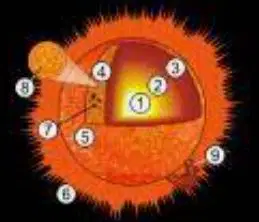
Identify the prominence in the diagram below.
a)
6
b)
7
c)
8
d)
9
4.
How does the Sun produce energy?
a)
Fusion
b)
Solar Flares
c)
Prominences
d)
Solar Wind
5.
What fuels the Sun?
a)
Lithium
b)
Carbon
c)
Helium
d)
Hydrogen
6.
What is the effect of solar weather on Earth? (check all that apply)
a)
There is no effect.
b)
Communications could be interrupted.
c)
Auroras at the poles.
d)
Gravity will increase.
7.
An explosion on the surface of the sun is called a _______________.
a)
Solar Flare
b)
Sunspot
c)
Prominence
d)
Corona
8.
Which of the following is a main way that scientist classify planets?
a)
by their shape
b)
by their color
c)
by what they are made of
d)
by their temperature
9.
How do you describe the orbit of each planet around the Sun in our solar system?
a)
no defined shape
b)
elliptical/oval
c)
circular
d)
spherical
10.
Which list has the planets in order of closest to the sun to furthest?
a)
Mercury, Venus, Earth, Mars, Jupiter, Saturn, Uranus, Neptune.
b)
neptune, uranis, saturn, jupiter, mars, earth, venus, mercury
c)
neptune, uranis, jupiter, saturn, mars, venus, earth, mercury
d)
venus, mercury, earth, neptune, uranus, saturn, jupiter, mars
11.
Where are asteroids found?
a)
Asteroid Belt
b)
Oort Cloud
c)
Kuiper Belt
d)
Between Mars and Earth
12.
Where are comets found? (check all that apply)
a)
Asteroid Belt
b)
Oort Cloud
c)
Kuiper Belt
d)
Between Mars and Earth
13.
What happens to a comet as it gets closer to the Sun?
a)
The comet melts and completely disintegrates, never to be seen again.
b)
The comet forms a tail that can be seen as the comet's orbit nears the Sun.
c)
The comet begins to melt and speeds up just before it melts into the Sun.
14.
A small rock found in space.
a)
Meteor
b)
Asteroid
c)
Comet
d)
Meteoroid
e)
Meteorite
15.
A small space rock that strikes the surface of the Earth.
a)
Meteor
b)
Asteroid
c)
Comet
d)
Meteoroid
e)
Meteorite
16.
A small space rock that enters the Earth's atmosphere.
a)
Meteor
b)
Asteroid
c)
Comet
d)
Meteoroid
e)
Meteorite
17.
Small space object made up of ice, dust, and particles.
a)
Meteor
b)
Asteroid
c)
Comet
d)
Meteoroid
e)
Meteorite
18.
Sometimes referred to as a "shooting star".
a)
Meteor
b)
Asteroid
c)
Comet
d)
Meteoroid
e)
Meteorite
19.
A very large space rock.
a)
Meteor
b)
Asteroid
c)
Comet
d)
Meteoroid
e)
Meteorite
20.
Where is the Asteroid Belt located?
a)
Between the orbits of Mars and Jupiter
b)
Beyond the orbit of Pluto
c)
Between the orbits of Jupiter and Saturn
21.
What contributed to the extinction of dinosaurs 65 million years ago?
a)
asteroid impact
b)
volcanic eruption
c)
ice age
22.
What comprises the structure of a comet?
a)
nucleus, coma, tail
b)
nucleus, coma, gases.
c)
nucleus, tail, gases
d)
nucleus, tail, ice
23.
The tail of a comet _________ .
a)
always points towards the Sun
b)
always points away from the Sun
c)
always points towards Earth
d)
always points away from Earth
24.
These are made mostly of rock. (check all that apply)
a)
stars
b)
asteroids
c)
meteoroids
d)
comets
25.

Identify the nucleus of the comet below.
a)
A
b)
B
c)
C
100 %

