
 Worksheets
24-25 Newton's Laws Review
Total questions: 21
Worksheet time: 11mins
Name
Class
Date
1.
What is the acceleration of a wagon with a mass of 20 kg if a horizontal force of 64 N is applied to it? (ignore
friction)
a)
.31 m/s²
b)
3.2 m/s
c)
1280 m/s²
d)
3.2 m/s²
2.
A truck has a mass of 2500 kg and is moving at 50 m/s. What is its momentum?
a)
50 kg x m/s
b)
.02 kg x m/x
c)
125,000 kg x m/s
d)
250 kg x m/s
3.
Car A travels at 10 m/s and then increases its speed to 20 m/s over 5 seconds. Car B travels at 2 m/s and increases its speed to 20 m/s over 6 seconds. Which car experiences greater acceleration?
a)
Car A
b)
Car B
4.
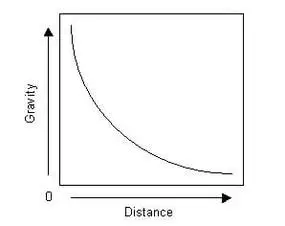
According to the graph, what happens to gravity as distance increases?
a)
It also increases
b)
It decreases
c)
It does not change
5.
A force that resists the motion of two objects/surfaces that are touching is
a)
Acceleration
b)
Friction
c)
Momentum
d)
Inertia
6.
Which of the following is NOT a non-contact force?
a)
Magnetism
b)
Friction
c)
Electrostatic
d)
Gravity
7.

Is the Net Force on this object balanced or unbalanced?
a)
Balanced
b)
Unbalanced
8.
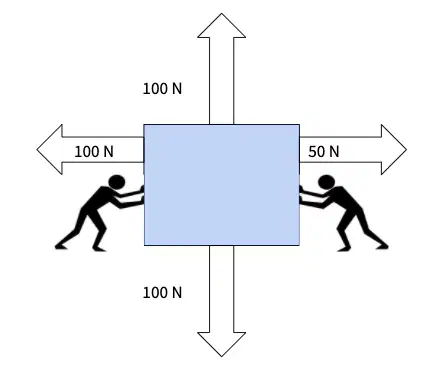
What is the Net Force on this object?
a)
150 N left
b)
50 N right
c)
100 N down
d)
50 N left
9.

If the net force on an object is balanced, the object will
a)
Move slightly
b)
Not move
c)
Move intensely
10.
Newton's 1st Law is often referred to as the Law of
a)
Friction
b)
Net Force
c)
Inertia
d)
Momentum
11.
Why does weight change depending on where you are in the universe, but mass does not?
a)
Mass accounts for gravity unlike weight
b)
Weight accounts for gravity unlike mass
c)
Neither mass or weight account for gravity
12.
The _________ is the combination of all forces acting on an object.
a)
Inertia
b)
Friction
c)
Total Force
d)
Net Force
13.

When balanced forces act on an object, the net force is ____.
a)
Zero
b)
Positive
c)
Negative
14.
The force you must overcome to start moving a stationary object is
a)
Sliding Friction
b)
Static Friction
c)
Fluid Friction
d)
Rolling Friction
15.
Newton's 2nd law of motion states that
a)
An object will remain at rest or keep moving in a straight line with constant speed unless a force acts on it
b)
When a force is applied on an object, there is an equal force applied by the object in the opposite direction
c)
The force on an object can be found by dividing its mass by its acceleration
d)
Acceleration is equal to an object's force divided by its mass
16.
Newton's 1st law of motion states that
a)
An object will remain at rest or keep moving in a straight line with constant speed unless a force acts on it
b)
When a force is applied on an object, there is an equal force applied by the object in the opposite direction
c)
The force on an object can be found by dividing its mass by its acceleration
d)
Acceleration is equal to an object's force divided by its mass
17.
For every action force, there is a reaction force that is equal in magnitude and in the opposite direction of the action force (this describes Newton's ___ Law)
a)
1
b)
2
c)
3
d)
None
18.
How can an object accelerate?
a)
Speed Up
b)
Slow Down
c)
Change Direction
d)
All of the above
19.
If three people pushing on a car each apply a force of 100 N, how much force does the car exert on each person?
a)
33 N
b)
100 N
c)
300 N
20.
What happens to gravity as mass increases?
a)
It also increases
b)
It will decrease
c)
It will stay the same
21.
Kg x m/s² are the units for
a)
Mass
b)
Friction
c)
Newton
d)
Ohm
100 %

