
 Worksheets
Chapter 3 Ag Comm Research Methods
Total questions: 74
Worksheet time: 37mins
What does 'ethical conduct' in communication research primarily involve?
Following strict legal guidelines
Doing the right thing with respect and concern for others
Maximizing research output
Avoiding all forms of communication
What is the term used for asking people if they want to be research participants before starting a project?
Permission
Approval
Consent
Agreement
Which of the following is NOT one of the three main priorities in research involving human subjects?
Respect
Justice
Beneficence
Profitability
Why is it important for communicators to understand research methods?
To increase their personal fame
To effectively carry out their responsibilities
To avoid all forms of communication
To reduce the cost of research
What does the principle of "Justice" focus on in research ethics?
Minimization of harm
Fair distribution of study risks and benefits
Maximization of benefits
Development of bias-free language
Which principle promotes ethical treatment by minimizing harm and maximizing benefits?
Justice
Beneficence
Inclusiveness
Objectivity
What should researchers consider to ensure their research approach is inclusive?
Use of complex language
Consideration of alternative methods for underserved groups
Focus on a singular perspective
Limiting participant diversity
What is a key characteristic of quantitative research methods?
Subjective interpretation
Use of bias-free language
Objective and independent measures
Focus on participant narratives
What is the primary purpose of a quantitative study?
To enhance the generalization of a theory by adding the use of the theory in a specific context
To understand how people's natural settings create meaning
To capture the rich context of a phenomenon on a smaller scale
To adjust or change the research design during the study
Which approach uses inductive reasoning and allows researchers to adjust during the research?
Quantitative approach
Qualitative approach
Experimental approach
Survey approach
What do qualitative researchers strive to minimize?
The distance between those being researched and themselves
The generalization of theories
The use of specific contexts in studies
The number of surveys conducted
Which methods are typically included in quantitative research?
Interviews and observations
Surveys and experiments
Case studies and focus groups
Ethnographies and narratives
What is one reason to conduct research according to the text?
To develop new technologies
To attain information about target audiences
To increase sales revenue
To improve employee satisfaction
How can message development be influenced according to the text?
By the color of the message
By the lifestyle and location of the audience
By the time of day the message is sent
By the cost of the message
What is the most important step in the communication process as mentioned in the text?
Designing a visually appealing message
Understanding your audience
Using advanced technology
Reducing communication costs
What does an audience analysis provide according to the text?
A list of potential customers
A detailed description of demographic and psychographic characteristics
A summary of previous sales data
A forecast of future market trends
Which of the following is a demographic characteristic?
Lifestyles
Knowledge
Age
Values and beliefs
What type of characteristic is 'economic status' considered as?
Psychographic
Demographic
Behavioral
Cognitive
Which of the following is a psychographic characteristic?
Geographic location
Education level
Perceptions and attitudes
Economic status
Identify a characteristic that is not measurable.
Age
Economic status
Habits
Geographic location
What is a population in the context of research?
A small group selected for study
The overall group you want information about
A random subset of individuals
A specific type of data collected
What is the purpose of sampling in research?
To collect data from every individual in a population
To represent an entire population with a smaller subset
To ensure 100% accuracy in data collection
To increase the cost of research
What is a random sample?
A sample selected based on convenience
A sample generated using random methods
A sample that includes every individual in a population
A sample with no error margin
What does the margin of error represent in a sample?
The exact number of people in a population
The cost of conducting the research
An estimate of how much the sample results might differ from the true population
The total number of errors in data collection
What is one of the most common types of quantitative communication research?
Interviews
Case Studies
Surveys
Experiments
How can surveys be conducted according to the text?
Only online
By phone, mail, in person, and online
Only in person
By mail and online only
What type of questions allow you to write a free-form narrative answer?
Close-ended questions
Multiple choice questions
Open-ended questions
True/false questions
What do close-ended questions include?
Only true/false questions
A range of answers or response items
Only open-ended responses
Only ranking questions
What type of survey is shown in the image?
Open-ended survey questionnaire
Close-ended survey questionnaire
Mixed-method survey questionnaire
Qualitative survey questionnaire
Which age group is NOT listed in the survey options?
18-25
26-35
46-55
70-75
What is one of the questions asked in the survey?
Have you ever planted a tree?
Have you purchased flowers in the last six months?
Do you like gardening?
What is your favorite flower?
Which of the following is a category for race in the survey?
Pacific Islander
Hispanic
Middle Eastern
European
What is the highest level of education listed in the survey?
Bachelor's degree
Master's degree
Doctoral degree
Post-doc
What is the first step in conducting a good survey?
Distribute the survey
Establish the goals of the project
Analyze the data
Report the results
Which step involves deciding whom to interview or send the survey to?
Choose the survey methodology
Pre-test the questionnaire
Determine your sample
Create the questionnaire
What is the purpose of pre-testing the questionnaire?
To analyze the data
To test the questions
To report the results
To distribute the survey
Which step requires using statistical techniques to understand the information?
Analyze the data
Establish the goals of the project
Distribute the survey
Report the results
What is one suggestion for developing good questions?
Use complex, lengthy sentences.
Use simple, short sentences.
Use technical terms and acronyms.
Use vague terms with multiple meanings.
Why should questions be asked in positive terms?
To make them more confusing.
To avoid clarity.
To ensure they are easily understood.
To use more technical language.
What is a better way to ask about TV watching habits?
Do you watch TV regularly?
How often do you watch TV per week?
Do you like TV?
Is TV your favorite activity?
What should be avoided when developing questions?
Providing examples.
Using complete sentences.
Using technical terms and acronyms.
Accepting all possible answers.
What is an example of a double-barreled question?
What is your favorite color and why?
Do you like pizza or pasta?
Was the information helpful and without bias?
How often do you exercise?
Why should leading questions be avoided in surveys?
They are too short.
They lead respondents to answer in a certain way.
They are too complex.
They are too vague.
What type of question provides an "either/or" answer?
Multiple choice
Yes/no
Open-ended
Essay
When should you use a multiple-choice question?
When you need a yes or no answer
When you want to provide a range of possible answers
When you want a detailed explanation
When you need a single-word answer
What is the primary purpose of ranking questions?
To learn respondents' values of one item in relation to another item
To measure the frequency of an event
To assess the knowledge of a subject
To evaluate the speed of a response
Which type of question uses a scale such as "from 1 to 5" for answers?
Rating questions
Ranking questions
Multiple-choice questions
Open-ended questions
What is an example of a Likert-type question?
A question asking for a preference ranking from 1 to 7
A question asking for a yes or no answer
A question asking for a numerical scale response from strongly disagree to strongly agree
A question asking for a short written response
What type of question uses bipolar adjectives as anchors with intervals between them?
Multiple-choice question
Semantic differential
True/false question
Open-ended question
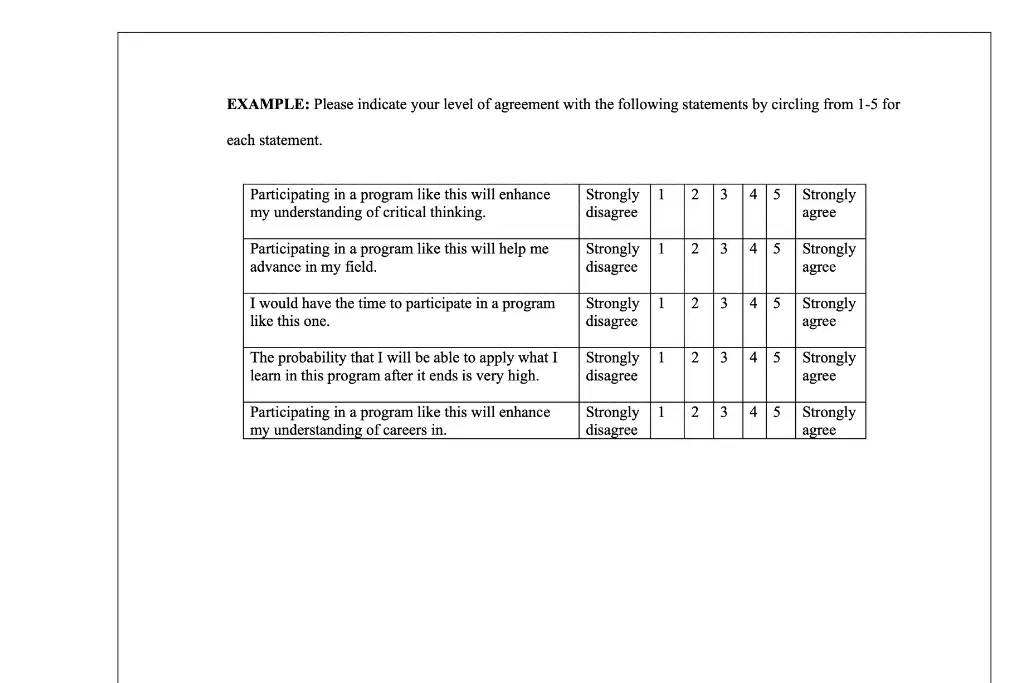
In a rating question, how are the answers typically provided?
Horizontally with letters
Vertically with a numerical scale
In a paragraph form
Using symbols
What are summated scales used for in questionnaires?
To measure multiple concepts simultaneously
To measure a single concept, construct, or variable
To provide open-ended responses
To design the layout of a questionnaire
What is the purpose of open-ended questions in a questionnaire?
To limit responses to yes or no
To let people provide their own responses in their own words
To ensure responses are quantifiable
To provide multiple-choice options
Which of the following is a tip for effective questionnaire design?
Use complex language to challenge respondents
Include as many questions as possible
Design the questionnaire to fit the medium
Avoid using a title for simplicity
Why should a questionnaire include a short introduction?
To confuse the respondents
To detail what the study is about and who you are
To make the questionnaire longer
To provide a summary of all questions
What is a necessary component to include in a questionnaire introduction or conclusion?
A detailed explanation of the survey's purpose
A thank you message
A list of all questions
A summary of results
Why is it important to reassure respondents about the confidentiality of their responses?
To increase the length of the survey
To ensure honest and accurate responses
To make the survey more complex
To reduce the number of questions
What should be included with mailed surveys to facilitate responses?
A cover letter and a return postage prepaid envelope
A list of all survey questions
A detailed map of the survey area
A copy of previous survey results
When should demographic information be requested in a questionnaire?
Only at the beginning
Only at the end
In either the first or last few questions
Throughout the entire survey
What is a recommended practice for the layout of multiple-choice questions in a questionnaire?
List them horizontally
Use a different font for each option
Line them vertically
Include images with each option
What is one characteristic of an effective questionnaire?
It should be long and detailed.
It should include only one type of question.
It should be concise and easy to complete.
It should have complex instructions.
Why is it important to be an educated consumer of information from questionnaires?
To ensure all questions are biased.
To understand data that supports a position.
To ignore the sample size.
To avoid reading the questions carefully.
What is the benchmark for an accurate national poll?
500 to 1,000 people
1,000 to 1,500 people
1,500 to 2,000 people
2,000 to 2,500 people
What does a 3% margin of error mean in a poll?
The result is exactly 3% accurate
The result could vary by plus or minus 3%
The result is 3% less than expected
The result is 3% more than expected
Who typically releases all findings of a survey?
Privately funded organizations
Independent pollsters and news organizations
Political candidates
Social media platforms
How can participation in polls vary?
By the time of day
By age, social media engagement, and geographic location
By the color of the poll
By the type of questions asked
What was the effect of mentioning troop numbers in a CBS News poll?
It increased approval rates
It decreased disapproval rates
It resulted in a 58% disapproval rate
It had no effect
In political polling, why is the order of questions important?
It helps in reducing the survey time.
It ensures all questions are answered.
It can influence the results by favoring those listed first.
It makes the survey more interesting.
What is a potential issue with a poor response rate in surveys?
It increases the accuracy of the survey.
It can skew the survey results.
It reduces the number of questions needed.
It makes the survey more reliable.
What is the primary purpose of content analysis in communications research?
To create new content for media.
To provide insight into how messages are communicated.
To increase the speed of communication.
To develop new communication technologies.
What is a coding sheet used for in content analysis?
To record the names of researchers.
To guide researchers on what to look for in the material.
To calculate the total time spent on analysis.
To list the equipment needed for analysis.
What is a key advantage of using interviews over questionnaires in research?
They are more cost-effective.
They provide more flexibility to build rapport with participants.
They require less time to conduct.
They are easier to analyze.
In what type of research are interviews more commonly used?
Quantitative research
Experimental research
Qualitative research
Longitudinal research
When are one-on-one interviews particularly useful?
When the topic is not sensitive
When participants are comfortable in groups
When participants may feel hesitant sharing with a crowd
When time is limited
Why are focus group interviews preferred in certain situations?
They are less expensive than other methods.
They allow participants to interact with each other.
They require less preparation.
They are quicker to conduct.

