
Font size
 Worksheets
Chemistry Final Exam - Part 1 Multiple Choice
Total questions: 232
Worksheet time: 8hrs 0mins
Which of the following statements about a chemical change is true?
A. A chemical change results in a change in energy AND a change in the amount of matter.
B. A chemical change results in a change in energy but not a change in the amount of matter.
C. A chemical change results in a change in the amount of matter but not a change in energy.
D. A chemical change results in neither a change in energy OR a change in the amount of matter.
What is purposefully being manipulated and changed in an experiment is the .
constant
dependent variable
control group
independent variable
How many significant figures are in the measurement 0.0051 mL?
2
3
4
5
How many significant figures are in the measurement 906 mmHg?
0
1
2
3
You are conducting an experiment and find the volume of a substance to be 4.52 mL. If the known volume of the substance is 4.99 mL, find the percentage error in your measurement.
-10.4%
-9.42%
10.4%
9.42%
How many valence electrons does an atom of aluminum typically have?
2
3
13
27
You can determine the identity of an element if you know how many it has.
protons
neutrons
electrons
energy levels
The nucleus of an atom has all of the following characteristics EXCEPT that it
is positively charged.
contains nearly all of the atom’s volume.
is very dense.
contains nearly all of the atom’s mass.
The nucleus of isotope A of an element has a larger mass than isotope B of the same element. The number of protons in the nucleus of isotope A is the number of protons in the nucleus of isotope B.
less than
greater than
the same as
The nucleus of isotope A of an element has a larger mass than isotope B of the same element. The number of neutrons in the nucleus of isotope A is the number of neutrons in the nucleus of isotope B.
less than
greater than
the same as
Which of the following elements would be the most reactive?
Bromine
Silicon
Nickel
Krypton
Anions have electrons and thus have a charge.
lost; negative
gained; negative
lost; positive
gained; positive
Cations have electrons and thus have a charge.
lost; negative
gained; negative
lost; positive
gained; positive
Which of the following groups of elements would most likely have the greatest electronegativity?
Halogens
Alkali metals
Alkaline earth metals
Transition metals
Which of the following groups of elements would most likely have the least electronegativity?
Halogens
Alkali metals
Alkaline earth metals
Transition metals
Metals will react as you move down and left in the periodic table. Nonmetals will react as you move up and right.
increase; increase
decrease; increase
increase; decrease
decrease; decrease
Identify the number of energy levels in an element with this electron configuration: 1s2 2s2 2p6 3s2 3p3.
1
2
3
5
Identify the total amount of electrons in an element with this electron configuration: 1s2 2s2 2p6 3s2 3p3.
3
5
11
15
Identify the number of valence electrons in an element with this electron configuration: 1s2 2s2 2p6 3s2 3p3.
3
5
11
15
Consider the periodic trend seen for ionic radius. Atoms that lose electrons tend to become ____. Atoms that gain electrons tend to become ____.
smaller; smaller
larger; smaller
smaller; larger
larger; larger
The picture to the right best represents a(n) bond.
hydrogen
ionic
metallic
covalent
Which of the following statements is true about O2?
The two atoms share 4 electrons.
It has a double bond.
Its electronegativity difference is 0.
All of the above are true.
The forces between different molecules are considered intermolecular while the forces within molecules between the atoms are intramolecular. Chemical bonds are the same thing as forces.
Intermolecular; intramolecular, intramolecular
Intramolecular; intermolecular; intramolecular
Intermolecular, intramolecular, intermolecular
Intramolecular; intermolecular; intermolecular
Which of the following statements is true about VSEPR theory?
It is the tendency for electron pairs to want to be as far apart as possible because valence electrons are repulsed by each other.
It is the tendency for electron pairs to want to be as far apart as possible because valence electrons are attracted to each other.
It is the tendency for electron pairs to want to be as close together as possible because valence electrons are repulsed by each other.
It is the tendency for electron pairs to want to be as close together as possible because valence electrons are attracted to each other.
The most dominant intermolecular force at work between two CO₂ molecules would be.
Hydrogen bonds
Covalent bonds
London dispersion forces
Dipole-dipole forces
How many atoms of oxygen are represented in 2Pb(SO₄)₂?
2
4
8
16
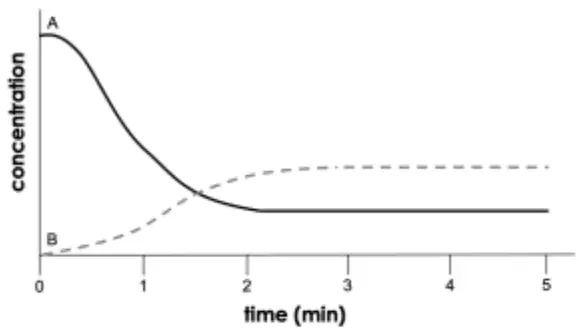
Substance A is a and Substance B is a.
reactant; reactant
product; reactant
reactant; product
product; product
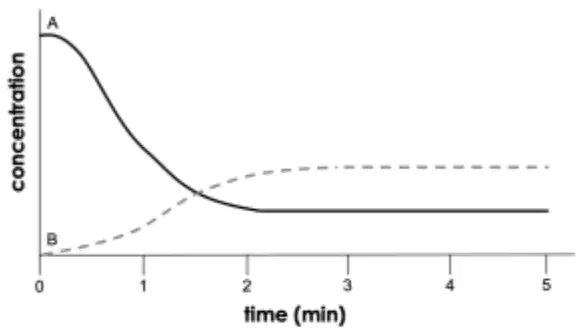
How long did it take for the reaction to reach equilibrium?
1 min
1.5 min
3 min
5 min
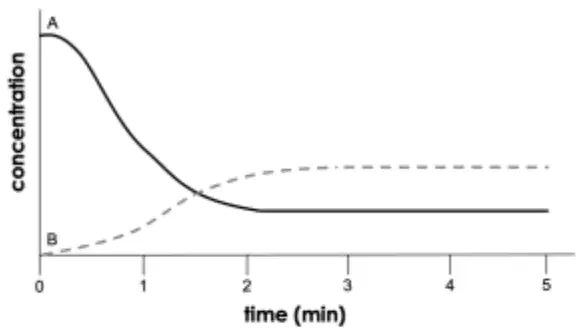
What would most likely happen to the point of equilibrium if more product was added 1 minute after equilibrium was reached?
The graph will show a sharp rise in the B line.
A new equilibrium will be established.
Both substances A and B will increase in concentration.
All of the above will most likely happen.
According to Le Chatelier’s principle, if the temperature of an exothermic reaction at equilibrium is increased, what will happen?
The forward reaction will be favored.
The reaction rate will increase.
The reverse reaction will be favored.
No change will occur.
What is the independent variable(s) in this experiment?
The variable that is changed or controlled by the experimenter
The variable that is measured in the experiment
The variable that remains constant
The result of the experiment
b. What is the dependent variable(s) in this experiment?
The variable that is measured in the experiment
The variable that is changed by the scientist
The variable that remains constant
The variable that is not involved in the experiment
c. Write a hypothesis for this experiment.
A hypothesis is a possible explanation for an observation that can be tested.
A hypothesis is a list of materials needed for the experiment.
A hypothesis is the final conclusion of the experiment.
A hypothesis is a summary of the experiment's results.
What is the control group in this experiment?
The group that receives the experimental treatment
The group that is not exposed to the experimental treatment
The group that receives a placebo
The group that is measured after the experiment
What is the experimental group(s) in this experiment?
The group that receives the treatment or variable being tested
The group that does not receive the treatment
Both groups in the experiment
The group that receives a placebo
List two constants in this experiment.
Temperature and volume
Mass and time
Pressure and temperature
Volume and color
Convert 3.6 tablespoons to L.
Butane (C4H10) can be described using which of the following statements involving the terms atom, element, and compound?
Butane is an atom made up of elements carbon and hydrogen.
Butane is an element made up of atoms of carbon and hydrogen.
Butane is a compound made up of atoms of the elements carbon and hydrogen.
Butane is a compound made up of only one type of atom.
Use the information provided and a periodic table to complete the chart on your answer sheet. Which of the following tools is most essential for this task?
A calculator
A periodic table
A ruler
A protractor
A Bohr model for an atom of magnesium with a mass number of 24 would have how many protons, neutrons, and electrons?
12 protons, 12 neutrons, 12 electrons
12 protons, 12 neutrons, 24 electrons
24 protons, 12 neutrons, 12 electrons
12 protons, 24 neutrons, 12 electrons
Differentiate between a nuclear reaction and a chemical reaction.
A nuclear reaction involves changes in the nucleus, while a chemical reaction involves changes in electron arrangement.
A nuclear reaction involves changes in electron arrangement, while a chemical reaction involves changes in the nucleus.
Both nuclear and chemical reactions involve only changes in electron arrangement.
Both nuclear and chemical reactions involve only changes in the nucleus.
Define the three types of nuclear reactions that can occur.
Fission, fusion, and radioactive decay
Combustion, oxidation, and reduction
Photosynthesis, respiration, and fermentation
Evaporation, condensation, and precipitation
An electron moves from the 2nd energy level to the 1st. This would be considered:
Absorption
Emission
Which of the following correctly identifies the error in the electron configuration 1s2 2s2 2p6 3s2 3p6 3d10 3p6 4s2 4p5 for Bromine and provides the correct configuration?
The configuration repeats 3p6 and should be 1s2 2s2 2p6 3s2 3p6 4s2 3d10 4p5.
The configuration should have 3d10 before 3p6.
The configuration should end with 4p6, not 4p5.
The configuration should have 4s2 after 4p5.
Metals tend to form cations and nonmetals tend to form anions because:
metals lose electrons easily while nonmetals gain electrons easily
metals gain electrons easily while nonmetals lose electrons easily
both metals and nonmetals lose electrons easily
both metals and nonmetals gain electrons easily
On the periodic table, the atomic radii of elements tend to increase as you move down a group and left in a period. This pattern is seen because:
Electrons are added to higher energy levels and there is less effective nuclear charge across a period.
Electrons are removed from lower energy levels and there is more effective nuclear charge across a period.
Protons are added to the nucleus, making the atom smaller as you go down a group.
Neutrons are added to the nucleus, making the atom larger as you go across a period.
The statement “bonding is a spectrum” means that:
All bonds are either purely ionic or purely covalent.
Bonding types exist on a continuous range between ionic and covalent.
Bonding only occurs in molecules with similar atoms.
Bonding is always unpredictable.
The difference between an ionic bond and a polar covalent bond is:
Ionic bonds involve the transfer of electrons, while polar covalent bonds involve unequal sharing of electrons.
Ionic bonds involve equal sharing of electrons, while polar covalent bonds involve the transfer of electrons.
Both involve equal sharing of electrons.
Both involve the transfer of electrons.
44. Write the name or chemical formula for each compound on your answer sheet.
Write the name or chemical formula for each compound.
Balance the chemical equation for each compound.
Draw the structural formula for each compound.
List the uses of each compound.
Place each letter below in its correct location in the chart on your answer sheet. Which of the following is the correct placement?
Option A
Option B
Option C
Option D
Complete each of the following equations. Then balance. a. Combustion: CH4 + O2 → b. Double: Pb(NO3)2 + NaCl →
CH4 + 2O2 → CO2 + 2H2O b. Pb(NO3)2 + 2NaCl → PbCl2 + 2NaNO3
CH4 + O2 → CO2 + H2O b. Pb(NO3)2 + NaCl → PbCl2 + NaNO3
CH4 + 2O2 → CO2 + 2H2O b. Pb(NO3)2 + NaCl → PbCl2 + 2NaNO3
CH4 + O2 → CO2 + 2H2O b. Pb(NO3)2 + 2NaCl → PbCl2 + NaNO3
Write the chemical equation for each of the following reactions with appropriate notation. Then balance and classify. Aqueous copper (II) chloride reacts with aqueous lithium hydroxide to make solid copper (II) hydroxide and aqueous lithium chloride.
CuCl2(aq) + 2LiOH(aq) → Cu(OH)2(s) + 2LiCl(aq)
CuCl2(aq) + LiOH(aq) → Cu(OH)2(aq) + 2LiCl(s)
CuCl2(s) + 2LiOH(aq) → Cu(OH)2(aq) + 2LiCl(aq)
CuCl2(aq) + 2LiOH(aq) → Cu(OH)2(aq) + 2LiCl(aq)
The amount of product formed in a reaction is always determined by the limiting reactant because:
the limiting reactant is completely consumed first, stopping the reaction.
the excess reactant determines the product amount.
all reactants are always used up equally.
the product forms only from the excess reactant.
Consider the following reaction between lithium hydroxide and carbon dioxide. 2LiOH(s) + CO2(g) → Li2CO3(s) + H2O(l) a. Identify the limiting reactant if you start with 0.963 mol of LiOH and 0.571 mol of CO2.
LiOH is the limiting reactant.
CO2 is the limiting reactant.
Both are limiting reactants.
There is no limiting reactant.
49. Consider the following reaction between lithium hydroxide and carbon dioxide. 2LiOH(s) + CO2(g) → Li2CO3(s) + H2O(l) b. Determine how many moles of excess reactant will remain unused.
0.0895 mol CO2.
0.0450 mol LiOH.
0.1200 mol CO2.
0.0100 mol LiOH.
Consider the following reaction between lithium hydroxide and carbon dioxide. 2LiOH(s) + CO2(g) → Li2CO3(s) + H2O(l). How many moles of each product are formed?
0.4815 mol Li2CO3 and 0.4815 mol H2O
0.2407 mol Li2CO3 and 0.9630 mol H2O
0.9630 mol Li2CO3 and 0.2407 mol H2O
1.000 mol Li2CO3 and 0.500 mol H2O
Find the molar masses of each product formed.
Li2CO3: 73.89 g/mol H2O: 18.02 g/mol
Li2CO3: 60.00 g/mol H2O: 20.00 g/mol
Li2CO3: 100.00 g/mol H2O: 15.00 g/mol
Li2CO3: 50.00 g/mol H2O: 25.00 g/mol
Find the masses, in grams, of each product formed.
Li2CO3: 0.4815 mol × 73.89 g/mol = 35.59 g H2O: 0.4815 mol × 18.02 g/mol = 8.68 g
Li2CO3: 0.4815 mol × 60.00 g/mol = 28.89 g H2O: 0.4815 mol × 20.00 g/mol = 9.63 g
Li2CO3: 0.4815 mol × 80.00 g/mol = 38.52 g H2O: 0.4815 mol × 15.00 g/mol = 7.22 g
Li2CO3: 0.4815 mol × 70.00 g/mol = 33.71 g H2O: 0.4815 mol × 19.00 g/mol = 9.15 g
If this reaction is conducted in a lab and 7.85 g of water are actually produced, what is the percent yield?
90.5%
75.2%
82.7%
97.1%
BONUS: The compound that would mostly form between carbon and fluorine would be:
Ionic, because of the large difference in electronegativity.
Covalent, because both are nonmetals and share electrons.
Ionic, because carbon easily loses electrons to fluorine.
Covalent, because fluorine donates electrons to carbon.
BONUS: Consider the compound that would mostly form between carbon and fluorine. b. Which of the following is the correct Lewis structure for the compound that would form?


Consider the compound that would mostly form between carbon and fluorine. Write the chemical formula for the compound.
CF4
C2F2
CF2
C2F4
Consider the compound that would mostly form between carbon and fluorine. Write the name for the compound.
Carbon tetrafluoride
Carbon difluoride
Carbon hexafluoride
Carbon monoxide
BONUS: Consider the compound that would mostly form between carbon and fluorine. e. Predict its molecular shape (if applicable). If not applicable, explain why not.
Tetrahedral
Linear
Trigonal planar
Bent
Consider the compound that would mostly form between carbon and fluorine. Is the compound polar? Use the proper notation to identify the partial charges.
Yes, the compound is polar. Carbon has a partial positive charge (δ+) and fluorine has a partial negative charge (δ−).
No, the compound is nonpolar. Both atoms have equal partial charges.
Yes, the compound is polar. Fluorine has a partial positive charge (δ+) and carbon has a partial negative charge (δ−).
No, the compound is nonpolar. Fluorine has a partial positive charge (δ+) and carbon has a partial negative charge (δ−).
Identify the dominant intermolecular force at work in the substance.
London dispersion forces (induced dipole-induced dipole interactions) are the dominant intermolecular force in CF4.
Hydrogen bonding is the dominant intermolecular force in CF4.
Dipole-dipole interactions are the dominant intermolecular force in CF4.
Ion-dipole forces are the dominant intermolecular force in CF4.
In a double replacement, ____________________
The reactants are usually a metal and a nonmetal
One of the reactants is often water
The reactants are generally 2 ionic compounds in aqueous solutions
Energy in the form of light or heat is often produced
Which of the following statements is NOT true about what happens in all chemical reactions?
The ways in which atoms are joined together change
New atoms are formed as products
The starting substances are called reactants
The bonds of reactants are broken and new bonds of products are formed
Chemical equations must be balanced to satisfy ____.
The law of definite proportions
The law of multiple proportions
The law of conservation of mass
Avogadro's principle
What are the coefficients that will balance the skeleton equation below?
AlCl3 + NaOH → Al(OH)3 + NaCl
1,3,1,3
3,1,3,1
1,1,1,3
1,3,3,1
How many moles of aluminum are needed to react completely with 1.2 mol of FeO?
2Al(s) + 3FeO(s) → 3Fe(s) + Al2O3(s)
1.2 mol
0.8 mol
1.6 mol
2.4 mol
When an equation is used to calculate the amount of product that could form during a reaction, then the value obtained is called the ____.
Actual yield
Percent yield
Minimum yield
Theoretical yield
The equation 2C3H7OH + 9O2 → 6CO2 + 8H2O is an example of which type of reaction?
Combustion reaction
Single replacement reaction
Double replacement reaction
Decomposition reaction
A process that absorbs heat is a(n) _________.
Exothermic process
Polythermic process
Endothermic process
Ectothermic process

Which group typically forms a -2 ionic charge?
Group 3A
Group 2A
Group 7A
Group 6A
Which group typically forms a +3 ionic charge?
Group 3A
Group 2A
Group 7A
Group 6A
Which group typically forms a +1 ionic charge?
Group 1A
Group 2A
Group 7A
Group 4A
Periodic law states that the elements are arranged according to their atomic ________ so that elements with similar chemical properties are in the same ________ and properties repeat periodically.
numbers, period
masses, period
masses, group
numbers, group
Where are the metalloids found on the Periodic Table?
to the left of the stairstep
along/on the stairstep
to the right of the stairstep

Which elements are to the LEFT of the staircase (yellow)?
metals
nonmetals
metalloids

Which elements are to the RIGHT of the staircase (red)?
nonmetals
metals
metalloids
Which elements are to the RIGHT of the staircase (red)?
nonmetals
metals
metalloids
The horizonal rows on the Periodic Table are called...
groups
period
Elements that share similar physical and chemical properties are most likely located in the same...
period
group
Which process is an example of a physical change?
Cutting Carrots into pieces and mixed in a salad
A peanut butter and jelly sandwich being digested
Sodium metal and water combining to form a compound and a gas
Sodium metal and chlorine gas combined to form table salt
Which process is an example of a physical change?
Burning
Rusting
Flattening
Decomposing
formation of a gas/fizzing
dissolving in water
Which of the following physical changes shows a change in a substance's STATE OF MATTER?

Table salt (NaCl) is a ...

Aluminum metal is a ...

Kool-Aid is a ...
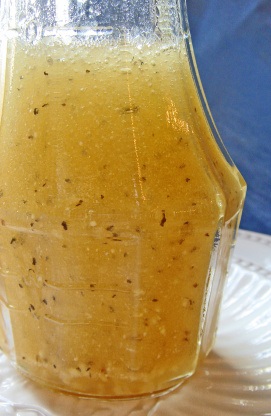
A mixture that is NOT evenly distributed (has 2 or more phases) is called ....

How many valence electrons does Aluminum Have?
1 Valence electron
2 Valence electron
3 Valence electron
4 Valence electron
5 Valence electron

What ionic charge does Potassium form when it becomes an ion?
-3
-1
+1
+3
What ionic charge does Sulfur form when it becomes an ion?
+2
-2
+1
0

How many valence electrons does Nitrogen Have?
1 Valence electron
2 Valence electron
3 Valence electron
4 Valence electron
5 Valence electron
Most atoms are trying to reach a full valence shell (octet) with ____ valence electrons.
4
6
8
32
A limiting reactant is a reactant that.....
runs out during a chemical reaction
causes a reaction to stop
determines the amount of products that can be made
all of these
How are covalent bonds formed?
Covalent bonds are formed when two atoms transfer electrons.
Covalent bonds are formed when two atoms repel each other.
Covalent bonds are formed when two atoms attract each other.
Covalent bonds are formed when two atoms share electrons.
What does the visible light spectrum cover?
The wavelengths that can be seen by the human eye.
The wavelengths that cannot be seen by the human eye.
The wavelengths used in radio communication.
The wavelengths that are used in X-rays.
Which wavelengths of the EM spectrum are dangerous to life?
radio, micro and gamma
gamma, infrared, and UV
Infrared, UV and X Rays
UV, X rays and Gamma
F2 + LiBr → LiF + Br2
Synthesis/ Combination
Decomposition
Single Replacement
Double Replacement
Combustion
AlBr3+ NaOH → Al(OH)3 + NaBr
Synthesis/ Combination
Decomposition
Single Replacement
Double Replacement
Combustion
NaClO3 → NaCl + O2
Synthesis/ Combination
Decomposition
Single Replacement
Double Replacement
Combustion
K + Br2 → KBr
Synthesis/ Combination
Decomposition
Single Replacement
Double Replacement
Combustion
Balance the following chemical equation: ___ Al + ___ O 2 → ___ Al 2 O 3
2, 1, 2
4, 3, 2
1, 1, 1
2, 3, 1

A mole of any substance is how many particles?
6.02 x 10²³
6.02 x 10⁻²³
602 million
602
When calculating molar mass for an element, which number do you need to look at on the periodic table?
Atomic number
Atomic Mass
Atomic particles
Avogardo's Number
Which is the correct molecular structure for carbon dioxide?


Which of the following is the correct electron dot structure for nitrogen?


This could be the dot diagram of
Mg
Cl
C
O
What are valence electrons?
The total number of electrons in an atom
The number of electrons in the outermost shell
The number of electrons in the second shell
The number of protons in the outermost shell
What type of bond contains atoms with "partial" charges? (Example: δ+)
Polar Covalent
Non-Polar Covalent
Ionic
What are the seven diatomic elements?
H2, Cl2, Br2, O2, N2, I2, F2
H2, Cl2, I2, F2, Hg2, Br2, Fe2
H2, Cu2, Ni2, B2, O2, I2, Fe2

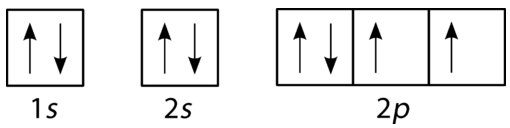
If an atom has no charge, which of the following must be true?
It has more neutrons than protons or electrons.
There are only neutrons inside the atom.
Its number of protons is equal to its number of electrons.
The neutrons in the atom outnumber the electrons and protons.

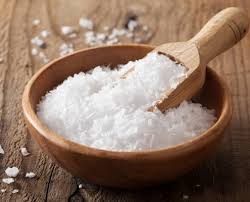


What type of bonding does this picture show?
Ionic
Covalent

What kind of bonds are shown here?
Covalent
Ionic
Valence electrons are shared
Ionic bonds
Covalent bonds
Valence electrons are transferred
Ionic bonds
Covalent bonds


Which of these is NOT a unit of pressure?
cm3
torr
psi
mmHg
Find the unit of volume (multi answers are good!)
psi
cm3
ml
lm
atm
K,F,C all are units for....
temp
vol
pressure
weather
PSI, torr, mmHG, atm all are units for....
temp
vol
pressure
weather
ml, L, cm3 all are units for....
temp
vol
pressure
weather
How would you convert 34oC to Kelvin?
K = oC + 273
oC = K + 273
K = oC - 273
oC = K + 273
1 atm= 760 mm Hg = ? kPa
75.01
90.02
101.3
110.5
What is the name for this acid HNO2
hydronitric acid
nitrous acid
nitric acid
nitrate acid
what is the name for this acid HF
fluoric acid
hydrofluoric acid
fluorous acid
Identify the solvent


Ga2(SO3)3
What is Avogadro's Number?
1.2 x 1024
6.02 x 10²³
602
305
1 mole=_____?
6.022X10²³
6.022X10⁻²³
6.022X1024
1.672X10²³
( Fill in the blank) Long hair should be ____________ in the laboratory.
tied back
cut
down
curled
(True or False) Horse playing is allowed in the laboratory
true
false
( Fill in the blank) Long hair should be ____________ in the laboratory.
tied back
cut
down
curled
(True or False) Horse playing is allowed in the laboratory
true
false
(True or False) It is okay to pick up broken glass with your bare hands as long as the glass is placed in the trash can
true
false


The following footwear is the best in the laboratory
sandals
open-toed shoes
closed-toe shoes
shoes appropriate for the weather
True or False: Laboratory work can be started immediately upon entering the laboratory even if the instructor is not yet present.
True
False
True or False: Read all procedures thoroughly before entering the laboratory
True
False

After completing an experiment, all wastes should be
taken home
tossed in the trash can
disposed of according to your teacher's directions
left out for someone else to clean

Approved eye protection devices (such as goggles) are worn in the laboratory
to avoid eye strain
to improve your vision
so that you look super cool
any time chemicals, heat or glassware are used


