wayground logo

Free Printable Worksheets

Font size

S
M
L
XL
Worksheets

Unit 6: Surface Area, Volume, & Tessellations

Total questions: 166

Worksheet time: 13hrs 37mins
Name
Class
Date
1.
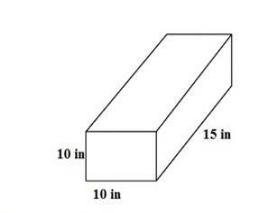
Find the total surface area of the prism.
a)
48 square inches
b)
64 square inches
c)
88 square inches
d)
76 square inches
2.
Which example requires you to find the surface area?
a)
Finding out how much water will fill a cylinder
b)
Finding out how much wrapping paper is needed to cover a present
c)
Finding the amount a container can hold
d)
Finding out how much wood is needed to build a fence in your back yard.
3.
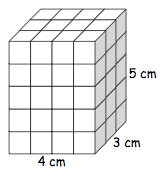
What is the surface area of this figure?
a)
200 cm 2
b)
800 cm 2
c)
400 cm 2
d)
100 cm 2
4.
A cube's side length measures 15 inches.  What is the surface are of the cube?
a)
225 in2
b)
1350 in2
c)
3375 in2
d)
1125 in2
5.
A rectangular brick has a length of 5 centimeters, a width of  9 centimeters and a height of 20 centimeters. What is the surface area of that brick? 
a)
650 cm2
b)
600 cm2
c)
525 cm2
d)
450 cm2
6.
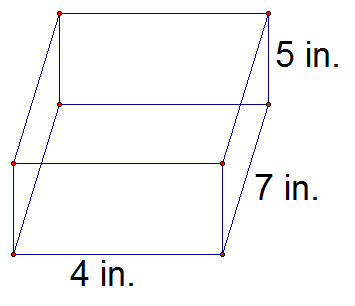
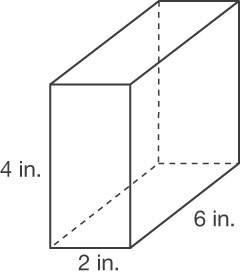
Find the surface area of the rectangular prism.
a)
140 in.2
b)
83 in.2
c)
166 in. 2
d)
100 in.2
7.
Find the surface area of the rectangular prism.
a)
94 cm. squared
b)
60 cm. squared
c)
12 cm. squared
d)
19 cm. squared
8.

How many FACES does a rectangular prism have?

a)

4

b)

5

c)

6

d)

8

9.
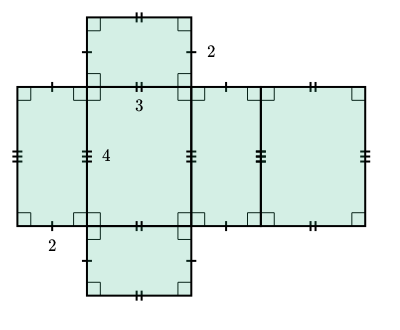
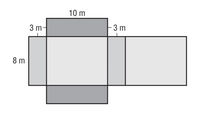
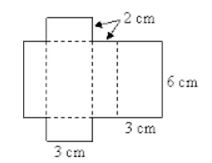
Find the surface area of the figure formed by the net with 2 cm ,  3 cm, and 4 cm edges below.
a)
40 cm2
b)
48 cm2
c)
52 cm2
d)
62 cm 2
10.
Find the surface area of the rectangular prism with the following dimensions: 
length = 16 m
height = 10 m
width = 11 m
a)
872 m squared
b)
752 m squared
c)
1,760 m squared
d)
892 m squared
11.
Find the surface area of the rectangular prism with the following dimensions: 
length = 9 m
height = 10 m
width = 12 m
a)
630 m squared
b)
636 m squared
c)
710 m squared
d)
1080 m squared
12.

Mrs. Jarrell is wrapping a present for her puppy's birthday. The box is shaped like a cube with sides that are 13 inches long. How much wrapping paper is she going to need to use to wrap her puppy's present?

a)

1014 in2

b)

1004 in2

c)

676 in2

d)

1150 in2

13.

Coach Hanf wants to repaint her daughter's room. The room's dimensions are 10 feet long and 11 feet wide. The room has 8 foot ceilings. How much paint is she going to need to paint the walls?

a)

556 ft2

b)

880 ft2

c)

336 ft2

d)

446 ft2

14.

What is the total surface area of the figure shown? (Base is shaded dark)

a)

73.5 m2

b)

162.94 m2

c)

192.34 m2

d)

110.94 m2

15.

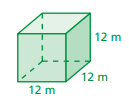
Find the surface area of a cube with side length 12 m.

a)

144 m2

b)

36 m2

c)

864 m2

d)

216 m2

16.
Find the surface area of the rectangular prism.
a)
94 cm. squared
b)
60 cm. squared
c)
12 cm. squared
d)
19 cm. squared
17.
What is the SURFACE AREA of this figure? * hint the height of this CUBE is 3
a)
64 cm2
b)
54 cm2
c)
36 cm
18.
Find the Surface area of the shape?
a)
258 m2
b)
268 m2
c)
248 m2
d)
278 m2
19.

What is the surface area? (6 in by 3 in by 5 in prism)

a)

90 in2

b)

180 in2

c)

126 in2

d)

96 in2

20.

If the measurements of a Rectangular Prism are 4,5, and 6; what could be it total surface area?

a)

2 (4x5) + 2(4x6) + 2(5x6) = 148 square units

b)

2 (4x5) + 2(4x4) + 2(5x5) = 122 square units
21.
How do you find the AREA of a TRIANGLE?
a)
Height x Base divided by 4
b)
Length x Width
c)
1/3 (Length x width)
d)
1/2 (Base x height)
22.
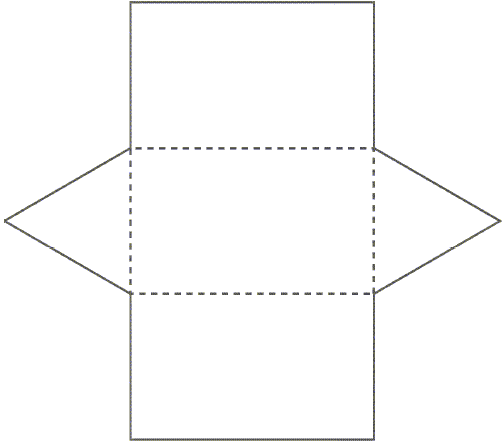
What 3D solid does this net create?
a)
Triangular Prism
b)
Triangular Pyramid
c)
Rectangular Pyramid
d)
Square Prism
23.
Find the total surface area of the prism.
a)
161 square feet
b)
1,700 square feet
c)
75 square feet
d)
186 square feet
24.
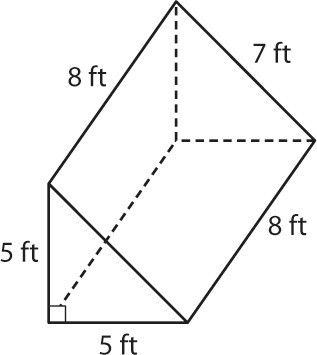
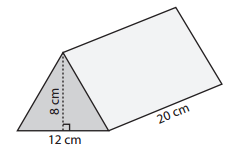
What is the total surface area of the triangular prism shown? 
a)
468 in2
b)
540 in2
c)
576 in2
d)
700 in2
25.

How many Faces does a Triangular Prism have?

a)

3

b)

6

c)

9

d)

5

26.

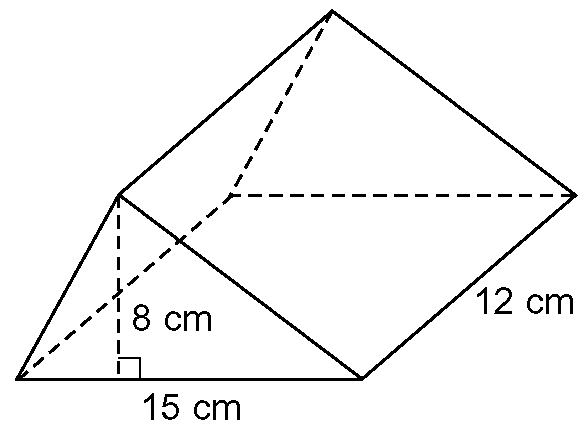
Find the surface area of the triangular prism.

a)

356 in2

b)

348 in2

c)

336 in2

d)

340 in2

27.
Find the total surface area of the figure.
a)
500 ft2
b)
515 ft2
c)
525 ft2
d)
510 ft2
28.

Find the lateral surface area of the figure shown.

a)

672 cm2

b)

480 cm2

c)

576 cm2

d)

864 cm2

29.

What is the difference in LATERAL surface area of the prisms shown?

a)

612 cm2

b)

108 cm2

c)

720 cm2

d)

144 cm2

30.

Find the total surface area of the figure shown.

a)

120 cm2

b)

216 cm2

c)

130 cm2

d)

168 cm2

31.
a)

100 mm2

b)

132mm2

c)

114 mm2

d)

120 mm2

32.
a)

184 mm2

b)

186 mm2

c)

172 mm2

d)

196 mm2

33.
How many faces are on a cube?
a)
3
b)
4
c)
5
d)
6
34.
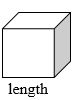
When you find the surface area of a cube, you ________ the length of the cube and multiply by 6.
a)
square
b)
cube
c)
add
d)
divide
35.
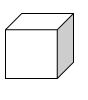
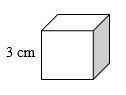
Find the surface area of this cube.
a)
18 sq cm
b)
36 sq cm
c)
54 sq cm
d)
60 sq cm
36.
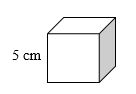
Find the surface area of the cube.
a)
150 cm2
b)
125 cm2
c)
60 cm2
d)
30 cm2
37.
Find the surface area of this cube.
a)
84 cm2
b)
420 cm2
c)
343 cm2
d)
294 cm2
38.
True/False  This is the net for a cube.
a)
True
b)
False
39.
True/False  This is the net for a cube.
a)
True
b)
False
40.
You found the surface area of a cube.  Which units would be appropriate?
a)
in
b)
in2
c)
in3
d)
in4
41.
The formula for the surface area of a cube is 6s2     What is the surface area of cube if the length is 10?
a)
3600
b)
360
c)
600
d)
120
42.
The formula for the surface area of a cube is 6s2     Jack plugs in 8 for the length of of the cube.  He multiplies 6 by 8.  Then he "squares" 48 to get 2304.  What mistake, if any, did he make?
a)
He should have doubled 48.
b)
He should have squared 8 before multiplying by 6.
c)
He should have squared 6.
d)
He did not make a mistake.
43.

What is surface area?

a)

The amount you can put inside an object.

b)

the sum of all the areas of all the shapes that cover the surface of the object.

c)

The distance around a figure.

d)

The inside space taken by a two-dimensional figure.

44.

The radius is ___________ of the diameter?

a)

one-fourth

b)

one - half

c)

twice

d)

three times

45.

Campbell Soup is creating a new soup label. If a can has a height of 6 in and a diameter of 4 in, how much material does Campbell need for each soup label? Use 3.14 for π.


Is this looking for Lateral or Total surface area?

a)

Lateral Surface Area

b)

Total Surface Area

c)

Can't be Determine

d)

Not Enough Information is Given

46.

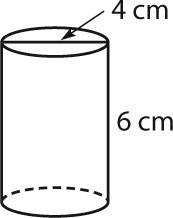
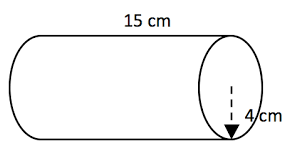
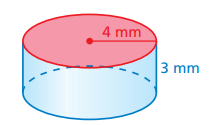
Find the total surface area of the cylinder.

Don't forget to divide the diameter by 2 to get the radius.

a)

25.13 square cm

b)

75.40 square cm

c)

50.27 square cm

d)

100.53 square cm

47.
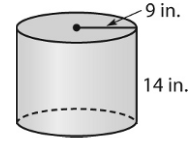
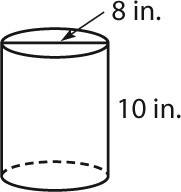
What is the total surface area of the cylinder to the nearest square inch
a)
625 in2
b)
1300 in2
c)
1046 in2
d)
414 in2
48.

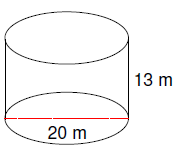
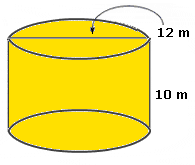
Find the lateral surface area of the figure. Don't forget to divide the diameter by 2 to get the radius.

a)

456 m2

b)

1444 m2

c)

1245 m2

d)

816 m2

49.
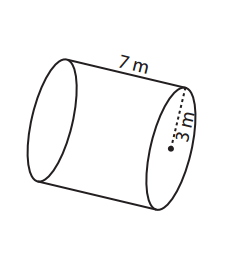
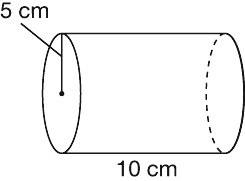
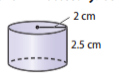
Find the lateral surface area of the cylinder.
a)
471.24 square centimeters
b)
157.08 square centimeters
c)
314.16 square centimeters
d)
296.72 square centimeters
50.
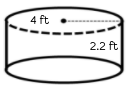
Find the surface area
a)
60.4 m2
b)
188.4 m2
c)
94.2 m2
d)
881.9 m2
51.
Find the Total Surface area of the cylinder. 
a)
62.8m
b)
477.28 cm2
c)
 235.5 cm3
d)
942 cm2
52.

Find the lateral surface area of the prism. Don't forget to divide the diameter by 2 to get the radius.

a)

100.53 square inches

b)

351.86 square inches

c)

251.33 square inches

d)

50.27 square inches

53.
What is the Lateral Area of the Figure
a)
163in3
b)
188.4in2
c)
283in2
d)
324in3
54.
Find the lateral surface area of the cylinder.
a)
471.24 square centimeters
b)
157.08 square centimeters
c)
314.16 square centimeters
d)
296.72 square centimeters
55.
What is the total surface area of the cylinder to the nearest square inch
a)
625 in2
b)
1300 in2
c)
1046 in2
d)
414 in2
56.
Find the lateral surface area of the figure.
a)
456 m2
b)
1444 m2
c)
1245 m2
d)
816 m2
57.
Find the lateral surface area of the cylinder.
a)
192π
b)
128π
c)
96π
d)
402π
58.
Find the Total Surface area of the cylinder. 
a)
62.8m
b)
477.28 cm2
c)
 235.5 cm3
d)
942 cm2
59.

Find the total surface area of the cylinder.

Don't forget to divide the diameter by 2 to get the radius.

a)

25.13 square cm

b)

75.40 square cm

c)

50.27 square cm

d)

100.53 square cm

60.
What is the total surface area of the cylinder to the nearest square inch
a)
625 in2
b)
1300 in2
c)
1046 in2
d)
414 in2
61.

Find the total Surface Area of the cylinder. Round to the nearest tenth.

a)

3015.9 cm2

b)

1155.5 cm2

c)

578.1 cm2

d)

779.1 cm2

62.

Find the total surface area. Use 3.14 for pi. The diameter is 4. Round to the nearest tenths.

a)

138.16

b)

113

c)

25.1

d)

226.1

63.

Find the lateral surface area. Use 3.14 for pi. The diameter is 2. Round to the nearest tenths.

a)

62.8

b)

37.7

c)

6.3

d)

31.4

64.

Find the total surface area. Use 3.14 for pi. Round to the nearest tenths.

a)

45.2

b)

100.5

c)

55.3

d)

155.7

65.

Find the lateral surface area. Use 3.14 for pi. Round to the nearest tenths.

a)

251.2

b)

653.1

c)

2009.6

d)

401.9

66.

Find the lateral surface area. Use 3.14 for pi. The diameter is 18. Round to the nearest tenths.

a)

7121.5

b)

1780.4

c)

395.6

d)

197.8

67.
Find the surface area
a)
140.25 cm2
b)
439.82 cm2
c)
219.91 cm2
d)
192.25 cm2
68.

Find the surface area of a cylinder with a radius of 4 and a height of 3. Use 3.14 for π

a)

175.84 mm2

b)

709.89 mm2

c)

75.36 mm2

d)

100.48 mm2

69.

Find the surface area of the cylinder with a radius 1 in. and a height 2 in.

a)

12.56 in2

b)

6.28 in2

c)

39.44 in2

d)

18.84 in2

70.
What does the "B" in the volume formula V = Bh stand for?
a)
Bottom of the object
b)
Box
c)
Between
d)
Area of the base
71.
What is the area of this circle?
a)
1256.64
b)
31.41
c)

314

d)
123.12
72.
Given a cylinder with the height of 10cm and the base radius of 9cm. Find the volume of this cylinder to the nearest tenth.   (use 3.14 as an approximation for Π)
a)
810 cm3
b)
2543.4 cm3
c)
847.8 cm3
d)
2826 cm3
73.
Soda is sold in aluminum cans that measure 6 inches in height and 2 inches in diameter.  How many cubic inches of soda are contained in a full can?
a)
12.0
b)
24.0
c)
75.4
d)
18.8
74.
Find the volume of the figure. Round to the nearest tenth.
a)
128.6 units³
b)
1,286.1 units³
c)
401.9 units³
d)
5,144.6 units³
75.
A silo in the shape of a cylinder is partially filled with corn to feed cows. The corn fills 50% of the height of the silo. What is the approximate volume of the part of the silo that is filled with corn if the silo is 12 feet in diameter and 60 feet high?
a)
27,143.36 ft3
b)
3391.2 ft3
c)
13,571.68 ft3
d)
6,785.84 ft3
76.
Michael has a very large soup pot shaped like a cylinder that has a height of 15  inches and a radius of 6 inches. How much soup can Michael’s soup pot hold?
a)
4239 in3
b)
423.9 in3
c)
1695.6 in3
d)
 1695.6 in2
77.
A 9 cm wide cross section pipe has a height of 13 cm. Calculate the volume of the pipe. 
a)
827.02 cm3
b)
367.57 cm3
c)

826.6 cm3

d)
3308.1 cm3
78.
Which label would NOT be appropriate for volume.
a)
square miles
b)
inches3
c)
cm3
d)
cubic feet
79.
Find the volume of the cylinder. Round your answers to the nearest tenth if necessary. Use 3.14 for π.
a)
16.4 cm3
b)
31.7 cm3
c)
31.4 cm3
d)
22.0 cm3
80.
What is volume?
a)
The amount of space of a 2-D object
b)
The amount of space in a 3-D object
c)
Water
d)
Area
81.
What is the radius of this circle?
a)
12
b)
6
c)
24
82.

What is the volume of the cylinder? Approximate your answer by rounding to the nearest tenth.

a)

60 km3

b)

942.5π km3

c)

942 km3

d)

300 km3

e)

188.5 km3

83.
A cylinder has a height of 4 m and a diameter or 4 m. What is the volume?
a)
64π m3
b)
16π m3
c)
64π m2
d)
16π m2
84.
What is the area of this circle?
a)
163.2
b)
15.3
c)
124.2
d)
113.1
85.
Which cylinder will have a larger volume?
a)
Cylinder A
b)
Cylinder B
86.

Find the volume of the cylinder. Round your answers to the nearest tenth if necessary. Use 3.14 for π.

a)

7230 m3

b)

4,521.6 m3

c)

1130.4 m3

d)

907 m3

87.
What is the area of this circle?
a)
6082.12
b)

1519.8

c)
1893.14
d)
1292.92
88.

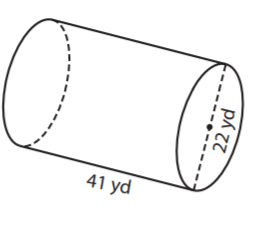
Find volume of the cylinder

a)

1,416.1 yd3

b)

62,310.2 yd3

c)

2,832.3 yd3

d)

15,577.5 yd3

89.
What is the radius of this circle?
a)
140
b)
35
c)
70
90.
Find the volume of the figure?
a)
4003 cm3
b)
336 cm3
c)
36 cm3
d)
412 cm3
91.
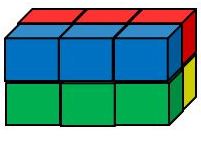
What is the volume of this rectangular prism?
a)
26 cubic units
b)
24 cubic units
c)
24 square units
d)
26 square units
92.

What is the difference in volume, in cm3, between M and N?

a)

47

b)

53

c)

144

d)

197

93.

A cuboid has ---------- faces

a)

4

b)

8

c)

6

d)

12

94.

A cube has a side length 5 cm. what is length of all edges together

a)

60

b)

20

c)

40

d)

10

95.

what is the area front side of this figure ?

a)

25

b)

10

c)

20

d)

60

96.

The volume of the cuboid is ... unit cubes.

a)

128

b)

120

c)

112

d)

108

97.

A cube-shaped aquarium is only HALF-FILLED. The edge of the aquarium is 40 cm. So, the volume of the water inside the aquarium is ... mL.

a)

64.000 mL

b)

32.000 mL

c)

16.000 mL

d)

8.000 mL

98.

The rectangular tank shown is partially filled with water. The volume of water inside the tank is ... cm3


(WRITE THE NUMBER WITHOUT ANY SPACE)

(a)  

99.

A rectangular tank measuring 27 m by 25 m by 22 m is partially filled with water. The volume of water inside the tank is ... m3

(WRITE THE NUMBER ONLY WITHOUT ANY SPACE)

(a)  

100.

Calculate the Volume

a)

410 cm3

b)

420 cm3

c)

402 cm3

d)

401 cm3

101.
What is the volume of the following rectangular prism?
a)
100 cubic centimeters
b)
100 cubic feet
c)
25 cubic centimeters
d)
25 cubic feet
102.
What is the volume of this rectangular prism?
a)
6 cubic units
b)
16 cubic units
c)
12 cubic units
d)
10 cubic units
103.

Each side of this ice cube measures 20 cm. What is the volume of the ice cube?

a)

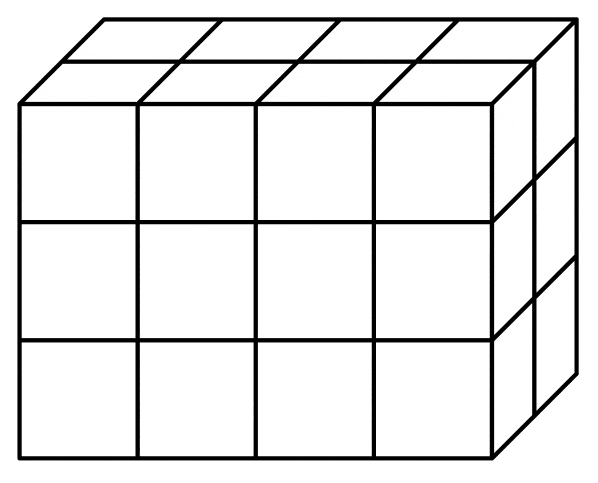
6000 cm3

b)

8000 cm3

c)

600 cm3

d)

60 cm3

104.
What shape is this?
a)
cone
b)
pyramid
c)
rectangular prism
d)
cube
105.
a)
546 m3
b)
456 m3
c)
654 m3
d)
54 m3
106.
a)
1170 cm3
b)
170 cm3
c)
1100 cm3
d)
1170 ft3
107.
a)

784 m3

b)

748 mm3

c)

847 mm3

d)

880 m3

108.

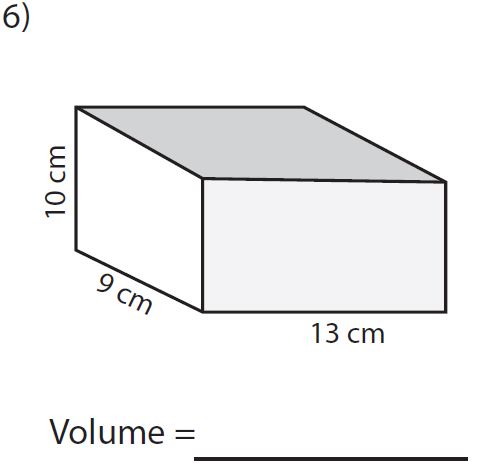
what is the volume of this prism?

a)

72

b)

27

c)

1.5

d)

272

109.
If a rectangular prism's volume is 420cm3.  The prism has a  length of 12cm, and width of 7cm, what is height of the rectangular prism? 
a)
12cm
b)
5cm
c)
420cm
d)
84cm
110.

What is the volume of this prism?

a)

45 cubic units

b)

48 cubic units

c)

54 cubic units

d)

96 cubic units

111.
What is the volume of this prism?
a)
18 cubic cm
b)
6 cubic cm
c)
9 cubic cm
112.
A cereal box is 12cm tall.  The area of the base is 7cm.  What is the volume?
a)
84 cm2
b)
84 cm3
c)
83 cm
d)
84
113.
The volume of a rectangular prism is 125 units 3.  If the height is 25 units, what is the area of the base?
a)
5
b)
3,125
c)
15
d)
25
114.

A triangular prism has a base area of 12 cm and a height of 4 cm. What is the volume?

a)

3 cubic centimeters

b)

48 cubic cemtimeters

c)

24 cubic centimeters

d)

124 cubic centimeters

115.

Find the volume of the figure. Round to the nearest tenth.

a)

80 cm³

b)

160 cm3

c)

42 cm3

d)

40 cm³

116.

Lucia has a triangular prism that has a length of 6 cm, a width of 4 cm, and a height of 8cm. What is the volume?

a)

96cm³

b)

54cm³

c)

80cm³

d)

24cm³

117.

Find the Volume of this triangular prism.

a)

960 cm 3

b)

240 cm 3

c)

960 cm 2

d)

1920 cm 3

118.

This triangular planting trough is 3.5 m long, 1.2 m wide at the top, and 0.75 m deep. How much soil will it hold?

a)

4 cubic m

b)

3.15 cubic m

c)

1.575 cubic m

d)

0.5 cubic m

119.

A triangular prism has a volume of 400 cm3 and a base area of 25 cm2. What is the height of the prism?

a)

10 000 cm

b)

5 000 cm

c)

8 cm

d)

16 cm

120.
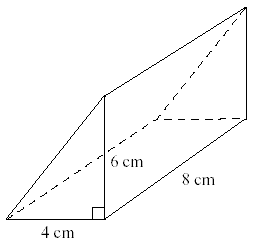
Find the volume of this triangular prism.
a)
1440 cm3
b)
60 cm3
c)
720 cm3
d)
180 cm3
121.
Find the volume.
a)
18 m3
b)
20 m3
c)
16 m3
d)
22 m3
122.

Find the volume of the triangular prism.

a)

62 m3

b)

60 m3

c)

64 m3

d)

66 m3

123.

Find the volume.

a)

22 321 cm3

b)

12 541 cm3

c)

21 432 cm3

d)

10 716 cm3

124.

Julie uses a tent like the one shown to go camping with friends. The tent is 210 cm tall, 150 cm wide and 400 cm long. Calculate the volume of the tent.

a)

12 600 000 cm3

b)

8 400 000 cm3

c)

6 300 000 cm3

d)

150 000 cm3

125.

A tessellation is...

a)

a repeating pattern

b)

a repeating pattern with no over laps

c)

a repeating pattern with no gaps or over laps

d)

a repeating pattern with no gaps

126.

is this an example of tessellation

a)

yes

b)

no

127.

This figure is a tessellation.

a)

True

b)

False

128.

The three polygons that can make a regular tessellation are the triangle, the square and the ___________.

a)

pentagon

b)

octagon

c)

hexagon

d)

decagon

129.

It is a fact that any triangle and any quadrilateral can cover the plane.

a)

True

b)

False

130.

In a tessellation, the measures of the angles that meet at each vertex must add up to 360°.

a)

True

b)

False

131.

Is this a semi-regular tessellation?

a)

Yes

b)

No

132.

To decide if given figures will tessellate, we first look at the shapes' _____________________.

a)

number of sides

b)

interior angles

c)

number of vertices

d)

size

133.

This figure can always be used to tessellate, because its sum of internal angles is 360°.

a)

Triangle

b)

Quadilateral

c)

Pentagon

d)

hexagon

134.

Would the octagon and the equilateral triangle tessellate?

a)

Yes; two octagons and one triangle meet at each vertex; 150+150+60=360

b)

Yes; two octagons and one triangle meet at each vertex

135+135+60=360

c)

Yes; one octagon and two triangles meet at each vertex

135+60+60=360

d)

No; there is no combination of 135 and 60 that adds up to exactly 360

135.

Non-polygonal figures can also make tessellations.

a)

Yes,they can

b)

No, they cant

136.

Can this be considered a tessellation where figures were reflected?

a)

Yes,of course

b)

Definitively not.

137.
A tessellation is...
a)
a repeating pattern 
b)
a repeating pattern with no overlaps
c)
a repeating pattern with no gaps or overlaps
d)
a repeating pattern with no gaps
138.
This figure is a tessellation.
a)
True
b)
False
139.

Which of these images represents a tessellation?

a)
b)
c)
d)
140.
Is this an example of a tessellation?
a)
Yes
b)
No
141.

The three polygons that can make a regular tessellation are the triangle, the square and the ___________.

a)

pentagon

b)

hexagon

c)

octagon

d)

decagon

142.

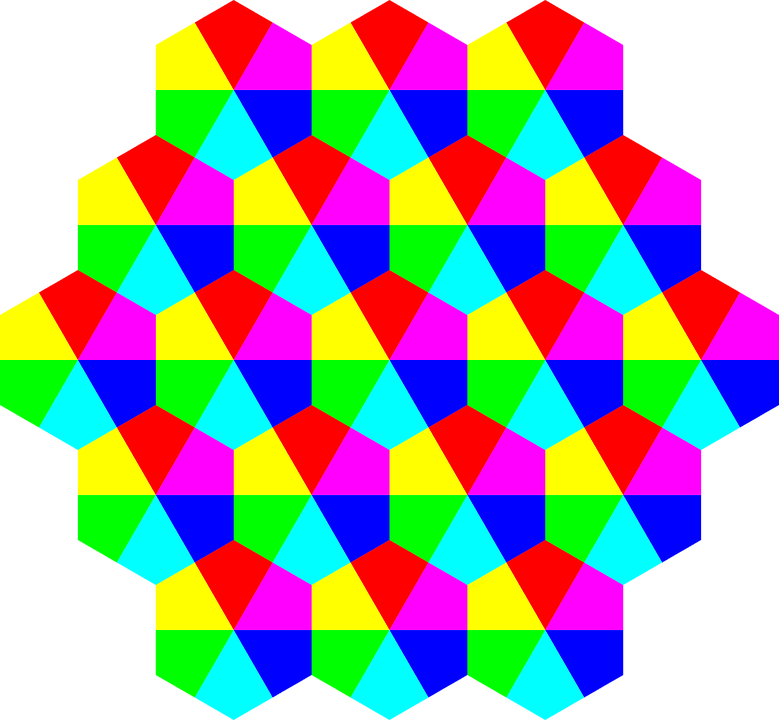
What shape makes up the tessellation in the image?

a)

Triangles

b)

Squares

c)

Hexagons

d)

Pentagons

143.

In a tessellation, the measures of the angles that meet at each vertex must add up to 360°.

a)

True

b)

False

144.

What shapes make up the tessellation in the image?

a)

Triangles and Squares

b)

Triangles and Rectangles

c)

Triangles and Triangles

d)

Triangles and Hexagons

145.

To decide if given figures will tessellate, we first look at the shapes' _____________________.

a)

number of sides

b)

interior angles

c)

number of vertices

d)

size

146.

This figure can always be used to tessellate, because its sum of internal angles is 360°.

a)

Triangle

b)

Quadrilateral

c)

Pentagon

d)

Hexagon

147.
Would the octagon and square tessellate?
a)
No; two octagons and one square would not meet at each vertex
b)
Yes; two octagons and one square meet at each vertex
135+135+90=360
c)
Yes; two octagons and one square meet at each vertex 130+130+100=360
d)
Yes; two octagons and one square meet at each vertex; 140+140+80=360
148.
Would the octagon and the equilateral triangle tessellate?
a)
Yes; two octagons and one triangle meet at each vertex; 150+150+60=360
b)
Yes; two octagons and one triangle meet at each vertex
135+135+60=360
c)
Yes; one octagon and two triangles meet at each vertex
135+60+60=360
d)
No; there is no combination of 135 and 60 that adds up to exactly 360
149.

Non-polygonal figures can also make tessellations.

a)

Yes, they can.

b)

No, they can't.

150.

M.C. Escher was an artist that used rotation, reflection and translation to make art. Are these pieces considered tessellations?

a)

Yes, they fill the gaps with no overlaps.

b)

No, they have gaps and overlaps.

151.

Can you find tessellations in nature?

a)

Yes, I can find them in nature.

b)

No, I can not find them in nature.

152.
A tessellation is...
a)
a repeating pattern 
b)
a repeating pattern with no overlaps
c)
a repeating pattern with no gaps or overlaps
d)
a repeating pattern with no gaps
153.
This figure is a tessellation.
a)
True
b)
False
154.

Which of these images represents a tessellation?

a)
b)
c)
d)
155.
Is this an example of a tessellation?
a)
Yes
b)
No
156.

The three polygons that can make a regular tessellation are the triangle, the square and the ___________.

a)

pentagon

b)

hexagon

c)

octagon

d)

decagon

157.

What shape makes up the tessellation in the image?

a)

Triangles

b)

Squares

c)

Hexagons

d)

Pentagons

158.

In a tessellation, the measures of the angles that meet at each vertex must add up to 360°.

a)

True

b)

False

159.

What shapes make up the tessellation in the image?

a)

Triangles and Squares

b)

Triangles and Rectangles

c)

Triangles and Triangles

d)

Triangles and Hexagons

160.

To decide if given figures will tessellate, we first look at the shapes' _____________________.

a)

number of sides

b)

interior angles

c)

number of vertices

d)

size

161.

This figure can always be used to tessellate, because its sum of internal angles is 360°.

a)

Triangle

b)

Quadrilateral

c)

Pentagon

d)

Hexagon

162.
Would the octagon and square tessellate?
a)
No; two octagons and one square would not meet at each vertex
b)
Yes; two octagons and one square meet at each vertex
135+135+90=360
c)
Yes; two octagons and one square meet at each vertex 130+130+100=360
d)
Yes; two octagons and one square meet at each vertex; 140+140+80=360
163.
Would the octagon and the equilateral triangle tessellate?
a)
Yes; two octagons and one triangle meet at each vertex; 150+150+60=360
b)
Yes; two octagons and one triangle meet at each vertex
135+135+60=360
c)
Yes; one octagon and two triangles meet at each vertex
135+60+60=360
d)
No; there is no combination of 135 and 60 that adds up to exactly 360
164.

Non-polygonal figures can also make tessellations.

a)

Yes, they can.

b)

No, they can't.

165.

M.C. Escher was an artist that used rotation, reflection and translation to make art. Are these pieces considered tessellations?

a)

Yes, they fill the gaps with no overlaps.

b)

No, they have gaps and overlaps.

166.

Can you find tessellations in nature?

a)

Yes, I can find them in nature.

b)

No, I can not find them in nature.