
 Worksheets
EHMS 8th Grade Final Exam Review 25-26
Total questions: 27
Worksheet time: 14mins
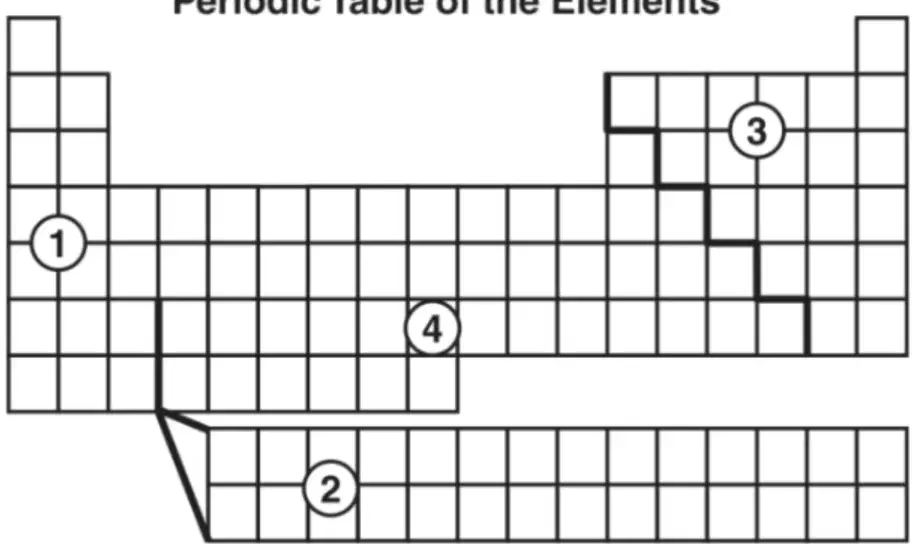
In which region of the table would nonmetals be found?
1
2
3
4
Nonmetals are classified based on their properties. The carbon element is classified as nonmetal because it displays the following properties...
is shiny, conducts electricity and heat, and has a low melting point.
is shiny, conducts electricity and heat and it has a high melting point.
is dull, does not conduct electricity and heat and it has a low melting point.
is dull, conducts electricity and heat, and has a high melting point.
Copper, Silver, and Gold are elements found on the periodic table. Tests involving these three elements would show that they are —
highly conductive metals that exhibit excellent malleability and ductility
poor conductors of electricity that are highly malleable and ductile
highly conductive metalloids that are malleable and ductile
all nonmetals that are malleable and conduct electricity
Nitrogen and nitrogen-containing compounds are involved in many different reactions. Which balanced equation represents a reaction that involves 6 atoms of nitrogen?
N₂ + 3H₂ → 2NH₃
4NH₃ + 3O₂ → 2N₂ + 6H₂O
3N₂ + 2O₂ → 2N₃O₂
Sodium bicarbonate, commonly known as baking soda or bicarbonate of soda, is a chemical compound with the formula NaHCO₃. How many different elements are in the compound sodium bicarbonate?
1
4
6
7
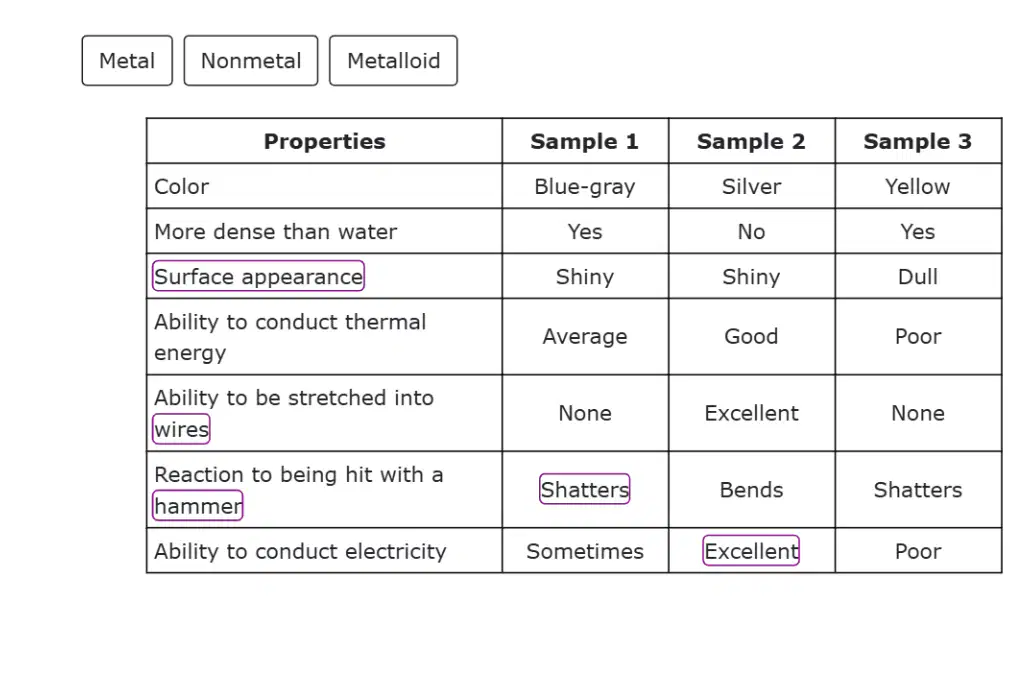
Students examined the properties of three different elements and recorded observations about their properties in the table. Based on the students' observations, classify each sample as a metal, nonmetal, or metalloid.
Metalloid
Sample 1
Metal
Sample 2
Nonmetal
Sample 3
The balanced equation below represents the reaction of NaOH with H3PO4. When 20 grams of NaOH reacts with 49 grams of H3PO4, 9 grams of water (H2O) is produced. How many grams of NaH2PO4 are produced?
11 grams
60 grams
69 grams
78 grams
Which of the following is a characteristic of ALL chemical changes?
A. A different state of matter is produced.
B. A new material is formed.
C. Some mass is converted to energy.
D. Some form of light is given off.
In making a pizza, which processes involve a chemical change? Select TWO correct answers.
mixing spices such as salt and pepper for the sauce
baking the dough to form the crust
spreading three different cheeses on the pizza
slicing circles of pepperoni for the topping
placing the pizza in the oven having the cheese melt and the pepperoni become crispy

In the chemical reaction shown below, all of the HCl and Zn will react to form H₂ and ZnCl₂. Reactants: 2HCl (hydrochloric acid, liquid) + Zn (zinc, solid) Products: H₂ (hydrogen, gas) + ZnCl₂ (zinc chloride, solid) Which of the following statements describes the result of this reaction?
The hydrogen gas will have a mass of zero
The zinc chloride will have less mass than the zinc
The mass of the products will equal the mass of the reactants
The mass of the hydrogen atoms will decrease in the products

The picture shows a girl skiing down a mountain. She is increasing her speed while skiing downhill. Which statements accurately describe the potential and kinetic energy of this skier?
Kinetic energy increases. Potential energy decreases.
Kinetic energy increases. Potential energy remains constant.
Kinetic energy remains constant. Potential energy decreases.
Kinetic energy remains constant. Potential energy increases.

In a distance-time graph, a horizontal line indicates that the object –
Is moving at a constant speed
Is speeding up
Is at rest
Is accelerating

A basketball player jumps off the floor, pushing down on the ground with their feet. According to Newton’s Third Law, what force allows the player to move upward?
Inertia
The downward force applied by the player’s feet
The reaction force exerted by the ground
The force of gravity

Which of Newton’s laws explains the player’s continued upward motion after their feet leave the ground until gravity pulls them back down?
Newton’s First Law
Newton’s Second Law
A student lets a toy car roll four times down a ramp that is 1 m long. Each time the student covers the surface of the ramp with a different material. The student measures the time it takes the car to roll down the ramp and records the results in the table below. Material | Time to Complete Ramp (s) W | 4 X | 8 Y | 7 Z | 5 Which of these would be the best conclusion based on the data in the table?
Different surfaces affect how fast a toy car accelerates.
Different toy cars travel at different speeds.
Gravity has little effect on the speed of toy cars on different surfaces.
Air resistance is the greatest factor in limiting the acceleration of different toy cars inoculated mice faster
A car travels 150 kilometers in 3 hours. What is the average speed of the car?
50
30
60
45
You push a 4 kg box with a force of 36 Newtons and it accelerates at 9 m/s2 . If you push a different box with a mass of 3 kg with the same force, what will be its acceleration?
12 m/s^2
9 m/s^2
15 m/s^2
6 m/s^2

Which of Newton’s Laws relates to the action of the rider on horse number two?
When an object is at rest, it will remain at rest.
The amount of force is equal to mass times acceleration.
For every action there is an equal and opposite reaction.
An object in motion continues in the same direction and speed.
When 30 grams of NaOH reacts with 48 grams of H3PO4, 9 grams of NaH2PO4 is produced. How many grams of water (H2O) are produced?
11 grams
60 grams
69 grams
78 grams

Calculate the acceleration of the 3 kg car by first finding the net force.
3 m/s²
4 m/s²
6 m/s²
12 m/s²
A student pushes against a wall with 20N of force and the wall does not move. In this situation, the wall exerts -
0N of force.
20N of force.
less than 20N of force.
more than 20N of force.
Net force is the sum of all forces acting on an object. Which of the following forces would result in a net force of 10 N to the right? Select THREE correct answers.
5 N to the right and 5 N to the left
10 N to the right and 0 N to the left
15 N to the right and 5 N to the left
8 N to the right and 2 N to the left
20 N to the right and 10 N to the left

What causes ocean tides on Earth?
The rotation of the Earth around the Sun
The gravitational pull of the Sun and Moon on Earth's oceans
The tilt of the Earth's axis
The wind patterns across the oceans

The moon remains in orbit around Earth because of the force of ________.
gravity
friction
magnetism
electricity
What is the primary reason Earth experiences different seasons throughout the year?
The tilt of Earth's axis as it revolves around the Sun
The Earth is closer to the Sun during summer
The Earth spins faster during certain months
The Moon's gravitational pull on Earth changes each season
Which of the following statements accurately describes the relationship between potential energy and kinetic energy?
Potential energy is always greater than kinetic energy
Kinetic energy is the energy stored due to an object's position
Gravitational potential energy increases as an object's height increases
Chemical potential energy cannot be converted to kinetic energy

Amusement park rides use both potential and kinetic energy. When the coaster is at the top of a hill, it has ----
Only kinetic energy
Only potential energy
Both kinetic and potential energy
No energy at all

