wayground logo

Free Printable Worksheets

Font size

S
M
L
XL
Worksheets

Final Exam Review 2- 4th Quarter

Total questions: 52

Worksheet time: 3hrs 36mins

Name
Class
Date
1.
Boyle's law :  The pressure and volume of a gas show a _____ relationship. 
a)
No relationship 
b)
Direct 
c)
Inverse 
d)
Equal
2.
You have a gas that has a pressure of 2 ATM and a volume of 10L.  What would be the new volume if the pressure was changed to 1 ATM?
a)
5 L
b)
20 L
c)
It would stay at 10L
d)
1 L
3.
In order to convert to Kelvin, you add ______ to the Celsius measurement.
a)
372
b)
273
c)
237
d)
732
4.
If 200 mL of a gas at 27°C is cooled to -33°C at a constant pressure, the volume will be
a)
250 mL
b)
204 mL
c)
196 mL
d)
160 mL
5.
The following graph shows ____ relationship. 
a)
Direct
b)
Inverse
6.

A student measures the pressure and volume of an empty water bottle to be 1.4 atm and 2.3 L. She then decreases the pressure to 0.65 atm. What is the new volume?

a)

2.1 L

b)

5.0 L

c)

8.2 L

d)

3.9 L

7.

What is the pressure of a car tire that had an initial pressure of 1.8 atm but was heated from 38°C to 123°C?

a)

0.9 atm

b)

2.1 atm

c)

1.6 atm

d)

3.4 atm

8.
Charles' Law States...
a)
As Pressure goes up volume goes down
b)
As Pressure goes up temperature goes up
c)
As Volume goes up temperature goes up 
d)
As Pressure goes down volume goes down 
9.

How many moles of NH3 are in a 96.74 L container at 5.762 atm and 998.7 K?

a)

5.92 mol

b)

6.80 mol

c)

7.35 mol

d)

8.43 mol

10.

A 8.33 mol sample of BF3 is in a 34.22 L container. What is the pressure of this gas in atmospheres at 239.5 K?

a)

4.79 atm

b)

5.12 atm

c)

5.93 atm

d)

6.41 atm

11.

The pressure of a 1.43 mol sample of O2 in a 71.644 L container is measured to be 4.7008 atm. What is the temperature of this gas in kelvins?

a)

2070 K

b)

2380 K

c)

2470 K

d)

2880 K

12.
Hydrogen bonding occurs when hydrogen is bonded to N, O, or F.  Which of the following has hydrogen bonding?
a)
CBr4
b)
NO2
c)
H2S
d)
NH3
13.
Does CH4 have hydrogen bonding?
a)
yes
b)
no
14.

Intermolecular forces for: CO2

a)

London Dispersion Force

b)

Dipole dipole

c)

Hydrogen bonding

15.
Type of intermolecular force present in I2, Br2, and Cl2.
a)

dipole dipole

b)

H-bond

c)

London Dispersion Forces

d)

metallic

16.
H2S has what kind of intermolecular force?
a)

dipole dipole

b)

London Dispersion Force

c)

H-bond

d)

ionic

17.
Intermolecular forces are the forces
a)
within molecules
b)
between molecules
18.
Type of intermolecular force present in HF.
a)

dipole dipole

b)

London Dispersion Force

c)

H-bond

d)

ionic

19.
Intermolecular force present in HCl?
a)

dipole dipole

b)

London dispersion forces

c)

H-bond

d)

ionic

20.

What is the volume of 5 moles of Ne gas?

a)

20 Grams

b)

22.4 Liters

c)

448 Liters

d)

112 Liters

21.

If 50 Liters of Cl2 gas was used, how much O2 was produced? 2 Fe2O3+6 Cl2  4 FeCl3+3 O22\ Fe_2O_3+6\ Cl_{2\ }\rightarrow\ 4\ FeCl_3+3\ O_2  

a)

22.4 L of O2

b)

25 L of O2

c)

1.12 L of O2

d)

20 L of O2

22.

If 3.6 * 10 ^ 24 molecules of H2 were used in a reaction, how many liters of N2 were needed?

N2(g)+3H2(g)  2 NH3(aq)N_2\left(g\right)+3H_2\left(g\right)\ \rightarrow\ 2\ NH_3\left(aq\right)  

a)

22.4 mol of N2

b)

2 mol of N2

c)

44.8 mol of N2

d)

44.8 L of N2

23.

William was conducting a science experiment and found that a certain substance had a pH less than 7. This substance is likely a(n) ______.

a)

Acid

b)

Alkaline

c)

Base

d)

Buffer

24.

David was conducting a science experiment and found a substance with a pH greater than 7. This substance is a(n) _______.

a)

Base

b)

Acid

c)

Buffer

d)

Water

25.
What is a property of bases?
a)
Slippery touch
b)
Sour taste
c)
Ability to dissolve metal
d)
Ability to form hydronium ions
26.
How do acidic solutions taste?
a)
Delicious
b)
Sweet
c)
Bitter
d)
Sour
27.
If the pH of a solution is 5 the [H+] is
a)
1.0 x 10 M
b)
1.0 x 10 M
c)
5.0 x 10 M
d)
1.0 x 10⁻⁵  M
28.
If the pH of a solution is 5.6 the pOH is
a)
6.5
b)
12.4
c)
8.4
d)
5.6
29.
A  pH and a pOH will add up to:
a)
0
b)
7
c)
14
d)
1.0 x 10⁻¹⁴
30.
If the [H3O+] of a solution is 1 x 10⁻⁸ mol/L the [OH-] is
a)
1.0 x 10⁻⁶
b)
1.0 x 10⁶
c)
1.0 x 10⁻⁸
d)
1.0 x 10⁸
31.
If the [H+] of a solution is 6.8 x 10⁻⁹ mol/L the pH is
a)
8.17
b)
8.2
c)
9.99
d)
8.62
32.

An Arrhenius base:

a)

donates H+

b)

accepts H+

c)

produces H+

d)

produces OH-

33.

An Arrhenius acid:

a)

donates H+ to another substance

b)

accepts H+ from another substance

c)

produces H+

d)

produces OH-

34.

A Bronsted Lowry acid:

a)

donates H+ to another substance

b)

accepts H+ from another substance

c)

produces H+

d)

produces OH-

35.

A Bronsted Lowry base:

a)

donates H+ to another substance

b)

accepts H+ from another substance

c)

produces H+

d)

produces OH-

36.

In the equation below, what is the Bronsted Lowry acid?

HCl + NH3 --> Cl- + NH4+

a)

HCl

b)

NH3

c)

Cl-

d)

NH4+

37.

In the equation below, what is the Bronsted Lowry base?

HCl + NH3 --> Cl- + NH4+

a)

HCl

b)

NH3

c)

Cl-

d)

NH4+

38.

Label the acid, base, conjugate acid and conjugate base.

39.

 6 CO2+ 6 H2O + Energy  C6H12O6 + 6 O26\ CO_2+\ 6\ H_2O\ +\ Energy\ \rightarrow\ C_6H_{12}O_6\ +\ 6\ O_2 

a)

endothermic reaction

b)

exothermic reaction

40.

 O2(g) + 2 H2 (g)  2 H2O (g) + EnergyO_2\left(g\right)\ +\ 2\ H_2\ \left(g\right)\ \rightarrow\ 2\ H_2O\ \left(g\right)\ +\ Energy  

a)

endothermic

b)

exothermic

41.

In an endothermic reaction, energy is _________.

a)

absorbed

b)

released

42.

During an exothermic reaction, heat is _________ and chemical bonds __________.

a)

released, formed

b)

absorbed, broken

c)

released, broken

d)

absorbed, formed

43.
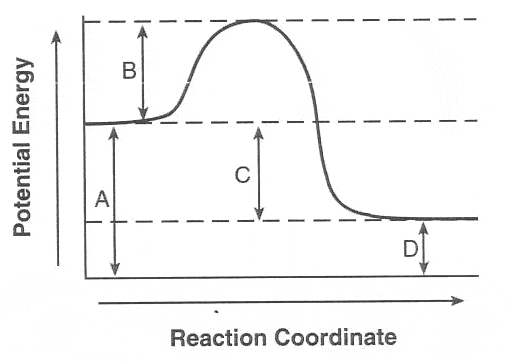
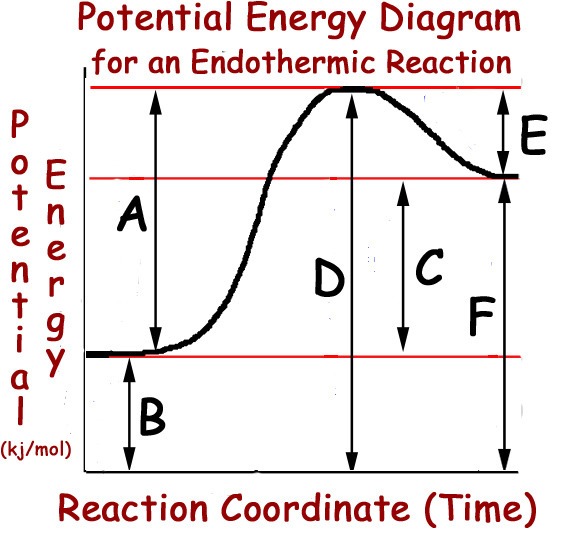
What letter represents the energy of the products?
a)
A
b)
B
c)
C
d)
D
44.
What letter represents the energy of the products?
a)
A
b)
B
c)
C
d)
D
45.
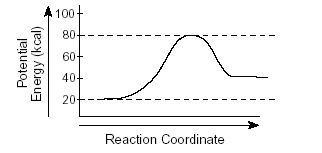
Is this reaction endothermic or exothermic?
a)
endothermic 
b)
exothermic
46.

What is the ΔH of this reaction?

a)

40 kJ

b)

20 kJ

c)

80 kJ

d)

-60 kJ

47.

The graph above represents the data collected under certain conditions for the decomposition of N2O4(g) according to the chemical equation above. Based on the graph, at approximately which time is equilibrium established?

a)

At time A, because N2O4(g) is expanding to fill the container.

b)

At time B, because the reaction is reversible and [NO2] = [NO4].

c)

At time D, because there are no observable changes in [NO2] and [NO4].

d)

At time C, because the reaction is about to reach completion and [NO2] > [NO4].

48.
This symbol indicates that a reaction is ____________
a)
reversible
b)
irreversible
49.
When the system X + 2 Y <=> Z has reached equilibrium, which of the following is TRUE?
a)
Forward reaction and Backward reaction stop.
b)
Forward reaction has sped up and backward reaction has slowed down.
c)
Forward and backward reactions occur at the same rate.
d)
Forward reaction has slowed down and backward reaction has sped up.
50.

Any reaction that involves the particles in the nucleus of an atom are called ________?

a)

Fission

b)

Nuclear Reaction

c)

Fusion

d)

Particle Accelerator

51.
Takes two small nuclei and combines them into a larger nucleus
a)
fission
b)
fusion
52.
The splitting of a nucleus into smaller nuclei is
a)
fusion
b)
fission
c)
half-life
d)
gamma radiation