
 Worksheets
A1P1 Final Exam
Total questions: 228
Worksheet time: 19hrs 0mins
Select all: Natural Numbers
4.5
5
-2
0
7,652
Select all: Integers
4.2
4
-4.2
4/3
-2
Select all: Which categories does the number 3.7 belong to?
Real numbers
Rational numbers
Integers
Whole numbers
Natural numbers
Select all: Which categories does the number zero belong to?
Rational number
Integer
Whole number
Natural number
Which of the following is NOT an irrational number?
16
5.58703...
96
π
Which of the following is NOT a natural number?
12
3,000
5
0
Classify the following: -78
Integer
integer, real
integer, whole, rational
integer, rational, real
1,378,472,706 can best classified as what?
natural, whole, integer, rational
whole, integer, rational
rational
natural, whole, integer, rational, real
Pi is an example of which type of number?
Irrational number
Natural number
Unnatural number
Fraction
Classify the following number: 1.01276894...
Rational
Irrational
Classify the following: 13
Natural, whole, integers rational, real
Whole
Whole, natural
What type if number is 2 ?
Integer
Rational Number
Irrational Number
Whole Number
What type of number is 3.5 ?
Integer
Rational Number
Irrational Number
Natural Number
5+1 = 1+5
Commutative Property of Addition
Associative Property of Addition
Inverse Property of Addition
Distributive Property
(5•2) • 4 = 5 • (2•4)
Commutative Property of Multiplication
Associative Property of Multiplication
Transitive Property
Symmetric Property
9 + 0 = 9
Reflexive Property
Distributive Property
Identity Property of Addition
Inverse Property of Addition
12⋅121=1
Identity Property of Multiplication
Associative Property of Multiplication
Commutative Property of Multiplication
Inverse Property of Multiplication
π⋅0=0
Property of Zero
Distributive Property
Reflexive Property
Symmetric Property
2(a+c) = 2a+2c
Transitive Property
Distributive Property
Symmetric Property
Commutative Property of Multiplication
t = t
Substitution Property
Transitive Property
Reflexive Property
Symmetric Property
4x+3 = 15 , 15 = 4x+3
Transitive Property
Substitution Property
Reflexive Property
Symmetric Property
If x+y = 4 and 4 = 3+1, then x+y = 3+1
Transitive Property
Reflexive Property
Symmetric Property
Substitution Property
(x•y) • z = z • (x•y)
Associative Property of Multiplication
Commutative Property of Multiplication
Multiplicative Inverse Property
Identity Property of Multiplication
a² + (b² + c²) = (a² + b²) + c²
Commutative Property of Addition
Zero Property
Associative Property of Addition
Identity Property of Addition
-x + x = 0
Additive Inverse Property
Identity Property of Addition
Commutative Property of Multiplication
Associative Property of Addition
(x + y) • 0 = 0
Substitution Property
Distributive Property
Zero Property
Inverse Property of Multiplication
xyz = xyz
Symmetric Property
Reflexive Property
Substitution Property
Transitive Property
q + p = 0 , 0 = q + p
Transitive Property
Reflexive Property
Symmetric Property
Substitution Property
If s = d and d = -12, then s = -12
Transitive Property
Symmetric Property
Multiplicative Inverse Property
Reflexive Property
42+15÷3
Which operation do you need to solve first?
Addition
Division
Exponent
Evaluate the following expression:
42+7×2
(a)
Solve: 70÷5−23
6
8
27
14

Addition ALWAYS comes before subtraction.
Who is correct?
Sallie
16÷2×8=64
Brian
16÷2×8=1
Sallie
Brian
Neither
Both
Solve: 5−2(23−5)
-1
3
-9
9
Which mathematical operation would I perform first?
52
20−4
8÷2
4+5
Evaluate:
[14+4 ⋅(3 ⋅ 2)]÷2
50
18
40
19
Evaluate the following expression:
15−9÷336−3⋅4
(a)
Evaluate the following expression:
18−421+3⋅5−∣−11∣
(a)
if a = 5, then a2+4 =
5
-5
21
29
if b =−1, then 2+b=
1
3
-1
10
if c=2 and d=1, then 35c −d=
11/3
3
-2
5
if f=3, then 6f2+f=
2
4
-2
12
Evaluate the following expression when x = -2, y = -1, and z = 5
(2z−4)2−x−3y
41
35
11
50
(6−2a)−b2+3c
Evaluate the expression when
a = 2, b = -3, and c = 4
(a)
Evaluate the following expression if w = -1, x = 6, and y = -3:
2y−5w
(a)
Evaluate the following expression if w = -1, x = 6, and y = -3:
2∣y∣−x2
(a)
Evaluate the following expression if w = -1, x = 6, and y = -3:
−x2−7xy+w3
(a)
BONUS: Evaluate the following expression:
7[42−65+(23−18)+16÷8]
(a)
What is the first step in solving a multi-step equation?
Distribution (If necessary)
Combine Like Terms (if necessary)
Move Variable Terms
Move the constant
What is the second step in solving a multi-step equation?
Distribution (if necessary)
Combine Like Terms (if necessary)
Move Variable Terms
Solve! With SADMEG (reverse order of operations)
What is the first step in solving this equation?
2a - 4(a - 5) = 10
(read ALL answer choices before answering)
Add 4 to both sides
Add the 2a and a
Distribute 4 into the parentheses. This means you will do 4 times a and 4 times -5 and end up with 2a + 4a -20 = 10
Distribute -4 into the parentheses. This will mean you will do (-4 time a) and (-4 times -5) and end up with 2a -4a + 20 = 10
Solve: 10x+9=4x−9
(a)
Solve: x−6=18−2x
x=8
x=−8
x=12
x=4
Solve: 8v−4(v+8)=8
v=2
v=10
v=4
v=−4
Solve: 2(x+3)=8
x=2.5
x=1
x=7
x=5.5
solve for m:
32(9m−6)=20m=4
m=3
m=2
m=8
−5(4x − 2) = −2(3 +6x)
x = 2
x = 8
x = −2
x = −8
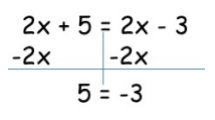
Solve the equation:
3x + 15 = 3(x + 5)
no solutions
x = 15
infinitely many solutions
x = 5
8x + 38 = -3 (-6 - 4x)
no solutions
infinite solutions
one solution
Simplify each equation. Tell whether the equation has one, no, or infinite solutions.
3x - 8 = 3(x - 4) + 1
one
no solutions
infinite solutions
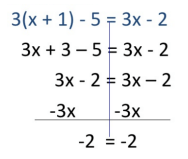
Combine like terms and solve for b.
50=−10−4b+5−b
(a)
Solve
-19 = -8 (-4+a) - (2a+1)
-1
14
-5
5
3x + 2(4x - 4) = 3
What is the solution to the equation?
(a)
Jacob solved the following equation using the steps shown.
Step 1 5x + 9 = 2x - 3
Step 2 3x + 9 = -3
Step 3 3x = -12
Step 4 x = -4
What operation did he perform to get from Step 1 to Step 2?
Subtracted 2x from both sides of the equation
Subtracted 9 from both sides of the equation
Multiplied both sides of the equation by 3
Added -3 to both sides of the equation
4(2p−5)=−18−2(1−4p)
p=1
p=−20
No Solution
Infinite Solutions
Solve:
6(y + 4) = 6y + 10
y = 10
y = 24
infinitely many solutions
no solutions
What is the first step in the equation:
2x - 3 + 4x = 27
Combine Like Terms
Add 3 on both sides
Divide by 2 on both sides
Subtract 4x from both sides
What is the second step to solve the equation:
2x - 3 + 4x = 27
Divide everything by 2
Add 3 to both sides
Divide everything by 6
Subtract 3 to both sides
What is the last step to solve the equation:
2x - 3 + 4x = 27
Add 4 on both sides
Subtract 6 from both sides
Subtract 27 from both sides
Divide by 6 on both sides

What is the first step in solving this equation?
subtract 3 to both sides
subtract the 6 - 2
distribute 2
distribute -2

What will the equation look like after you combine like terms?
-5x + 5 = 35
x + 5 = 35
5x + 5 = 35
-x + 5 = 35
Which step is incorrect?
120 = -4(7a+2)
Step 1: 120 = -28a - 8
Step 2: 112 = -28a
Step 3: a=-4
Problem is correct
step 1
step 2
step 3
-5(2b + 2) = -3b - 5(b + 10)
2
20
-2
-20
8
Solve the equation 4(5x + 2) + 11 = 18x + 3
-8
-32
8
-16
subtract
multiply and divide only
multiply by a negative number
multiply or divide by a negative number
4(8a−6)+a<108
what is your first step?
add 6 to both sides
distribute 4 to the quantity (8a-6)
add a to both sides
combine 8a-6 to get 2
4(8a−6)+a<108
what is the solution to the inequality?
a<132
a>4
a<33
a<4

When writing a solution in interval notation, what brackets do i use for:
> or <
[ ]
( )
When writing in interval notation, what kind of brackets do I use for:
or ≤ or ≥
[ ]
( )
When graphing an inequality solution, what type of circle do I draw for the symbol:
> or <
open circle
closed circle
When graphing an inequality solution, what type of circle do I draw for the symbol:
or ≤ or ≥
Closed Circle
Open Cirlce

What interval notation does this graph represent?
[∞, -5)
(∞, -5)
[-5, ∞)
(-5, ∞)
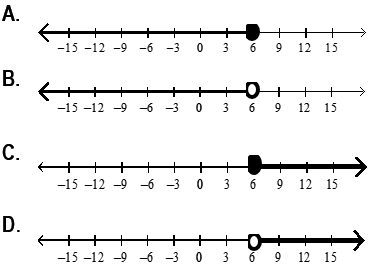
Which graph represents (-∞,6) ?
A
B
C
D
In interval notation, +∞ and -∞ gets what symbol?
( ) Parentheses
[ ] Square Brackets
{ } Braces
Write x ≥ 100 in interval notation
(0, 100]
(∞, 100]
[100, ∞)
(∞, 100)
Write x ≥ -3 in interval notation:
[ -3, ∞ )
( -3, ∞ )
( -∞ , -3 )
( -∞ , -3]
( ∞ , -3 ]


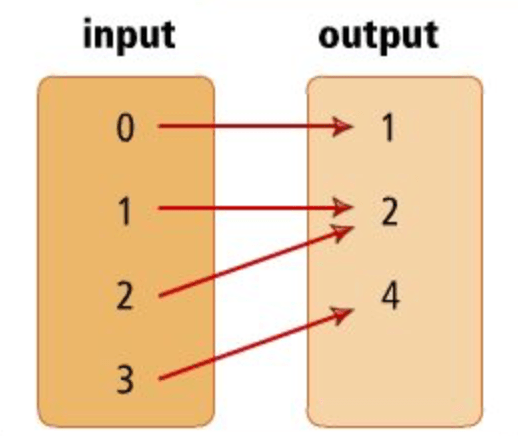
Which relation does the mapping show?
{(0, 1), (1, 2),(3, 4)}
{(1, 0), (2, 1), (2, 2), (4, 3)}
{(0, 1), (1, 2), (2, 2), (3, 4)}
{(1, 0), (2, 1), (4, 3)}
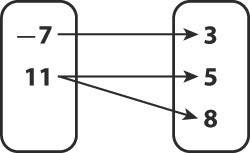
Is the relation shown a function?
No, because the x-value 11 is paired with 5 and 8.
Yes, because each x-value has only one y-value paired with it.
What is the domain of a relation?
the set of all x-values
the set of all y-values
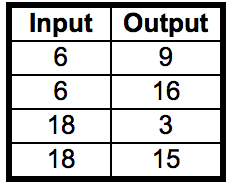
What is the domain of the relation shown in the table?
{12}
{6, 18}
{3, 9, 15, 16}
{13}


What is the domain of the graph?
[-3, 3]
(3, -3]
(-3, 3)
(2, 10]

What is the DOMAIN of this graph?
-4 ≤ x ≤ 3
-1 ≤ x ≤ 4
4 < x < 3
-1 < x < 4

What is the domain of the graph?
undefined
{x:−3≤x≤3}


Find the Domain.
(3, +∞)
(0, +∞)
[0, +∞)
Which is the set of all y-values or the outputs?
Domain
Range
Relation
Function
What is the range of the mapping?
{1, 2, 4}
{0, 1, 2, 3}
{0, 3}
{1, 4}
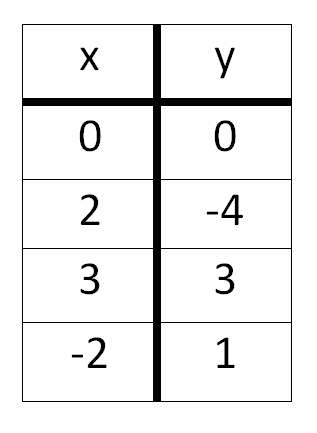
What is the range of the table?
{-4, 0, 1, 3}
{-2, 0, 2, 3}
{-4, -2, 0, 1, 2, 3}
{ (0, 0), (2, -4), (3, 3), (-2, 1) }


What is the range of this function?
{y| -6 ≤ y ≤ 3}
{y| -6 < y < 3}
{y|y = all real numbers}
{y| -2 ≤ y ≤ 4}

What is the Range?
All real numbers
y ≥ 3
y > 3
3 ≤ y ≤ 8

What is the range of the function?
{y: −1≤y<+∞}
{y: −1<y<1}
{y: 1.5≤y<+∞}
{y:−1≤y≤1.5}
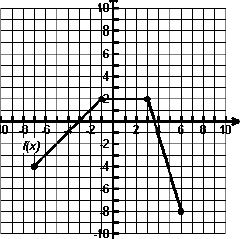
What is the range of the function?
-7≤x≤6
-7<x<6
-8<y<2
-8≤y≤2
R: {0, 1, 2, -4}
R:{1, -3, -4}
R:{1, -3, -4}
What is the domain of the relation {(5,-6),(1,6),(-3,-4),(-5,-5}?
{-5,-3,1,5}
{-6,-5,-4,6}
{-5,-3,1,-5}
{-5,-4,6}


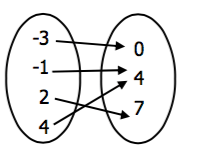
Which relation has a domain of {3,7} and a range of {0,5} ?
(3,5), (3,7), (0,5), (0,3)
(3,0), (7,0), (3,5), (7,5)
(3,0), (3,5), (3,7), (7,5)
(7,0), (5,7), (3,5) (7,5)

What is the range of the given function?
[-1, 1]
(-1, 1)
(∞, -∞)
(-∞, ∞)

What is the domain of the graphed function?
0 ≤ x ≤ 4
All positive real numbers
All real numbers
0undefined yundefined 4

What is the range?
[-3, infinity)
[-1, infinity)
(-infinity, infinity)
(-infinity, -1]

The first number in an ordered pair is...
the larger number.
the origin.
the x-coordinate.
the y-coordinate.

The point where the two axes intersect in known as...
the center.
the relation.
the intersection.
the origin.

What is the domain of this graph?
D = { 2,3,-5,-3,-3,-5}
D = {-5, -3, 2 }
D = {-5, -3, 3}
D = {-5, -3}
What is the range of this graph?
R = { 2,3,-5,-3,-3,-5}
R = {-5, -3, 2 }
R = {-5, -3, 3}
R = {-5, -3}

The left grouping in a mapping is the...
domain.
range.
y-axis.
relation.

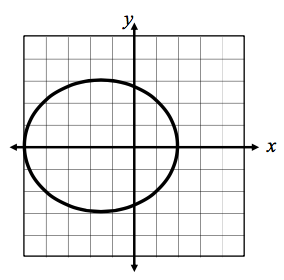
Which graph is NOT a function? (It does NOT pass the vertical line test.)
Graph 1
Graph 2
Graph 3
Graph 4
{(-1,2), (-2,4), (2,5), (0,-2), (2,0)}

Is the relation a function? Why or why not?
Yes, because the x-value 11 has two y-values paired with it.
Yes, because each x-value has only one y-value paired with it.
No, because the x-value 11 has two y-values paired with it.
No, because each x-value has only one y-value paired with it.


R: {0, 1, 2, -4}
R:{-4, -3, 1}
R:{1, -3, -4}


How would you write y = 2x - 3 in function notation?
y = 2x-3
f = 2x - 3
f(x) = 2x-3
Translate the function notation into a coordinate point.
f(−1)=5
(−1,5)
(1,5)
(5,1)
(5,−1)
Translate the coordinate pair into function notation.
f(0)=8
f(0)=−8
f(8)=0
f(−8)=0
Find g(-5)
g(10) = ______
Let
h(x)=13−5xWhat is h(5)= ?
h(5)=12
h(5)=3
h(5)=−2
h(5)=−12
If h(x) = 3 - 2x2, find h(-3).
33
21
39
-15

What is f(1)?
1
5
0
4

What is f(8)?
8
0
3
-2

f(x) = -2?

f(4)
(a)

m(12)
(a)

h(-18)
(a)

f(x)=-10 what does x = ?
(a)

m(x) = -7, x = ?
(a)

f(5) – h(4) =
(a)

g(-5) + h(-3) =
(a)
f(1) · g(1) =
(a)
Evaluate the function for f(9) if f(x)=53x+8 .
567
−513
−567
513
If
f(x)=3x−12 and f(x)=−6 what is the value of x?12
-6
24
2
If f(x)=21x2−(41x+3) , what is the value of f(8)
11
17
27
33
The function B(x) = 8x + 25 represents the cost (in dollars) of renting a bicycle for x days.
What is the cost of renting a bicycle for 5 days?
$65
$40
$125
$57
The function B(x) = 8x + 25 represents the cost (in dollars) of renting a bicycle for x days.
Explain the meaning of B(13)=129
The cost of renting the bicycle for 13 days is $129.
The cost of renting the bicycle for 129 days is $13.
The cost of renting the bicycle for 8 days is $129.
The cost of renting the bicycle for 129 days is $25.

The function R represents the rain total rainfall, in cm, after x hours. The graph of the function is shown.
What was the rainfall after 2 hours?
1 cm
3 cm
4 cm
5 cm
The function R represents the rain total rainfall, in cm, after x hours. The graph of the function is shown.
After how many hours was the rainfall 2 cm?
1 hour
2 hours
3 hours
4 hours
Write the linear function that has
p(−4)=−82 and p(12)=6f(x)=5x+6
p(x)=5.5x−60
p(x)=10x−8
p(x)=−10.5x−80
Given that y = x+3
Find the value of y when x = - 2
-1
1
5
-5
If y=4x+5, what does y equal when x is 4?
21
-11
-31
25

y=x-6
What is the missing number?
12
10
14
13


Fill in the table.
A= (a)
Fill in the table.
B= (a)
Fill in the table.
C= (a)
Fill in the table.
D= (a)
Find the range of the function y = 10x + 7 when the domain is {-1, 0, 1}.
{-3, 7, 17}
{3, 0, 10}
{-7, 7, 17}
{0, 1, 2}

Which equation matches the table?
y = x + 5
y = 5x
y = x - 5
x = y - 5

Which table of values can be defined by y=2x+1?
A
B
C
D

Which table of values can be defined by y=x+5?
A
B
C

Which equation matches the table?
y = 3x + 9
y = x + 9
y = x + 3
y = 12x - 3

Which table is correct for y=−23x+5 ?


How would you write y = 2x - 3 in function notation?
y = 2x-3
f = 2x - 3
f(x) = 2x-3
Translate the function notation into a coordinate point.
f(−1)=5
(−1,5)
(1,5)
(5,1)
(5,−1)
Translate the coordinate pair into function notation.
f(0)=8
f(0)=−8
f(8)=0
f(−8)=0
Find g(-5)
g(10) = ______
Let
h(x)=13−5xWhat is h(5)= ?
h(5)=12
h(5)=3
h(5)=−2
h(5)=−12
If h(x) = 3 - 2x2, find h(-3).
33
21
39
-15
What is f(1)?
1
5
0
4
What is f(8)?
8
0
3
-2
f(x) = -2?
f(4)
(a)
m(12)
(a)
h(-18)
(a)
f(x)=-10 what does x = ?
(a)
m(x) = -7, x = ?
(a)
f(5) – h(4) =
(a)
g(-5) + h(-3) =
(a)
f(1) · g(1) =
(a)
What do zeros (of a function) represent?
how much you care about functions
the place that the function crosses the x axis/ the x value that makes the whole function equal to zero
the place that the function crosses the y axis/ the y value where x=0
the number zero


Which of the following is NOT an x-intercept of the function.
x = -1
x = 2
x = 4
x = 5

What are the zeros of the function f(x)= -4(x - 3)(x+5)?
-12 and 20
-5 and 3
-4 and -5
-3 and 5
How many (real) zeros does the function p(x) = 3x4+4x-8 have?
HINT: Graph the function!
1
2
3
4

