
 Worksheets
7th Grade Semester 2 Exam
Total questions: 70
Worksheet time: 35mins
Name
Class
Date
1.
Anything with mass that takes up space is -
a)
living
b)
matter
c)
liquid
d)
gas
2.
What object has a definite shape and volume?
a)
solid
b)
liquid
c)
gas
d)
none of the above
3.
Matter is anything that has __________ and takes up ____________.
a)
mass, space
b)
space, mass
c)
weight, gravity
d)
gravity, space
4.
Volume is the amount of ___________ an object takes up. (only type the missing word)
a)
gravity
b)
space
c)
mass
5.
Chemistry is the study of __________.
a)
matter
b)
rocks
c)
organisims
d)
none of the above
6.
True or False: Oxygen is an example of matter.
a)
True
b)
False
7.
True or False: Everything around us is made of matter.
a)
True
b)
False
8.
What are the characteristics of a solid? It has a _____________ shape and a definite ____________.
a)
indefinite volume
b)
definite color
c)
indefinite color
d)
definite, volume
9.
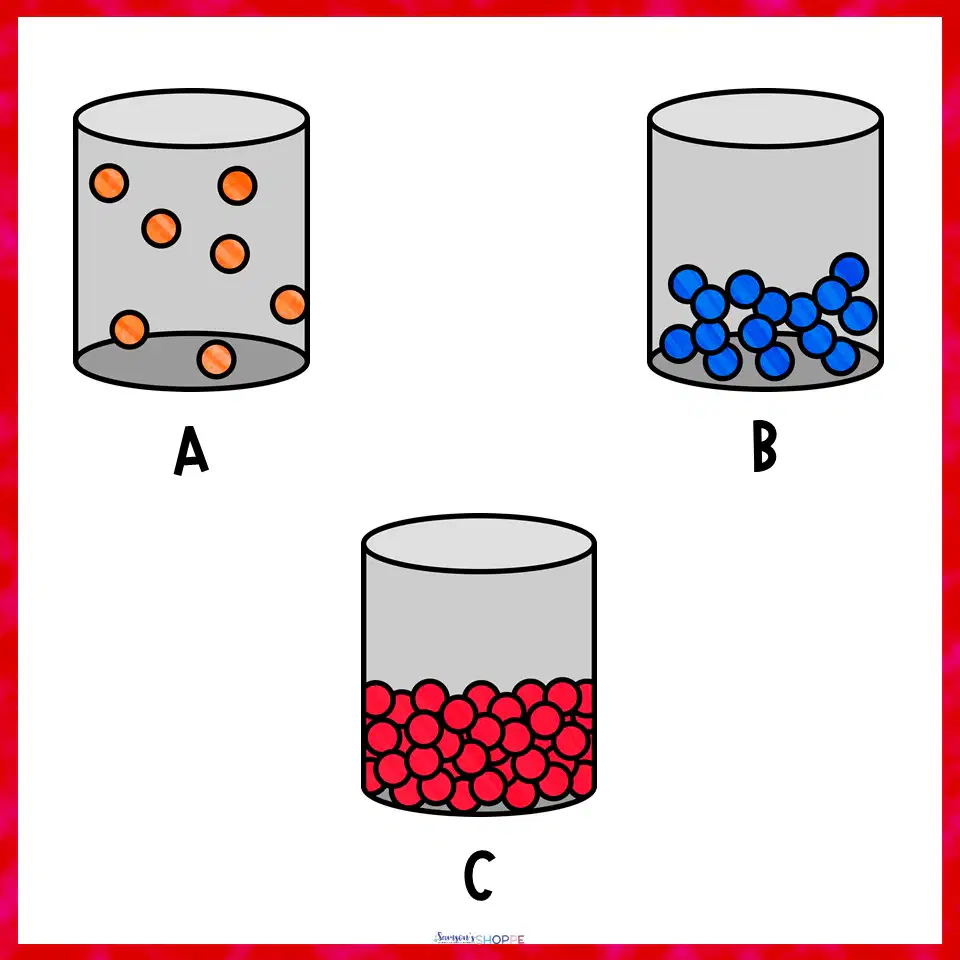
9. Which illustration shows the particles of a solid?
a)
A
b)
B
c)
C
10.
The particles of a solid vibrate in place.
a)
True
b)
False
11.
There is water inside your water bottle. Identify the solid.
a)
water
b)
water bottle
c)
CO2
12.
True or false: A shirt is an example of a solid because even though it changes shape, it keeps a shape.
a)
true
b)
false
13.
A liquid ____________ have a definite shape but has a __________ volume.
a)
does not, definite
b)
does, definite
c)
does not, indefinite
d)
does, indefinite
14.
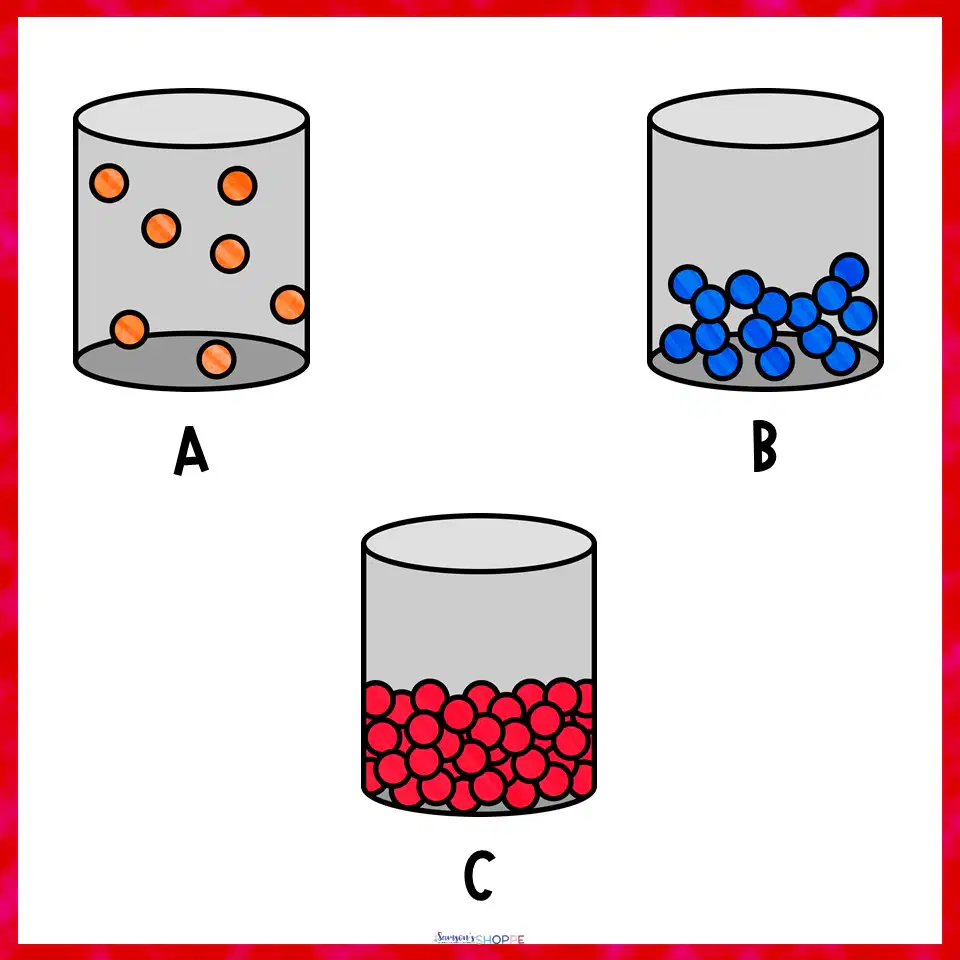
Which illustration shows the particles of a liquid?
a)
A
b)
B
c)
C
15.
The water in your water bottle won't keep its shape if it spills out. What is the water missing?
a)
shape
b)
volume
c)
color
16.
True or false: Liquid molecules have more room to slide past one another which is why they can easily change shape.
a)
True
b)
False
17.
Is neon, gasoline, or skin an example of a liquid?
a)
neon
b)
gasoline
c)
skin
18.
Characteristics of a gas include that it __________ have a definite shape or volume
a)
does
b)
does not
19.
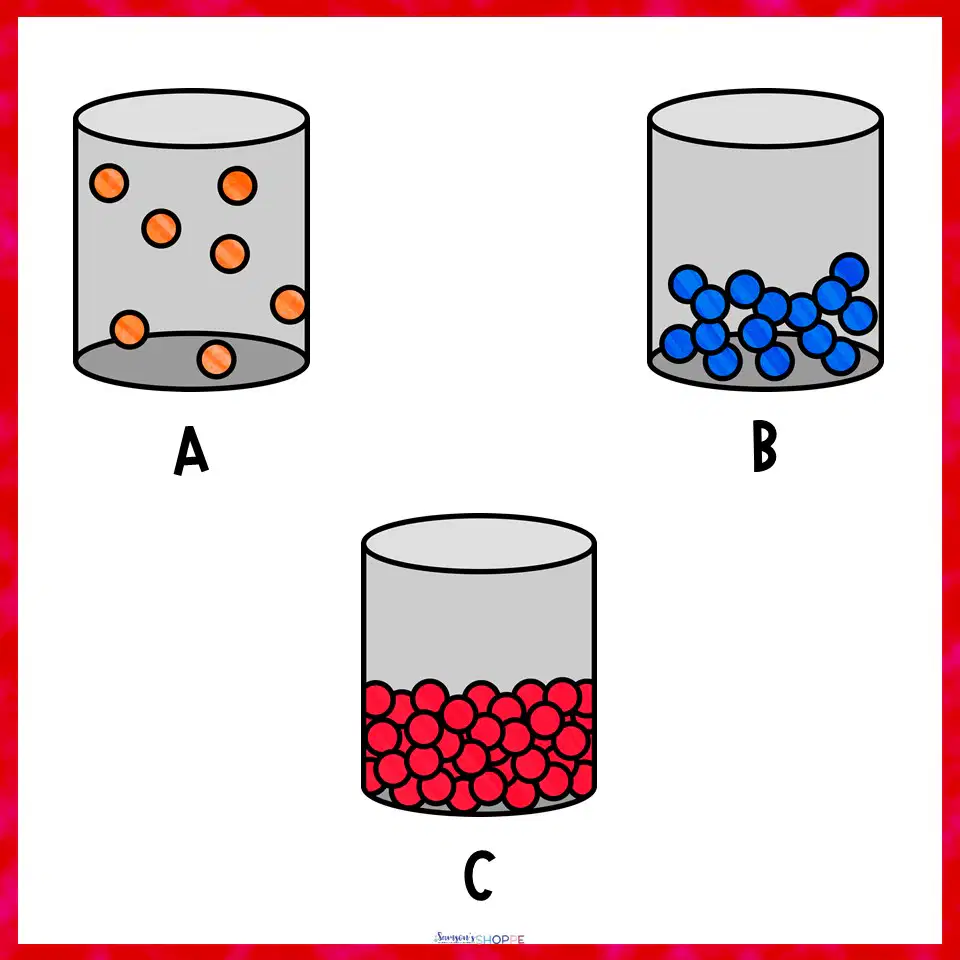
Which illustration shows the particles of a gas?
a)
A
b)
B
c)
C
20.
Particles of a gas move _____________ and have a lot of room to move past one another.
a)
slowly
b)
quickly
21.
True or false: A container can be half full of gas.
a)
true
b)
false
22.
Which is an example of a gas? Helium, gasoline, or photosynthesis
a)
helium
b)
gasoline
c)
photosynthesis
23.
Matter can change forms.
a)
True
b)
False
24.
A liquid changing to a gas is an example of...
a)
evaporation
b)
condensation
c)
sublimation
25.
A gas changing to a liquid is called...
a)
evaportion
b)
condensation
c)
freezing
d)
sublimation
26.
Temperature causes matter to change.
a)
True
b)
False
27.
Ice can become water and then become water vapor when the temperature decreases.
a)
True
b)
False
28.
Which object has a definite volume, but not a definite shape?
a)
solid
b)
liquid
c)
gas
d)
none of the above
29.
All of the following are examples of solids, except -
a)
table
b)
chair
c)
pencil
d)
lemonade
30.
All of the following are examples of gases, except -
a)
air
b)
steam
c)
ice
d)
carbon dioxide
31.
Select all of the following listed below if it is evidence that a chemical reaction has occurred.
a)
Color Change
b)
Gas Produced
c)
Precipitate Forms
d)
New Smell
32.
How many different elements are in the compound sodium carbonate (Na2CO3)?
a)
a. 1
b)
b. 3
c)
c. 6
d)
d. 7
33.
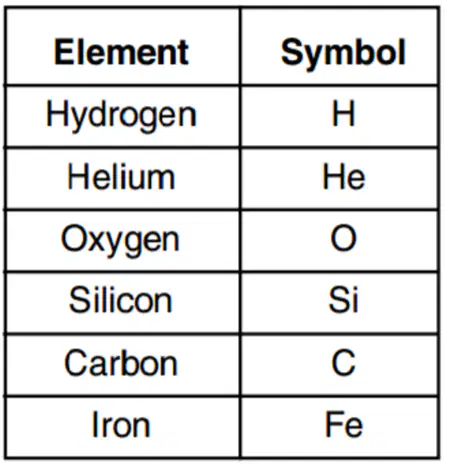
The table shows the chemical symbols for some common elements. Based on the information in the table, which of the four substances below is a compound?
a)
a. CO
b)
b. Si
c)
c. He
d)
d. Fe
34.
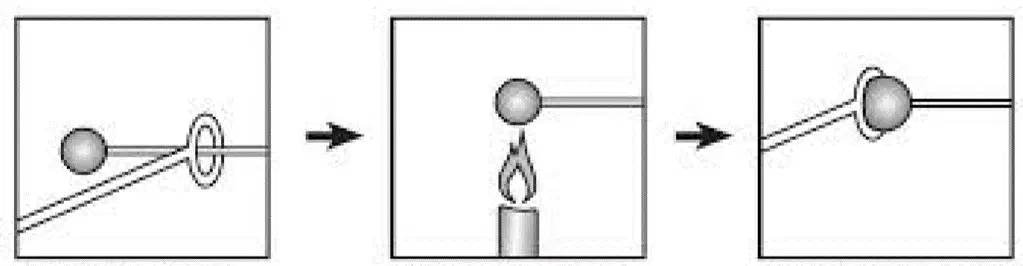
The illustration shows a solid metal ball and a ring before and after heat is applied to the metal ball. Before heat is applied, the metal ball passes easily through the ring. After heat is applied what will happen?
a)
The metal ball pass through the ring quicker.
b)
The brass ring shrinks.
c)
The metal ball does not pass through the ring.
d)
The brass ring expands.
35.
Water freezes at ---
a)
0 degrees Celsius
b)
32 degrees Celsius
c)
100 degrees Celsius
d)
none of the above
36.
The growth of plant roots and animal activity cause
a)
mechanical weathering
b)
erosion
c)
chemical weathering
d)
abrasion
37.
What is weathering?
a)
a type of climate
b)
the movement of rock and sediment from one place to another
c)
the breaking of rock
d)
the setting down of sediment in a new area
38.
When a rock containing iron is chemically changed and becomes soft and crumbly and reddish-brown in color:
a)
abrasion
b)
carbon dioxide
c)
oxidation
d)
acid rain
39.
The type of mechanical weathering in which rock is worn away by the grinding action of other rock particles is called
a)
erosion
b)
cracking and peeling
c)
abrasion
d)
ice wedging
40.
A hot and wet climate causes weathering to take place
a)
slowly
b)
at the same rate as when the climate is cool and dry
c)
unevenly
d)
quickly
41.
Ice wedging breaks apart rocks by
a)
heating and cooling
b)
plant growth
c)
animal actions
d)
freezing and thawing of water
42.
When the mineral composition of rocks change, it is this type of weathering
a)
mechanical
b)
chemical
c)
permeable
d)
general
43.
Which of the following can help prevent mudslides and erosion?
a)
rain
b)
wind
c)
sand
d)
plants
44.
How can erosion change mountains over many years?
a)
it can make the peaks taller
b)
it can make the mountains shorter
c)
it can move the mountain west
d)
it can cause a volcano
45.
landslides are caused by
a)
gravity
b)
water
c)
ice
d)
wind
46.
Moving water was the most important factor in forming which of these?
a)
Grand Canyon
b)
San Andreas Fault
c)
Rocky Mountains
d)
Mt. St. Helens Volcano
47.
A mass of ice that moves slowly over the land is called a(n)
a)
levee
b)
dune
c)
glacier
d)
tsuname
48.
The movement of weathered rock is called
a)
erosion
b)
deposition
c)
weathering
d)
tectonics
49.
Which of the following is NOT a cause of erosion?
a)
heat
b)
wind
c)
water
d)
ice
50.
"U" shaped valleys are formed by
a)
rivers
b)
lakes
c)
rock slides
d)
glaciers
51.
Deposition can be described as a process that...
a)
moving rock particles
b)
breaks down rock
c)
builds mountains
d)
setting down rock particles
52.
Rivers slow down and deposit sediments at their mouth in fan-shaped landforms called
a)
deltas
b)
sandbars
c)
floodplains
d)
levees
53.
A large groove in the soil that carries runoff after a rainstorm
a)
rill
b)
gully
c)
till
d)
valley
54.
The weakest agent of erosion is
a)
Water
b)
Ice
c)
gravity
d)
wind
55.
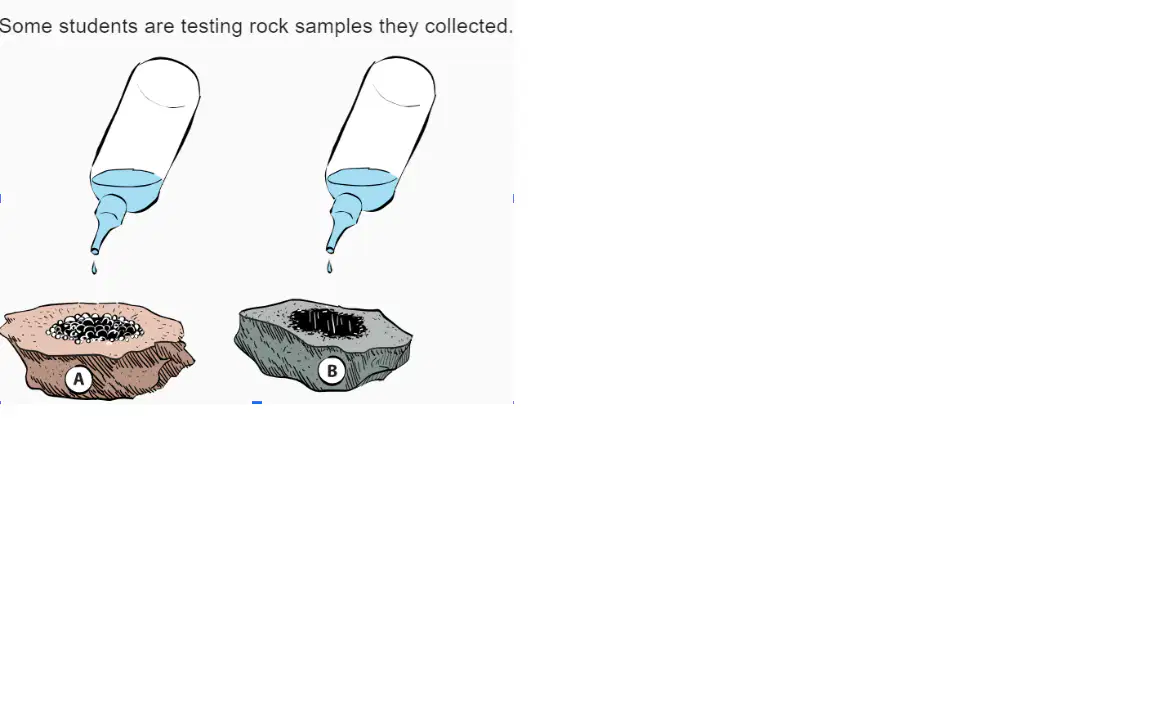
If you wanted to test these rocks for calcite, what would you put in the bottle and what would you expect to happen if calcite is there?
a)
Put water in the bottle; if there is calcite, the rock will dissolve.
b)
Put salt water in the bottle; if there is calcite, the rock will turn a darker color.
c)
Put acid in the bottle; if there is calcite, the rock will fizz.
d)
Put liquid soap in the bottle; if there is calcite, the liquid will form a dome on the rock.
56.
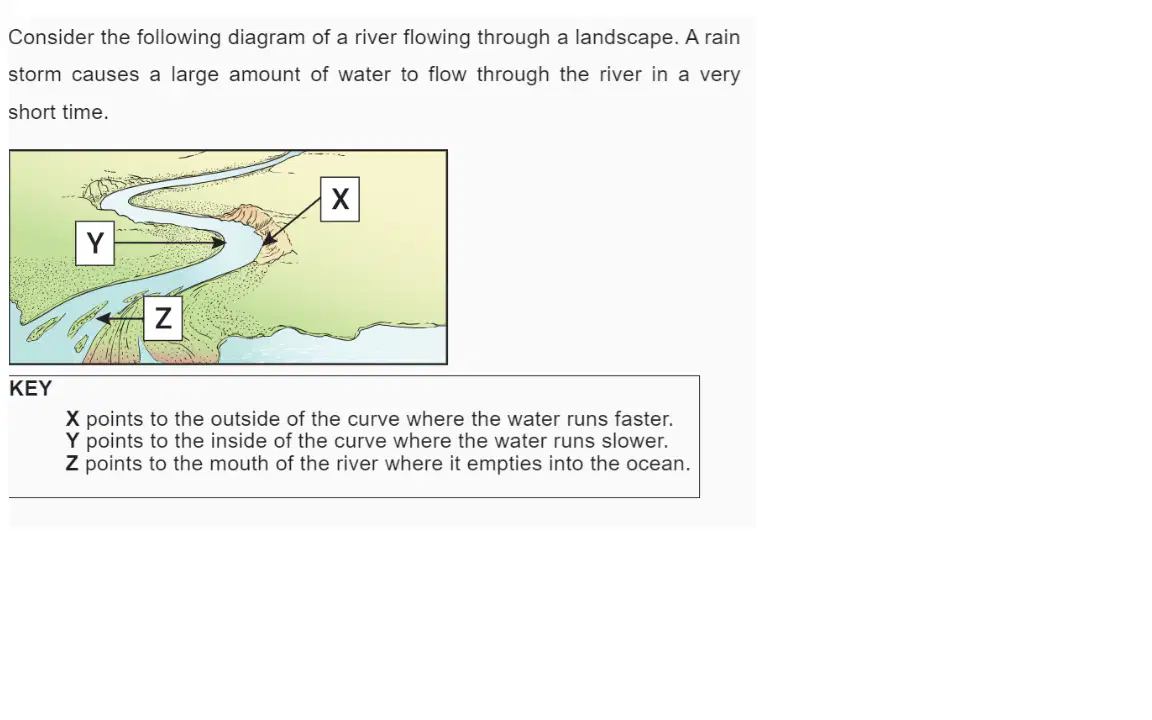
Which size sediments would you most likely find at each location, x, y, and z?
a)
Water can carry larger particles farther. Therefore you are more likely to find cobbles and pebbles at location z where the water runs faster, smaller rocks like sand and gravel at location Y where the water runs slower, and finer clay particles at location x.
b)
Water can carry smaller particles farther. Therefore you are more likely to find cobbles and pebbles at location x where the water runs faster, smaller rocks like sand and gravel at location Y where the water runs slower, and finer clay particles at location z.
c)
Water can carry smaller particles farther. Therefore you are more likely to find cobbles and pebbles at location z where the water runs faster, smaller rocks like sand and gravel at location Y where the water runs slower, and finer clay particles at location x.
57.
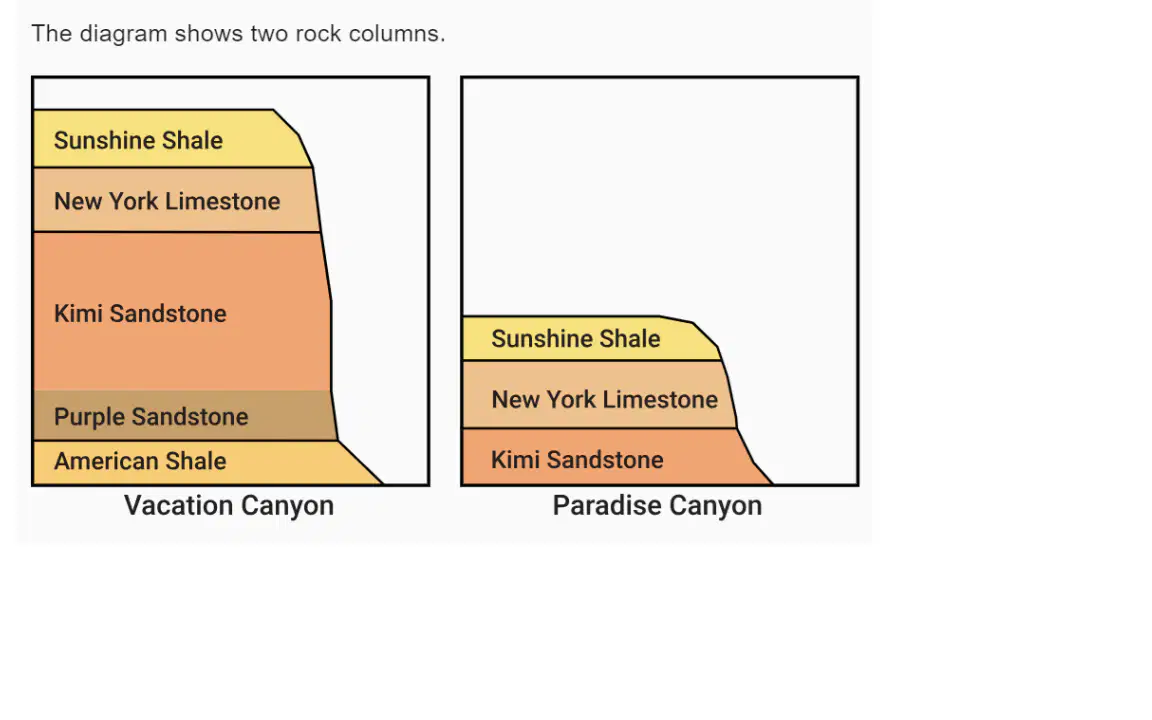
A mining company is sending a team to Paradise Canyon to drill down below Kimi Sandstone. What kind of rock do you think they will find directly under the Kimi Sandstone?
a)
Sunshine Shale
b)
New York Limestone
c)
Purple Sandstone
d)
American Shale
58.
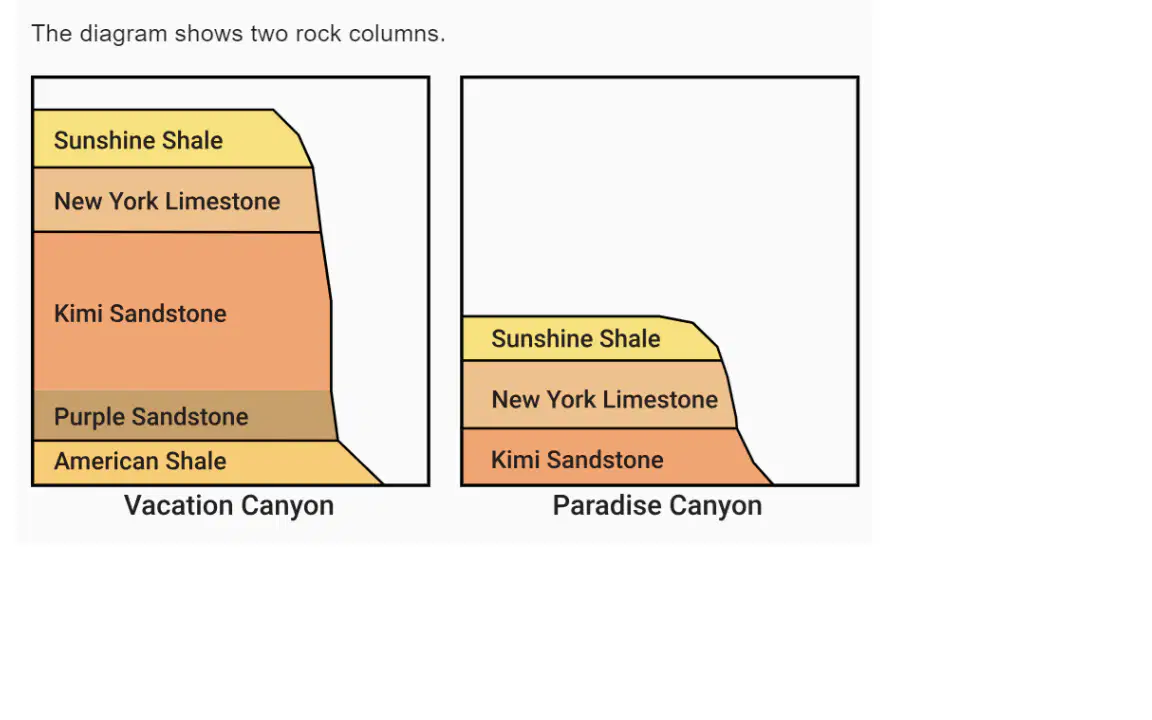
Surprise Canyon is located between these two canyons, 2o km away from Vacation Canon and 15 kilometers away from Paradise Canyon. What kind of rock do you think you might find at the top of Surprise Canyon?
a)
Sunshine Shale
b)
New York Limestone
c)
Purple Sandstone
d)
American Shale
59.
Which explanation best describes how a boulder can turn into silt as it moves down a river?
a)
Water washes over the boulder until it is silt-sized.
b)
The boulder hits other rocks or objects and breaks apart.
c)
The boulder moves down the river until it lands in a basin and becomes silt.
d)
A chemical reaction turns the boulder into silt.
60.
You find some soil that is mostly made of clay and silt, but no sand. How might this soil have formed? (mark the one best answer)
a)
Slow-moving water carried the sand downstream and left behind the silt and clay.
b)
Wind blew all the sand away, leaving behind the silt and clay particles.
c)
Silt, clay, and organic material settled out of slow-moving water.
d)
A fast-moving stream washed away all the sand.
61.
You dig up two soil samples and forget to record where they came from. If you return to the soil samples a week later, what are the characteristics of the soils you would use to match them to the locations where they were collected? Select all characteristics that would help you identify the soil sample's location
a)
Volume of the sample
b)
Kinds of sediments
c)
Amount of mositure
d)
Color of the sample
e)
Amount of organic material
62.
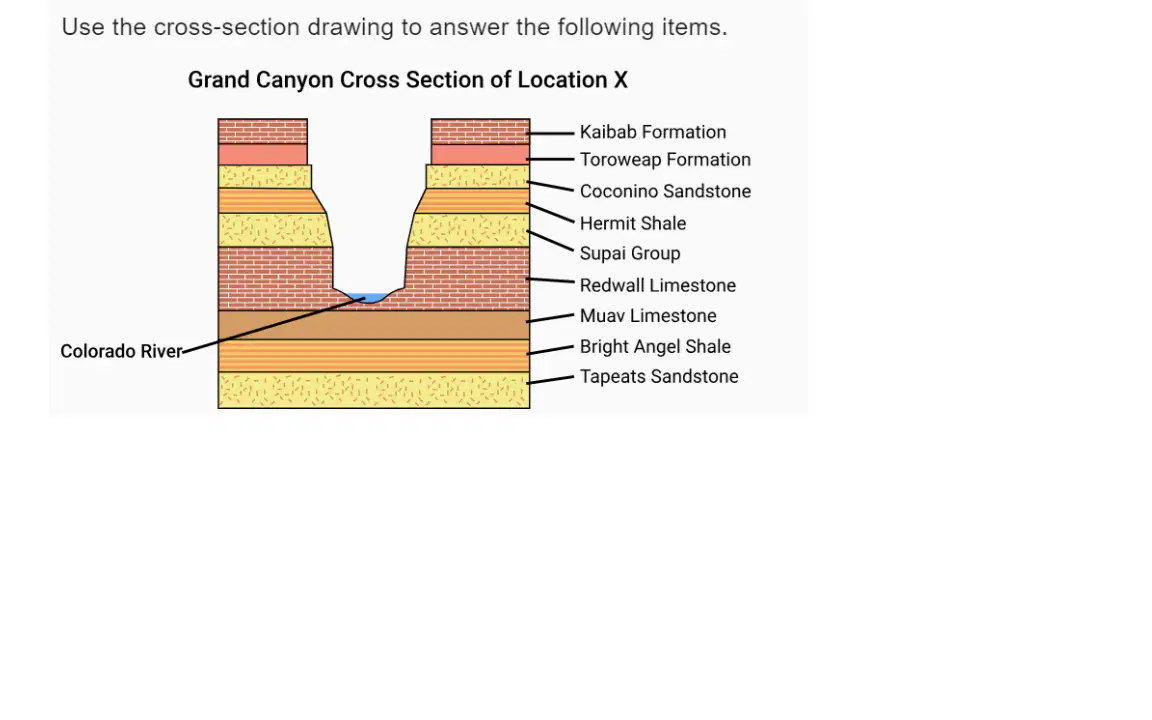
The Colorado River started eroding the Grand Canyon 6 million years ago. Of the layers shown at location x, which two layers did the Colorado River erode away first? ( mark the one best answer).
a)
Kaibab Formation and Toroweap Formation
b)
Redwall Limestone and Supai Group
c)
Bright Angel Shale and Tapeats Sandstone
d)
All layers are eroded at the same time by the Colorado River
63.
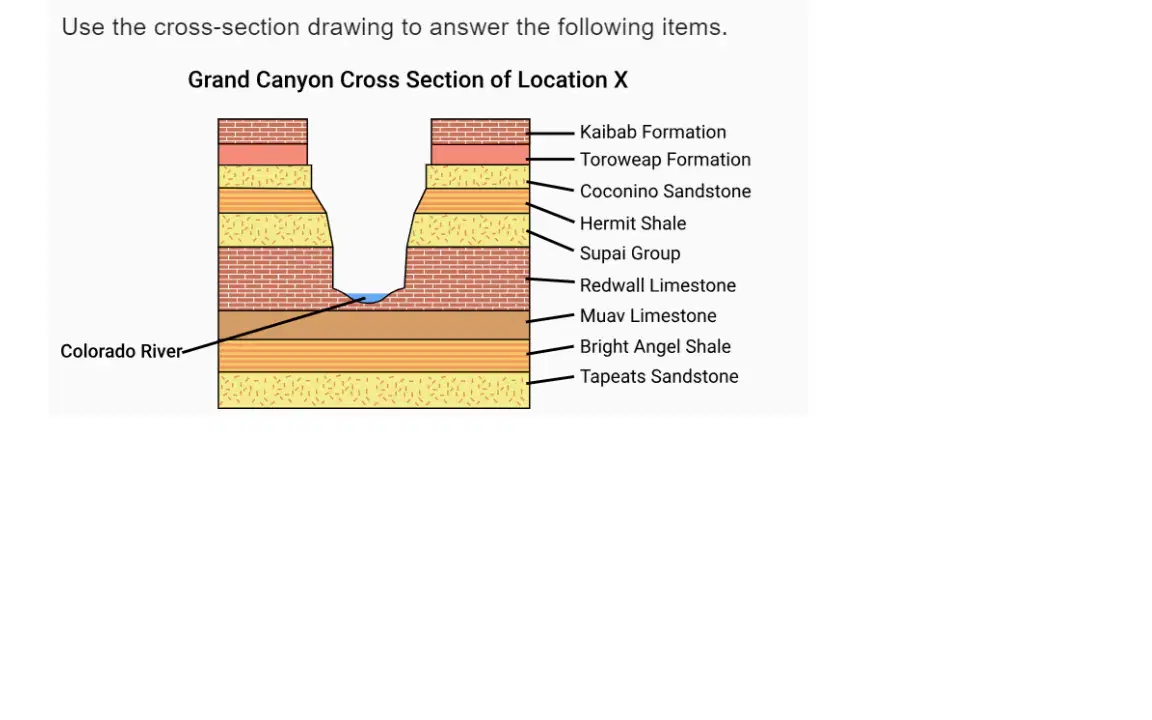
If you could return to the Grand Canyon in 1 million years. you might be able to see the Muav Limestone or the Bright Angel Shale at water level. What variables would determine how much the river has eroded and the rock in that million years?
a)
How much rock gets eroded in a million years will depend on things like temperature, hot temperatures will cause more erosion then if it were cold.
b)
How much rock gets eroded in a million years will depend on things like number of floods and temperature. If floods occur often and at hot enough temperatures, less erosion will occur.
c)
How much rock gets eroded in a million years will depend on things like number of floods-floods move a lot more material; if there is a long drought, there will be little water to continue the erosion. It will also depend on how hard the limestone and shale are and on the materials in the water that cause abrasion.
64.
The type of mechanical weathering in which rock is worn away by the griding action of other rock particles is called_________.
a)
erosion
b)
cracking and peeling
c)
abrasion
d)
ice wedging
65.
What is weathering?
a)
a type of climate
b)
the movement of rock from one place to another
c)
breaking down of rock
d)
the setting down of sediment in a new area
66.
When carbon dioxide reacts with water it forms carbonic acid, a weak acid. Carbonic acid can be responsible for what type of change to the Earth's surface?
a)
erosion
b)
chemical weathering
c)
deposition
d)
mechanical weathering
67.
Select the landforms that were created with our Stream Table Experiment.
a)
Plateau and Meander
b)
Canyon and Meander
c)
Plateau, Meander, Canyon
d)
None of the above
68.
Which of these particles are the smallest ?
a)
silt
b)
very fine sand
c)
clay
d)
gravel
69.
What year did Powell start his expedition for the Green and Colorado River?
a)
1910
b)
1474
c)
1869
d)
1874
70.
Bonus: What was your favorite lesson in science class this year and why? Your insight is very important to me!
4 lines
100 %

