
 Worksheets
The Cold War 20th Century
Total questions: 84
Worksheet time: 45mins
The Cold War developed as a period of political tension and military rivalry between which two superpowers, including the Arms Race?
United States and Soviet Union
United States and China
Britain and France
Germany and Japan
Compare the economic ideologies of capitalism and communism.
Capitalism emphasizes private ownership and profit, while communism advocates for collective ownership and equality.
Capitalism promotes collective ownership, while communism supports private ownership and competition.
Both capitalism and communism support private ownership and free markets.
Capitalism and communism both discourage economic growth.
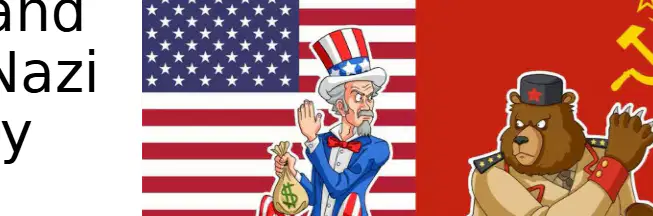
What two countries cooperated to defeat Nazi Germany during World War II, but their alliance quickly crumbled after the war?
United States and Japan
United States and Soviet Union
Germany and Soviet Union
United States and China
The conflict between the United States and the Soviet Union dominated world politics from ______ to 1991. Fill in the blank.
1945
1939
1950
1961
This period of conflict between the United States and the Soviet Union is known as the ________. Fill in the blank.
Cold War
World War I
Vietnam War
Industrial Revolution
The United States and the Soviet Union faced one another in direct military conflict during the Cold War.
True
False
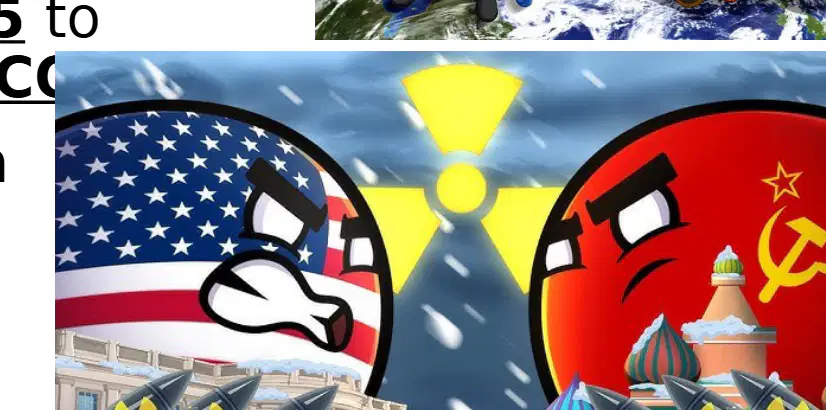
During the Cold War, the United States and the Soviet Union never faced one another in direct military conflict. Instead, they...
Only a
Only b
Both a and b
Neither a nor b
Why did the United States and the Soviet Union clash after WWII?
They were both superpowers with enough political, economic, and military strength to influence world events
They were both small countries
They had the same ideologies
They avoided world events
What were the main ideological differences between the United States and the Soviet Union during the Cold War?
Capitalism vs. Communism
Democracy vs. Totalitarianism
Both A and B
None of the above
Fill in the blank: The United States followed an economic system called _______ based on private ownership of property.
Capitalism
Socialism
Feudalism
Communism
Fill in the blank: The Soviet Union followed an economic system called _______ where the government made decisions about what to produce and private property was banned.
Communism
Capitalism
Feudalism
Mercantilism
Which type of government did the United States have during the Cold War?
Totalitarian state
Representative democracy
Monarchy
Dictatorship
Which type of government did the Soviet Union have during the Cold War?
Representative democracy
Totalitarian state
Monarchy
Republic
Why did the United States and the Soviet Union clash after World War II?
Competition for territory
Religious differences
Economic cooperation
Shared political ideology
During WWII, which countries did the Soviets occupy?
Poland, Hungary, and other Eastern European Nations
France and Spain
Italy and Greece
Norway and Sweden
After World War II, Soviet dictator Josef Stalin insisted that Eastern European nations were ______ under Soviet influence.
communist
democratic
neutral
capitalist
At the Potsdam Conference in 1945, the Allies divided Germany into occupation zones. Which countries were involved in this division?
USA, Great Britain, France, Soviet Union
USA, Italy, Japan, Soviet Union
France, Spain, Portugal, Soviet Union
USA, China, France, Great Britain
Refer to the map titled 'Occupation Zones of Germany After World War II.' Which country controlled the eastern part of Germany?
The Soviet Union controlled the eastern part of Germany.
The United States controlled the eastern part of Germany.
The United Kingdom controlled the eastern part of Germany.
France controlled the eastern part of Germany.
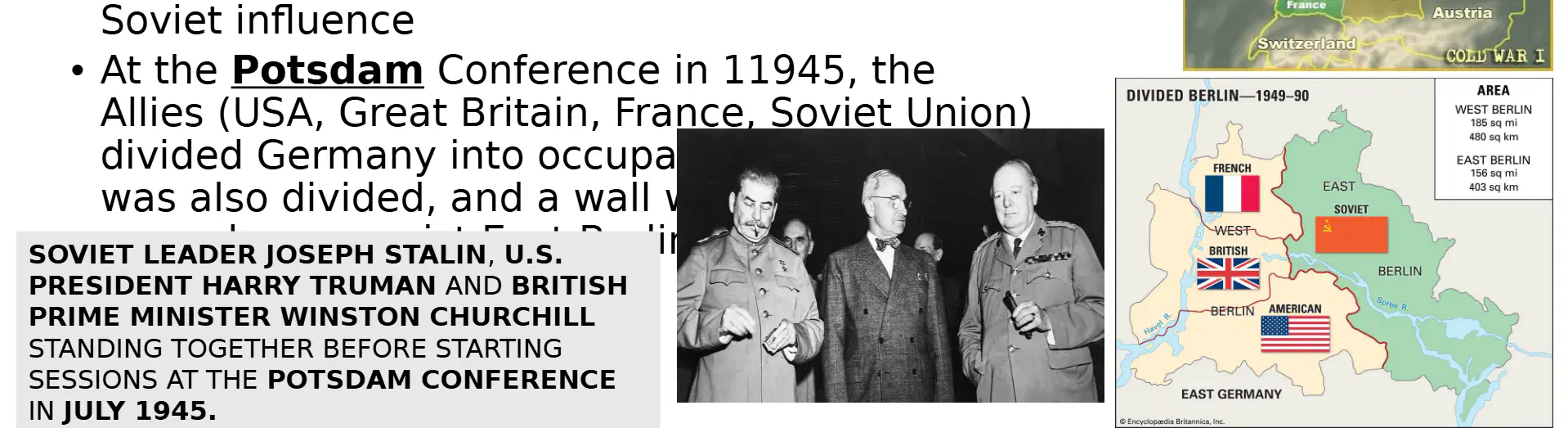
Who are the three leaders standing together at the Potsdam Conference in July 1945?
What was the Iron Curtain during the Cold War?
A) A physical wall built across Europe
B) An imaginary line that divided Europe between Soviet and Western influence
C) A treaty between the United States and the Soviet Union
D) A type of weapon used in World War II
Fill in the blank: The Iron Curtain was an __________ line that divided Europe between Soviet and Western influence during the Cold War.
imaginary
physical
visible
legal
According to Winston Churchill's speech, the 'iron curtain' symbolized what in Europe after World War II?
A division between Eastern and Western Europe
The rebuilding of European cities
The end of World War II
A new economic alliance
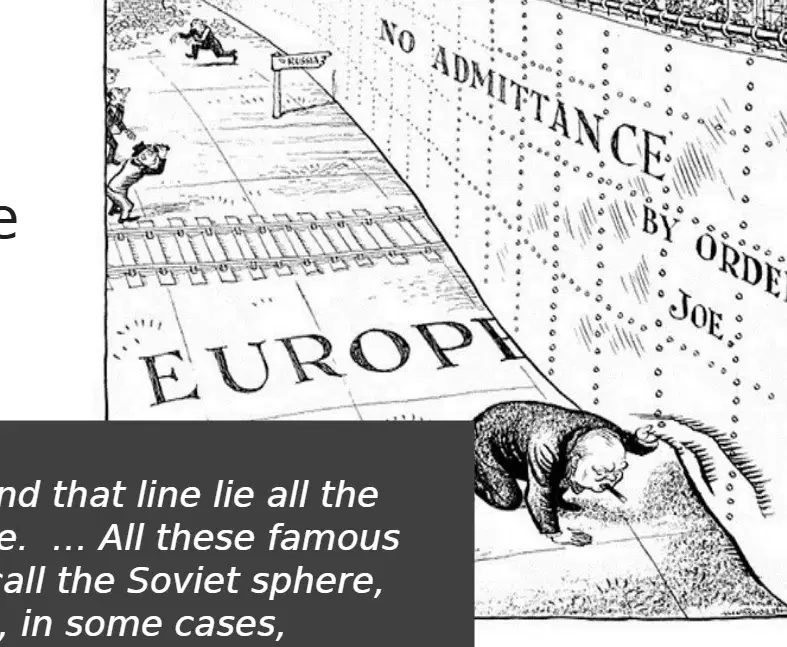
Look at the cartoon depicting the Iron Curtain. The cartoonist is trying to convey that:
Europe was united after World War II.
The Iron Curtain symbolized the division between Eastern and Western Europe.
The Iron Curtain represented economic prosperity.
There was no significant change in Europe after World War II.

What was the Berlin Airlift of 1948, and why did it occur?
It was a military invasion of Berlin by Allied forces to remove Soviet control.
It was a massive airlift operation by Western Allies to supply West Berlin after the Soviet blockade.
It was the construction of the Berlin Wall to separate East and West Berlin.
It was a peace treaty signed between the Soviet Union and Western Allies to end World War II.
Fill in the blank: The Soviets tried to ______ the Allied forces out of Berlin in 1948, leading to the Berlin Airlift.
force
invite
welcome
escort
Fill in the blank: Every day, military planes dropped ______ and other supplies into West Berlin during the Berlin Airlift.
food
weapons
cars
books
Fill in the blank: After ______ days, Stalin ended the blockade of West Berlin.
324
200
400
500
The Cold War was a turning point in the 20th century. Which of the following best describes its lasting political and economic effects around the world?
It led to the spread of democracy and capitalism, the formation of military alliances like NATO and the Warsaw Pact, and ongoing regional conflicts influenced by superpower rivalry.
It resulted in the immediate unification of all countries under a single government and the end of all economic competition.
It caused the collapse of all global trade and the isolation of every nation from international affairs.
It had no significant impact on global politics or economics.
The Cold War developed as a period of political tension and military rivalry between which two superpowers, including the Arms Race?
United States and Soviet Union
United States and China
United Kingdom and France
Germany and Japan
3. Capitalism and communism differ primarily in their economic ideologies. Which of the following best describes this difference?
Capitalism promotes private ownership and profit, while communism advocates for collective ownership and equality.
Capitalism supports government control of resources, while communism encourages free markets.
Both capitalism and communism support equal distribution of wealth.
Communism promotes private businesses, while capitalism opposes them.
During World War 2, which country developed and used the first atomic bomb?
Soviet Union
United States
Germany
Japan
In what year did the Soviet Union test its own atomic bomb?
1949
1945
1952
1955
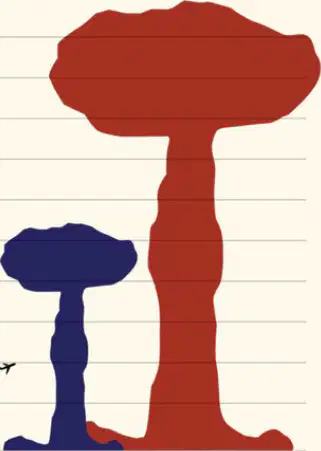
Refer to the diagram showing the size of nuclear explosions. Which bomb had the largest explosion in 1951?
Little Boy
Fat Man
Castle Bravo
Tsar Bomba
A superpower is:
A special ability beyond normal human capabilities
A type of food
A nation that has enough economic, political, and military power to influence world events
A musical instrument
What are four reasons the United States and the Soviet Union clashed after WWII?
Differences in political ideologies, competition for global influence, nuclear arms race, and disputes over postwar Europe
Shared economic interests, mutual defense agreements, cultural exchanges, and joint space missions
Similar government structures, cooperative military strategies, open borders, and free trade agreements
Unified approach to rebuilding Europe, joint occupation of Germany, mutual trust, and disarmament initiatives
The term “Cold War” is used because:
there was no direct fighting between the main rivals
it was fought in cold regions
it involved cold weapons
it was a short conflict
American and Soviet economic ideologies were different in that:
The United States supported capitalism, while the Soviet Union supported communism.
Both supported capitalism.
Both supported communism.
The United States supported communism, while the Soviet Union supported capitalism.
Select 2 nations that were communist after WWII.
United States and Canada
France and Italy
Soviet Union and China
Japan and South Korea
The Iron Curtain was:
a type of military weapon used in World War II
a political and ideological barrier separating Eastern and Western Europe after World War II
a famous speech given by Winston Churchill
a treaty signed between the US and the Soviet Union
The Berlin Airlift occurred because:
The Soviet Union blockaded West Berlin, cutting off all ground access.
The United States wanted to test new aircraft.
Berlin was being evacuated due to natural disaster.
Germany requested international aid for economic reasons.
How did the arms race increase tensions between the United States and the Soviet Union?
By encouraging cooperation between the two nations
By reducing military spending on both sides
By leading to a buildup of nuclear weapons and mutual distrust
By ending the Cold War quickly
Fill in the blank: The Cold War is considered a turning point in the 20th century because it had lasting effects around the world. We are learning to analyze the Cold War as a turning point in the 20th century and explain its lasting _______ and _______ effects around the world.
political, economic
scientific, artistic
geographical, culinary
athletic, musical
Fill in the blank: I will know I am successful when I can describe how competition between the Soviet Union and non-communist nations resulted in Supranational Organizations such as _______ and the _______ Pact.
NATO, Warsaw
UN, Geneva
EU, Paris
ASEAN, Munich
Why did alliances such as NATO and the Warsaw Pact emerge after World War II?
Because of the rising tension between the Soviet Union and the United States
To promote global trade
To end colonialism
To spread democracy worldwide
In 1949, which countries and regions formed the North Atlantic Treaty Organization (NATO)?
The United States, Canada, and ten European democracies
The Soviet Union and Eastern Europe
Only Western European countries
Only the United States and Canada
What was the main goal of NATO when it was formed in 1949?
To promote economic growth
To respond jointly to any military attack on Western Europe
To expand territory
To spread communism
The policy of trying to keep the Soviet Union from expanding its territory beyond what it already controlled was called _________
containment
expansionism
appeasement
isolationism
In 1955, the Soviet Union and seven ________ Eastern European nations formed the Warsaw Pact.
communist
capitalist
neutral
democratic

According to the map, which of the following countries was a member of NATO during the Cold War?
Poland
France
Soviet Union
Hungary
List 2 members of the Warsaw Pact.
Poland and Hungary
France and Italy
United Kingdom and Spain
Norway and Sweden
NATO’s main goal was:
To promote economic cooperation among member states
To ensure collective defense against aggression
To establish a single European currency
To expand global trade networks
Containment means:
Allowing something to spread
Keeping something under control or within limits
Encouraging expansion
Ignoring a problem
The Warsaw Pact was:
A military alliance of Western European countries.
A military alliance of Eastern European communist countries led by the Soviet Union.
An economic agreement between Asian countries.
A peace treaty signed after World War I.
Analyze the Cold War as a turning point in the 20th century and explain its lasting political and economic effects around the world.
The Cold War marked a significant shift in global politics and economics, leading to the rise of two superpowers and influencing international relations for decades.
The Cold War had no significant impact on global politics or economics.
The Cold War only affected the countries directly involved and had no global consequences.
The Cold War resulted in immediate global peace and economic prosperity.
Cold War alliances and rivalries led to wars in Korea and Vietnam because:
They caused direct military confrontations between superpowers.
They encouraged local conflicts by supporting opposing sides.
They resulted in immediate peace in the region.
They had no impact on regional conflicts.
After World War 2, imperialism in ______ declined. Both the United States and the Soviet Union competed to gain influence in this region. Fill in the blank.
Asia
Europe
Africa
South America
Who led the Chinese Communists to seize the capital of China in 1949?
Mao Zedong
Chiang Kai-shek
Sun Yat-sen
Deng Xiaoping
What is the capital of China that was seized by the Chinese Communists in 1949?
Beijing
Shanghai
Guangzhou
Chengdu
In 1949, China was established as the People's Republic of China.
True
False
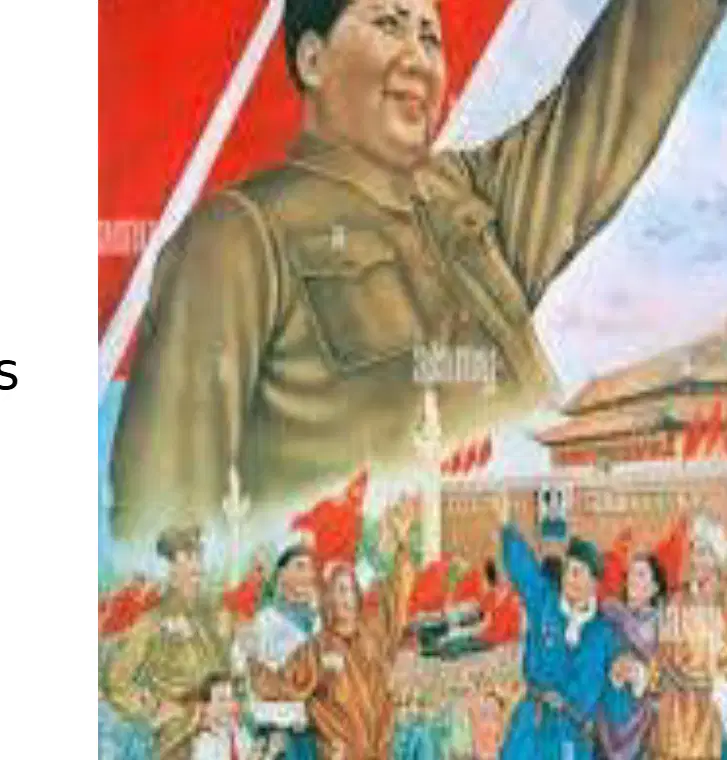
Refer to the image of Mao Zedong and the crowd. This image represents which of the following in the context of the Cold War in Asia?
The rise of communism in China
The end of the Korean War
The signing of the Treaty of Versailles
The fall of the Berlin Wall
After WWII, which country was split into North and South, leading to future conflict?
Vietnam
Germany
Korea
Japan
Which side of Korea was communist and supported by the Soviet Union and China?
North Korea
South Korea
Which side of Korea was democratic and supported by the United States?
North Korea
South Korea
In 1950, which country invaded South Korea, starting the Korean War?
China
North Korea
Japan
Soviet Union
Who sent troops to support North Korea during the Korean War?
United States
Soviet Union
China
Japan
The United Nations sent troops to help ________ Korea during the Korean War.
South
North
East
West
The war dragged on until a ________ in 1953. Neither side gained significant territory.
ceasefire
treaty
election
revolution
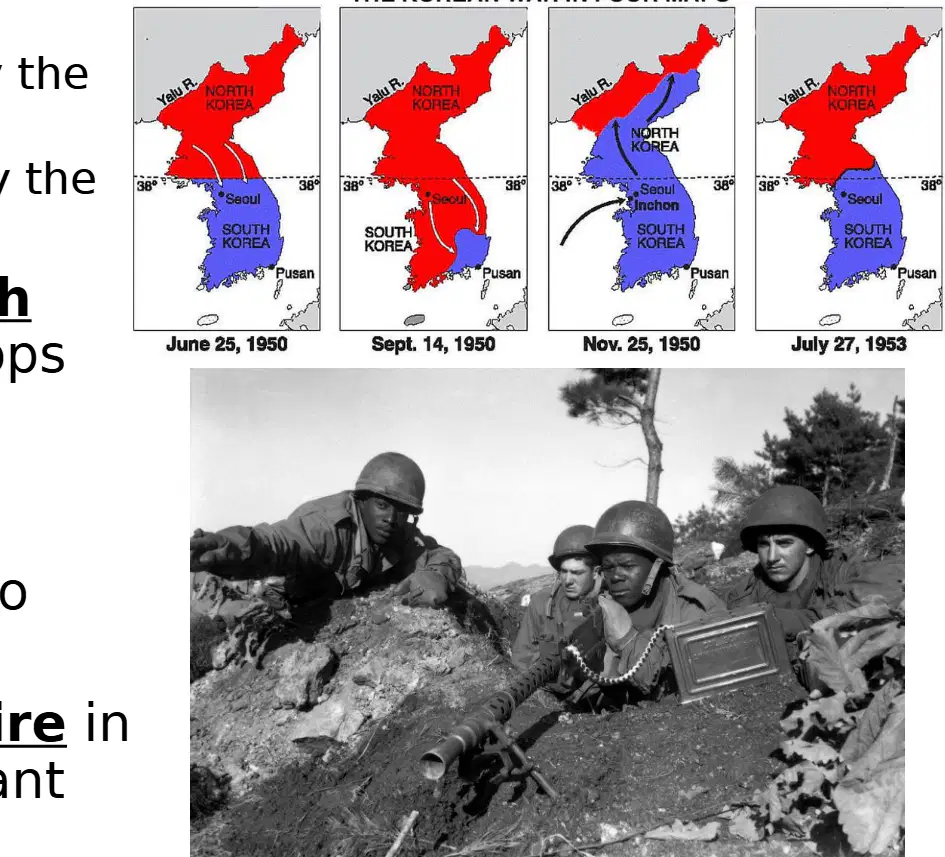
Describe how the territory controlled by North and South Korea changed from June 25, 1950 to July 27, 1953.
The territory changed little, ending near the original border.
North Korea gained control of the entire peninsula.
South Korea gained control of the entire peninsula.
The territory was divided along the 38th parallel, with no changes.
The leader of China when it became communist was:
Sun Yat-sen
Chiang Kai-shek
Mao Zedong
Deng Xiaoping
The difference between a “hot war” and a “cold war” is:
A hot war involves direct military conflict, while a cold war involves indirect conflict and tension without open fighting.
A hot war is fought with words, while a cold war is fought with weapons.
A hot war only happens in winter, while a cold war happens in summer.
A hot war is a type of economic competition, while a cold war is a type of sports competition.
The Korean War had a clear winner. Why or why not?
Yes, North Korea won the war because it unified the peninsula.
Yes, South Korea won the war by conquering the North.
No, there was no clear winner because the war ended in a stalemate.
No, the war ended with one side surrendering.
Before WW2, Vietnam was a French _______.
Colony
Republic
Protectorate
Kingdom
After Japan’s defeat, who wanted to regain control of Vietnam?
The United States
The French
The Chinese
The British
Many Vietnamese wanted _______ after Japan’s defeat.
independence
reunification
colonization
emigration
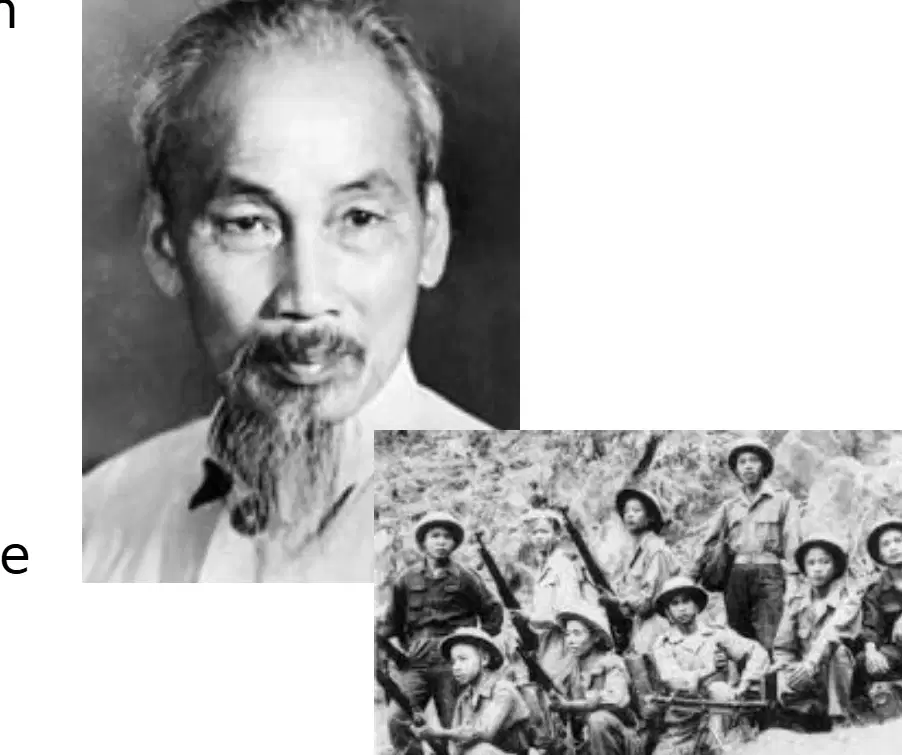
Who was Ho Chi Minh?
A French general
A Japanese emperor
A nationalist, communist leader who led the Viet Minh
An American president
With support from China and the Soviet Union, the Viet Minh began to ______ the French.
attack
negotiate with
ignore
support
The US and Great Britain ______ France to avoid the spread of communism.
supported
invaded
isolated
ignored
After the Viet Minh defeated the French in 1945, Vietnam was temporarily (a) into a communist North Vietnam and a noncommunist South Vietnam.
Who gained more territory in the south as the war continued?
The French
The communists
The United States
Great Britain
Which countries supported France to avoid the spread of communism?
China and the Soviet Union
The US and Great Britain
Cambodia and Laos
North and South Vietnam
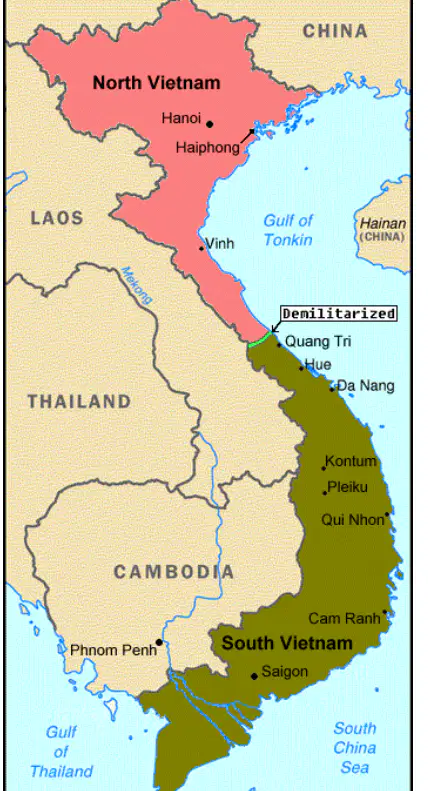
Which part of Vietnam was communist after 1945?
North Vietnam
South Vietnam
Who supported the Viet Mihn?
The United States
The Soviet Union and China
France
Japan
Who supported the French?
The British
The chinese
The Russians
The Germans
The Vietnam War was won by:
North Vietnam
South Vietnam
United States
France

