
 Worksheets
Triple Chemistry Neutralisation, Evaporation and Titration
Total questions: 16
Worksheet time: 17mins
Oscar is doing a science experiment. He mixes an acid with an alkali in a beaker. Complete the equation: Acid + Alkali --> ____ + Water
Base
Acid
Alkali
Salt
Oliver is performing a chemistry experiment. He mixes Zn(OH)2 with HNO3 and observes the following reaction:
Zn(OH)2 + HNO3 ---> H2O + Zn(NO3)2
Identify the salt formed in this reaction.
Zn(OH)2
HNO3
H2O
Zn(NO3)2
During a chemistry lab, Rosie is performing a titration experiment. What is the endpoint of her titration?
Where the amount of acid and base are equal as shown by a color change
Where there is no base
When the volume of base in the burette is used up
When there is no acid

Arthur is preparing a solution in the chemistry lab and needs to accurately measure and transfer a specific volume of liquid. What is this piece of apparatus called?
Pipette
Burette
Janette
Cuvette
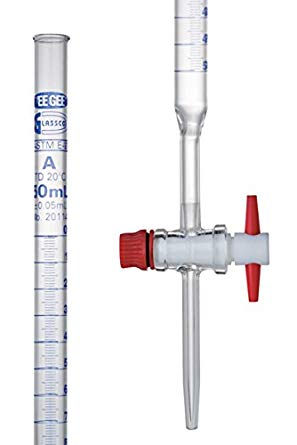
During a titration experiment, Max needs to accurately measure and deliver a specific volume of liquid. What is this piece of apparatus called?
Pipette
Burette
Janette
Cuvette

Sophie is performing a titration experiment in her chemistry class. What is the reading on this burette?
24.0cm3
25.8cm3
24.2cm3
23.9cm3
Florence is conducting an experiment in the lab where she neutralises potassium hydroxide with sulphuric acid. What is the salt produced in her experiment?
Hydrogen sulfate
Potassium chloride
Potassium sulfite
Potassium sulfate
Leo and Lily are performing a titration experiment in their chemistry class. They are discussing which indicator to use. Why is a universal indicator not normally used as an indicator when performing a titration?
It changes color over a very narrow pH range.
It changes color over a very wide pH range.
It decomposes too quickly.
It only changes color in acidic solutions.
During a science experiment, Ava adds phenolphthalein to a solution. She observes that in a basic solution, it turns pink. What color will phenolphthalein change to if Ava adds it to an acidic solution?
Red
Colorless
Yellow
Blue
Priya is performing a titration in her chemistry lab using a strong acid and a strong base. Which indicator should she choose for the most accurate result?
Bromothymol blue
Methyl orange
Phenolphthalein
Universal indicator
During a titration, what is the purpose of swirling the flask while adding the titrant?
To prevent evaporation
To cool the solution
To speed up the reaction
To mix the reactants thoroughly
In a science experiment, Benjamin mixes hydrochloric acid with sodium hydroxide in a beaker. Which of the following is a product of this reaction?
Calcium carbonate
Potassium sulfate
Magnesium nitrate
Sodium chloride
Copper Oxide is a (a)
Sodium hydroxide is a (a)
To make copper sulphate crystals, you need
Hydrochloric acid
Sulfuric acid
Copper Oxide
Copper Nitrate
The Role of Excess Copper Oxide in Copper Sulfate Preparation
Copper sulfate is a chemical compound that is widely used in various industrial and laboratory applications. It is typically prepared through a reaction between copper oxide and sulfuric acid. In this process, copper oxide acts as a base and reacts with the acid to form copper sulfate and water. The reaction is an example of a neutralization process, where the base neutralizes the acid, resulting in the formation of a salt. This salt, copper sulfate, is known for its vibrant blue color and is often used in agriculture and chemistry experiments.
In the preparation of copper sulfate, excess copper oxide is often used to ensure the complete reaction of sulfuric acid. This is important because any unreacted sulfuric acid can lead to impurities in the final product. By using an excess of copper oxide, the reaction is driven to completion, ensuring that all the acid is consumed. This not only improves the purity of the copper sulfate but also enhances the yield of the desired product. The excess copper oxide can be easily removed by filtration, leaving behind a pure solution of copper sulfate.
The use of excess copper oxide also serves as a practical method to control the reaction conditions. It helps in maintaining a consistent reaction rate and prevents the formation of unwanted by-products. Additionally, the presence of excess copper oxide can act as a buffer, stabilizing the pH of the solution during the reaction. This is particularly useful in laboratory settings where precise control over reaction conditions is necessary. Overall, the strategic use of excess copper oxide is a key factor in the efficient and effective preparation of copper sulfate.
What is the primary role of excess copper oxide in the preparation of copper sulfate?
To ensure complete reaction of sulfuric acid
To increase the acidity of the solution
To decrease the yield of copper sulfate
To change the color of copper sulfate
Why is it important to use excess copper oxide in the reaction with sulfuric acid?
To prevent impurities in the final product
To increase the reaction temperature
To produce a different compound
To reduce the cost of production
What happens to the excess copper oxide after the reaction is complete?
It is removed by filtration
It remains dissolved in the solution
It reacts with water
It evaporates
How does excess copper oxide affect the pH of the solution during the reaction?
It acts as a buffer, stabilizing the pH
It makes the solution more acidic
It makes the solution more basic
It has no effect on pH
What is the color of the copper sulfate formed in the reaction?
Vibrant blue
Bright red
Pale yellow
Dark green

