
 Worksheets
Final Trimester 2 Phantastic Physics Units 4-7 24-25
Total questions: 153
Worksheet time: 3hrs 4mins
What are the three NON-CONTACT forces were mentioned in this unit?
Gravity, friction, air resistance
Forces, motion, human body systems
Friction, electrostatic, muscular system
Gravity, electrostatic, and magnetism

If the mass of either m1 or m2 is increased then the force of gravitation between them will...
increase
decrease
stay the same
Which of the following would be a proper setup for this problem: A 60 kg person is standing on earth's surface (radius = 6.4x10⁶ m). The mass of earth is 6x1024 kg.
(6.4x10⁶)2(6.67x10⁻¹¹)(60)(6x1024)
(6x1024)2(6.67x10⁻¹¹)(60)(6.4x10⁶)
(6.4x10⁶)(6.67x10⁻¹¹)(60)(6x1024)
(6.4x10⁶)2(60)(6x1024)
The value of Universal Gravitational constant is
6.673X10⁻¹¹ Nm-2kg2
6.673X10⁻¹¹ Nm2kg2
6.673X10⁻¹¹ Nm2 kg-2
6.673 x10⁻¹¹ N m-2 kg-2
Calculate the force of gravity (F) between two objects whose masses are m1 = 100 kg and m2 = 1000 kg if they are separared by a distance of d = 500 m.
2.67 * 10-11 N
0.4 N
6.67 * 10-11 N
1.3 * 10-8 N


If a satellite is closer to Earth, it must travel ______ than a satellite further from Earth.
The same speed
Slower
Faster

Calculate the centripetal force required to make a 5 kg ball move 4 m/s in a circle with a radius of 2 m.
10 N
20 N
30 N
40 N
A field that will apply a force to an object with mass is called a
gravitational field
Newton's field
angular rotation field
force field
What is the gravitational field strength on Earth?
11 N/kg
10 N/kg
9 N/kg
8.9 N/kg
If the gravitational field strength on Planet X is 11 N/kg and on Planet Y it is 7 N/kg, where would you weigh the least if you were to visit?
Planet X
You would weigh the same on both planets.
Without knowing the mass, you cannot determine the answer.
Planet Y
A mass m is released just above the surface of a planet with mass M and radius R . Which expression gives its initial gravitational acceleration?
r2Gm
rGmM
r2GmM
r2GM
What is the gravitational field strength of an object with mass 1200 kg at a distance of 2.0 m?
4.0 x 10^-5 N
6.0 x 10^-11 N
2.0 x 10^-8 N
1.0 x 10^-3 N
What's the acceleration of gravity of a planet with a mass of 1 x 10²² kg and a radius of 5x10⁵ meters?
.267 m/s2
2.67 m/s2
26.7 m/s2
267 m/s2

A object is 4AU from the sun, what is its orbital period T?
8 years
2 years
4 years
16 years
What is needed to calculate work?
time and distance
speed and distance
force and distance
acceleration and velocity
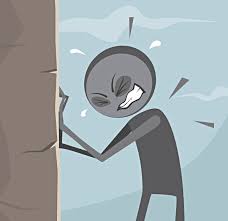
Is this an example of work?
Yes
No
What is the unit of measurement for work?
meters
newtons
m/s
Joules
500 J of work is done by a person who uses a force of 50N to move a box, how far does it go?
10 m
0.1 m
25,000 m
10 J
Energy is
stored work
is destroyed when used
can not be changed into another form of energy
measured in newtons

If the mystery machine moves 100 meters how much work is done?
130,000,000 J
70,000 J
100,000 J
30,000 J
Which formula is used to calculate Gravitational Potential Energy (GPE)?
GPE = ½ kx²
GPE = mgh
GPE = mv²
GPE = ½ mv²
What is the formula for Elastic Potential Energy (EPE)?
EPE = mgh
EPE = ½ kx²
EPE = mv²
EPE = ½ mv²
The greater the mass, the (more / less) potential energy it has at a given height.
more
less
same
zero
The higher the position of the object, the (more / less) potential energy it has.
more
less
same
zero
The more distance a spring is stretched, the (more / less) elastic potential energy it has.
more
less
same
zero
The stiffer a spring is, the (more / less) elastic potential energy it has when it is stretched.
more
less
same
zero
A car with mass 500 kg is driving along at a speed of 30 m/s. What is its Kinetic Energy?
225,000 J
150,000 J
300,000 J
100,000 J
If a football player throws a ball that has a Kinetic Energy of 1225 J and the ball has a mass of 2 kg, what is the ball's velocity?
35 m/s
30 m/s
25 m/s
40 m/s
Which would increase an object’s kinetic energy more: doubling its mass or doubling its velocity?
Doubling its velocity.
Doubling its mass.
Both have the same effect.
Neither affects kinetic energy.
What happens to the kinetic energy (KE) of the car as heat is generated at the brakes/rotors?
The kinetic energy increases.
The kinetic energy remains the same.
The kinetic energy decreases.
The kinetic energy is converted into potential energy.
What is potential energy?
moving energy
stored energy
renewable energy
non renewable energy
What is kinetic energy?
moving energy
potential energy
stored energy
renewable energy


What is the Kinetic Energy at point C?
500,000 J
400,000 J
300,000 J
50,000 J
What is the Kinetic Energy at point B?
500,000 J
400,000 J
300,000 J
50,000 J
What is the GPE at point E?
500,000 J
250,000 J
300,000 J
100,000 J
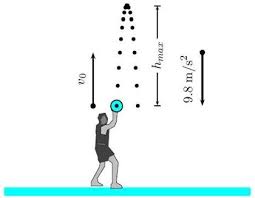
If a 0.5 kg ball is thrown up with 250 J of kinetic energy, how high will it go?
(HINT: At the ball's highest point it has stopped.)
KE = 1/2mv2 , PE = mgh
g = 9.8 m/s2
51 m
25.5 m
12.76 m
31.6 m
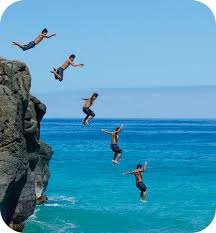
A cliff diver with a mass of 125 kg jumps off a 50m high cliff, how fast will he be traveling just before he hits the water? (His height at this point is 0m)
(HINT: Find PE first. then KE = 1/2mv2
g = 9.8 m/s2
61,250 m/s
980 m/s
31.3 m/s
247.5 m/s

What is the KE at point B?
14 J
12 J
6 J
8 J
how high up was an object that is 8 kg, if right before it hit the ground it had a velocity of 18 m/s?
16.2 m
28 m
1296 m
impossible to determine

Two rocks with different size and mass are dropped from the same height. Which of the rock will reach the ground first?
greater rock
smaller rock
both reach the ground at the same time
A pumpkin is dropped from a 35 m building. What is its initial velocity, u?
9.8 m/s^2
35 m
0 m/s
9.8 m/s
A ball is thrown straight up from the ground. When is the ball’s velocity zero?
on the way up
at the heighest point
half way down
just before hitting the ground
A 3.0 kg mass is thrown vertically upward with an
initial speed of 10 m/s. What is the maximum height
this object will reach?
0.3m
3.3m
5m
30m
A 45 kg child is sliding the incline from 1.2 m height. Ignoring the friction, what would be his speed at the bottom of the slide?
0 m/s
4.8 m/s
3.4 m/s
2.6 m/s

2 marbles sit at the top of 2 different ramps. Which marble has the most Potential Energy at the top of the ramp?
The marble on the left
The marble on the right
The both have the same potential energy
Neither. They both have 0 potential energy because they are both stopped.

What types of charges attract?
Positive and Positive
Positive and Neutral
Negative and Neutral
Positive and Negative
When an object gains a charge, it is due to the movement of what subatomic particles?
protons
electrons
neutrons
protons and electrons
What is the net charge of an atom that has...
13 protons
14 neutrons
11 electrons
+13
-14
-11
+2
-2
How many elementary charges (e- or p+) are in 1 Coulomb of charge?
6.242 x 10⁸ elementary charges
6.242 x 10¹⁸ elementary charges
6.242 x 10⁻¹⁹ elementary charges
6.242 x 10¹⁷ elementary charges
Calculate the force exerted between two charged objects separated by a distance of 0.6 m. One object has a charge of -5 C and the other has a charge of +2.0 C.
-1.5x10⁻¹¹ N
2.5x10⁻¹¹ N
-2.5x10¹¹ N
-7.5x10⁻¹⁰ N
FE= (k*q1*q2) / r2
What is the approximate electrostatic force between two protons separated by a distance of 1.0 x 10⁻⁶ meter? qp+ = 1.6x10⁻¹⁹ C
9.0 x 10²¹ N and attractive
9.0 x 10²¹ N and repulsive
2.3 x 10⁻¹⁶ N and attractive
2.3 x 10⁻¹⁶ N and repulsive


Which diagram correctly shows the electric field around a negative charge?
A
B
they are both positive
What is the magnitude of the electric field intensity at a point where a proton experiences an electrostatic force of magnitude 2.30 x 10⁻²⁵ newton? Charge of a proton is 1.6x10⁻¹⁹ C

The diagram above shows a point, P, located midway between two oppositely charged parallel plates.
If an electron is introduced at point P, the electron will
accelerate toward the negatively charged plate
travel at constant speed toward the negatively charged plate
travel at constant speed toward the positively charged plate
accelerate toward the positively charged plate
What is the flow of charges through a circuit known as?
Voltage
Resistance
Current
Power
Which material is a better conductor than copper but more expensive?
Aluminum
Silver
Gold
Iron
What is electric current a measure of?
The number of protons in a wire
The number of electrons flowing through a wire each second
The speed of electrons in a wire
The voltage across a wire
In direct current (DC) systems, how does the charge flow?
In one direction, like a river's flow
In multiple directions, like a wave
In a circular motion
Randomly, without a set path
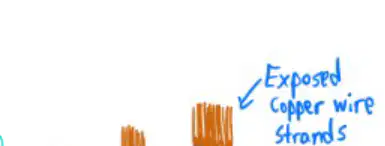
Which factor affects the resistance of a wire by allowing more charges to pass through at any given time?
Lower Conductivity
Greater Thickness
Longer Length
Higher Temperature
Water flows through a pipe. Select the correct analogies.
Current is like how much water flows through
Voltage is like the water pressure; it's what makes the water flow through
Resistance is like how big the pipes are; it's how easy or hard it is for water to flow through.
None of the above.
Which of the following best describes the direction of electron flow in the circuit?
From low potential to high potential
From high potential to low potential
In both directions simultaneously
From the bulb to the battery only
In reality, current actually flows from which terminal to which terminal of a battery?
Negative to positive
Positive to negative
Neutral to positive
Both directions equally
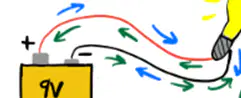
What color arrows in the diagram represent the actual direction of electron flow?
Green
Blue
Red
Yellow
What is the most dangerous factor for injury or death?
Voltage (volts)
Current (amps)
Resistance (ohms)
All are of equal importance
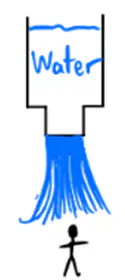
What would happen if both the tank was large and the flow was fast in the analogy to electricity?
High voltage and high current
Low voltage and low current
High voltage and low current
Low voltage and high current
Provides the push that allows charges to flow through a circuit.
Current
Resistance
Voltage
Measures how difficult it is for charges to flow through a circuit.
Current
Resistance
Voltage
Match the following terms with their unit
Current
Amps
or Ampere
Voltage
Volts
Resistance
Ohms
What are the two main factors that affect the current flowing through a circuit?
Resistance and voltage
Temperature and pressure
Length and width of the wire
Color and shape of the circuit
What happens to the current if the voltage in a circuit increases?
The current decreases.
The current stays the same.
The current increases.
The current becomes zero.
Which equation correctly represents Ohm’s Law?
I = V + R
I = V × R
I = V / R
I = R / V
If the current in a circuit is 3A and the resistance is 4Ω, what is the voltage?
12V
7V
1.33V
0.75V
If the voltage is 24V and the current is 6A, what is the resistance?
4Ω
18Ω
144Ω
0.25Ω
What is the primary function of symbols in schematic diagrams?
To represent each element in the circuit.
To decorate the diagram.
To show the size of components.
To indicate the color of wires.
If a circuit does not have a voltage source, what will happen?
No current will flow
The resistance will increase
The switch will not work
The wire will break
What is a key advantage of LEDs over traditional light bulbs?
They are more energy efficient
They are more expensive
They are larger in size
They require more maintenance

Battery
Lines
Resistor
bulb

resistor
Ammeter
Voltmeter
Switch

zig zag
Resistor
Ammeter

Which one is the circuit diagram of this picture?


Which schematic circuit matches this circuit picture?


Select the symbol for LIGHT BULB


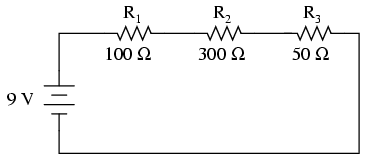
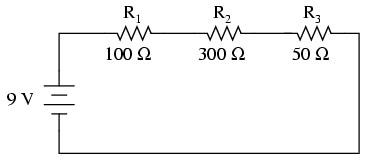

Solve for the voltage drop at resistor 1
38 volts
60 Kvolts
50 volts
25 volts
If one bulb goes out in a series circuit, the remaining bulbs...
also go out
get brighter
get dimmer
explode, leaving shards of glass everywhere
If three identical bulbs are connected in parallel, how does the brightness of each bulb compare to a single bulb connected to the battery?
Each bulb is dimmer
Each bulb is brighter
Each bulb has the same brightness
Only one bulb lights up
If the battery voltage is 6V, what is the voltage across each bulb in the parallel circuit?
2V
3V
6V
12V
If three bulbs are connected in parallel and one is removed, what happens to the total current from the battery?
It increases
It decreases
It stays the same
It becomes zero
If a fourth bulb is added in parallel to the circuit, what happens to the total resistance?
It increases
It decreases
It stays the same
It becomes infinite
In a parallel circuit, if one bulb fails, what happens to the other bulbs?
They stay on
They all go out
They flicker
They get brighter
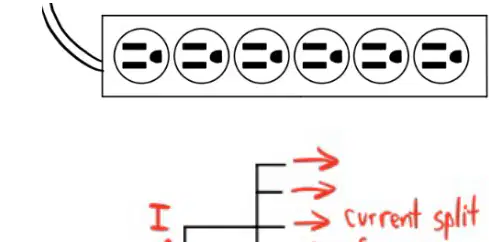
What does the diagram show about current in a power strip?
Current splits into six branches.
Current flows in a single path.
Current reverses direction.
Current stops flowing.
A parallel circuit provides multiple paths for electron flow.
True
False

Based on the information provided in the schematic:
Voltage drop at R1 =
3 V
8 V
18 V
24 V
Based on the information provided in the schematic:
Current through R1 =
2 V
2 A
2 Ω
2 W

The equivalent resistance (total resistance) for the circuit shown is ___.
0.333 ohms
3 ohms
31 ohms
10 ohms
6 ohms
Use your knowledge of parallel circuits and Ohm's Law to solve for the missing components of the circuits.
6 V
4 A
16 V
8 A
12 A
24 V
How many path exists for current in a combination circuit?
None.
One.
Up to two.
Two or more.
What is the effective resistance of a circuit with a 10 Ω resistor in series with two 20 Ω resistors in parallel?
10 Ω
20 Ω
30 Ω
40 Ω
A combination circuit is made of series and parallel resistances.
True
False

What is the value of RT ?
54 Ω
4 Ω
6.083 Ω
18 Ω
What is the value of IT ?
1 A
2 A
3 A
4 A

What is the voltage drop over the 2 ohm resistor?
6 V
3 V
2 V
1 V


A kettle of power 2000 W is switched on for 25 mins. What is its energy consumed in kWh?
50000 kWh
50kWh
500 kWh
.5kWh
.83 kWh
How much time did you play video games if the PS4 uses 210 W of power and you used a total of 14.5 kWh of energy?
6.63 hrs
0.15 hrs
69 hrs
50 hrs
A 200 W drill transfers 3 kWh of electrical energy. How long was in used for?
5 hr
15 hr
20 hr
10 hr

