
 Worksheets
Exam Instructions Quiz
Total questions: 17
Worksheet time: 9mins
In the context of the Finite Element Method, why are elements with poor aspect ratios (e.g., highly elongated elements) generally avoided?
They are computationally expensive.
They lead to faster convergence.
They may result in inaccurate solutions.
They are more stable for elastic problems.
What is the primary purpose of shape functions?
To approximate the geometry of the elements.
To define the material properties of the elements.
To interpolate the unknown field variables within the elements.
To determine the size of the finite elements.
If a force F is applied to the spring system, what principle should be used to find the equilibrium position of the mass?
Principle of maximum energy
Principle of minimum of the potential energy
Principle of equal forces
Principle of constant velocity
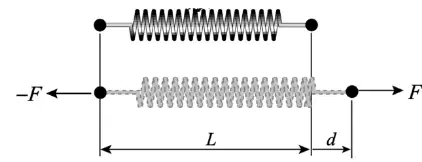
What does the diagram show?
A pulley system
A spring system with forces applied at both ends
A lever and fulcrum
A rotating wheel
Which equation represents the force-balance method for a spring system?
F equals k times x
F equals x divided by k
F equals k divided by x
F equals k plus x
If the potential energy of a spring system is given by Pi equals one half k x squared minus F x, what do you do to find the equilibrium position?
Set the potential energy to zero
Take the derivative with respect to x and set it to zero
Multiply by the spring constant
Divide by the force
CFD simulations can be done on a computer using which technique(s)?
Finite Element Method
Finite Difference Method
Finite Volume Method
All of the above
Consider the equation (du/dx) = (u_j - u_{j-1})/dx formulated using the Taylor series expansion. Find the type of equation.
First-order forward difference
First-order backward difference
Second-order forward difference
Second-order backward difference
For the aerofoil simulation mentioned in Question 16, which salient parameters would you use to determine the size of the mesh required in the regions of interest?
Using the Reynolds number and if it is laminar or turbulent.
Using the Froude number
Using the y+ values
Using the Mach number
What is the unit of the flow velocity u given in the problem?
Meter per second
Meter per hour
Second per meter
Newton per second
What is the characteristic length L given in the problem?
0.1 meters
1 meter
10 meters
100 meters
If you are given values of u at equally spaced grid points in the y-direction, what is the spacing Δy between the points?
0.1 meters
1 meter
0.01 meters
10 meters
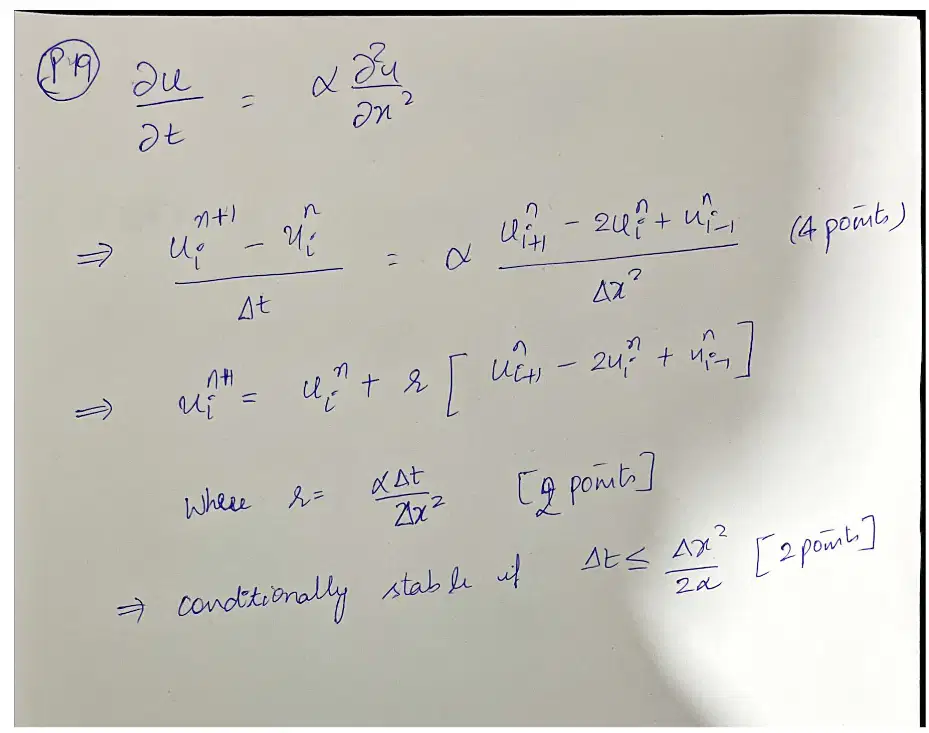
What is the stability condition for the time step Δt in terms of Δx and α as shown in the handwritten notes?
Δt ≤ Δx² / 2α
Δt ≥ Δx² / 2α
Δt = Δx² α
Δt = 2α Δx²
Which method is used in 20.1 to calculate the value?
First order one-sided difference
Second order one-sided difference
Third order one-sided difference
Exact analytical calculation
What is the main focus of question 20.4 in the document?
Calculate the error of numerical results
Calculate the exact value of the shear stress analytically
Use third order one-sided difference
Use first order one-sided difference
What is the value of shear stress (τw) calculated using the first order one-sided difference method?
0.0275 N/m²
0.0288 N/m²
0.0289 N/m²
0.0300 N/m²

What is the value of shear stress (τw) calculated using the third order one-sided difference method?
0.0289 N/m²
0.0275 N/m²
0.0288 N/m²
0.0300 N/m²

