
 Worksheets
Science 7 Unit #4 Structures & Forces
Total questions: 39
Worksheet time: 20mins
Mass structures have a low level of compressive strength. Mark only one oval.
True
False
Spreading the weight of a structure over a large area increases its stability. Mark only one oval.
True
False
Increasing a structure's stability reduces the structural efficiency of that structure. Mark only one oval.
True
False
One way to reduce material failure is to build using composite materials.
True
False
Because rectangular-shaped frames can be easily pushed or pulled out of shape, they should not be used in structures.
True
False
Excessive torsion forces will cause a structure to shear.
True
False
Metal fatigue occurs when the forces holding particles of material together are weakened because of regular movement.
True
False
In order for a structure to "fail" it must collapse completely.
True
False
A bird sitting on the windowsill of your house is an example of a dead load.
True
False
Your weight is the same when you are standing at sea level as it is when you are standing on a high mountain.
True
False
The mass of a structure would be the same on the Moon as it is on Earth.
True
False
A structure that is constructed by humans.
Load
Design
Function
Natural Structure
Manufactured Structure
The manner in which a structure is put together.
Load
Design
Function
Natural Structure
Manufactured Structure
The weight supported by a structure
Load
Design
Function
Natural Structure
Manufactured Structure
The purpose of a structure.
Load
Design
Function
Natural Structure
Manufactured Structure
A structure that is not made by humans.
Load
Design
Function
Natural Structure
Manufactured Structure
Crushes material by squeezing it together.
Tension
Compression
Shear
Torsion
Stretches material by pulling its ends apart.
Tension
Compression
Shear
Torsion
Bends or tears material by pushing it in opposite directions at the same time.
Tension
Compression
Shear
Torsion
Doorknobs are designed to withstand this kind of force. Check all that apply.
Tension
Compression
Shear
Torsion
Fill in the Blanks
Use the following words: (a word may be used more than once)
- Forces
- Stable
- Fail
- Mass
- Compression
- Shear
- Dead
- Distance
22. Structures are most ________________________ when their base rests on a large area and when they have most of their ________________________ close to the ground.
Stable, Mass
Fail, Distance
Shear, Compression
Dead, Forces
Structures are designed to resist ________________________ that might affect their shape.
Forces
Colors
Textures
Sounds
Designers study why structures ________________________ in order to devise ways to strengthen and improve them.
Fail
Succeed
Float
Disappear
________________________ forces bend or tear a material by pressing different parts in opposite directions at the same time.
Shear
Tensile
Compressive
Torsional
The Leaning Tower of Pisa exerts ________________________ forces on the ground beneath it.
downward
upward
sideways
rotational
A ________________________ load refers to the weight of a structure itself.
dead
live
dynamic
impact
The gravitational force between two objects depends on the ________________________ of each object and the ________________________ between them.
mass, distance
volume, temperature
area, speed
density, color
You are meeting with a designer to plan a huge monument to your favorite teacher. What do designers do to create a firm foundation?
Find a solid base to build on.
Create a solid layer to build on.
Spread the load of a structure over a large area.
Balance forces.
All of the above
What does spin stabilization allow you to do?
increase your stability by crouching down low
balance a stack of plates in your hands
walk upright
carry large loads
ride a fast-moving bicycle with no hands on the handlebars
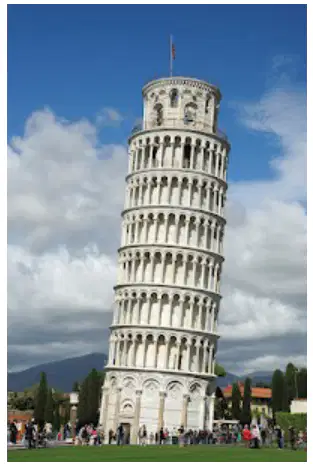
Why is the Leaning Tower of Pisa tipping?
The weight of the structure is causing the soil on one side to compress and slip sideways.
One side of the tower is heavier than the other side.
The foundation hole was dug unevenly.
Water drained into one side of the base.
none of the above
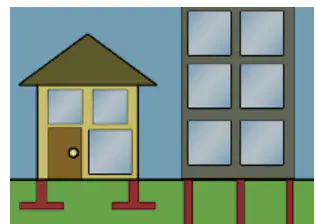
Why is it important that foundation walls extend into the soil layers that never freeze?
The freezing will not let the concrete harden.
The freezing and thawing will cause the soil to weaken and fall away.
The foundation must always be kept warm to maintain its strength.
The metal reinforcement in the foundation will break if frozen.
In order to spread out the weight of a structure, foundation walls are set on which of the following?
loose gravel
packed sand
packed top soil
concrete footings
The driver of a racing car is in the middle of a race when it begins to rain. The rain gets in between the slick tires and the road and acts as a lubricant. The car is very unstable and hard to drive in this situation. How could you increase the friction between tire and road to correct this problem?
Replace the large slick tires with a smaller slick tire.
Replace the existing slick tires with larger slick tires.
Replace the slick tires with ones that have grooves to form a tread.
Replace the large slick tires with smaller slick tires and remove weight from the car.
All structures have a maximum load that they can carry. Once the load passes this point the structure begins to be damaged or fails completely. How can the use of I-, L-, or T-beams instead of solid beams help with this problem?
The I-, L-, and T-beams are stronger than the solid beams.
The I-, L-, and T-beams are more flexible than the solid beams.
The I-, L-, and T-beams are more easily attached together than the solid beams.
The I-, L-, and T-beams have less dead load but comparable strength to the solid beams.
Sarah's teacher demonstrated the strength of different materials in class. In the last demonstration he brought out a cardboard moving box. He gave the box to Sarah for her to weigh, and she told the class that the box had a weight of 875 g. The teacher then stood on a scale and told the class he weighed 90 kg. Sarah's teacher then took the box and placed it on the floor. He proceeded to stand on the box without it collapsing. How was the lightweight box able to support such a large load?
The cardboard was very heavy.
The corrugations in the cardboard focused the load in one area.
The corrugations in the cardboard spread the load out over the entire box.
The corrugations in the cardboard made it more flexible under the load.
You are hired by a contractor to help frame a house. On your first day, you want to impress everyone with your understanding of design. You tell the contractor that frames that are weak in the middle can be stabilized by ____________________________.
bracing the middle of the beam
supporting the load by an arch
adding a cantilever
A, B, and C
A and C
Spider silk has a great deal of what type of strength?
Tensile
Compressive
Shear
Torsion
The difference between mass and weight is:
Mass is the amount of matter in an object, while weight is the force exerted by gravity on that object.
Mass and weight are the same thing.
Mass is measured in newtons, while weight is measured in kilograms.
Weight does not depend on gravity, but mass does.
Studying how structures fail helps designers create more efficient and stable structures by:
Identifying weaknesses and improving future designs
Increasing the cost of construction
Making structures more complex
Ignoring past mistakes