
 Worksheets
Baileys General Otolaryngology
Total questions: 51
Worksheet time: 51mins
Which stimuli use ion channels for taste transduction?
Sweet
Sour
Salty
Bitter
sour and salty
Which of the following symptoms of chronic rhinosinusitis would be least improved
by endoscopic sinus surgery?
Postnasal discharge
Facial pain
Hyposmia
Nasal congestion
A 44-year-old woman with diabetes presents with a 2-day history of painful swelling of
the submandibular gland. Her symptoms are exacerbated by eating. Purulence is expressible
from Wharton duct. A Cf scan demonstrates enlargement of the submandibular
gland with surrounding fat stranding, and a 3-mm intraductal sialolith is present. Her
blood glucose is 320 mgfdL. The next appropriate step in management would be:
Sialendoscopy and removal of the obstructing sialolith
Admission to the hospital, intravenous antibiotics, and tight blood glucose control
Oral antistaphylococcal antibiotics, sialagogues, and gland massage
Transoral removal of the sialolith
The Agency for Healthcare Research and Quality (AHRQ) offers a number of health
care effectiveness resources for clinicians. Which of the following is one among them?
Health-related quality-of-life instruments
Technology assessments
Meta-analysis tutorials
Links to patient interest group sites
A 45-year-old woman presents to the emergency room with a 2-day history of progressive
swelling of the floor of mouth, firm induration of the submandibular region,
trismus, and dyspnea. Which of the following is the most appropriate next step in
management?
Awake tracheotomy
Conventional endotracheal intubation
Close observation and monitoring in the intensive care unit
Thoracic surgery consultation
Which of the following is the most common etiology of acute pharyngitis in children
and adults?
Bacterial
Viral
Fungal
Inflammatory
Autoimmune
Which is the most robust taste sensation?
Sweet
Salty
Sour
Bitter
Severe complications of Kawasaki disease include:
Acute renal failure
Coronary artery aneurysm
Pulmonary hemorrhage
Ascending neuropathy
Hepatic dysfunction
A 7-year-old boy presents with a 5-week history of a parotid mass. The boy was
evaluated by his pediatrician and completed a 14-day course of amoxicillin without
improvement. There is a 2-cm fluctuant mass with a violaceous hue to the closely adherent
overlying skin. Fine-needle aspiration (FNA) demonstrated acid-fast bacilli in
the aspirate. Resolution of the patient's disease would be most effectively achieved by:
Incision and drainage of the abscess and culture
Incision and drainage of the abscess and clarithromycin
FNA, culture, and clarithromycin
Superficial parotidectomy
A 3-year-old boy presents with an abscess of the retropharyngeal space. What is the
most likely etiology for this infectious process?
Sialadenitis
Upper respiratory tract infection
Tooth decay
Surgical instrumentation trauma
Which of the following is the most consistent landmark for the localization of the
facial nerve?
1 cm lateral and inferior to the tragal pointer
6 mm to 8 mm deep to the tympanomastoid suture
Anterolateral aspect of the styloid process
Lateral to the posterior belly of the digastric muscle
Which of the following statements is true regarding treatment of disorders of the
temporomandibular j oint (TMJ) ?
Clinical evidence supports the use of open surgical intervention over arthroscopy for
intracapsular disorders of TMJ .
Nonsteroidal anti-inflammatory drugs (NSAIDs) have been shown to reduce discomfort
from myofascial pain, symptomatic intracapsular disorders, and otalgia associated
with temporomandibular disorder (TMD ) .
Restorative dental procedures prevent worsening ofTMD i n the presence o f mild TMD .
Comminuted, laterally displaced segments i n fractures o f the mandibular condyle
should be treated nonoperatively.
A 2 7 -year-old otherwise healthy man is admitted to the hospital for a fever of unknown
origin. The next morning he presents with a right-sided jugular vein thrombosis,
ptosis, anhidrosis, and miosis. The infection is most likely located in which deep neck
space?
Prestyloid parapharyngeal space
Poststyloid parapharyngeal space
Retropharyngeal space
Anterior visceral space
Which of the following organisms are common sources of infection in acute bacterial
sialadenitis?
Gram positive cocci
Aerobic gram-negative rods
Anaerobic gram-negative rods
All of the above
An 81-year-old woman presents on postoperative day 6 following a hemicolectomy
with swelling and severe tenderness over the right preauricular region, purulent fluid
from Stensen duct, and no trismus. In addition to hydration, antimicrobials targeting
which organism should be administered?
Klebsiella pneumoniae
Streptococcus viridians
Streptococcus pyogenes
Staphylococcus aureus
Sensory innervation of the temporomandibular j oint is from:
Facial nerve
Auriculotemporal, deep temporal, and masseteric nerves
Great auricular nerve
Superficial temporal nerve
A 25-year-old woman is diagnosed with Crohn disease. Which characteristic oral manifestation
of Crohn disease might you expect to see in this patient?
Strawberry gingivitis
Ulcers that heal with scarring
Fissuring of the tongue
Buccal mucosal cobblestoning
Odontogenic infections are more prevalent in which demographic?
Children
Elderly men
Middle age men
Elderly women
Which of the following medications has demonstrated efficacy in preventing
chemoradiation-related mucositis?
Topical triamcinolone
Palifermin
Hydroxyurea
Second-generation cephalosporins
Which of the following odontogenic space infections do not commonly have trismus
at presentation?
Buccal space infection
Masseteric space infection
Temporal space infection
Pterygoid space infection
Where are taste buds located?
Fungiform papillae
Filiform papillae
Foliate papillae
Circumvallate papillae
Fungiform papillae, Foliate papillae dan Circumvallate papillae
Which of the following statements is true regarding pemphigus vulgaris ( PV) ?
Direct immunofluorescence shows linear deposition of IgG and C3 along the basement
membrane.
Oral involvement is rare in PV.
The pathogenesis of PV is loss of cell-to-cell adhesion due to damaged desmosomal
proteins.
PV has not been associated with other autoimmune disorders.
Which of the following properties allow saliva to act as a good lubricant and biofilm
barrier?
High solubility
Low viscosity
High elasticity
Weak adhesiveness
Which of the following glands produce the majority of the unstimulated saliva?
Parotid glands
Minor salivary glands
Sublingual glands
Submandibular glands
Which of the following attributes of a health-related quality-of-life instrument would
be particularly important in planning a study to evaluate the effect of an intervention?
Construct validity
Interobserver reliability
Face validity
Responsiveness
Which of the following is important in the evaluation of burning mouth syndrome?
Punch biopsy of the tongue
Patch testing of oral mucosa
Trial of a-lipoic acid
Serum ferritin and B vitamin levels
Based on the multicellular theory of tumorigenesis, mucoepidermoid carcinoma
arises from:
Excretory duct cells
Striated duct cells
Acinar cells
Intercalated duct cells
Appropriate management of an 18-year-old patient with infectious mononucleosis
with a positive monospot test includes:
A.
A single dose of intramuscular ceftriaxone
Oral penicillin
Intravenous penicillin
Oral acyclovir
Rest, hydration, antipyretics, and analgesics
How many cell types are there in a taste bud?
Five
One
Three
More than 1 0
Which of the following antibiotics represents the most appropriate empiric treatment
of an odontogenic infection?
Amikacin
Clindamycin
Erythromycin
Doxycycline
Temporomandibular disorders (TMDs) are associated with:
Depression
Irritable bowel
Fibromyalgia
All o f the above
Tasters and nontasters are identified based on the individual's ability to perceive:
Capsaicin
Alcohol
Sucrose
6-n-Propyl-thiouracil (PROP)
Which of the following statements regarding juvenile recurrent parotitis is false?
The disease typically resolves by the end of adolescence.
Treatment during acute parotitis episodes is similar to acute bacterial sialadenitis.
Ligation of Stenson duct and tympanic neurectomy have been shown to be effective
treatment options.
Sialendoscopy with dilation, saline irrigation, or steroid irrigation has been shown to
improve symptoms.
Which cells are responsible for producing the primary salivary secretion?
Myoepithelial cells
Ductal cells
Acinar cells
Basal cells
Which of the following statements best describes concurring occlusal appliance
(splint) therapy?
The type of appliance is of critical importance.
Use of the device repositions the displaced articular disc over time.
This therapy is effective for temporomandibular j oints (TMJs) -related myofacial pain.
This therapy slows the progression of arthritis in the TMJ.
Which structure directly contributes to the borders of the retropharyngeal space?
Pharyngobasilar fascia
Pharyngeal constrictor musculature
Buccopharyngeal fascia
Prevertebral fascia
Which muscle attachment helps predict the spread of odontogenic infections into the
submandibular space?
Anterior digastric muscle
Genioglossus muscle
Mylohyoid muscle
Stylohyoid muscle
Which of these salivary glands are most sensitive to injury from radiation treatment?
Submandibular glands
Parotid glands
Sublingual glands
Minor salivary glands
According to the World Health Organization's International Classification of Functioning,
Disability, and Health (ICF) definitions, tinnitus would be classified as a(n) :
Disorder
Handicap
Disability
Impairment
Generic health-related quality-of-life instruments are usually divided for measurement
into three core domains. They are:
Physical, social, and psychological
Physical, emotional, and self-help
Physical, role functioning, and mood
Physical, interpersonal interactions, and vocational
Odontogenic infections are most likely to arise from:
Maxillary central incisor
Mandibular lateral incisor
Maxillary first molar
Mandibular second molar
Which of the following disorders can be confused with oral mucosa drug eruptions,
contact allergies, and lupus?
Lichen planus
Behcet disease
Recurrent aphthous stomatitis
Orofacial granulomatosis
Which of the following statements is not true regarding temporomandibular disorder
(TMD) pathology?
Studies have shown abnormal pain processing in patients with chronic myofascial
pain.
Cytokines, metalloproteinases, free radicals, and reperfusion inj ury likely all contribute
to intracapsular pathology and symptoms in TMD .
The disc o f the temporomandibular j oint has a central, abundantly neurovascular
zone which contributes to pain when it is damaged.
Disc displacement in intracapsular disorders moves the disc anteriorly, and may be
followed by reduction and accompanied by j oint noise, or may be nonreducing and
have an absence of j oint noise.
After a positive rapid antibody detection test (RADT) for group A -hemolytic streptococcus
(GABHS) in a 4-year-old patient, which of the following is the next appropriate
step in management?
Confirmation with GABHS culture on blood agar
Symptomatic therapy
Treatment with amoxicillin
Treatment with azithromycin
Treatment with acetaminophen
In a patient with suspected acute retroviral syndrome pharyngitis, initial diagnostic
testing for human immunodeficiency virus (HIV) is performed by:
Western blot
Southern blot
Culture on chocolate agar
Enzyme-linked immunosorbent assay (ELISA)
Monospot test
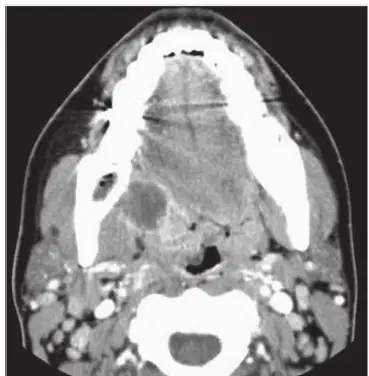
A 34-year-old man with drooling and fever. What is the most likely source for the
abscess seen on this CT?
Hematologic
Palatine tonsils
Odontogenic
Suppurative node
Osteomyelitis
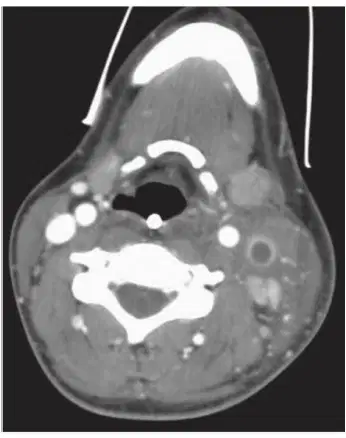
A 19-year-old girl with deep space neck infection. What is the most likely complication
that should be sought through further imaging?
Retropharyngeal abscess
Danger space extension to the mediastinum
Osteomyelitis
Intracranial infection
Lung abscess
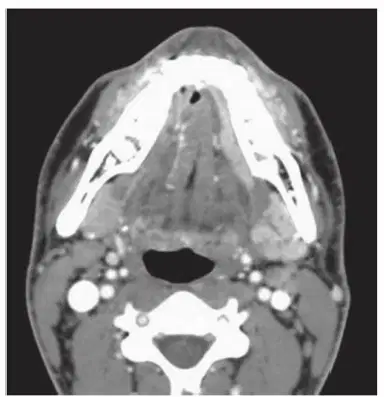
A 29-year-old with neck swelling. The key finding on this CT is:
Submandibular sialadenitis
Sublingual sialadenitis
Sialolithiasis
Cellulitis
All of the above
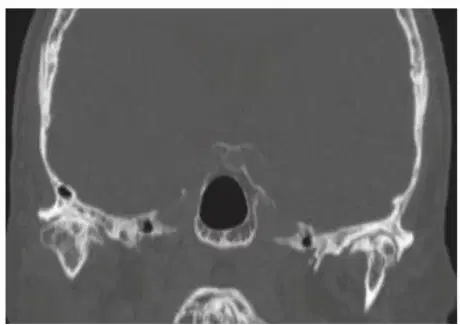
68-year-old woman with headaches and facial pain. What is the most likely cause?
Sinusitis
Paget disease
Cervical spondylopathy
Cerebrospinal fluid leak
Temporomandibular osteoarthropathy
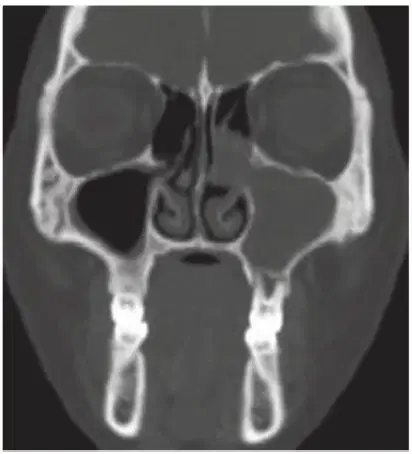
A 38-year-old woman with sinus pain. What is the most likely source of maxillary
sinusitis?
Odontogenic
Isolated nasal polyp
Nasal polyposis
Cystic fibrosis
Nasal cavity malignancy
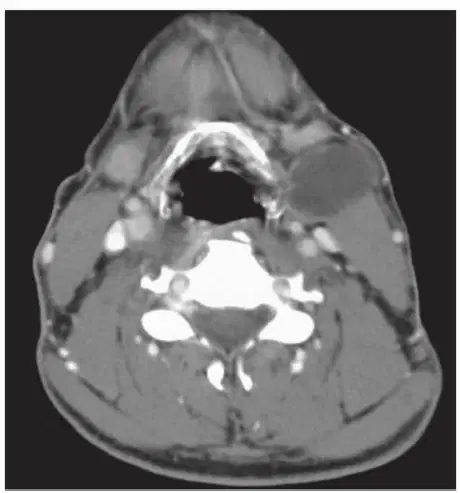
A healthy, nonsmoking 48-year-old man with painless neck mass. What is the most
likely diagnosis?
Branchial cleft cyst
Thyroglossal duct remnant
Mycobacterial infection
Bacterial abscess
Squamous cell carcinoma (SCC)

