wayground logo

Free Printable Worksheets

Font size

S
M
L
XL
Worksheets

Biochemistry Final Review Quiz!

Total questions: 69

Worksheet time: 2hrs 15mins

Name
Class
Date
1.

Amino Acids are unique due to their...

a)

Attached 'R-Group'

b)

Attached 'A - Group'

c)

Attached 'P - Group'

2.

Amino Acids all have which TWO in common?

a)

Carboxyl Group (COOH)

b)

Amine Group (NH2)

c)

Hydroxyl Group (OH)

d)

Methyl Group (–CH3)

e)

Cyanide Group (–CN)

3.

Amino Acids that have to be gotten through your diet are called...

a)

Essential Amino Acids

b)

Dietary Amino Acids

c)

Gastrointestinal Amino Acids

4.

The bond between amino acids is called a...

a)

Peptide Bond

b)

Peptic Bond

c)

Protein Bond

d)

Transpeptic Bond

5.

A peptide bond is a 'special' type of _____ bond between amino acids.

a)

Covalent

b)

Ionic

6.
The limiting reactant . . .
a)
slows the reaction down.
b)
is used up first.
c)
is the reactant that is left over.
d)
controls the speed of the reaction.
7.
3. The reactant that is not completely used up in a chemical reaction is called the __________ .
a)
spectator reagent
b)
limiting reagent
c)
excess reagent
d)
catalyst
8.
When you use a balanced chemical equation to calculate the amount of a product on paper it is referred to as the 
a)
experimental value
b)
theoretical value
c)
true amount
d)
percent yield
9.

Why is it important to identify the limiting reagent?

a)

The limiting reagent speeds up the reaction.

b)

The limiting reagent controls the amount of product formed.

c)

If there is no limiting reagent, the reaction will not occur.

d)

No stoichiometry calculations can be done without a limiting reagent.

10.
Identify the limiting reagent when 6.00 moles HCl combines with 5.00 moles Mg to form MgCl2.
 
1 Mg +  2 HCl --> 1 MgCl2  +  1 H2   
 
a)
Mg
b)
H2
c)
MgCl2
d)
HCl
11.
Use the equation 2 Al + 3 Cl2 ---> 2 AlCl3.  If 2 moles of aluminum and 2 moles of chlorine are reacted, identify the limiting reactant.
a)
AlCl3
b)
Cl2
c)
Al
d)
None
12.

Theoretical yield = 73g

Actual yield = 62g

Calculate the percent yield.

a)

116%

b)

85%

c)

1.16%

d)

76%

13.
A reaction was predicted to produce 32.4 grams of a compound. When the product was measured, there were only 26.1 grams made. What is the percent yield?
a)
80.6%
b)
6.3%
c)
24.1%
d)
58.5%
14.

Cl2 + 2 KBr → Br2 + 2 KCl

How many grams of potassium chloride can be produced from 356 g of Cl2 and 356 g of potassium bromide?

a)

749 g

b)

223 g

c)

479 g

d)

814 g

15.
What is the molar mass of AuCl3?
a)
96 g
b)
130 g
c)
232.5 g
d)
303.3 g
16.

What is the total mass, in grams, of a 0.75 mole sample of SO2?

a)

16 g

b)

24 g

c)

32 g

d)

48 g

17.
Balance this equation
_Zn+_HCl-->_ZnCl+_H2
a)
1,1,2,1
b)
1,1,1,2
c)
1,2,1,1
d)
2,1,1,1
18.
KNO3 --> KNO2 + O2
What coefficients are needed to balance the reaction?
a)
2, 2, 1
b)
2, 3, 2
c)
1, 2, 2
d)
1, 3, 1
19.
If the percentage yield for a chemical reaction is 80.0%, the 
a)
actual yield is 80.0g for every theoretical yield of 100g.
b)
actual yield is 80 times as much as the theoretical yield.
c)
theoretical yield is 80 times as much as the actual yield. 
d)
theoretical yield is 80.0 g for every actual yield of 100g.
20.

What is the molarity of 1.2 moles of CaCO3 in 1.22 L of solution?

a)

0.98 M

b)

9.8 M

c)

5.11 M

d)

0.16 M

21.

How many grams of K2CO3 are needed to make 200 mL of a 2.5 M solution? (Hint MM of K2CO3= 138.204 g/mol)

a)

69102 g

b)

69.102 g

c)

0.5 g

d)

500 g

22.
How many moles of NaCl are present in a solution with a molarity of 8.59 M and a volume of 125 mL?
a)
1074 mol
b)
0.069 mol
c)
1.07 mol
d)
62.7 mol
23.
How many L are required to make 3.5 M hydrochloric acid using 1.1 moles? 
a)
3.18 L
b)
0.31 L
c)
3.85 L
d)
4.6 L
24.

What is the [H+] in a solution with a pH of 11?

a)

1 x 10⁻¹ M

b)

1 x 10⁻² M

c)

1 x 10¹¹ M

d)

1 x 10-11 M

25.

What is the pH of a solution that has a [H+] of 2.5 x 10⁻⁵?

a)

4.6

b)

5.0

c)

2.5

d)

7.0

26.

What is the [OH-] if the [H+] is 1.0 x 10⁻³ M?

a)

1.0 x 10⁻³ M

b)

6.02 x 10⁻²³ M

c)

1.0 x 10⁻¹⁴ M

d)

1.0 x 10⁻¹¹ M

27.

What is the pOH of a 1 x 10⁻⁸ M solution of HNO3?

a)

8

b)

6

c)

7

d)

9

28.

If a solution has a very low pH, the hydroxide concentration is _______.

a)

very high

b)

very low

c)

zero

29.

Oranges have a [H+] of 1.7 x 10⁻² M. Their pOH is

a)

1.77

b)

12.23

c)

10.91

d)

3.09

30.

Ba(NO3)2Ba\left(NO_3\right)_2  

a)

Soluble

b)

Insoluble

31.

Ca(C2H3O2)2Ca\left(C_2H_3O_2\right)_2  

a)

Soluble

b)

Insoluble

32.

Al2(CO3)3Al_2\left(CO_3\right)_3  

a)

Soluble

b)

Insoluble

33.

Li2SLi_2S  

a)

Soluble

b)

Insoluble

34.

(NH4)2CO3\left(NH_4\right)_2CO_3  

a)

Soluble

b)

insoluble

35.

RbI

a)

Soluble

b)

Insoluble

36.

NaOH

a)

Soluble

b)

Insoluble

37.

BaSO4BaSO_4  

a)

Soluble

b)

Insoluble

38.

What is the correct chemical formula for magnesium chloride?

a)

MgCl

b)

Mg2Cl

c)

MgCl2

d)

MgCl3

e)

Mg3Cl

39.
How do the following two elements bond together?
Na1+  F1-         
a)
NaF
b)
NaF3
c)
Na3F
d)
Na1F2
40.
How do the following two elements bond together?
K1+  S2- 
a)
KS
b)
K8S
c)
K6S3
d)
K2S
41.

What is an electrolyte?

a)

A substance that dissolves in water and produces ions.

b)

A substance that dissolves in water but doesn't produce ions.

c)

A substance that doesn't dissolve in water.

d)

A substance that melts at room temperature.

42.

What makes a solution a WEAK electrolyte?

a)

When the solute completely ionizes in water.

b)

When the solute doesn't dissolve in water.

c)

When the solute partially ionizes in water.

d)

When the solute is not added to the water.

43.
Which solution would be least likely to carry an electric current?
a)
NaCl
b)
HCl
c)
C6H12O6
d)
CsI
44.

What type of reation occurs between an acid and a base?

a)

Combustion

b)

Synthesis

c)

Neutralization

45.

What are the products of a neutralization reactions

a)

water

b)

salt

c)

acid

d)

base

46.

Which molecule shape has three atoms bonded to the central atom and no unshared pairs on the central atom?

a)

tetrahedral

b)

trigonal pyramidal

c)

trigonal planar

d)

bent

47.

Which of the following molecular shape is bent?

a)

SCl2

b)

CO2

c)

PH3

d)

NCl3

48.

What molecular geometry would PBr3 have?

a)

trigonal pyramidal

b)

trigonal planar

c)

tetrahedral

d)

linear

49.

When you have H-Cl, what is the polarity?

a)

nonpolar

b)

polar

c)

ionic

50.

When you have Be-F, what is the polarity?

a)

nonpolar

b)

polar

c)

ionic

51.

When you have F-F, what is the polarity?

a)

nonpolar

b)

polar

c)

ionic

52.

Is this molecule polar or non-polar?

a)

Non-polar

b)

Polar

53.

Is this molecule polar or non-polar?

a)

Polar

b)

Non-polar

54.

What is the IMF shown below?

a)

Hydrogen bonding

b)

dipole dipole

c)

LDF

d)

ion dipole

55.

What is the IMF shown below?

a)

hydrogen bonding

b)

ion dipole

c)

LDF

d)

dipole dipole

56.

Which of the following has the highest boiling point?

a)

CH4

b)

H2O

c)

HCl

d)

PH3

57.

What is the order of IMF from weakest to strongest?

a.dipole dipole

b.covalent bonds

c.ion dipole

d.hydrogen bond

e. LDF

a)

a.b.c.d.e.

b)

e.d.c.b.a.

c)

b.a.c.e.d.

d)

e.a.d.c.b.

58.
Which of the following units are repeatedly joined together to form a strand of DNA?
a)
amino acids
b)
nucleotides
c)
fatty acids
d)
polysaccharides
59.
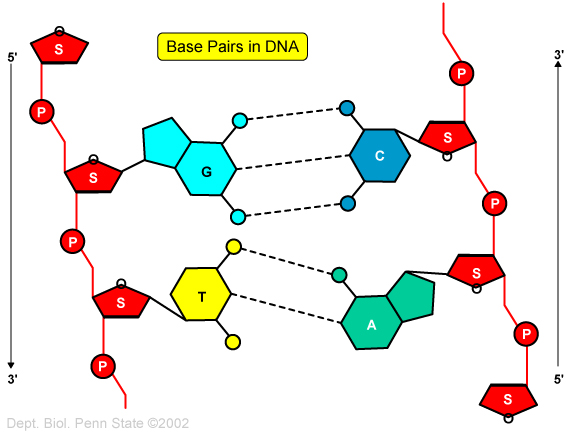
Guanine bonds with ______________.
a)
Adenine
b)
Guanine
c)
Cytosine
d)
Thymine
60.
What are the three components of a nucleotide?
a)
sugar, hydrogen, nitrogen base
b)
sugar, oxygen, nitrogen base
c)
sugar, phosphate, nitrogen base
d)
sugar, phosphate, protein
61.
Nitrogenous bases are joined by which type of bond?
a)
polar bonds
b)
ionic bonds
c)
covalent bonds
d)
hydrogen bonds
62.
Which biomolecule contains pastas and breads?
a)
Lipid
b)
Protein
c)
Nucleic Acid
d)
Carbohydrate
63.
Which biomolecule is responsible for insulation and energy storage?
a)
Protein
b)
Nucleic Acid
c)
Lipid
d)
Carbohydrate
64.
Which biomolecule is made of amino acids?
a)
Nucleic Acid
b)
Carbohydrate
c)
Protein
d)
Lipid
65.
The monomer of a protein is called...
a)
an amino acid
b)
a monosaccharide
c)
a fatty acid
d)
a nucleotide
66.
Lipids are made up of which of the following?
a)
glycerol and fatty acids tails
b)
glycerol and monolipids
c)
fatty acids and phosolipids
d)
amino acids and nucleotides
67.
What elements are common to all 4 biomolecules?
a)
Carbon, hydrogen, nitrogen
b)
Carbon, Nitrogen, Phosphorus
c)
Carbon, Hydrogen, Oxygen
d)
Carbon, Hydrogen, Phosphorus
68.

Which of the following is a characteristic of unsaturated fats?

a)

Found mostly in dairy products

b)

Increases risk of heart disease

c)

Solid at room temperature

d)

Liquid at room temperature

69.

What is the difference between saturated and unsaturated fats?

a)

Saturated fats have a double bond(s), unsaturated fats have only single bonds

b)

Saturated fats are liquids, but unsaturated fats are solids

c)

Saturated fats have only single bonds, unsaturated fats have a double bond(s)

d)

Saturated fats are healthier than unsaturated fats