
 Worksheets
Earth's Energy Absorption Quiz
Total questions: 18
Worksheet time: 10mins
When carbon dioxide in the atmosphere increases, the amount of energy absorbed by Earth’s surface should...
increase.
decrease.
stay at a constant level.
change unpredictably.
The Karoo Ice Age started about 360 million years ago and lasted for about 40 million years. During this time, less energy entered the Earth system than exited. What is one change to the atmosphere that could have caused this?
Carbon dioxide decreased, leading to less energy in the Earth system because less energy was trapped by gases and held in the atmosphere.
Carbon dioxide decreased, leading to less energy in the Earth system because less exiting energy was redirected (bounced) back toward Earth.
Carbon dioxide increased, leading to more energy in the Earth system because more exiting energy was redirected (bounced) back toward Earth.
Carbon dioxide increased, leading to less energy in the Earth system because more energy from the sun was redirected (bounced) back toward outer space.
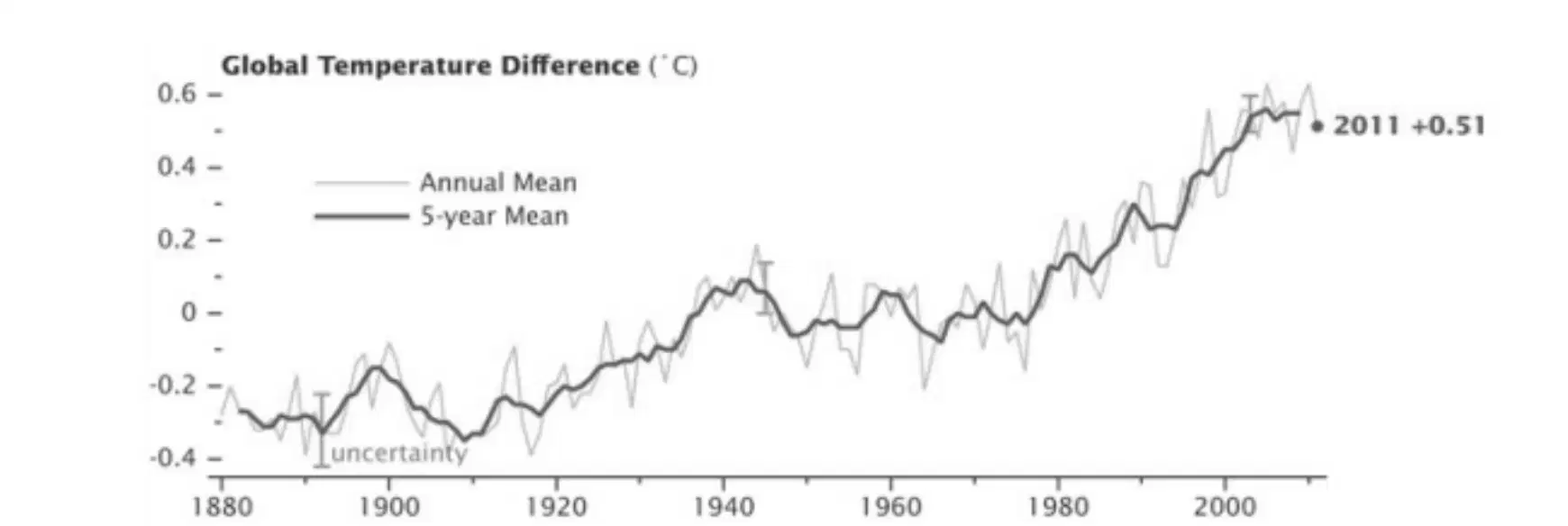
The graph above shows global temperature changes between the years 1880 and 2011. Which of the following best describes the changes seen in the graph?
The graph shows a trend of increasing temperature over time.
The graph shows temperatures go up and down, with no trend.
The graph shows the Annual Mean and 5-Year Mean have different trends.
The graph shows too much fluctuation to be confident about a trend.
Scientists are using a computer simulation to test ideas about climate on Earth. Looking at one period of time in the simulation, they notice that more energy entered the Earth system than exited. How might the amount of carbon dioxide have changed to cause this, and how would this have changed the energy in the Earth system?
carbon dioxide decreased, leading to more energy in the Earth system and more energy absorbed by Earth’s surface.
carbon dioxide decreased, leading to less energy in the Earth system and less energy absorbed by Earth’s surface.
carbon dioxide increased, leading to less energy in the Earth system and less energy absorbed by Earth’s surface.
carbon dioxide increased, leading to more energy in the Earth system and more energy absorbed by Earth’s surface.
Scientists study tree rings to learn more about Earth’s past climate. They found a time period when the amount of carbon dioxide in the atmosphere decreased. What happened to energy in the Earth system when carbon dioxide in the atmosphere decreased?
decreased, because more energy entered than exited. This is because less exiting energy was redirected (bounced) back toward Earth.
decreased, because less energy entered than exited. This is because less exiting energy was redirected (bounced) back toward Earth.
decreased, because less energy entered than exited. This is because less energy was trapped by gases and held in the atmosphere.
increased, because more energy entered than exited. This is because less energy from the sun was redirected (bounced) back toward outer space.
What is one reason that carbon dioxide is increasing in the atmosphere today?
There are more volcanoes than there were in the past.
People are riding bicycles instead of driving cars.
There are more people doing things that use combustion.
People are using solar power.
Scientists who study the atmosphere often need to take samples of the atmosphere in order to learn more. They take some atmosphere samples near the ground. They take other atmosphere samples high in the air, while flying in a helicopter. What would the scientists find out about the samples?
Both samples are made of one kind of gas.
Both samples are made of a mix of several different kinds of gases.
Neither sample is made of anything.
The samples are different from each other because each gas forms its own layer in the atmosphere.
What happened to the amount of energy absorbed by Earth's surface when carbon dioxide in the atmosphere decreased?
Decreased.
Increased.
Stayed at a constant level.
Changed unpredictably.
Some bacteria produce methane during digestion. If the amount of these bacteria decreased a lot, the amount of methane in the atmosphere would decrease. What would happen to energy in the Earth system if this happened? If methane decreased, . . .
there would be more energy in the Earth system and more energy absorbed by Earth’s surface, because more energy would enter than exit.
there would be more energy in the Earth system and more energy absorbed by Earth’s surface, because less energy would enter than exit.
there would be less energy in the Earth system and less energy absorbed by Earth’s surface, because less energy would enter than exit.
there would be less energy in the Earth system and less energy absorbed by Earth’s surface, because more energy would enter than exit.
From about 360 to 299 million years ago, there was a large increase in the amount of swampland on Earth, which scientists think led to a large increase in the amount of methane in Earth’s atmosphere. What happened to energy in the Earth system when the amount of methane in the atmosphere increased?
increased, because more energy entered than exited. This is because more exiting energy was redirected (bounced) back toward Earth.
Increased, because less energy entered than exited. This is because more exiting energy was redirected (bounced) back toward Earth.
increased, because more energy entered than exited. This is because more energy was trapped by gases and held in the atmosphere.
decreased, because less energy entered than exited. This is because more energy from the sun was redirected (bounced) back toward outer space.
When making an argument about how climate change is affecting the ice cover on Earth, which of the following would be the least effective type of evidence to support your argument?
data tracking the amount of snowfall for the last 50 years
data tracking the surface temperature for the last 200 years
data tracking carbon dioxide levels for the last 100 years
data tracking glacier size for the last 2 years
The Pleistocene Epoch lasted for about 2.6 million years. During this time, there were a few time periods when the amount of methane in the atmosphere decreased. What would scientists expect to observe about the amount of energy absorbed by Earth’s surface during the time periods when methane decreased?
increased.
decreased.
stayed at a consistent level.
changed unpredictably.
Eleanor wants to do an experiment in order to analyze what is in the atmosphere. What do you think she will find?
The atmosphere is made of one kind of gas.
The atmosphere is made of different kinds of gases, and each forms its own layer.
The atmosphere is made of a mix of different kinds of gases.
The atmosphere isn’t made of anything.
What happens to the total amount of energy in the Earth system if carbon dioxide levels decrease?
More energy enters the Earth system than exits.
Less energy enters the Earth system than exits.
The energy entering and exiting the Earth system remains the same.
More energy is absorbed by Earth's surface.
How does a decrease in carbon dioxide affect the global average temperature?
The temperature increases.
The temperature remains the same.
The temperature decreases.
The temperature fluctuates unpredictably.
Why does decreased carbon dioxide mean less outbound energy is redirected back toward Earth’s surface?
Carbon dioxide absorbs more energy.
Carbon dioxide reflects energy away.
Carbon dioxide traps less heat.
Carbon dioxide increases solar energy.

Fossil evidence from the time of Tyrannosaurus rex (85–65 million years ago) shows less energy entered the Earth system than exited, even though energy from the sun didn’t change. How might the amount of carbon dioxide changed to cause this, and how would that have changed the energy absorbed by Earth’s surface??
Carbon dioxide decreased so there was less energy in the Earth system and less energy absorbed by Earth's surface.
Carbon dioxide decreased so there was more energy in the Earth system and more energy absorbed by Earth's surface.
Carbon dioxide increased so there was more energy in the Earth system and more energy absorbed by Earth's surface.
Carbon dioxide increased so there was less energy in the Earth system and less energy absorbed by Earth's surface.

According to the bar chart, which of the following gases are the top 2 major contributors to the greenhouse effect?
Carbon dioxid and methane
Methan and argon
Carbon dioxide and argon
argon and nitrous oxide

