
 Worksheets
**GCA_ALL Semester 1 Questions RP
Total questions: 224
Worksheet time: 4hrs 26mins
I am a small body of rock, ice and dust that orbits the sun in a highly elliptical path and am sometime called a “dirty snowball”. What am I?
Comet
Meteoroid
Asteroid
Meteor
Meteorite
I am a rocky body that produces a streak of light as I burn up in our atmosphere and am sometimes called a shooting star. What am I?
Comet
Meteoroid
Asteroid
Meteor
Meteorite
I am a rocky body that moves through space and is smaller than an asteroid but can sometimes be found in the asteroid belt. What am I?
Comet
Meteoroid
Asteroid
Meteor
Meteorite
I have a hydrogen cloud, coma, and a nucleus. I am invisible except when near the sun. What am I?
Asteroid
Star
Meteor
Comet
What direction does a comet's tail point?
towards the Sun
it moves in all directions
away from the Sun
no one knows
What causes the tail of a comet to become visible?
Earth
Moon
Sun
Asteroid
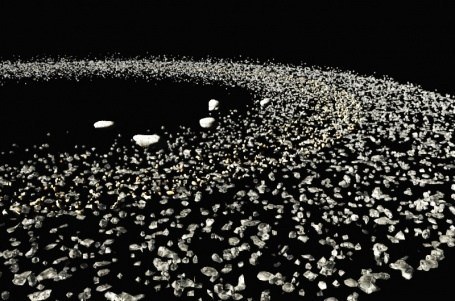
Almost Earth’s twin in size and mass, this planet has a very thick atmosphere and is the hottest planet in the solar system.
Venus
Mars
Mercury
Neptune
This cold, blue planet was discovered by a mathematical prediction instead of a telescope and has supersonic winds.
Neptune
Jupiter
Mars
Venus
This is the largest planet in the solar system and is famous for a century old storm called the the Great Red spot.
Saturn
Jupiter
Uranus
Venus
Most likely due to a massive collision, this planet rotates on its side.
Saturn
Venus
Neptune
Uranus

Which scientific instrument did Galileo use to discover the moons of Jupiter?
telescope
spyglass
microscope
magnifying glass

Who came up with this model?
Copernicus
Kepler
Galileo
Ptolemy

Which astronomer is responsible for the elliptical model of the solar system?
Copernicus
Newton
Aristotle
Kepler
Who improved the telescope and studied Jupiter's moons?
Galileo
Ptolemy
Brahe
Newton
Who came up with the idea of gravity?
Kepler
Newton
Aristotle
Galileo
Which astronomer first suggested that the sun is at the center of the solar system?
Aristotle
Ptolemy
Brahe
Copernicus
How many moons did Galileo discover orbiting Jupiter?
one
two
three
four

Newton
Why do the planets in our solar system orbit the sun?
because the sun is the brightest
because the sun was there first
because the sun has the most mass
because nothing can orbit planets

Who wrote the law of universal gravitation?
Newton
Galileo
Kepler
Edison

The force of attraction between objects that is due to their masses is -
acceleration
gravity
inertia
revolution
What keeps the planets in orbit around the sun?
gravity and inertia together
gravity
inertia
neither gravity or inertia
the tendency of an object to resist a change in its motion
acceleration
inertia
mass
frame of reference
What two things determine the gravity of an object?
mass & weight
mass & distance
density & mass
volume & distance
What would happen to the force of gravity when mass decreases?
the force of gravity would increase
the force of gravity would decrease
the force of gravity would remain the same
your mass does not influence gravity

Which model of the universe has the Earth at the center?
Heliocentric
Geocentric
Elliptical
Big Bang
Which model of the solar system is accepted today as accurate?
Geocentric
Heliocentric
Most scientists believe the Big Bang Theory explains which of the following questions?
How our planets and moons formed
How our universe began
How the sun turns hydrogen into helium
How fast light travels through space
Most distant galaxies show a red shift. This is considered evidence that the universe is ___.
getting cooler
expanding
condensing into a small point
swirling around


The classification of a galaxy is based on its observable characteristics. Which of these characteristics is used to classify galaxies?
shape
temperature
types of forces
chemical elements
What holds a galaxy together?
pressure
glue
gravity
planets
What does the Heliocentric system look like?


Imaginary line about which an object rotates is a(n) -
diameter.
radius.
pole.
axis.
What causes day and night?
the axis
Earth's revolution
Earth's rotation
Sun' rotation

As the Earth travels around the sun one complete time, it makes one -
revolution
rotation
day
month

In this diagram, the motion of the Earth can best be described as -
acceleration
gravity
revolution
rotation

In this diagram, the motion of the Earth can best be described as -
Gravity
Inertia
Revolution
Rotation
The path that an object takes as it moves around the Sun.
What is the shape of the orbit the planets have around the Sun?
For a solar eclipse to occur, the alignment must be ?
During what phase of the moon can a lunar eclipse occur?
You are less likely to see a total solar eclipse than a total lunar eclipse because
only people on the daytime side of Earth can see a solar eclipse.
the moon's shadow covers all of Earth during a solar eclipse.
the moon's umbra only covers a small area on Earth's surface.
new moon phases occur less often than full moon phases.
A total solar eclipse is visible from
only the dark side of Earth.
only within the moon's penumbra.
only within the moon's umbra.
all over Earth
During a total lunar eclipse, an observer on Earth would see
a new moon.
no change in the moon's brightness.
the moon turning a red color.
a first quarter moon.
What is the correct alignment during a total lunar eclipse?
Sun, moon, Earth
Sun, Earth, moon
Earth, Sun, moon
moon, Sun, Earth
The part of the shadow surrounding the darkest part of the shadow and producing a partial eclipse is the
axis

Which type of eclipse is shown in the diagram?
lunar eclipse
solar eclipse

Which type of eclipse is shown in the diagram?
A ___________ is the blocking of the Sun's light that occurs during a new moon when the moon's shadow falls on earth.
umbra
penumbra
A ___________ is the blocking of sunlight to the moon; occurs when the moon passes through earth's shadow.
umbra
penumbra


What type of tide when the sun, earth, and moon are at a 90 degree angle?
moon tide
spring tide
neap tide
tsunami tide
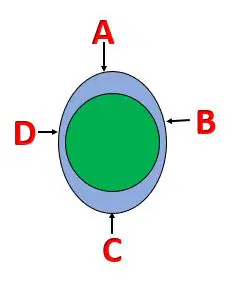
Where are the two high tides located in the diagram?
A and C
B and D
A and B
C and D
High tides are higher than normal and low tides are lower than normal during what type of tide?
neap tides
spring tides
tsunami tides
moon tides
Why does the moon's gravitational pull have more of an effect on tides than the sun's gravitational pull?
Spring tides occur during what moon phases?
1st and 3rd quarter
new moon and 1st quarter
new moon and full moon
waxing gibbous and waning crescent
Neap tides occur during what moon phases?
1st and 3rd quarter
new moon and 1st quarter
new moon and full moon
waxing gibbous and waning crescent
The moon moves around the Earth in what direction?
clockwise
counterclockwise
right
left

When the lit part of the moon is getting bigger, we call that ...
Waxing
Waning

When the lit part of the moon is getting smaller, we call that ...
Waxing
Waning
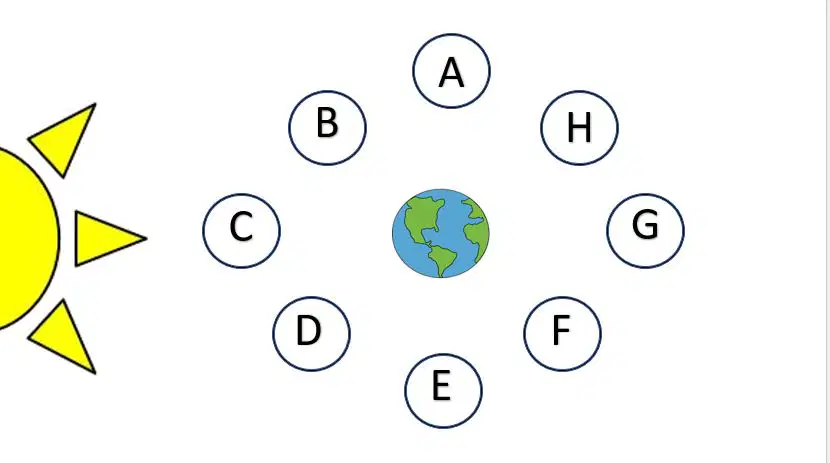
What moon phase is at location C?
3rd quarter
Full moon
New moon
waxing gibbous
What moon phase is at location G?
3rd quarter
Full moon
New moon
waxing gibbous
What moon phase is at location E?
3rd quarter
Full moon
New moon
1st quarter
What moon phase is at location A?
3rd quarter
Full moon
New moon
1st quarter
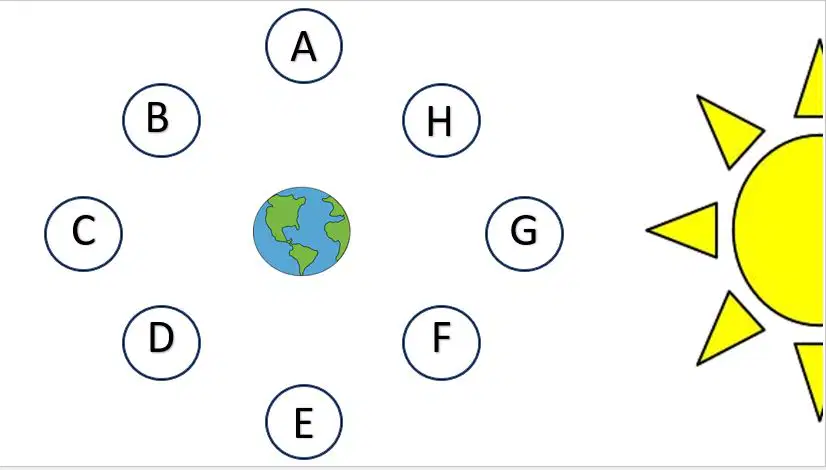
What moon phase is at location A?
3rd quarter
Full moon
New moon
1st quarter
What moon phase is at location G?
3rd quarter
Full moon
New moon
1st quarter
What moon phase is at location C?
3rd quarter
Full moon
New moon
1st quarter
What moon phase is at location B?
waning gibbous
waxing gibbous
waxing crescent
waning crescent
What moon phase is at location D?
waxing crescent
waning crescent
waxing gibbous
waning gibbous
In which direction does the Moon REVOLVE around the Earth?
clockwise
counter clockwise
some times it changes direction
it doesn't revolve
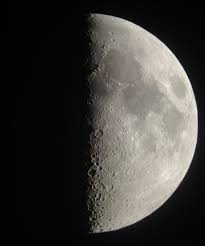
During this moon phase, we see half of the moon. What phase is this?
Quarter moon
Crescent moon
Why does the moon appear to change shape?
The Moon changes its actual shape throughout the course of the month.
As the Moon changes position, different amount of the moon is visible from Earth.
The season of the year determines the phase of the Moon.
The closer the Moon is to Earth, the more light the Moon reflects.
increasing light, growing in size
Losing light, shrinking in size

About how long is a lunar cycle?
two weeks
a month
6 weeks
6 months
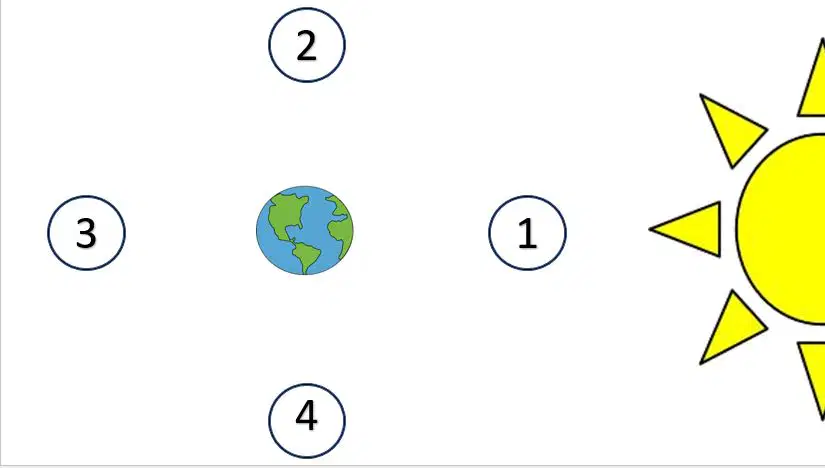

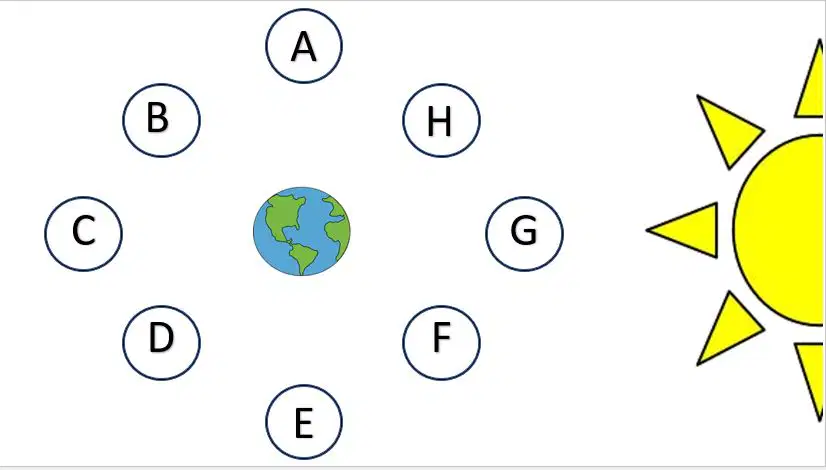
Name the phase of the moon for letter A
Full moon
First quarter
New moon
Third quarter
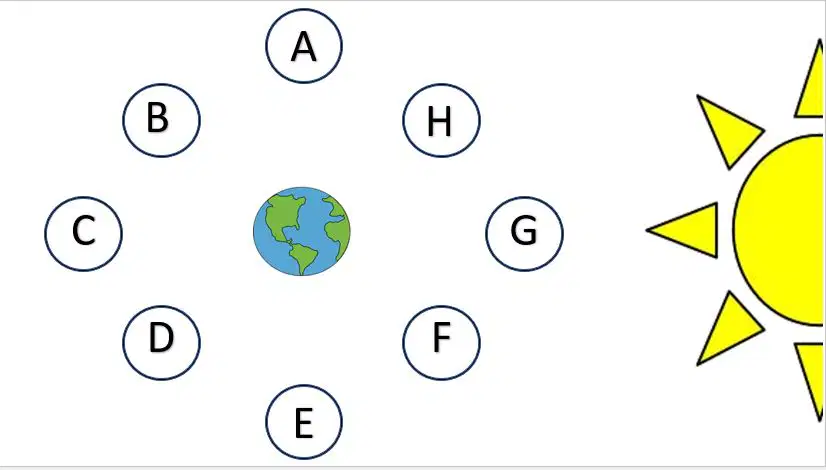
What moon phase is at location C?
new moon
1st quarter
full moon
3rd quarter
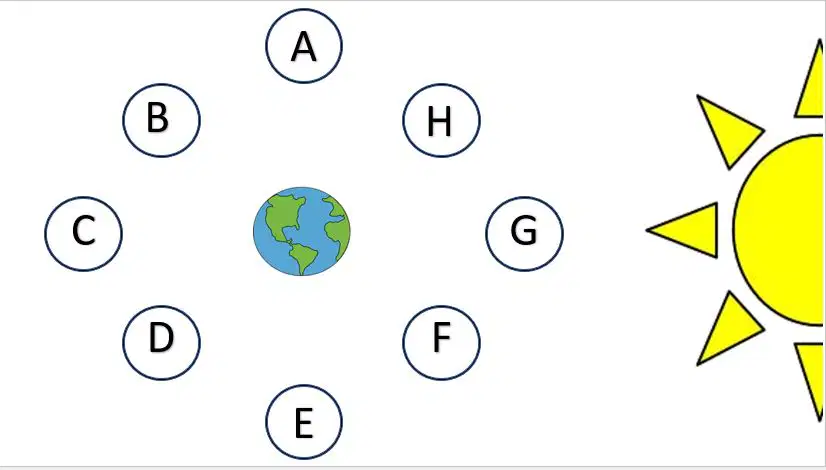
Name the phase of the moon for letter D.
Waning Gibbous
Waxing Gibbous
Waning Crescent
Waxing Crescent
Which of the following best describes the tilt of the earth when it is summer in the southern hemisphere?
The northern hemisphere is tilted toward the sun
The northern hemisphere is tilted away from the sun
The northern hemisphere is tilted neither toward or away from the sun
Why are you talking about the northern hemisphere when you asked about the southern hemisphere?


What causes day and night?
Earth's rotation on its axis
Earth's revolution around the Sun
Earth's distance from the Sun
Moon's revolution around Earth
What would seasons be like if Earth's axis were straight up and down?
Seasons would be the same as they are now
Seasons would be more extreme.
There would be no seasons.
none of the above
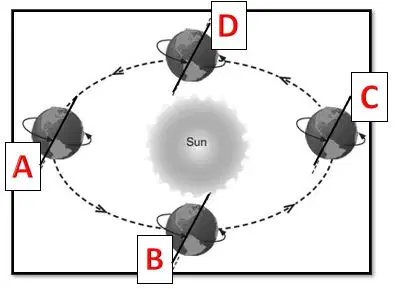
What season is the Northern Hemisphere having at location A?
summer
winter
fall
spring
What season is the Northern Hemisphere having at location C?
summer
winter
fall
spring

In winter, how is the Earth's axis pointed?
towards the sun
up
down
away from the sun

In summer, how is Earth's axis pointed?
towards the sun
up
down
away from the sun


What is the longest day of the year in the Northern Hemisphere?
summer solstice
winter solstice
fall equinox
spring equinox
What would happen to seasons if Earth's tilt was greater than 23.5?
They would be the same as they are now
Extreme seasons
no seasons

Which of these two layers is a solid?
inner core
Outer core
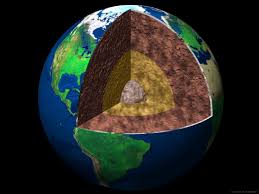
What part of the earth is a layer of rock that comprises 70% of Earth’s mass?
mesosphere
mantle
asthenosphere
lithosphere


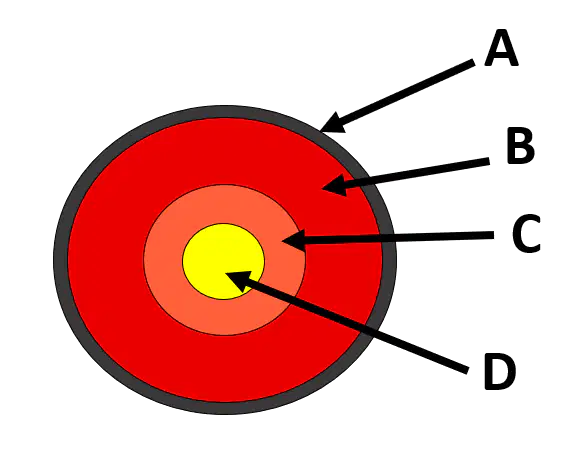
What is the name of layer A?
crust
mantle
outer core
inner core
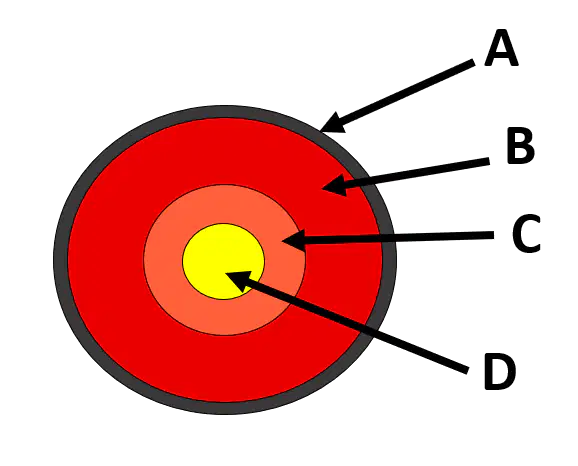
What is the name of layer B?
crust
mantle
outer core
inner core
What is the name of layer D?
crust
mantle
outer core
inner core
What is the name of layer C?
crust
mantle
outer core
inner core
Where is heat and pressure the greatest in the Earth?
crust
mantle
outer core
inner core
How have scientists been able to infer the internal structure of Earth without being able to directly observe inside the Earth?
Scientists analyze how earthquake waves move through Earth's interior.
Scientists use satellite radar and sonar technologies to map Earth's internal layers.
Scientists make educated guesses about Earth's internal structure based on previous hypothesis.
Scientists study different types of rocks from many different locations on Earth's surface.

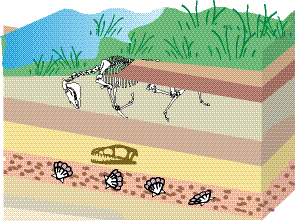
What are the oldest fossils and why?
B, C- because they are closest to the top
A, B- because they are closest to the bottom
They are all the same age- because they are all found on layer 2
A, B- because they are found closest to the top


According to the law of superposition, which layer is the youngest?
A
B
C
There is not enough information.
In which kind of rock do we usually find a fossil?
sedimentary rock
metamorphic rock
igneous rock
none of the above
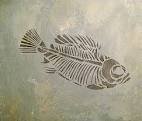
If scientists found this fossil, what could they infer?
what fish are like today
that this fish lacked oxygen
that water once covered the area where this fossil was found
none of the above
Fossils of fish are found under land where cows now live. What does this tell you?
the fish were dropped their by flying birds
this land was once under the ocean
fish used to live on land
none of the above

Organisms D and C clearly lived in an aquatic (water) environment. Organism A does not look like it lived in the water. What is the most likely explanation for this?
The fossil in layer A died on land and was carried to the water
The fossils in layer C and D did not live in the same location as the fossil in layer A
The environment changed over a long period of time. It used to be under water, but is not anymore

Which layer contains the oldest fossil?
Layer 1
Layer 2
Layer 3
Layer 4
Which of the following would be an example of absolute age?
Fossil A is older than Fossil B
Fossil A and Fossil B are the same age
Fossil A is 10 million years old
Which of the following is an example of relative age
Fossil A is older than Fossil B
Fossil A is about 10 million years old
Fossil B is 2 million years old

If you found an index fossil in a layer of rock in Montana and a similar fossil in a layer of rock in Texas, you would know that:
the fossils and rock layers are the same age
the fossils from Montana are older
the fossils from England are older
none of the above
What can the fossil record tell us?
groups of organisms changed over long periods of time
Information about the past climate of our Earth
information about the past environments and changes of the Earth's surface
all of these are correct
Fossils that are abundant, widespread, and only around for a short period of time are ____.
relative fossils
timeline fossils
index fossils
glossary fossils
When we know the exact age of a fossil it is the _____ age.
random
approximate
relative
absolute

What type of fossil is shown here?
trace
mold
cast
petrified

Q. What type of fossil is an imprint in a rock?
Cast
Mold
Trace
Petrified

This type of fossil forms when a mold is filled with sand or mud that hardens into the shape of the organism.
Mold
Cast
Trace
Petrified
This type of scientist finds, preserves, and interprets fossils remains.
Archeologist
geologist
anthropologist
paleontologist

What type of fossil is shown here?
trace
mold
cast
body

Look at this image. Which explanation best summarizes the hypothesis shown in the figure?
The present continents will gradually move to form a single landmass called Pangaea.
The continents were once a large landmass name Pangaea, which broke apart and gradually drifted to the present-day locations of the continents.
The continents were once a large landmass, but the north and south magnetic poles pulled the continents apart toward the poles
The continents were once a large landmass, but the ocean levels rose, and these oceans separate today's continents.

Look at this image, which shows changes at mid-ocean ridges. The highlighted section shows how one location of the sea floor moves over time. Which process is demonstrated in this image?
Continental drift
earthquakes
plate collisions
sea-floor spreading
___________ is the process by which one tectonic plate is pulled beneath another plate.
subduction
ridge push
mid-ocean ridge
convection


What evidence was NOT used by Wegener as proof of continental drift?
land features
erosion
climate
fossils
Any trace of an ancient organism that has been preserved in rock is called a
landform
continent
fossil
landmass
According to Wegener's theory of continental drift,
Earth's surface is made up of seven major landmasses
the continents do not drift
Earth is slowly cooling and shrinking
the continents were once joined together in a single landmass and have slowly moved.
What is Pangea?
the name of a German scientist
the name of a supercontinent that existed millions of years ago
another name for continental drift
the name of an ancient fossil
What is the process that continually adds new crust to the ocean floor along both sides of the mid-ocean ridge?
subduction
continental drift
convergent
sea floor spreading

What type of landform is at C?
mid-ocean ridge
continental crust
deep ocean trench
sea floor spread
In sea floor spreading, molten material rises from the mantle and erupts
along the edge of the continents
along the mid-ocean ridges
in deep ocean trenches
at the North and South pole

Identify the landform labeled A
mid-ocean ridge
deep ocean trench
sea floor spread
What is the process by which the ocean floor sinks beneath a deep ocean trench and back into the mantle?
continental drift
mid-ocean ridge
faults
subduction
What is Wegener's idea that continents are slowly moving over Earth's surface called?
divergence
faults
plates
continental drift
Most geologists think that the movement of Earth's plates is caused by
conduction
earthquakes
convection currents in the mantle
Earth's magnetic field
The geological theory that states that pieces of Earth's plates are in constant, slow motion, driven by convection currents is the theory of
subduction
plate tectonics
deep ocean trenches
sea floor spreading
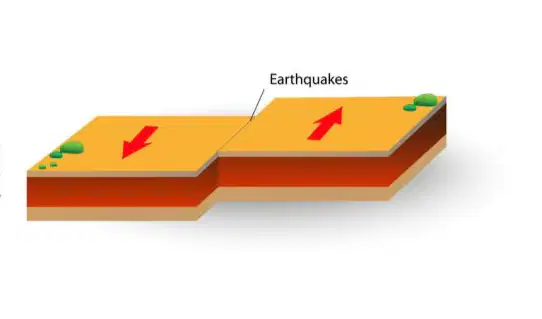
What type of boundary is this?

What type of boundary is this?
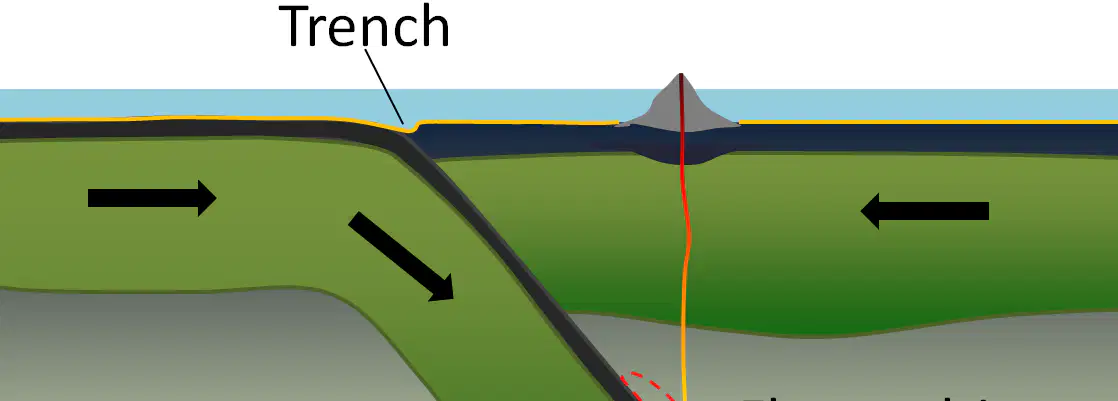
What type of boundary is this?
What is the process that continually adds new crust to the ocean floor along both sides of the mid-ocean ridge?
In sea floor spreading, molten material rises from the mantle and erupts. What happens?
What is the process by which the ocean floor sinks beneath a deep ocean trench and back into the mantle?
mid-ocean ridge
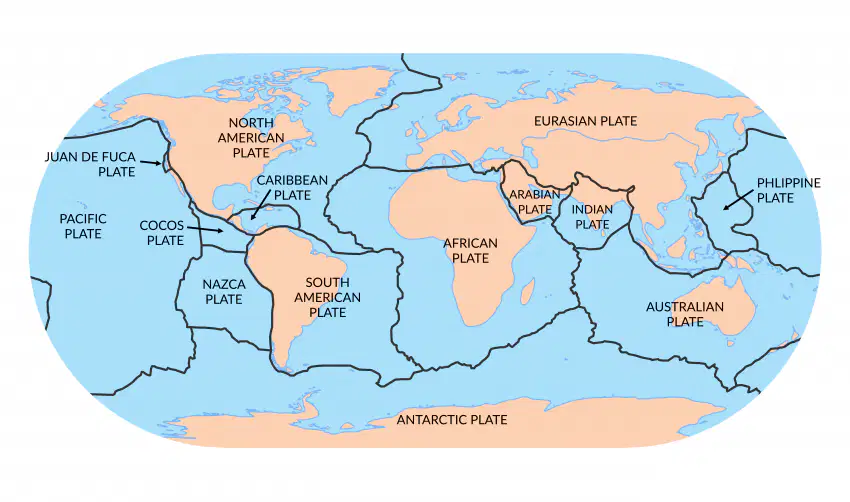
The large plates move across the surface of the Earth by what process?
radiation
condensation
convection
conduction

Here is a picture of sea-floor spreading. How are the ocean crusts moving?
no movement
sliding
converging
diverging
When an oceanic crust meets a continental crust, what occurs?
Both crusts are subducted down into the mantle.
The two crusts converge forming folded mountains such as the Himalayas.
The oceanic crust moves over the continental crust resulting in volcanoes.
The oceanic crust moves under the continental crust resulting in volcanoes.
What evidence did Wegener use in his theory?
mountain ranges and coal deposits line up across continents
Continents and fossils fitting together/matching-up like puzzle pieces
glacier scars and evidence from temperature
all of the above
What is a plate boundary where both plates move away from each other?
transform
divergent
convergent
What is a plate boundary where two plates move toward each other?
transform
divergent
convergent
What is a plate boundary where two plates slip past each other moving in opposite directions?
transform
divergent
convergent
What are breaks in Earth's crust where rocks have slipped past each other?
Most geologists think that the movement of Earth's plates is caused by
earthquakes
conduction
convection currents in the mantle
Earth's magnetic field
What 2 things are made at DIVERGENT Boundary?
Mid-ocean ridge and tsunami
Mid-ocean ridge and Rift Valley
Trench and mid-ocean ridge
Mountain and mid-ocean ridge
Mountains are created when....
two continental plates collide
two oceanic plate pull apart
two continental plates pull apart
an oceanic plate subducts under a continental plate

What kind of plate boundary is shown here?

What kind of plate boundary is shown here?
The San Andreas Fault in California is known as an active earthquake area. What type of boundary is it?