
 Worksheets
Transformers - Learning Outcomes
Total questions: 100
Worksheet time: 50mins
A pole-mounted transformer is installed on utility poles, while a pad-mounted transformer is installed on the ground. Identify which is which.
Pole-mounted transformer is on utility poles; pad-mounted transformer is on the ground.
Pole-mounted transformer is on the ground; pad-mounted transformer is on utility poles.
Both are installed on the ground.
Both are installed on utility poles.
Identify the primary and secondary bushings of a transformer.
The bushings connected to the high voltage and low voltage windings respectively
The bushings connected to the core and the tank
The bushings used for cooling the transformer
The bushings used for earthing only
The kVA rating of a transformer can be found on:
the nameplate
the winding
the core
the oil tank
The difference between a conventional and CSP (Completely Self-Protected) transformer is:
CSP transformers have built-in protection devices, while conventional transformers do not.
Conventional transformers are more compact than CSP transformers.
CSP transformers require external protection devices, while conventional transformers do not.
There is no difference between conventional and CSP transformers.
The core of a transformer is made of:
Copper
Aluminium
Silicon steel laminations
Plastic
The function of the windings in a transformer is to:
Transfer electrical energy between circuits through electromagnetic induction.
Increase the resistance in the circuit.
Store electrical energy as chemical energy.
Convert AC to DC.
The purpose of insulating fluids in a transformer is:
To provide electrical insulation and dissipate heat
To increase the voltage
To reduce the size of the transformer
To improve the efficiency of the core
The purpose of the pressure relief valve in a transformer is:
To regulate the voltage
To prevent overheating
To release excess pressure and protect the transformer
To increase the efficiency
Which of the following best defines induction, turns ratio, polarity, losses, and impedance in the context of transformers?
They are key electrical properties and characteristics that determine transformer operation and performance.
They are types of transformer windings.
They are transformer cooling methods.
They are transformer core materials.
The turns ratio of a transformer is calculated by dividing the number of primary windings by the number of secondary windings. What is the turns ratio if the primary has 200 windings and the secondary has 50 windings?
2:1
4:1
1:2
1:4
Explain how to locate the nameplate of a transformer.
To locate the nameplate of a transformer, look for a metal plate attached to the body of the transformer, usually on the tank or the main frame, which contains important identification and rating information.
Check inside the transformer core for a paper label with the nameplate information.
The nameplate is always found on the power supply cable connected to the transformer.
The nameplate is painted directly onto the transformer cooling fins.
By the end of this session, you should be able to: Identify and interpret the nameplate information of a transformer.
Nameplate information typically includes the transformer's voltage rating, current rating, frequency, phase, manufacturer, serial number, and other key specifications. Interpreting this information helps in understanding the transformer's capabilities and limitations.
Nameplate information only includes the color and shape of the transformer, which are important for aesthetic purposes.
Nameplate information is mainly about the installation date and the location of the transformer, which are not related to its operation.
Nameplate information provides details about the transformer’s packaging and shipping instructions, not its electrical characteristics.
By the end of this session, you should be able to: Explain when to refer to the nameplate of a transformer.
You should refer to the nameplate of a transformer whenever you need to verify its specifications, perform maintenance, troubleshooting, or ensure compatibility with the electrical system.
Only when the transformer is being installed for the first time.
Only if the transformer is making unusual noises.
Only when the transformer is being replaced with a new one.
Understanding the difference in an overhead and underground setting will help determine which transformer is needed for the job.
True
False
Where can you find the kVA rating, and why is it important?
The kVA rating is found on the transformer and is important because it has to do with the available wattage.
The kVA rating is found in the circuit breaker and is important for voltage regulation.
The kVA rating is found on the light bulb and is important for color temperature.
The kVA rating is found in the wiring and is important for insulation type.
There are significant differences between the two types of overhead transformers. Knowing those differences will help you in understanding how they are ________.
protected
installed
manufactured
tested
Calculating turn ratios will help you understand how we can change the voltage depending on the number of turns in the coil of wire.
True
False
Verifying the nameplate matches the job order is key to ________ installation.
correct
delayed
incomplete
hazardous
Bushings are in different positions in overhead and underground transformers.
True
False
The core plays a major factor in transformer efficiency. Knowing how to identify the core and which winding are larger or smaller helps explain how the secondary is labeled. This will help with understanding ________ connections.
transformer
resistor
capacitor
inductor
What can happen internally to a transformer if the insulating fluids do not operate properly?
It can be devastating to the transformer.
It will increase the efficiency of the transformer.
It will make the transformer lighter.
It will improve the cooling of the transformer.
What is an overhead transformer?
An overhead transformer is a transformer that is mounted on poles above ground level to distribute electrical power.
An overhead transformer is a device used to measure wind speed above buildings.
An overhead transformer is a type of generator installed underground.
An overhead transformer is a transformer that is only used in underwater power distribution.
What is an underground transformer?
An underground transformer is a transformer installed below ground level, typically in a vault, to distribute electrical power.
An underground transformer is a device used to measure soil moisture content.
An underground transformer is a machine that extracts minerals from underground mines.
An underground transformer is a type of underground water pump used in irrigation systems.
What does transformer rating refer to?
Transformer rating refers to the maximum amount of electrical power a transformer can handle safely.
Transformer rating refers to the voltage drop across the transformer windings.
Transformer rating refers to the physical size of the transformer core.
Transformer rating refers to the efficiency of the transformer at full load.
Name two types of transformers.
Overhead transformers and underground transformers.
Step-up transformers and step-down transformers.
Current transformers and potential transformers.
Dry-type transformers and oil-immersed transformers.
What is the core of a transformer?
The core of a transformer is the part that provides a path for the magnetic flux.
The core of a transformer is the part that stores electrical energy.
The core of a transformer is the part that generates heat.
The core of a transformer is the part that controls the output voltage.
What are the windings in a transformer?
The windings in a transformer are coils of wire that carry the electrical current.
The windings in a transformer are cooling fans used to reduce heat.
The windings in a transformer are metal plates that store energy.
The windings in a transformer are switches that control the voltage.
What is the function of insulating fluid in a transformer?
The insulating fluid in a transformer insulates and cools the internal components.
It increases the voltage output of the transformer.
It acts as a conductor to transfer electricity between windings.
It reduces the weight of the transformer.
What is a pressure relief valve in a transformer used for?
A pressure relief valve in a transformer is used to release excess pressure to prevent damage.
It is used to increase the voltage of the transformer.
It is used to cool down the transformer oil.
It is used to measure the current in the transformer.
The importance of Identification and Anatomy in transformers is:
To ensure proper functioning and maintenance
To increase the weight of transformers
To reduce the voltage output
To make transformers more expensive
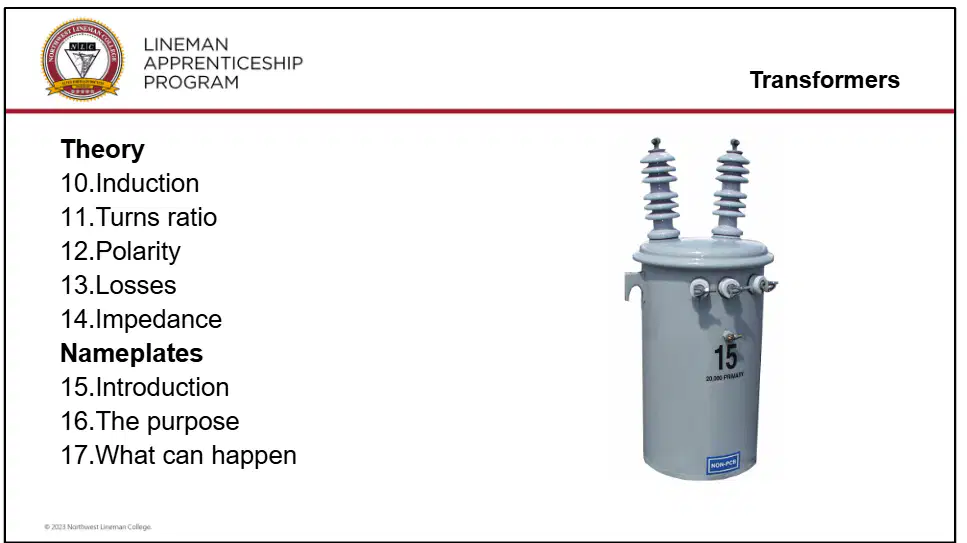
What is induction in the context of transformers?
Induction in transformers refers to the process by which a changing magnetic field in the core induces a voltage in the secondary winding.
Induction in transformers refers to the process of increasing the current in the primary winding.
Induction in transformers refers to the conversion of electrical energy to mechanical energy.
Induction in transformers refers to the process of reducing resistance in the core.
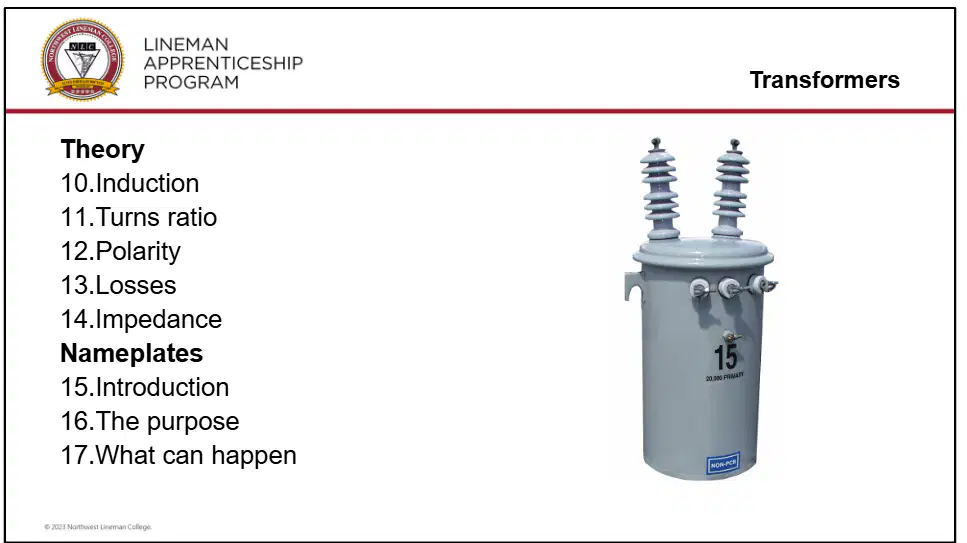
What does the term 'turns ratio' mean in transformers?
Turns ratio is the ratio of the number of windings in the primary coil to the number of windings in the secondary coil of a transformer.
Turns ratio is the ratio of the voltage in the primary coil to the current in the secondary coil of a transformer.
Turns ratio is the ratio of the resistance in the primary coil to the resistance in the secondary coil of a transformer.
Turns ratio is the ratio of the power in the primary coil to the power in the secondary coil of a transformer.
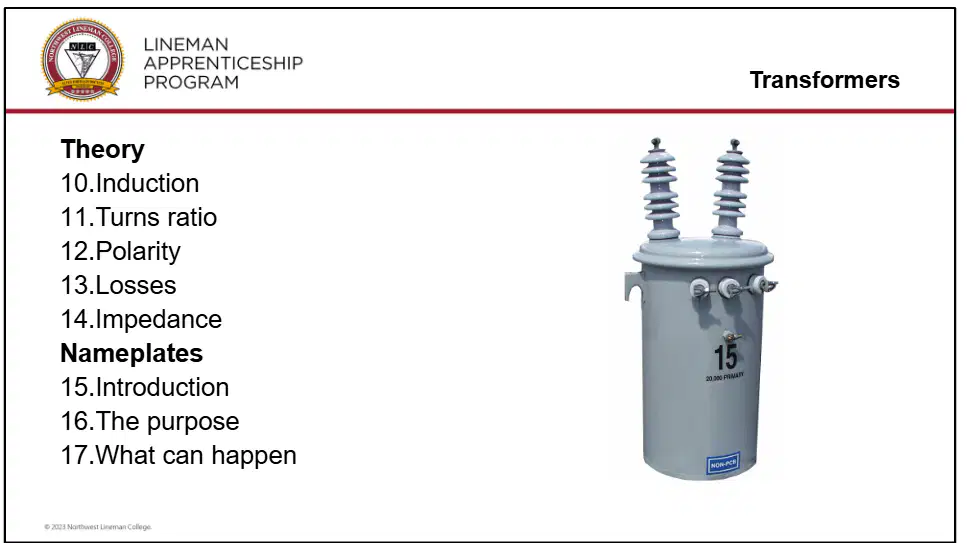
Explain the concept of polarity in transformers.
Polarity in transformers refers to the direction of the induced voltage in the windings relative to each other.
Polarity in transformers refers to the physical size of the transformer core.
Polarity in transformers refers to the color coding of transformer terminals.
Polarity in transformers refers to the efficiency rating of the transformer.
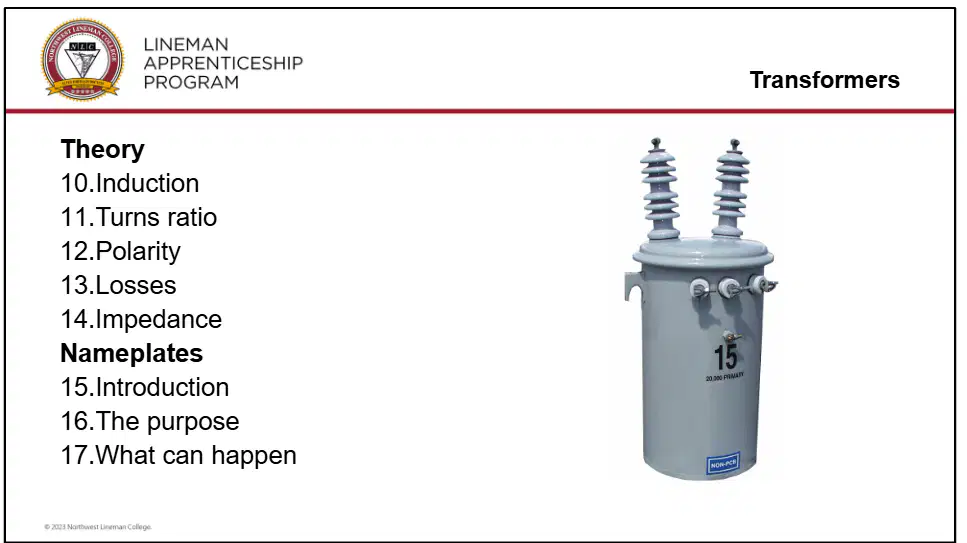
What are losses in transformers?
Losses in transformers are the energy losses that occur due to resistance in the windings and core, such as copper loss and core loss.
Losses in transformers are the increase in voltage due to magnetic flux.
Losses in transformers are the energy gained from external sources.
Losses in transformers are the reduction in transformer size due to cooling.
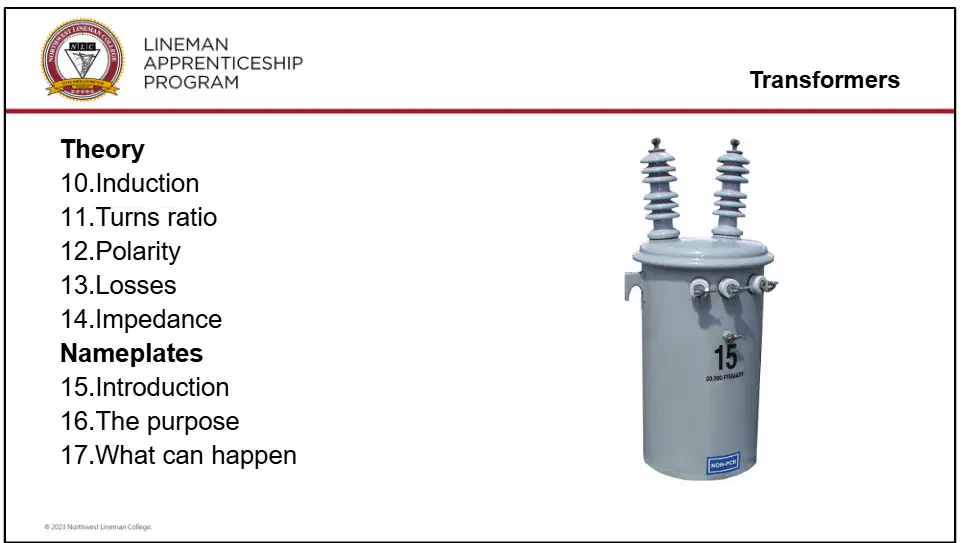
What is impedance in a transformer?
Impedance in a transformer is the total opposition to the flow of alternating current, consisting of resistance and reactance.
Impedance in a transformer is the measure of its efficiency in converting AC to DC.
Impedance in a transformer is the amount of voltage drop across the primary winding only.
Impedance in a transformer is the magnetic flux produced in the core.
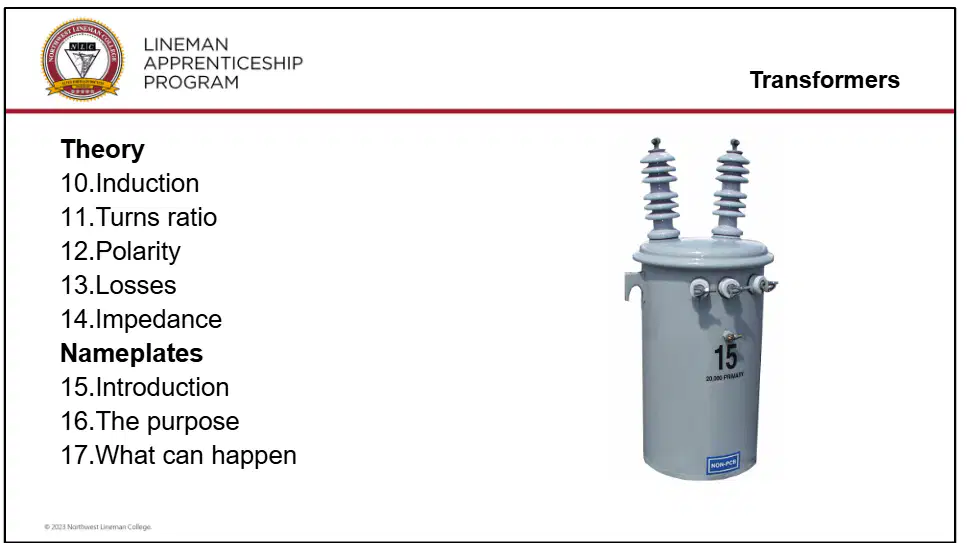
What information is typically found on transformer nameplates?
Transformer nameplates typically include information such as voltage rating, current rating, frequency, phase, and manufacturer details.
Transformer nameplates only display the color of the transformer and its installation date.
Transformer nameplates list the names of the engineers who installed the transformer.
Transformer nameplates provide only the weight and height of the transformer.
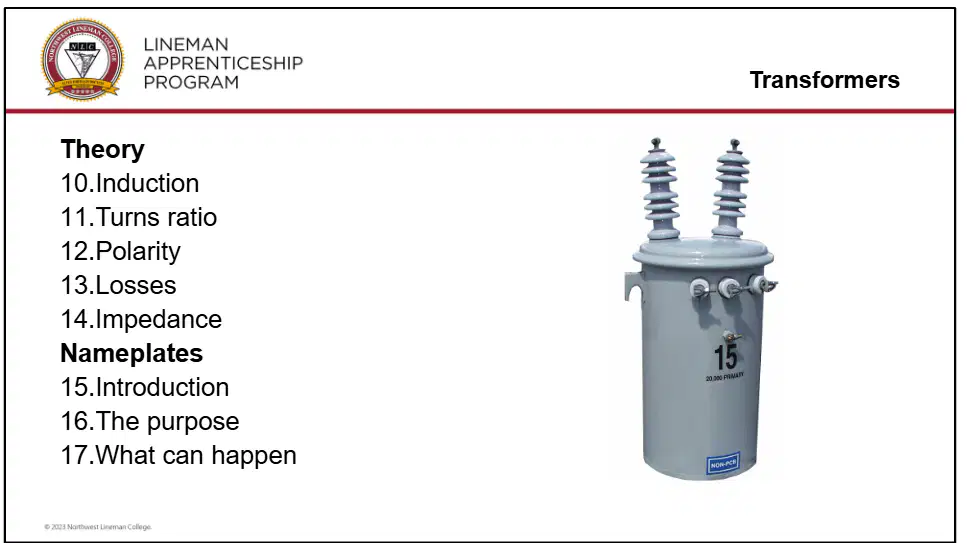
What is the purpose of a transformer nameplate?
The purpose of a transformer nameplate is to provide essential information about the transformer's specifications and operating limits.
To display the manufacturer's logo only.
To provide instructions for transformer installation.
To indicate the color of the transformer.

What can happen if the information on a transformer nameplate is ignored?
If the information on a transformer nameplate is ignored, it can lead to improper operation, equipment damage, or safety hazards.
Nothing will happen; the transformer will work as usual.
The transformer will automatically adjust to any condition.
Ignoring the nameplate information will improve transformer efficiency.
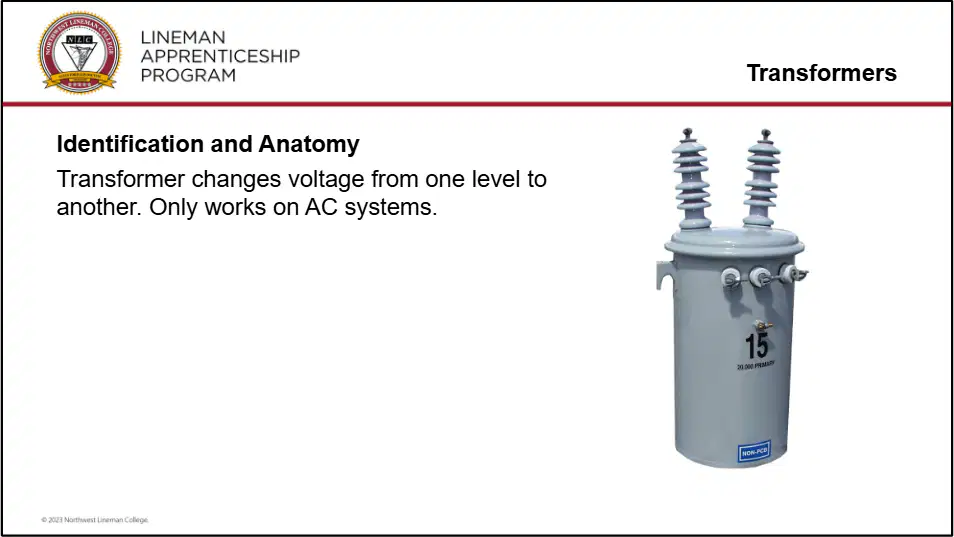
What is the primary function of a transformer?
To generate electricity
To change voltage from one level to another
To store electrical energy
To convert AC to DC
Transformers are used to either ________ voltage or ________ voltage.
step up; step down
increase; decrease
reduce; amplify
stabilize; fluctuate
Transformers only work on AC systems.
True
False
For transmission, voltage is ________ by transformers, and for customer use, it is ________.
stepped up; stepped down
stepped down; stepped up
kept constant; increased
reduced; increased
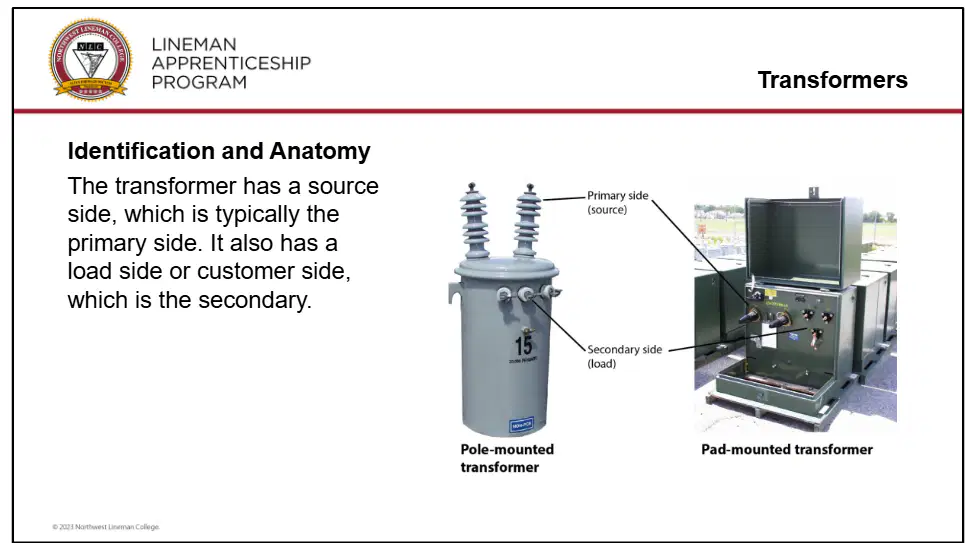
What is the source side of a transformer typically called?
Load side
Primary side
Secondary side
Customer side
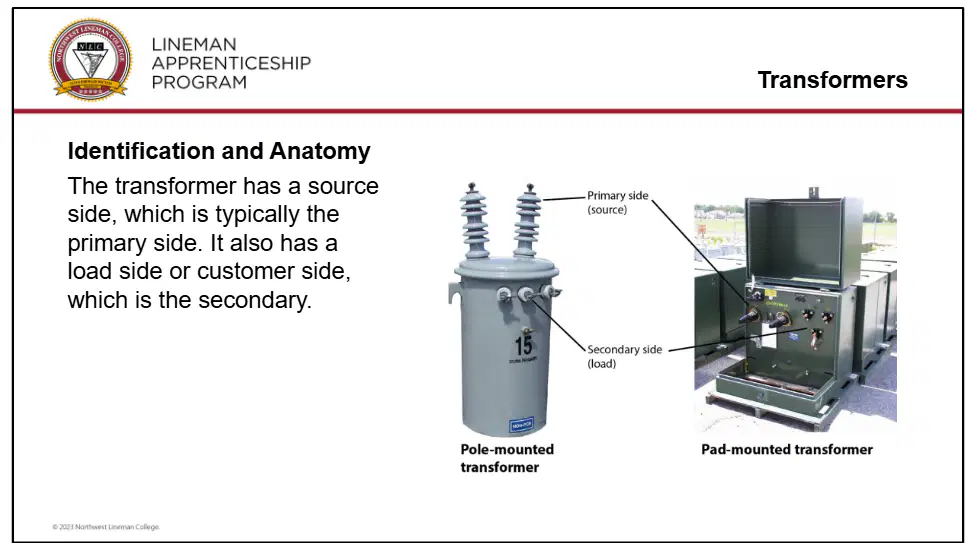
What is the load side of a transformer also known as?
Primary side
Source side
Secondary side
Neutral side
Fill in the blank: The primary bushings of a transformer are ____ and ____.
H1 and H2
X1 and X2
A and B
P1 and P2
Fill in the blank: The secondary lugs of a transformer are ____ and ____.
X1 and X2
H1 and H2
A1 and A2
P1 and P2
What is the neutral on the secondary side of a transformer called?
H1
X1
X0
H2
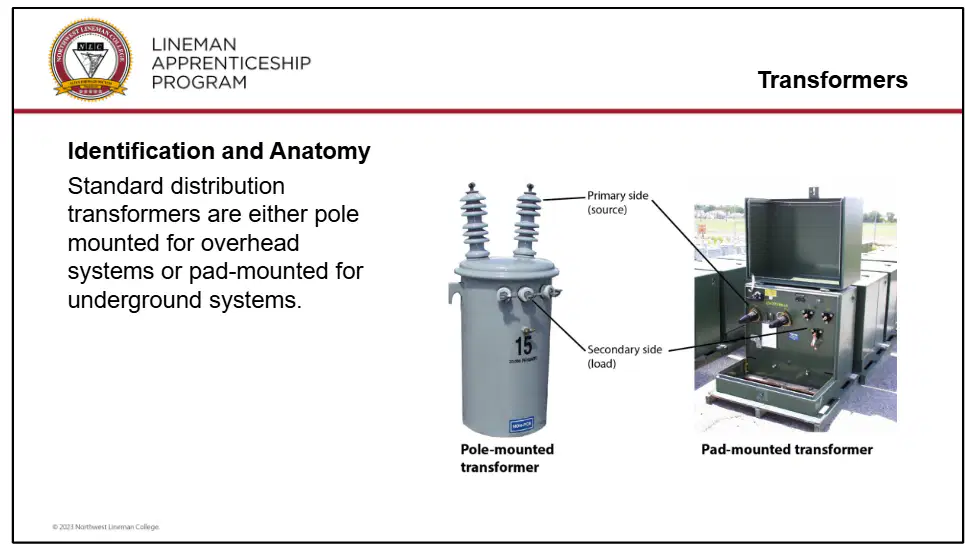
Which type of transformer is used for overhead distribution systems?
Pad-mounted transformer
Pole-mounted transformer
Both A and B
None of the above
Fill in the blank: Standard distribution transformers are either ________ for overhead systems or pad-mounted for underground systems.
pole mounted
wall mounted
floor mounted
ceiling mounted
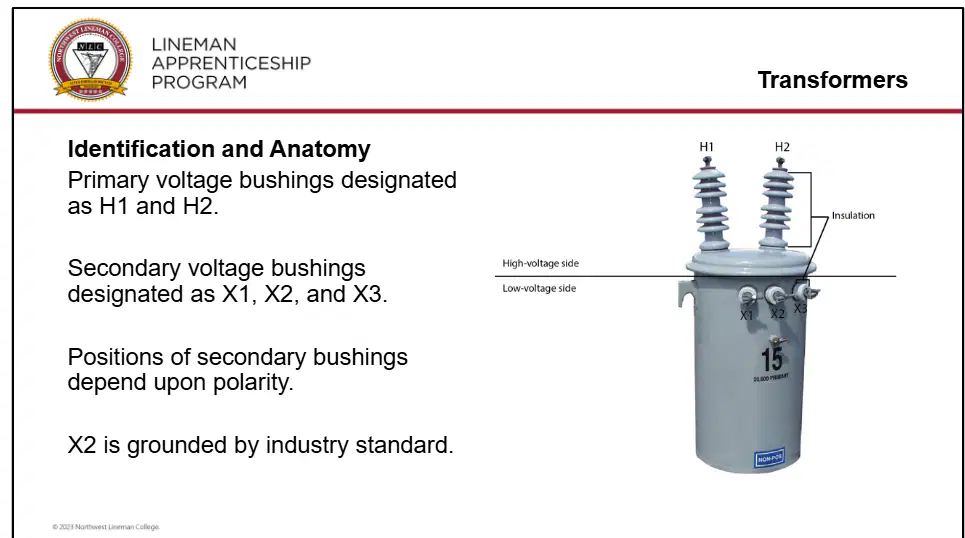
What are the primary voltage bushings of a transformer designated as?
X1 and X2
H1 and H2
X2 and X3
H2 and X1
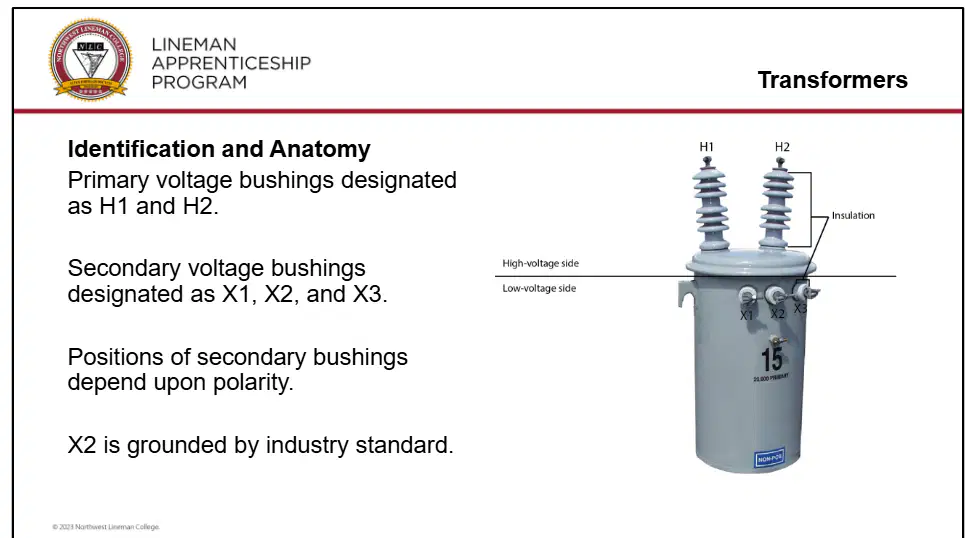
Which of the following are the secondary voltage bushings designated as?
H1, H2
X1, X2, X3
X2, H2, X3
H1, X1, X2
Fill in the blank: X2 is ________ by industry standard.
grounded
insulated
energized
isolated
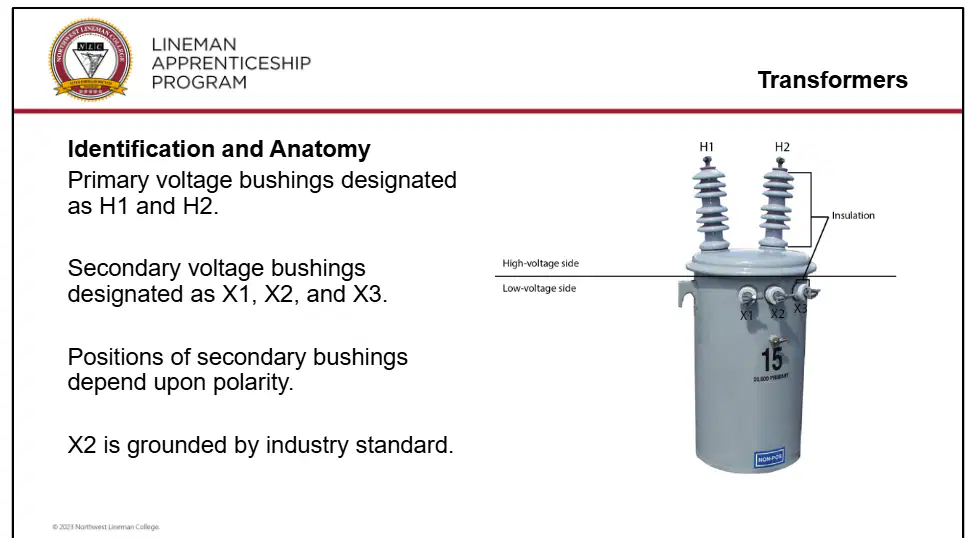
What does the number '15' stenciled on the transformer tank represent?
The 15 represents the kVA rating of the transformer.
The 15 represents the voltage rating of the transformer.
The 15 represents the serial number of the transformer.
The 15 represents the manufacturing year of the transformer.
The bushing of a power transformer is a type of porcelain or ebonite post insulator installed on the top or side of the transformer tank.
True
False
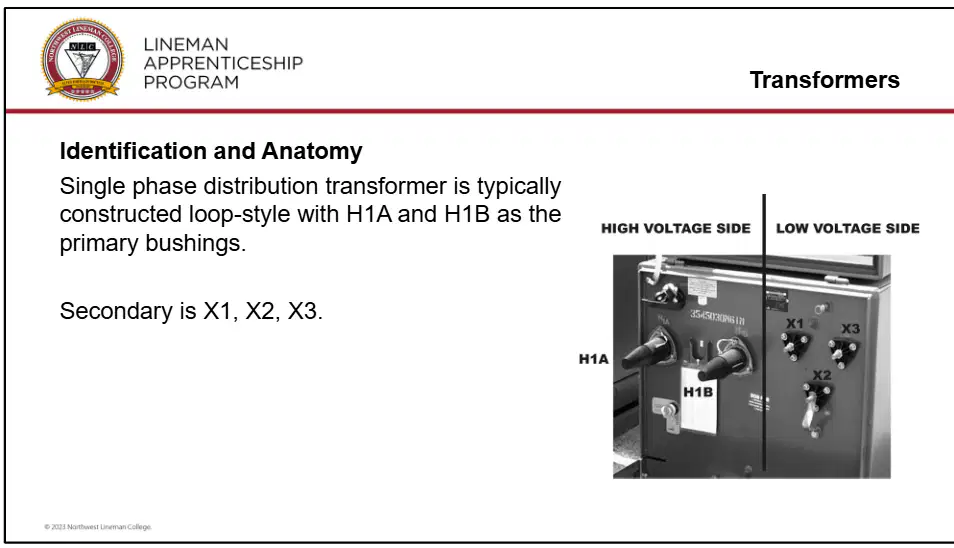
According to the slide, which bushings are typically used as the primary bushings in a single phase distribution transformer?
A) X1 and X2
B) H1A and H1B
C) X2 and X3
D) H1A and X1
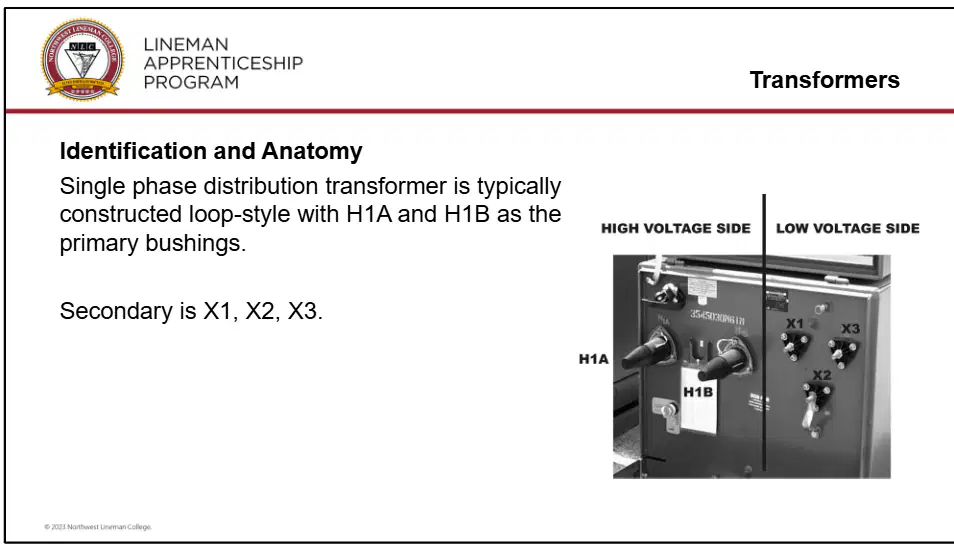
Fill in the blank: The secondary bushings of a single phase distribution transformer are ____.
X1, X2, X3
H1, H2, H3
A, B, C
P1, P2, P3
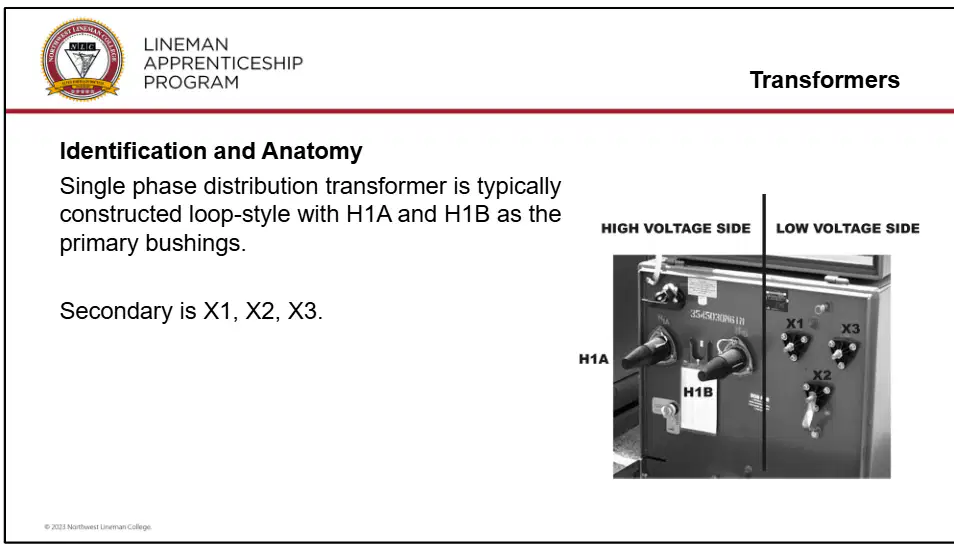
Which side of the transformer contains H1A and H1B bushings?
High voltage side
Low voltage side

Pad-mounted transformers are protected with a _______ style fuse.
bayonet
cartridge
plug
knife
What happens when the fuse is removed from a pad-mounted transformer?
The transformer is energized
The transformer windings are de-energized
The transformer explodes
Nothing happens
The bayonet mount fuse protects against secondary faults and transformer overload and is a field replaceable device.
True
False
What does the kVA rating of a transformer represent?
The voltage rating
The power capacity rating
The current rating
The resistance rating
Where is the kVA (kilo-volt ampere) rating usually found on a transformer?
On the front of the transformer and always on the nameplate.
Inside the transformer core.
On the transformer winding insulation.
On the transformer cooling fins.
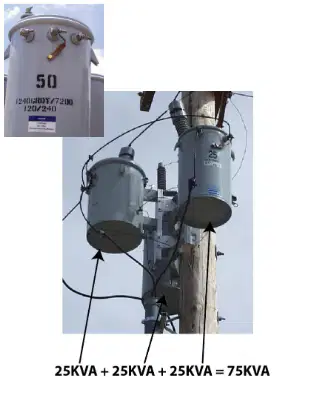
If you have three transformers banked together, each with a rating of 25kVA, what is the total kVA rating of the bank?
25kVA
50kVA
75kVA
100kVA
What are the two main types of overhead transformers?
Step-up and Step-down
Conventional and CSP (completely self protected)
Primary and Secondary
Manual and Automatic
Conventional transformers rely on ______ to protect them from fault current.
fused cut-out switches
circuit breakers
relays
lightning arresters
A fused cut-out switch is used in primary overhead feeder lines and taps to protect distribution transformers from current surges and overloads.
True
False
What happens when an overcurrent caused by a fault in the transformer or customer circuit occurs?
The transformer continues to operate
The fuse melts, disconnecting the transformer from the line
The voltage increases
The transformer explodes
A fused cut-out switch can also be opened manually by a lineworker standing on the ground and using a "hot stick."
True
False

What are the internal protection mechanisms of a CSP transformer?
Lightning arrestor and external fuse
Current-limiting fuse and secondary breaker
Surge protector and relay
External breaker and primary fuse
Where is the circuit breaker mounted when provided in a CSP transformer?
Outside the tank
Inside the tank, under the liquid level
On the pole
Next to the lightning arrestor
The function of the circuit breaker in a CSP transformer is to open the low-voltage circuit and protect the transformer from faults or severe ________.
overloads
undercurrents
shortages
leakages
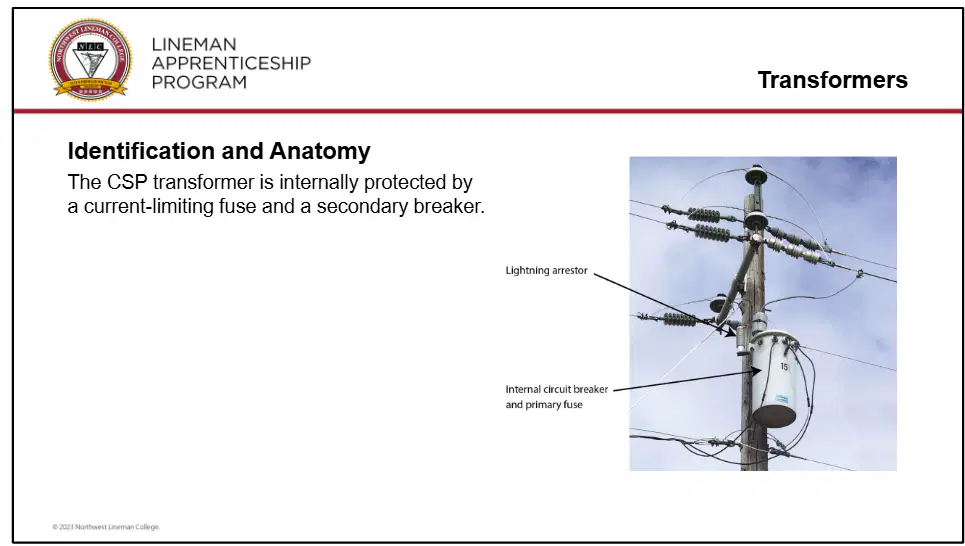
Refer to the diagram of the transformer. Which part is labeled as 'Lightning arrestor'?
The cylindrical tank
The wire at the top
The component attached above the transformer tank
The insulator at the bottom
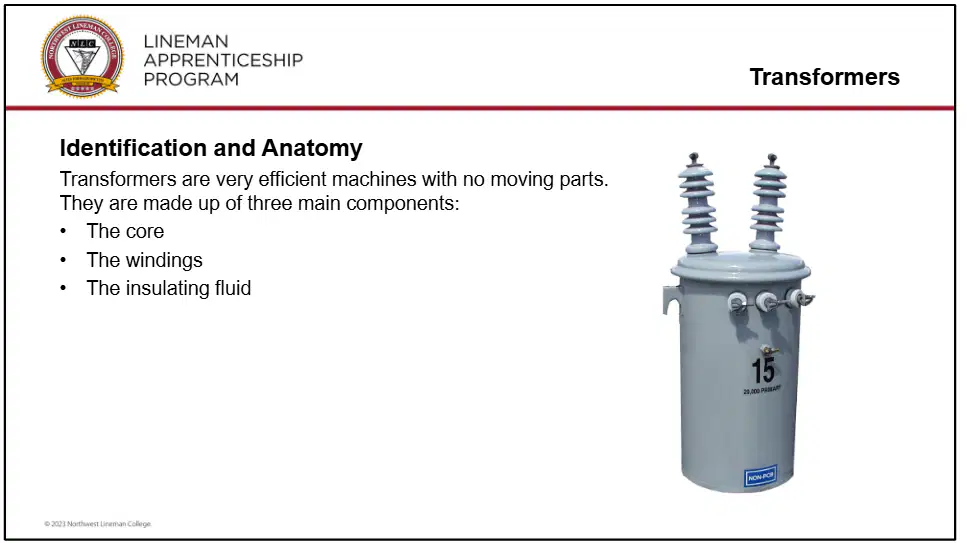
Transformers are made up of three main components. Which of the following is NOT a main component of a transformer?
The core
The windings
The insulating fluid
The rotor
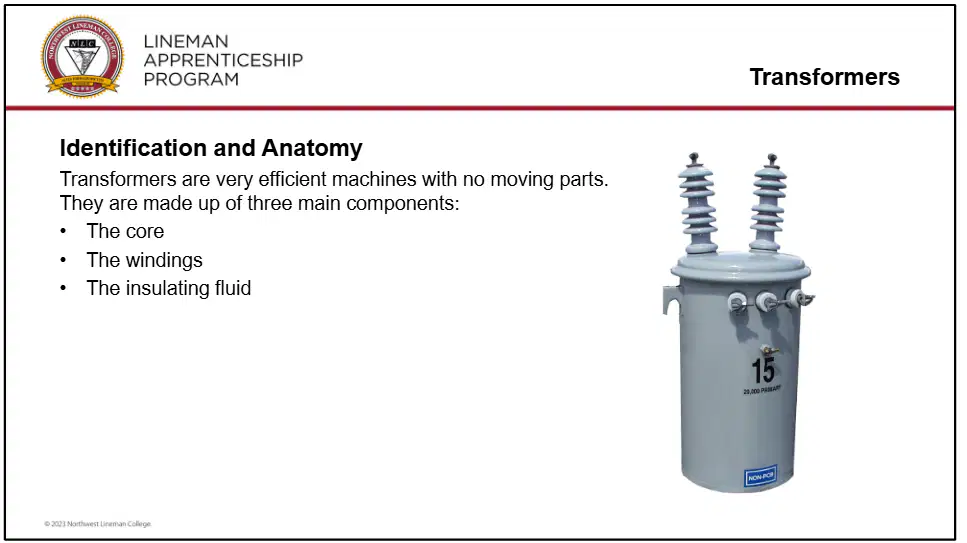
Fill in the blank: The three main components of a transformer are the core, the windings, and the ________.
insulating fluid
rotor
commutator
diode
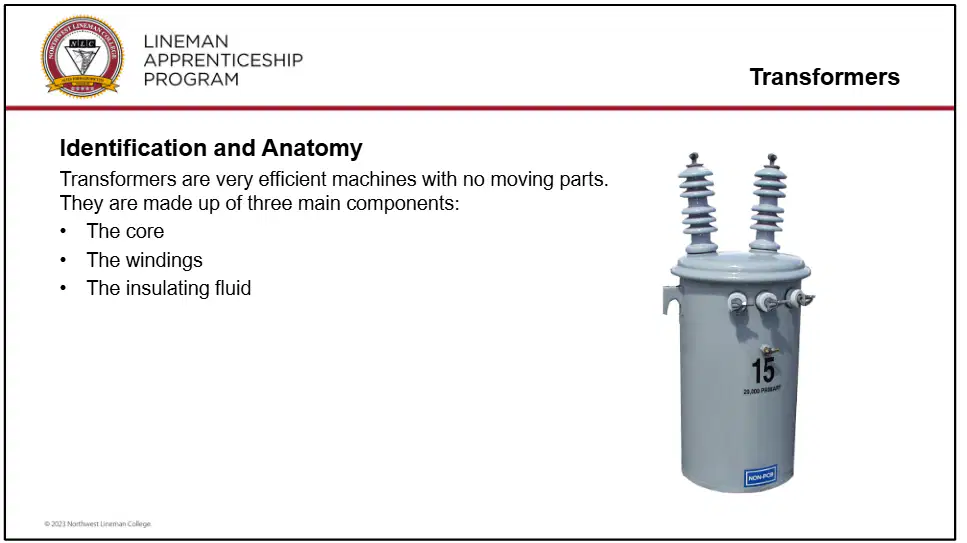
Transformers are very efficient machines with no moving parts.
True
False
What does the transformer core provide a magnetic path to channel?
Flux
Current
Voltage
Resistance
Which material is used in transformer cores to provide a desirable, low reluctance flux path?
Highly permeable material
Plastic
Copper
Aluminum
Why are transformer cores constructed of numerous thin strips of grain-oriented silicone steel, called laminations?
To reduce the no-load losses of the transformer by electrically isolating the strips from each other with thin coatings of insulating material.
To increase the weight of the transformer for stability.
To improve the color and appearance of the transformer core.
To make the transformer core more flexible and easier to bend.
The core is a source of heat in the transformer and as a core increases in size, cooling ducts within the core may become necessary.
True
False
What problem can occur if short-circuited core laminations are present in a transformer?
Increased losses and possibly overheating of the transformer core.
Reduced efficiency and lower output voltage.
Improved cooling and reduced noise.
Decreased magnetic flux and higher efficiency.
What material is the core of a transformer constructed from?
Copper
Grain-oriented silicon steel
Aluminum
Plastic
There are two main configurations of core construction in transformers: _______ type and _______ type.
wound, shell
core, shell
open, closed
primary, secondary
Which of the following is NOT an advantage of a wound core transformer?
Good mechanical strength
Prevents condensed flux leakage and iron loss
Efficient for high frequencies
Good for outdoor use
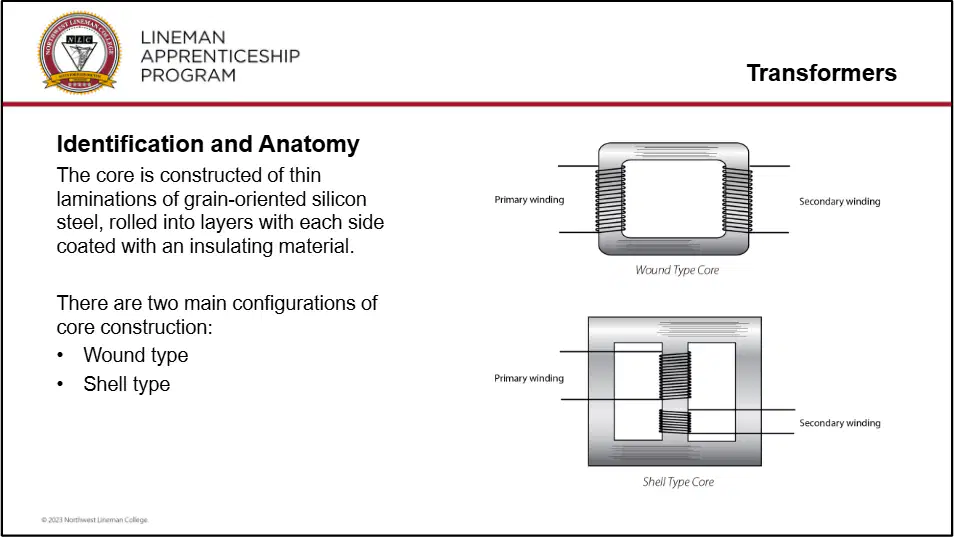
Which type of transformer core is shown in the diagram labeled 'Wound Type Core'?
Shell type
Wound type
List one disadvantage of wound core transformers.
It is not good for outdoor use or it can be noisy.
It is more expensive than shell type transformers.
It cannot be used for high voltage applications.
It requires frequent oil changes.
Which of the following is an advantage of shell core transformers?
Noisy operation
Greater mechanical strength
Poor short circuit withstand capability
Large design
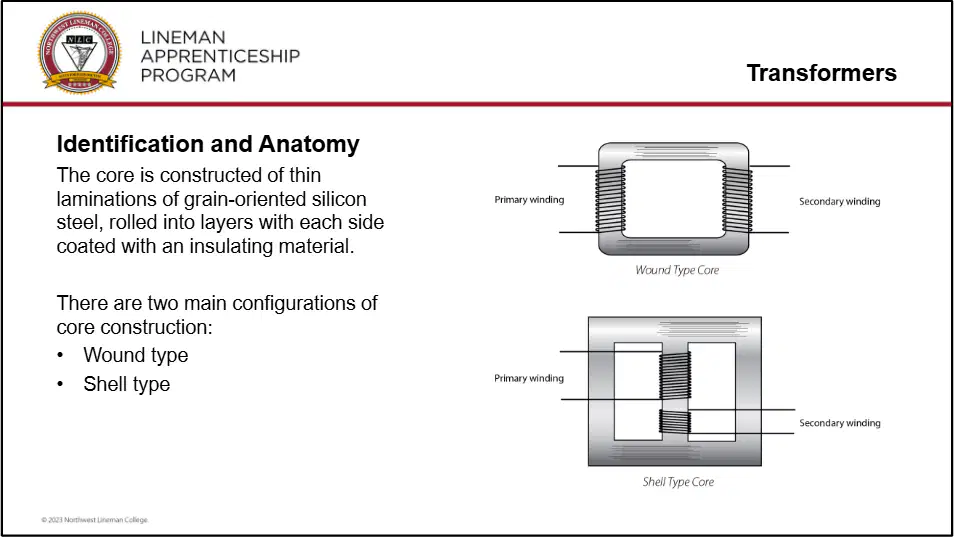
The diagram labeled 'Shell Type Core' shows which type of transformer core?
Wound type
Shell type
Fill in the blank: One advantage of Shell Core Transformer is that it can withstand a high amount of mechanical stress due to its design of greater ________ strength.
mechanical
thermal
electrical
magnetic
Fill in the blank: The control of the ________ flux is very good as the coil is surrounded by the core in a Shell Core Transformer.
leakage
main
mutual
exciting
Fill in the blank: Shell Core Transformers have an efficient ________ system as oil can travel easily through the vertical coils and cools the transformer.
cooling
heating
insulating
wiring
Fill in the blank: The wire size in each coil of a Shell Core Transformer can be selected ________.
flexibly
randomly
arbitrarily
permanently
Fill in the blank: Shell Core Transformers have a flexible design and can meet most requirements easily. Impedance can be easily adjusted between windings that ensure smooth operation with other transformers in ________.
parallel
series
isolation
cascade
Fill in the blank: The power-to-weight ratio is ________ in Shell Core Transformers.
better
worse
constant
negligible
Fill in the blank: Shell Core Transformers have a high ________ strength.
dielectric
magnetic
thermal
mechanical
Fill in the blank: Shell Core Transformers have a very reliable and ________ type of design.
robust
fragile
temporary
unstable
One disadvantage of Shell Core Transformer is that it is more difficult to assemble.
True
False
Electrical clearance is more difficult in Shell Core Transformers.
True
False
True or False: The repairing and the maintenance process is easy in Shell Core Transformers.
True
False
There is no natural cooling in Shell Core Transformers.
True
False
What is a transformer?
A grounding tool
An electrical device that converts voltage from either high voltage to low voltage or vice versa
Meter testing equipment
An electrical device that converts wattage from either high power or low power or vice versa

