
 Worksheets
Spring Semester Review
Total questions: 80
Worksheet time: 2hrs 0mins
If albedo is 70 %, then _________ light is REFLECTED.
7 %
30 %
100 %
70 %
If albedo is 45 %, then _________ light is ABSORBED.
55 %
45 %
100 %
0 %
If albedo is 35 %, then _________ light is ABSORBED.
35 %
65 %
100 %
What is albedo?
The measure of the amount of sunlight absorbed by a surface
The measure of the reflectivity of a surface
The measure of the heat emitted by a surface
The measure of the color of a surface
If you want to keep your house cool all year, should you design the house roof to have a high or a low albedo?
High
Low
Arizona is dry most of the time.
Weather
Climate

Concord, North Carolina has very warm summers.
Weather
Climate

We got 3 inches of rain yesterday.
Weather
Climate

Antarctica always has frigid(very cold) temperatures.
Weather
Climate
It rained 2 inches in Seattle, Washington on November 5th.
weather
climate
Why is it called "The Greenhouse Effect"?
Because greenhouse gasses protect Earth from UV radiation like a greenhouse protects plants from bad weather.
Because greenhouse gasses trap heat on Earth's surface like a greenhouse traps heat to keep plants warm.
Because greenhouse gasses reflect sunlight away from Earth like a greenhouse keeps plants in shade.
Because greenhouse gasses allow heat to pass through them like a greenhouse allows light to pass through for the plants to do photosynthesis.
If greenhouse gasses in the atmosphere decrease, the temperature on Earth will gradually:
increase.
decrease.
stay the same.
Greenhouse gasses are....
always bad
don't change anything
some are necessary otherwise earth would freeze
always good
Causes day and night
Rotation
Revolution
Takes one day, or 24 hours
Rotation
Revolution
Causes sunset in the west and sunrise in the east
Rotation
Revolution

Rotation
Revolution
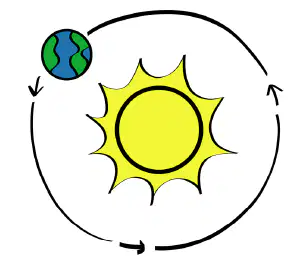
Rotation
Revolution
Earth’s rotation takes about _____, whereas its revolution takes about _____
one day; one year
one year; one day
one month; one year
one day; one eclipse
When the Northern Hemisphere is tilted towards the sun, what season is the Southern Hemisphere?
Winter
Spring
Fall
Summer


What season is it when the Earth is in position A in the Southern Hemisphere?
Winter
Summer
Spring
Fall
The point in a planets orbit where it is FARTHEST away from the sun
The point in a planets orbit where it is CLOSEST to the sun
Kepler's 1st Law says this about the orbits of planets
they are elliptical.
they are perfect circles.
they are always perfect polygons (square, pentagon, hexagon, etc.,)
they are parabolic.
Kepler's 3rd Law states that the farther away a planet is from the sun, the _______ it takes it to orbit the sun once (year).
longer
shorter
According to Kepler's 2nd Law when do planets move the fastest?

The diagram below shows a moon revolving around a planet in an elliptical orbit. Using your knowledge of Kepler's Law, at which position is the moon traveling fastest?
location 1
location 2
location 3
location 4

The diagram below shows a moon revolving around a planet in an elliptical orbit. Using your knowledge of Kepler's Law, at which position is the moon traveling slowest?
location 1
location 2
location 3
location 4
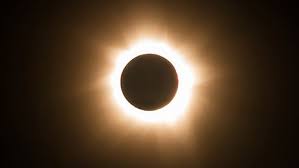
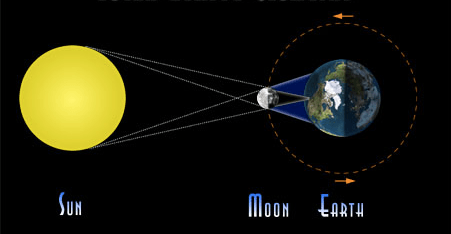
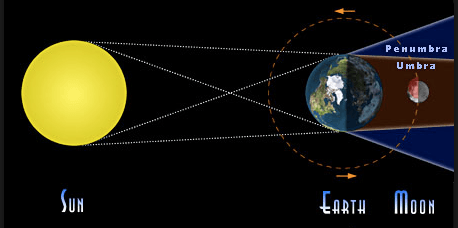
During a lunar eclipse
the Moon casts a shadow on Earth
the Earth casts a shadow on the Moon
the sun is partially blocked
a total eclipse occurs
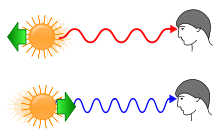
Why is the light from distant galaxies red-shifted?
They produce more red light than nearby galaxies
They are moving away from us
The longer wavelengths are filtered out more by dust
They are moving toward us

Which element(s) are found in the star's spectra below?
Hydrogen only
Hydrogen & Helium
Calcium only
Hydrogen & Calcium

A sample of gas is analyzed, producing the spectrograph in the image. Identify which element the sample is mostly made-up of?
Hydrogen
Helium
Neon
Mercury
Which of these is NOT a way nucleosynthesis occurs?
Big Bang
Nuclear Fission
Stars
Supernovas
Which process is responsible for the creation of elements heavier than helium in stars?
Stellar Nucleosynthesis
Radioactive Decay
Electron Capture
Big Bang Nucleosynthesis
Define nuclear fusion.
Combining lighter atoms to make heavier ones
Splitting lighter atoms to make heavier ones
Combining heavier atoms to make lighter ones
Splitting heavier atoms to make lighter ones
Which event causes more elements to be made?
Big Bang
Stars
Supernova
The Superbowl
Which type of fusion creates the MOST elements?
Big Bang
Stellar Nucleofusion (Stars)
Supernovas
Tardis

Which of the following characteristics determines the color of a star?
Luminosity
Temperature
Distance
Mass

The explosion of a supergiant star is also known as a ___________.
Neutron star
Nebula
Blackhole
Supernova

What is revealed by the BLUE color of the supergiant star, Rigel?
It is fairly cool
It is close
It is very hot
It is no longer emitting light

Which of the following stars are near the end of their life cycle?
Main sequence
White dwarfs
Giants
Supergiants

Only the MOST massive stars will end their lives as a _________.
Red supergiant
Blackhole
Neutron star
Black dwarf

Which of the following characteristics determines the life cycle of a star?
Luminosity
Temperature
Color
Mass

Our sun's NEXT phase in its life-cycle
Nebula
Red supergiant
Red giant
Planetary nebula

True or False: Larger, more massive stars have a LONGER lifespan than smaller less massive stars
True
False

The COOLEST stars appear to be what color?
Yellow
Red
Blue
White
How is the life cycle of a star determined?
by fusion
by its mass
by the color
by the tempature
Which type of star has a longer life span
High Mass Star
Small/Medium Star
What is a Nebula?
an enormous cloud of gas and dust
A type of planet
A cloud of helium and hydrogen
a ball of heat and energy

In the diagram given, what happens as we move from right to left?
Stars get larger
Stars get colder
Stars get hotter
Blue stars are the _____________.
hottest
coolest
smallest
biggest
What determines the color of a star?
Size
Temperature
Composition
They are all the same color
As you move from the bottom to the top of the H-R diagram the __________ changes.
Temperature
Luminosity or Brightness


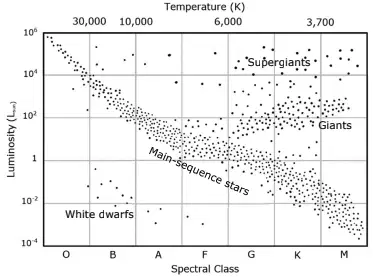
A star with a luminosity of 10^2 L and a temperature of 11,000 K would most likely be classified as a -
giant in spectral class G
main-sequence star in spectral class A
giant in spectral class K
main-sequence star in spectral class B

Which stars belong to spectral class G and have the lowest luminosity?
Main-sequence stars
White dwarfs
Giants
Supergiants
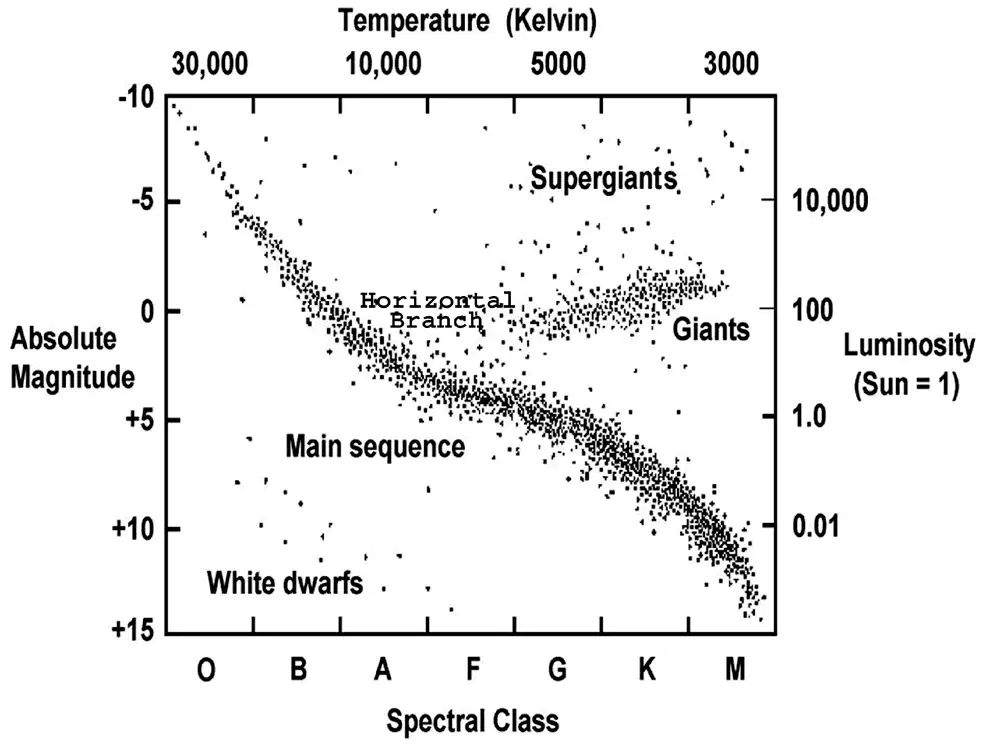
Which spectral class has stars with surface temperatures between 6000 and 7500 K?
A
F
G
K
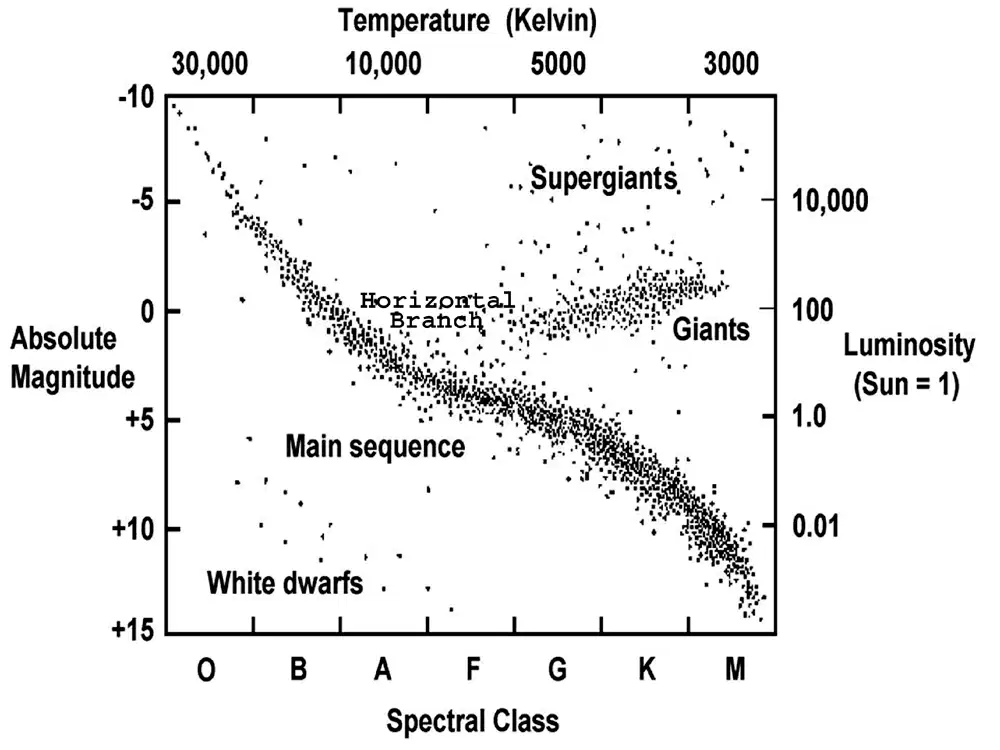
Stars of which spectral class have surface temperatures less than 3500 K?
G
K
M
O

