
 Worksheets
Scientific Method and Graphing Review
Total questions: 19
Worksheet time: 10mins
Base your answers to questions 1 through 3 on the information below and on your knowledge of biology. An experiment was carried out to answer the question "Does the pH of water affect the growth of radish plants?" Two groups of ten radish plants were set up. One group was watered with water having a pH of 3.0, and the other group was watered with water having a pH of 7.0. Both groups of plants received the same amount and intensity of light, the same amount of water, and they were grown in the same type of soil. The heights of the radish plants were measured every 2 days for a period of 2 weeks. 1. Which activity might help to increase the validity of this experiment?
repeating the experiment several times
using two different types of radish seeds in each group
using the same pH for both groups of plants
placing one set of plants in sunlight and one in darkness
An experiment was carried out to answer the question "Does the pH of water affect the growth of radish plants?" Two groups of ten radish plants were set up. One group was watered with water having a pH of 3.0, and the other group was watered with water having a pH of 7.0. Both groups of plants received the same amount and intensity of light, the same amount of water, and they were grown in the same type of soil. The heights of the radish plants were measured every 2 days for a period of 2 weeks. What is the dependent variable in this experiment?
heights of the plants
pH of the water
temperature of the water
type of soil
An experiment was carried out to answer the question "Does the pH of water affect the growth of radish plants?" Two groups of ten radish plants were set up. One group was watered with water having a pH of 3.0, and the other group was watered with water having a pH of 7.0. Both groups of plants received the same amount and intensity of light, the same amount of water, and they were grown in the same type of soil. The heights of the radish plants were measured every 2 days for a period of 2 weeks. Which of the following is a hypothesis for this experiment?
Does the pH of water affect the growth of radish plants?
Will the amount of water alter the heights of the radish plants?
The temperature of the water will affect the heights of the radish plants.
The pH of the water will affect the heights of the radish plants.
A student conducted an experiment to determine if listening to different types of music would affect pulse rate. She thought that pulse rate would change with different types of music. Each person participating in her experiment listened to seven different selections of music for 30 seconds each. The pulse rates were taken after each 30-second interval of music. Based on her experiment, the student concluded that a person's pulse rate changed when listening to different types of music. The component missing from this experiment is a
prediction
hypothesis
control group
research plan
Which statement describes the best procedure to determine if a vaccine for a disease in a certain bird species is effective?
A) Vaccinate 100 birds and expose all 100 to the disease.
B) Vaccinate 100 birds and expose only 50 of them to the disease.
C) Vaccinate 50 birds, do not vaccinate 50 other birds, and expose all 100 to the disease.
D) Vaccinate 50 birds, do not vaccinate 50 other birds, and expose only the vaccinated birds to the disease.
An investigation was designed to determine the effect of ultraviolet light on mold spore growth. Two groups of mold spores were grown under identical conditions, except one group was exposed only to ultraviolet light, while the other group was grown in total darkness. In this investigation, the group of mold spores grown without receiving any ultraviolet light is known as the
control
hypothesis
dependent variable
limiting factor
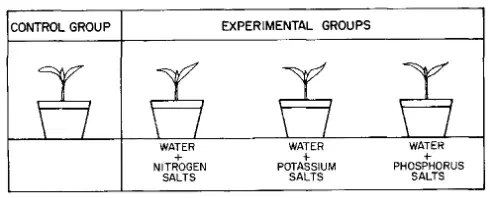
Which measurement would most likely be taken to determine the effect of different mineral salts upon the experimental groups?
weight of the medium in each pot
temperature of the 40 pots
height of the 40 plants
distance of each plant from the light source
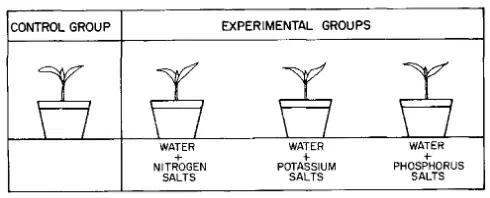
What was added to the control group of pots?
water, only
nitrogen salts, only
potassium salts, only
potassium and phosphorus salts
In an experiment, what should be the relationship between the control group and the experimental group?
They should be different in size
They should resemble each other in at least two respects
They should not be similar in any respect
They should be identical in all respects except one
In a scientific investigation, after the question is defined, the next step is most likely
formulating a hypothesis
identifying needed equipment
designing the experiment
collecting the data
Which sentence represents a hypothesis?
Environmental conditions affect the pollination of plants.
Boil 100 milliliters of water, let it cool, and then add 10 seeds to the water.
Is water depth in a lake related to available light in the water?
A lamp, two beakers, and elodea plants are selected for the investigation.
Diagrams, tables, and graphs are used by scientists mainly to
design a research plan for an experiment
test a hypothesis
organize data
predict the independent variable
Graphs of the data from laboratory investigations are used to
observe general trends in the data
make the observed data more accurate
prevent errors in measuring data
help change the original data tables
When heating a solution in a test tube, a student should
point the test tube in any direction
hold the test tube with two fingers
cork the test tube
wear goggles
Which statement represents an unsafe procedure for heating a nutrient solution in a flask?
heat the solution at the lowest temperature possible on a hot plate
stopper the flask tightly to prevent evaporation of the solution
use a Bunsen burner to heat the solution
stir the solution while it is heating
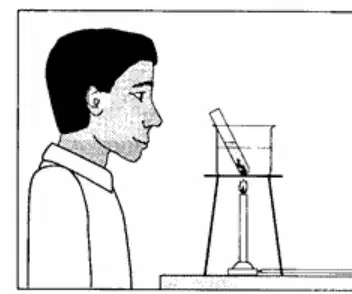
Which statement describes two unsafe laboratory practices represented in the diagram?
A) The flame is too high and the test tube is unstopped.
B) The opening of the test tube is pointed toward the student and the student is not wearing goggles.
C) The test tube is unstopped and the student is not wearing goggles.
D) The beaker has water in it and the flame is under the tripod.
A student conducted an original, well-designed experiment, carefully following proper scientific procedure. In order for the conclusions to become generally accepted, the experiment must
contain several experimental variables
be repeated to verify the reliability of the data
support the original hypothesis
be conducted by a scientist
A scientist is planning to carry out an experiment on the effect of heat on the function of a certain enzyme. Which would not be an appropriate first step?
doing research in a library
having discussions with other scientists
completing a data table of expected results
using what is already known about the enzyme
The analysis of data gathered during a particular experiment is necessary in order to
formulate a hypothesis for that experiment
develop a research plan for that experiment
design a control for that experiment
draw a valid conclusion for that experiment

