
 Worksheets
Guitar Effects Pedals Research Worksheet
Total questions: 36
Worksheet time: 18mins
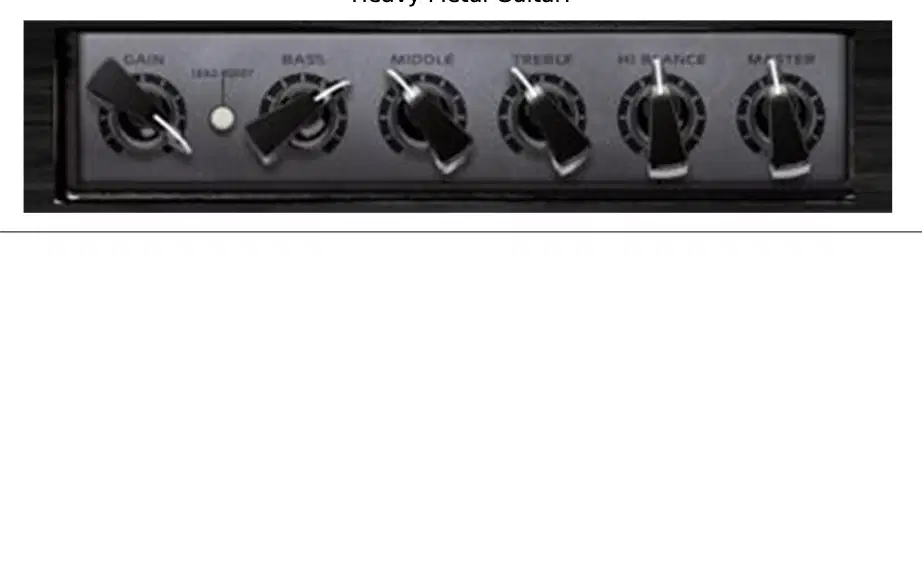
Which of the following best explains the functions of the controls (Gain, Bass, Middle, Treble, Hi Presence, Master) that can be seen in the picture?
They adjust the volume, tone, and presence of the audio signal in an amplifier.
They control the power supply to the amplifier.
They are used to switch between different audio sources.
They are decorative knobs with no functional purpose.
What is the function of the 'Attack' control in a compressor?
The 'Attack' control determines how quickly the compressor responds to the incoming signal once it exceeds the threshold.
The 'Attack' control sets the output volume of the compressor.
The 'Attack' control adjusts the frequency range being compressed.
The 'Attack' control determines the amount of gain reduction applied.
What is the function of the 'Release' control in a compressor?
The 'Release' control determines how quickly the compressor stops compressing after the signal falls below the threshold.
The 'Release' control sets the input gain of the compressor.
The 'Release' control adjusts the frequency response of the compressor.
The 'Release' control determines the stereo width of the output signal.
What is the function of the 'Ratio' control in a compressor?
The 'Ratio' control sets the amount of compression applied to the signal that exceeds the threshold.
It adjusts the overall output volume of the compressor.
It determines the frequency range affected by the compressor.
It sets the attack time for the compressor.
What is the function of the 'Threshold' control in a compressor?
The 'Threshold' control sets the level at which the compressor starts to act on the signal.
It determines the frequency range the compressor will affect.
It controls the speed at which the compressor returns to normal after compression.
It adjusts the overall output volume of the signal.
What is the function of the 'Make-up Gain' control in a compressor?
The 'Make-up Gain' control boosts the compressed signal to make up for any loss in volume caused by compression.
It determines the threshold at which compression begins.
It adjusts the speed at which the compressor reacts to signals above the threshold.
It sets the ratio of input to output level for signals above the threshold.
What is the function of the 'Input Gain' control in a compressor?
The 'Input Gain' control adjusts the level of the signal entering the compressor.
It determines the amount of compression applied to the output signal.
It sets the frequency range that the compressor will affect.
It controls the speed at which the compressor releases the signal.
What is the function of the 'Output Gain' control in a compressor?
The 'Output Gain' control adjusts the level of the signal leaving the compressor.
It determines the frequency range the compressor will affect.
It sets the speed at which the compressor starts to work after the threshold is exceeded.
It controls the amount of compression applied to the input signal.
What is the function of the 'Stereo Link' control in a compressor?
The 'Stereo Link' control links the left and right channels so that compression is applied equally to both.
It increases the overall output gain of the compressor.
It adjusts the attack time for only the left channel.
It bypasses the compressor entirely.
Describe the function of an Oscillator in a synthesizer.
An Oscillator generates the raw audio signal, usually in the form of a waveform such as sine, square, or sawtooth, which is the basis for sound synthesis.
An Oscillator amplifies the audio signal to increase its volume before output.
An Oscillator filters out unwanted frequencies from the audio signal to shape the sound.
An Oscillator records external sounds to be used as samples in the synthesizer.
What is the purpose of Pitch Fine & Coarse controls in a synthesizer?
Pitch Fine & Coarse controls are used to adjust the pitch of the oscillator, either in small increments (fine) or larger steps (coarse).
Pitch Fine & Coarse controls are used to change the volume of the synthesizer.
Pitch Fine & Coarse controls are used to modify the filter cutoff frequency.
Pitch Fine & Coarse controls are used to add reverb to the sound.
What is the function of a Filter in a synthesizer?
A Filter shapes the sound by removing certain frequencies, such as cutting out high or low frequencies to alter the timbre.
A Filter increases the volume of the sound without changing its frequency content.
A Filter generates new waveforms for the synthesizer to use as sound sources.
A Filter controls the tempo and rhythm of the synthesizer's output.
What does the Envelope control in a synthesizer?
The Envelope controls how a sound evolves over time, typically using parameters like Attack, Decay, Sustain, and Release (ADSR).
It controls the pitch of the sound produced by the synthesizer.
It determines the type of waveform generated by the oscillator.
It adjusts the overall volume output of the synthesizer.
What is the purpose of an LFO in a synthesizer?
A Low Frequency Oscillator (LFO) modulates other parameters, such as pitch or filter cutoff, to create effects like vibrato or tremolo.
An LFO generates the main audio signal in a synthesizer.
An LFO is used to store and recall preset sounds in a synthesizer.
An LFO amplifies the output signal to drive speakers.
What is the purpose of MIDI CC 0?
Modulation
Bank Select
Breath Controller
Undefined
MIDI CC 1 is generally used for _________
Modulation
Volume
Pan
Reverb
Which MIDI CC is often associated with aftertouch messages and was originally intended for use with a breath MIDI controller?
MIDI CC 0
MIDI CC 1
MIDI CC 2
MIDI CC 3
MIDI CC 3 is _________
Undefined
Modulation Wheel
Expression Controller
Foot Pedal
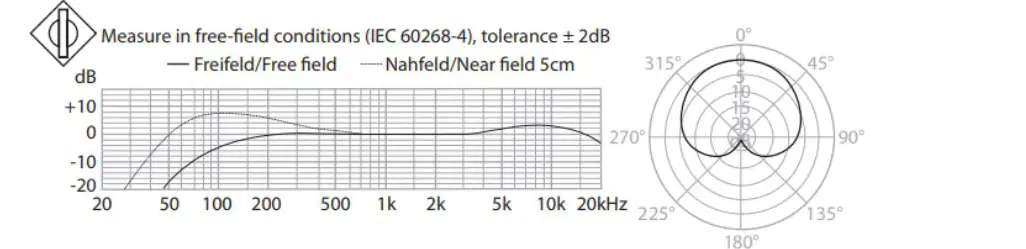
The suitability of this microphone to record Lead Vocals is:
Highly suitable
Somewhat suitable
Not suitable
Unsuitable
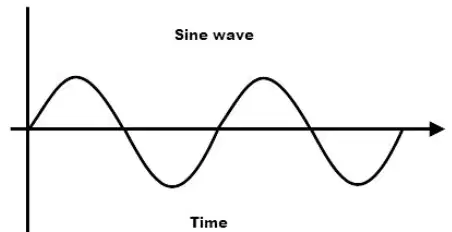
Identify the type of wave shown in the diagram and describe one characteristic of a sine wave.
The wave is a sine wave; it has a smooth, periodic oscillation.
The wave is a square wave; it has abrupt transitions between high and low values.
The wave is a triangular wave; it has linear rises and falls.
The wave is a sawtooth wave; it has a sharp rise and gradual fall.
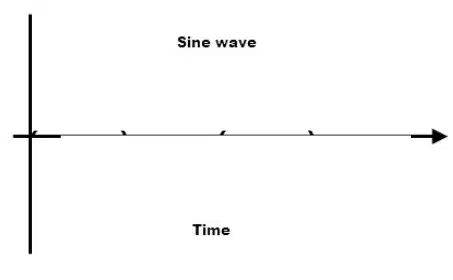
Draw the sine wave after hard clipping.
The sine wave after hard clipping should have its peaks flattened, creating a more squared-off appearance at the top and bottom of the wave.
The sine wave after hard clipping should become a perfect triangle wave with sharp peaks.
The sine wave after hard clipping should remain unchanged, retaining its smooth curves.
The sine wave after hard clipping should become a sawtooth wave with a linear rise and sudden drop.
Quantise does which of the following?
It adjusts the timing of notes to the nearest grid value.
It increases the volume of the track.
It adds reverb to the sound.
It changes the pitch of the notes.
What is the frequency range of an EQ?
20 Hz to 20 kHz
100 Hz to 10 kHz
50 Hz to 5 kHz
200 Hz to 2 kHz
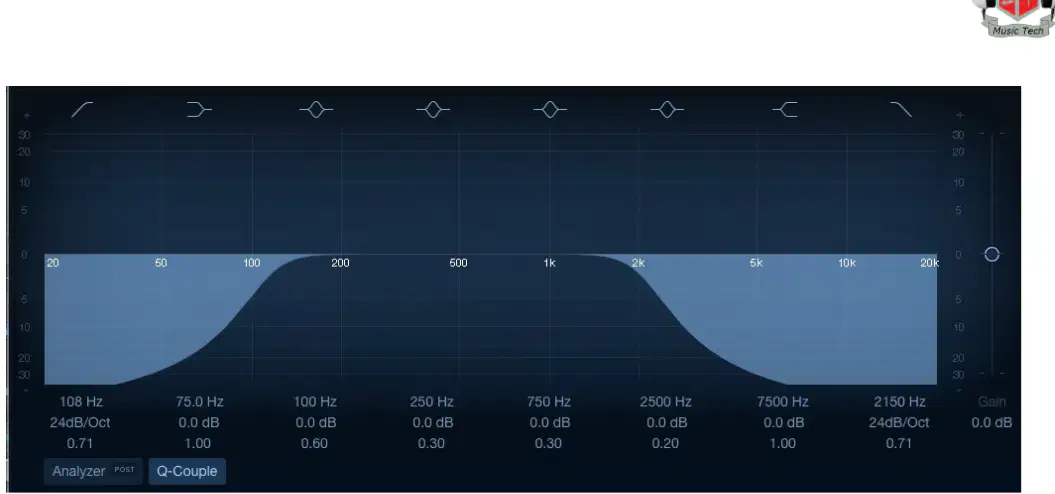
What two EQ curves are engaged on the EQ above?
High Pass and Low Pass
High Shelf and Low Shelf
Bell and Notch
Band Pass and Notch
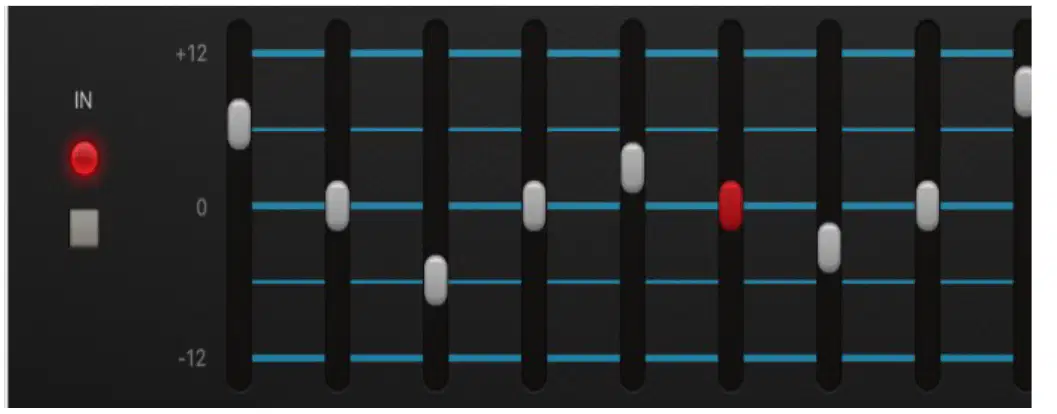
State one advantage of using a Graphic EQ.
Easy to use and visually intuitive for adjusting frequencies.
Requires no power to operate.
Automatically fixes all audio issues.
Only works with analog signals.
According to Nyquist’s theorem, why is this recording quality sufficient to record this vocal performance?
Because the sampling rate is at least twice the highest frequency in the vocal performance.
Because the recording is in stereo.
Because the recording uses lossless compression.
Because the microphone is high quality.
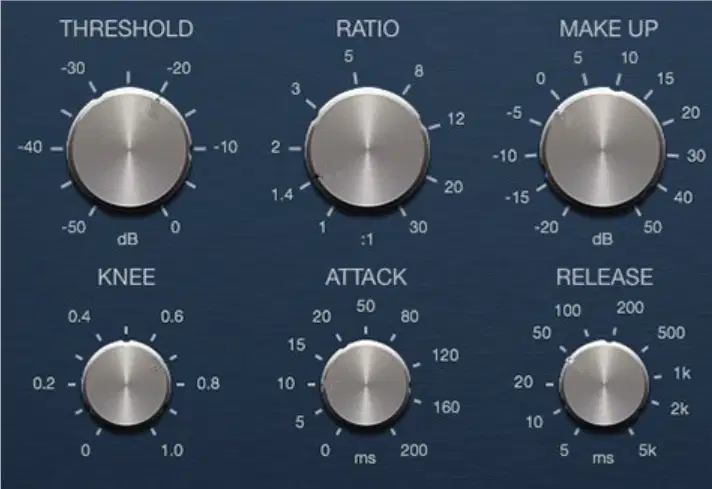
On the compressor below, which of the following is a suitable setting for a male lead rock vocal?
Attack: 10ms, Release: 50ms, Ratio: 4:1, Threshold: -6dB
Attack: 100ms, Release: 500ms, Ratio: 1:1, Threshold: 0dB
Attack: 1ms, Release: 10ms, Ratio: 20:1, Threshold: -30dB
Attack: 50ms, Release: 200ms, Ratio: 2:1, Threshold: -12dB
What is a D.I?
A D.I (Direct Injection) box converts a high-impedance instrument signal to a low-impedance signal suitable for mixing consoles or audio interfaces.
A D.I is a device that amplifies speaker signals for live performances.
A D.I is a type of microphone used for recording vocals.
A D.I is a software plugin for adding reverb effects.
3. Using a D.I to record an electric guitar is different from using an amplifier because:
A D.I captures a clean, uncolored signal, while an amplifier adds tonal coloration and effects.
An amplifier records a cleaner signal than a D.I.
A D.I always produces a louder sound than an amplifier.
There is no difference between using a D.I and an amplifier.
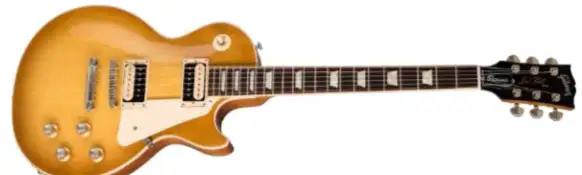
Give two possible causes of unwanted sound in a guitar track.
1. Electrical interference 2. Poor grounding or faulty cables
1. Using high-quality cables 2. Properly shielding the guitar
1. Playing in a soundproof room 2. Using new guitar strings
1. Regularly cleaning the guitar 2. Using a noise gate pedal
1. Practicing at low volume 2. Using headphones
1. Analogue means:
Digital
Continuous
Random
Discrete
It is important to use fades or crossfades when joining two sections of truncated audio because:
They help to create smooth transitions and avoid clicks or pops.
They increase the volume of the audio.
They add special effects to the audio.
They make the audio play in reverse.
Compression can be used to increase a sample’s sustain by:
Reducing the dynamic range and allowing quieter sounds to be heard longer
Increasing the attack time to make the sound punchier
Decreasing the release time to shorten the sound
Adding distortion to the sample
A condenser microphone has been used to record this vocal because:
It captures a wide frequency range and detailed sound
It is less sensitive than dynamic microphones
It is more durable than ribbon microphones
It is cheaper than all other microphones
State one recording scenario in which you could utilise a figure of 8 polar pattern.
Recording a duet with two singers facing each other
Capturing a solo vocalist in a live concert
Recording a drum kit overhead
Recording a guitar amplifier in a noisy room
Modulation effects are produced by an LFO. LFO stands for:
Low Frequency Oscillator
Linear Frequency Oscillator
Loudness Frequency Oscillator
Long Frequency Oscillator

