
 Worksheets
Protein Synthesis Week 3
Total questions: 25
Worksheet time: 38mins
Which of the following components is essential for translation?
Spliceosome
Ribosome
DNA polymerase
RNA polymerase
tRNAs adapt specific triplet codons in mRNA to what?
rRNAs
Other codons
Correct amino acids
Exons
Which part of the tRNA binds to the mRNA codon during translation?
Acceptor stem
D-loop
Anticodon loop
Variable loop
The enzyme responsible for attaching amino acids to their corresponding tRNAs is called:
Peptidyl transferase
Aminoacyl tRNA synthetase
DNA ligase
Topoisomerase
How many different types of aminoacyl tRNA synthetases exist in most organisms?
64
30-55
20
12
Which site on the ribosome does the first charged tRNA bind during initiation?
E site
P site
A site
Exit tunnel
What is the start codon for translation?
UGA
UAC
AUG
AAA
During elongation, which site on the ribosome does the new tRNA enter?
P site
Exit tunnel
A site
D-loop
What energy source drives elongation during translation?
ATP
NADH
GTP
FAD
Which of the following codons signals termination of translation?
AUG
GGU
UAA
UAC
What type of bond forms between amino acids during translation?
Phosphodiester
Peptide
Glycosidic
Ionic
Which proteins mediate proper protein folding?
Ligases
Ubiquitins
Chaperones
Helicases
Which molecule tags misfolded proteins for degradation?
Protease
Ubiquitin
Chaperonin
Ligase
Where are misfolded proteins transported for degradation?
Golgi apparatus
Nucleus
Proteasome
Mitochondria
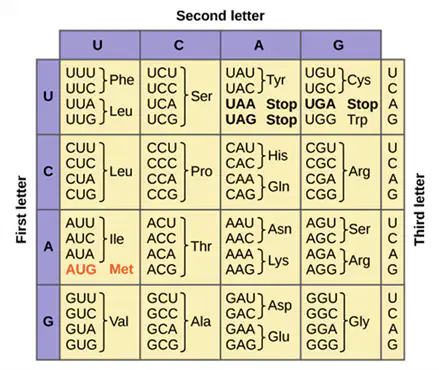
Using the Genetic Code Chart, Please Translate the following -
5' - UGGCAAUAUCACAUGUUUCUUGGCUGA - 3' ?
Phe-Leu-Gly
Trp-Gln-Tyr-His-Met-Phe-Leu-Gly
Val-Ser-Arg-Cys-Pro-Phe-Gly-Leu
The above sequence cannot be translated due to the absence of Thymine in the DNA provided
What determines the chemical nature of an amino acid?
Carboxyl group
Amino group
R group
Hydrogen atom
Which class of amino acids is hydrophobic?
Polar
Nonpolar
Positively charged
Negatively charged
Enzymes primarily function by:
Storing genetic information
Transporting mRNA
Catalyzing chemical reactions
Binding to ribosomes
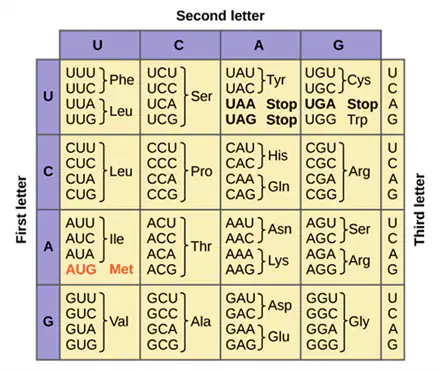
Using the Genetic Code Chart, which of the following statements would accurately describe the protein once translated using the mRNA sequence below?
5' - UGGCAAUAUCACAUGCUUUAAGGCUGA - 3'
The protein will be truncated (shortened) due to an early stop code
The protein will be comprised of 9 amino acids
The protein will start with the amino acid, Trp
It is impossible to know what the protein will be, given that the mRNA and not the DNA was provided.
Which ribosomal subunit binds first to the mRNA during translation?
Large Ribosomal Subunit
Small Ribosomal Subunit
Both bind at the same time
Ribosomes are not involved in the initiation of translation
What is one major difference between Translation and Transcription?
In Translation we are making RNA from a DNA template, In Transcription we are creating DNA from an RNA template
In Transcription we are making protein from a DNA template, while in Translation the final product is not clearly defined
RNA Polymerase plays a major role in Translation and Transcription, but its function during translation is most critical to the process
Translation involves the usage of mRNA, enzymes, and ribosomes, while transcription does not involve ribosomes

Which process is shown?
DNA Replication
Transcription
mRNA recombination
Translation
Which of the following processes involves the enzyme amino-acyl transferase?
Translation
DNA replication
Transcription
All Three Process involve this enzyme
Which of the following process involves the use of DNA Polymerase III?
The process of replication that occurs during S-Phase of the Cell Cycle
The process of creating RNA from a DNA template
The process of creating Protein from an mRNA template
The process that involves the usage of ribosomes in the creation of amino acids
Which of the following processes involves the use of TFIIA?
Transcription
Translation
DNA Replication
None of the Above

