
 Worksheets
Repaso #1 para el Examen Mayo 2025 MHS
Total questions: 67
Worksheet time: 1hrs 6mins
¿Qué género de música es esta?
Es salsa
Es cumbia

Empareja lo siguiente
I have
tengo
He has
tiene
She has
Ella tiene
They have
tienen
You have
tienes

Empareja lo siguiente
Tienes
you have
¿Tienes?
Do you have
Tienes un hermano.
You have a brother.
¿Tienes hermanos?
Do you have siblings?

Ordena la frase.
El
hermano
de
Lina

Ordena la frase
la
novia
de
Juan
Etiqueta los salseros

La frase famosa de (a) era (b)
Ordena la frase: Celia Cruz was a famous salsa artista and she was Afro-Cuban.
Celiz Cruz era
una salsera famosa
y
ella era
afrocubana.

Ordena la frase: Mark Anthony is a salsa artist, and is J-Lo's ex husband.
Mark Anthony es
salsero
y es
el ex esposo de
J-Lo
Escucha y elige la foto de la persona mencionada.

Cantante mexicana que canta Me voy

Cantante afrocubana que decía "¡Azúcar!"
Me (a) qué lástima pero (b)
Tu (a) lo que yo no (b) . (c) tengo lo que (d) no tienes
La (a) es una fusión de géneros del (b) y de Estados Unidos

Match the following
voy
I go
vas
you go
va
he goes
vamos
we go
van
they go
Etiqueta ls partes del toro.

Empareja lo siguiente.
The @ symbol represents the fact that it could end in an a or an o depending on gender of who is speaking or who you are asking/telling about.
Estás enojad@
You are feeling angry
Estás en clase
You are in class
¿Estás enojad@?
Are you feeling angry?
Estoy enojad@.
I'm feeling angry.
Está enojad@.
He is feeling angry.
How did the problem of the missing bike get solved?
Miguel analiza la situación por un momento. Su bicicleta está enfrente de la escuela, pero… ¿por qué?
En ese momento, Miguel recuerda(he remembers) que el viernes caminó a su casa con una chica que le gusta. Estaba muy feliz y distraído porque hablaba y caminaba con la chica. ¡Se le olvidó (he forgot) que su bicicleta estaba en la escuela!
Miguel remembered he got picked up after he said goodbye to his girlfriend because he had a doctor's appointment.
Miguel remembered he got happy and distracted by walking with a girl he likes and left it at school
Listen to the recording and select the way I said " was walking and talking".

hablaba y caminaba

habla y baila

bailaba y decía
According to what you hear, how was Miguel feeling on Friday as he walked and talked with the girl?
He was happy and confused.
He was happy and distracted.
He was feeling angry
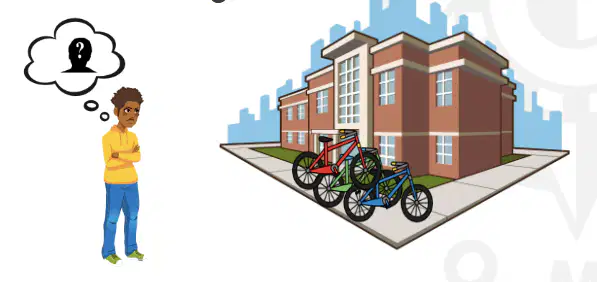
Make it say: Miguel is confused and furious because someone "stole" his bike.
Miguel
está
confundido y furioso
porque alguien le
robó la bicicleta
¿Cómo está Miguel ahora?
Miguel camina a la escuela. Cuando llega (arrives) a la escuela, ¡ve su bicicleta! Está enfrente de la escuela con las otras bicicletas. Miguel está confundido. ¿Cómo es posible que su bicicleta esté aquí? Está enojado. ¡Está furioso! ¿Quién se robó su bicicleta?
confundido y furioso
confundido y felíz
furioso y felíz
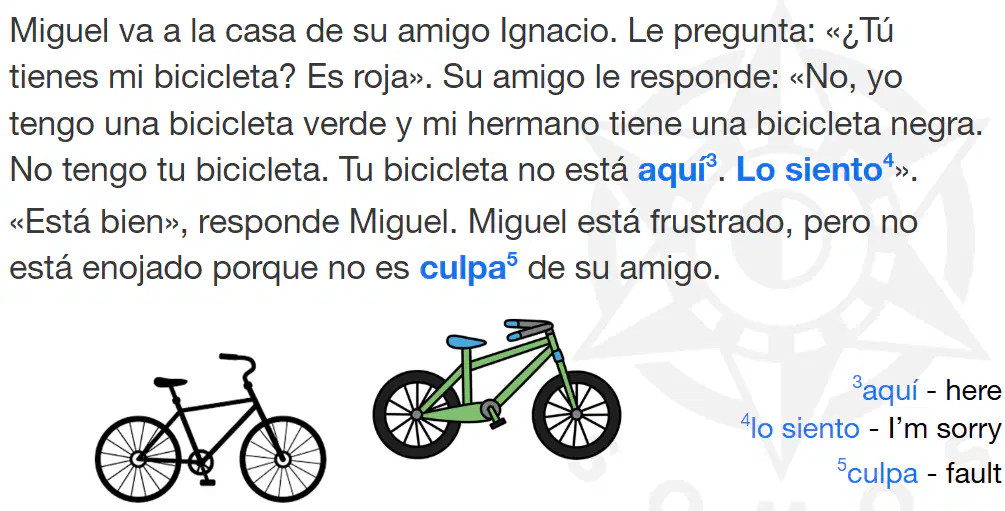
Order the sentence that explains how Miguel is feeling after talking to his friend Ignacio.
Miguel
está
frustrado,
pero no está
enojado
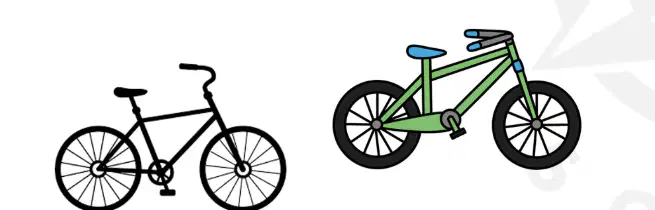
According to the reading, what color is Igancio's brother's bike?
Miguel va a la casa de su amigo Ignacio. Le pregunta: «¿Tú tienes mi bicicleta? Es roja». Su amigo le responde: «No, yo tengo una bicicleta verde y mi hermano tiene una bicicleta negra.
red
blue
green
black
Miguel siempre va a la escuela en bicicleta.
What does siempre mean in the sentence?
always
never
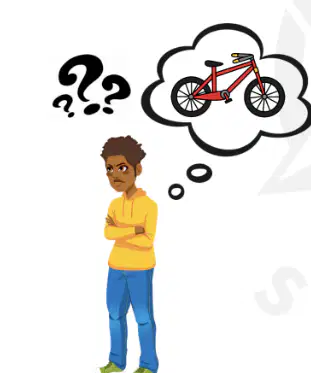
Miguel está enojado porque su bicicleta no está en el garaje. Está enojado porque no quiere caminar a la escuela y porque su bicicleta es muy importante para él.
According to the reading, which statement is NOT true about Miguel?
Miguel is feeling angry
Miguel doesn't want to walk to school
Miguel's bike is in the garage
Miguel's bike is important to him
Change to the yo form: ella camina -> (a)
Change to the yo form: Paco corre -> (a)
Change to the yo form: la chica puede -> (a)
Change to the yo form: él no puede -> (a)
Change to the yo form: mi mamá cierra -> (a)
Change to the yo form: Sally abre -> (a)
Change to the yo form: el animal no habla -> (a)
Change to the yo form: el estudiante toma -> (a)
Change to the yo form: ella quiere -> (a)
Change to the yo form: él levanta -> (a)
Change to the yo form: Señora Porterfield grita -> (a)
Change to the nosotros form: ella corre -> (a)
Change to nosotros form: el perro camina -> (a)
Change to the nosotros form: ella ve -> (a)
Change to nosotros form: la chica va -> (a)
Change to the nosotros form: el amigo habla
(a)
Change to the nosotros form: el estudiante toma
(a)
Change to the nosotros form: la persona lleva
(a)
Change to the nosotros form: el hermano levanta
(a)
Change to the nosotros form: la amiga grita
(a)
¿Qué les grita Sra. Roche a sus estudiantes todos los días?
<<¡Hola! ¡Buenos días!>>
A sus estudiantes
en la mañana
En la clase de español

¿Qué hace (doing) el chico?
Se levanta.
Se sienta.
Grita.
Va al baño.

¿Qué hace (do) la chica? La chica __.
Se sienta
Siéntate
Levántate
Se levanta
¿Qué NO grita un profesor?
<<¡Levánta la mano!>>
<<¡Siéntate!>>
<<¡Abre la boca!>>
<<¡Cierra el Chromebook!>>

El chico (a) .

El papá está MUY enojado y (a) .

Which of the following is NOT something this infographic is encouraging people to do while at work?
Get up and move!
Walk in your office
Exercise at least 30 minutes a day.
Walk to your friend's desk instead of messaging them

This infograph lists how being seated for too long detoriorates your body. According to this infograph, the longer you sit:
Electrical activity in your feet stops.
Calorie consumption decreases to 1 per minute.
The enzymes that help break down fat fall 80%
Good cholesterol falls 15%

What would be a good summary statement for this infographic?
Es muy importante sentarte mucho.
¡No grites! Es malo para otras personas.
¡No te levantes! Es muy difícil.
¡No te sientes mucho! Es malo para ti.

¿Qué es?
la cabeza
el hombro
la rodilla
el pie

¿Qué son?
los pies
los brazos
los hombros
las rodillas

¿Qué es?
el brazo
la cabeza
el hombro
la rodilla

¿Qué son?
los pies
las manos
los brazos
las piernas

¿Qué es?
el ojo
la oreja
la boca
la nariz

¿Qué es?
la boca
la oreja
el ojo
la nariz

¿Qué es?
El estómago
La pierna
La oreja
La boca

¿Qué es?
La garganta
La nariz
El brazo
El dedo

El objetivo de (a) es (b) el toro.
Categoricen las frase

combaten con los toros

ven las corridas de torros

tienen casas grandes

tienen carros rápidos

tienen fotos para recibir autógrafos de los torreros

gritan olé cuando el torro corre

ganan $75,000 por matar un toro

opinan que las corridas son arte

son matados durante una corrida de torros

combaten con los toreros

corren hacia los toreros

No les gusta ver un toro matado

no piensan que las corridas son arte ni cultura

están enojados con las personas que van a las corridas de toros
Escucha y elige el resúmen correcto.
The fans of the bullfighters get their autographs
The fans of the bullfighters think it is an art form and a cultural tradition
Escucha y elige el resúmen correcto.
The fans of the bullfighters get their autographs
The fans of the bullfighters think it is an art form and a cultural tradition
Ordena la oracion según lo que escuchan.
muchas personas
van a las corridas
de toros para
protestar y
están enojados

