
 Worksheets
G6 Science 1st CA 3rd Term PQ
Total questions: 25
Worksheet time: 5hrs 17mins
What is the result of the Earth moving around the Sun in its orbit? what is it called?
Earth's Revolution
What name is given to celestial bodies that revolve around the Sun in fixed paths?
By how many times is Earth's gravitational pull stronger than that of the Moon?

What is the name of the method used to separate a mixture in the shown image?
Sieving
Filtration
Pouring
Decantation
How would you define one year in terms of Earth's movement?
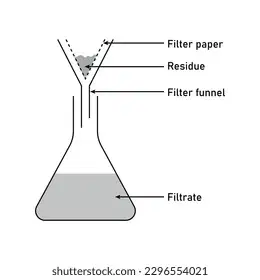
After filtration, the solid that couldn't pass through is called _________ while the liquid that passed through is called __________.
Which method is commonly used to separate immiscible liquids?
Centrifugation
Use of Separation Funnel
What is the quickest way to retrieve metal pins dropped onto sandy ground?
Which process is used to break down a colour into its individual pigments?
What is a smaller object called that orbits a larger one, like the Moon does around the Earth?
satellite
planet
eclipse
ellipse
What term describes long-term, significant changes in Earth's climate?
Which of the following is not a cause of climate change?
Natural occurrences
SELECT ALL the greenhouse gases listed below.
carbon dioxide
Nitrous oxide
chlorofluorocarbon gases
Which of the listed energy sources is not classified as clean or renewable?
What is global warming?
What is the formula for calculating weight using mass and gravity?
Who was the first human to travel into outer space?
Which country is he from?
Yuri Gagarin, from Russia.
Which planet is the hottest?
Which planet is the largest in size?
which planet is the smallest and closet to the sun?
Which planets has rings?
Which planet is farthest from the sun?
Venus, Jupiter, Mercury, Saturn and Uranus
Mercury, Jupiter, Venus, Saturn and Neptune
Venus, Jupiter, Mercury, Saturn, and Neptune
Mars, Mercury, Jupiter, Earth and Venus
What type of change releases heat or energy and results in the formation of a new substance?
What phenomenon is caused by the Earth spinning on its axis?
What phenomenon occurs when the Moon passes between the Earth and the Sun?
Lunar eclipse
Solar eclipse
Tidal wave
Meteor shower
What is the term for the path that a planet takes as it revolves around the Sun?
Orbit
Revolution
Axis
Rotation
Which gas is primarily responsible for the depletion of the ozone layer?
Nitrous Oxide
Methane
Carbon Dioxide
Chlorofluorocarbons (CFCs)
What is the phenomenon called when the Earth's shadow falls on the Moon?
Solar eclipse
Lunar eclipse
Stellar occultation
Planetary alignment
Which of the following defines mixture?

