
 Worksheets
Geography Grade 11 Final 2025
Total questions: 152
Worksheet time: 3hrs 6mins
The idea that explained how continents moved over time
Continental Drift
Pangea
Plate Tectonics Theory
Plate Boundaries
A German scientist who first had the idea of continental drift.
Albert Einstein
Galileo
Alfred Wegener
Gladys West
The name of the supercontinent before they moved to where the continents are today.
Continental Drift
Pangea
Super Country
United States of America
The year Wegener first had the idea for continental drift
1975
1950
1888
1912
The decade when other scientists started believing Wegener
1940's
1950's
1960's
1970's
The scientific theory that describes how the Earth’s crust (and upper mantle) is divided into plates that can move (very slowly).
Continental Drift
Pangea
Plate Tectonics Theory
Plate Boundaries
The places where tectonic plates (big pieces of crust) meet together
Continental Drift
Pangea
Plate Tectonics Theory
Plate Boundaries
The tectonic plates move apart
Convergent Boundary
Divergent Boundary
Transform Boundary
Personal Boundary
The tectonic plates move together
Convergent Boundary
Divergent Boundary
Transform Boundary
Personal Boundary
The tectonic plates slide past.
Convergent Boundary
Divergent Boundary
Transform Boundary
Personal Boundary
Which of the following WAS NOT a piece of evidence that Alfred Wegener considered when forming his model of continental drift?
the interaction between the Earth's lithospheric plates and the asthenosphere
the fit of the east coast of South America and the west coast of Africa
fossils of the same species match across the seas
similar mountain ranges on different continents
similar ancient climates evidence matches on present-day continents
Which of the following events lead to the discovery of the process of sea-floor spreading?
World War II
the American Civil War
the creation of the atomic bomb
the Apollo Moon-landing program
In which of the following regions is plate subduction dominant.
around the edges of the Pacific Ocean
down the middle of the Atlantic Ocean
along the Appalachian Mountains of the US northeast
at the North and South Poles
Plate tectonics is a direct result of the interaction between which of the following spheres of Earth?
lithosphere and asthenosphere
atmosphere and hydrosphere
pedosphere and cryosphere
magnetosphere and chromosphere
Earth's lithospheric plates at a rate of a few _____________ every year.
centimeters
miles
kilometers
yards
The term "plate tectonics" refers to the fact that the lithospheric crustal plates are moving very slowly across the Earth’s surface.
True
False
A tectonic plate boundary where the two plates are scraping alongside each other in a side-swiping motion is referred to as:
a strike-slip fault.
a subduction zone.
sea floor spreading.
a convergence.
The Pacific Ocean is the largest body of water on Earth and is growing larger each year.
True
False
The continental drift hypothesis stating that a supercontinent called Pangaea began breaking apart about 200 million years ago was proposed by:
Alfred Wegener
Antonio Pellegrini
Harry Hess
Bill Nye
During his lifetime, the main objection to Alfred Wegener’s proposal was the inability to find _________________ for continental drift.
a mechanism
an example
evidence
a timeline
The asthenosphere is _________________ than the lithosphere.
This allows for the ____________ of the lithosphere over the asthenosphere
hotter and weaker, motion
cooler and stronger, power
more brittle and lighter, dominance
darker and harder, subduction

Which of the following best describes this illustration.
Earth's largest tectonic plate and region of plate subduction
Earth's largest tectonic plate and region of plate divergence
Earth's hottest tectonic plate and region of strongest hurricanes
Contains the Mid-Atlantic Ridge

Which of the following is shown in this illustration?
Earth's longest mountain chain
the Hawaiian hotspot
the San Andreas fault
the Ring of Fire
One of the first clues that many people notice about continental drift is that:
the continents appear to fit together like puzzle pieces.
the lithospheric plates move across the asthenosphere.
ancient climates in different parts of the world appear to have been identical.
the Earth is protected from the solar winds by its magnetosphere.
A satisfactory mechanism for continental drift was finally discovered when data from ___________________ provided clues to how continents moved.
seafloor mapping
sea level rise
volcanic activity
atmospheric pollution levels
Which of the following dinosaur species was studied to attempt to solve the mystery of how the fossils of the same animal could be found on two continents separated by thousands of miles of ocean?
Brachiosaurus
Triceratops
Stegosaurus
Velociraptor
Mapping the locations of rocks gives clues as to how they may have moved along cracks in the crust called ______________.
faults
fails
tributaries
sink holes
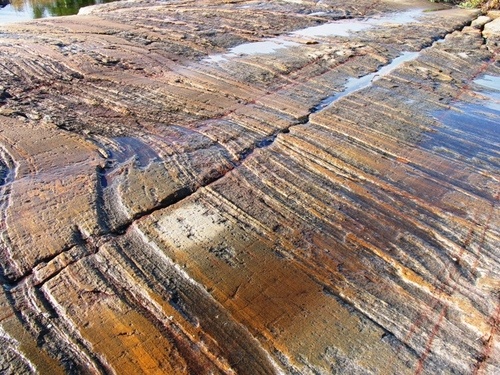

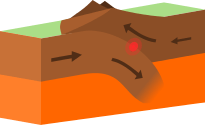
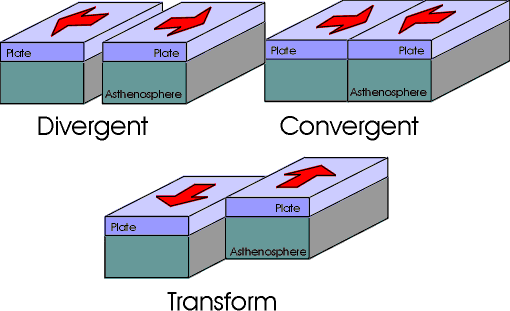


A fold that results in an arch shape is a syncline.
True
False
When the crust is stretched by rock moving in opposite directions, compression occurs.
True
False
How does folding affect Earth's surface?
Folding causes the crust to buckle, and over time, to rise up and form mountains.
Folding causes the crust to sink.
Folding causes the crust to bend in half.
Folding has no effect on Earth's surface.
Why is it dangerous to live along a fault line?
It's not dangerous at all!
The plates are sliding past each other here and this can cause serious changes to the landscape, including a fracture in the crust.
Which type of stress occurs at divergent boundaries where plates pull apart?
tension
compression
shear
Which type of stress occurs at convergent boundaries where plates push into each other?
tension
compression
shear
Which type of stress occurs at transform boundaries where plates slide past each other?
tension
compression
shear
What is syncline?
A downfolded portion of rock layers.
An upfolded portion of rock layers.
A word Ms. Powell made up.
What is anticline?
A downfolded portion of rock layers.
An upfolded portion of rock layers.
A word Ms. Powell made up.
In Earth Science, what is a fault?
It is who is to blame.
It is a fracture where pieces of earth move up, down and sideways.
It is a break in Earth's crust where pieces don't move.
In Earth Science, what is a joint?
It is something that moves on a hinge, like your elbow.
It is a fracture where pieces of earth move up, down and sideways.
It is a break in Earth's crust where pieces don't move.
When magma keeps coming up below the surface and eventually solidifies and creates igneous rock, what is formed?
An earthquake.
A volcano.
A pile of rocks.
Nothing, that doesn't happen.
A type of fault caused by two opposing parallel forces which result in slipping is known as
A tear fault
slip fault
anticlinal fault
thrust fault
Which of The following is not a types of fault
Normal fault
Nappe fault
Reserved fault
Shear fault
The steep slope facing the downthrow is called
Faultscarp
Throw
Hade
Heave
When the land move in relation to the others along the fault in a movement
Earth movement
Displacement
Throw
Faulting
Faulting is not caused by three forces
True
False
Not sure
None of the above
What is faulting
Cracking of the earth's crustal rocks
Fracturing of the rocks of the earth's crust
Bending of the rocks of the earth's crust
Is a word invented by Tr Ndavi

The picture shows a type a movement resulting from the compression of Rocks.
Faulting
Folding
Stratification
Tension
A type of movement that form cracks or fractures in rocks. The cracks are called fault lines.
Faulting
Folding
Anticline
Syncline

What happens to reverse fault?
Hanging wall drops down
Both walls move sideways
Forces are pulling the sides apart (Extensional)
The force is compressional, pushing the sides together
Which among the pictures shows SYNCLINE (Folding)?


Which among the pictures shows Transverse fault?

The picture shows the process of what kind of rock formation?
Stratified Rocks
Sedimentary Rocks
Metamorphic Rocks
Igneous rocks

What is the correct order (starting from the surface) of Earth’s layers?
crust, outer core, inner core, mantle
mantle, outer core, inner core, crust
crust, mantle, outer core, inner core
outer core, inner core, crust, mantle

Which layer of Earth flows slowly and causes the crust to move?
Crust
Mantle
Inner Core
Outer core


When plates collide we get ________.
crumbles
volcanos
trenches
mountain ranges

Most geologists think that the movement of Earth's tectonic plates is caused by
the rotation of the Earth.
the Earth's magnetic field.
subduction.
convection currents.


Lava that is very thin and runny probably
has low silica content
is high in silica
Where are volcanoes most likely to form?
along plate boundaries
near the center of continents
near water
on the moon
One major belt of volcanoes that surrounds the Pacific Ocean
Ring of Fire
Ring of Asia
Ring o' earthquakes
Ring a ding ding
A bowl shaped area that may form at the top of a volcano around the central vent
crater
vent
tube
leftovers


Rocks can change throughout many different processes through the rock cycle. Which of the following does not contribute in the changes of rocks?
compaction
deposition
melting
weathering
The processes involved in the rock cycle include all of the following EXCEPT:
compaction
condensation
erosion
weathering
How does extrusive igneous rock differ from intrusive igneous rock?
I. Extrusive igneous rock cools quickly and fine-grained in texture while intrusive igneous rock cools slowly and coarse-grained in texture.
II. Extrusive igneous rock cools slowly and coarse-grained in texture while intrusive igneous rock cools quickly and fine-grained in texture.
I
II
I and II
none of the above
All of the following conditions in Earth can cause metamorphic rocks to form EXCEPT:
exposure to air
heat
pressure
the presence of hot, watery fluids
How does sedimentary rock form?
formed because of changes in temperature and pressure, or the presence of hot watery fluids
formed from foliated igneous rock
formed from magma
formed when loose materials become pressed or cemented together or when minerals form from solutions
There are different types of rocks. What type of sedimentary rock is formed from broken fragments of pre-existing minerals and rocks?
chemical rocks
clastic rocks
inorganic rocks
organic rocks
Which type of metamorphic rock occurs when liquid rock comes into contact with other rocks?
allied metamorphism
contact metamorphism
contract metamorphism
regional metamorphism
Which statement about rock is TRUE?
A rock is always made of molten material.
A rock is always a mixture of minerals, organic matter, volcanic glass, or other materials.
A rock is always formed by heat and pressure.
A rock is always either igneous or sedimentary.
What metamorphic rocks comes from hard sandstone?
marble
schist
slate
quartzite
What sedimentary rock formed from the mixture of smooth round stones and pebbles?
arkose
chert
conglomerate
shale
Why is it hot at the equator?
Due to a lack of clouds
Due to the Sun's energy being more concentrated
Due to a lack of rainfall
Due to clouds keeping the surface insulated
Is there rising air or sinking air at the equator?
Rising air
Sinking air
Is rising air linked to wet or dry conditions?
Dry
Wet
Does rising air create high or low pressure conditions?
High
Low
What type of weather is associated with low pressure at the equator?
Cool and wet
Warm and dry
Warm and wet
Cool and dry
Is there a high-pressure or low-pressure belt 30 degrees north and south of the equator?
High pressure
Low pressure
Name the three types of plate tectonic margin
Destructive
Collision
Constructive
Conservative
Why is it cold at the poles?
Clouds reflect the Sun's energy back into space
There is low pressure
Heat escapes easily
The Sun's energy is spread out over a large area
Which type of tectonic crust is heavier?
Continental
Oceanic
What is the very centre of the Earth called?
Crust
Mantle
Inner Core
Outer Core
Which type of plate margin only has earthquakes?
Destructive
Constructive
Conservative
What is the epicentre of an earthquake?
The point within the Earth where the earthquake begins
The point on the surface of the Earth, directly above where it begins
At which type of plate margin are volcanoes found?
Destructive
Constructive
Conservative
At which type of plate margin are earthquakes found?
Destructive
Constructive
Conservative

A seismologist studies which branch of Earth Science?
Geology
Geography
Astronomy
Meteorology
A seismologist studies which branch of Earth Science?
Geology
Geography
Astronomy
Meteorology

The origin of the earthquake is the...
Epicenter
Focus
Epilogue
Superposition

What law states that the oldest rocks are on the bottom, youngest on top?
Epicenter
Focus
Epilogue
Superposition

What is it called when earthquake waves bend when traveling through different layers of earth?
Reflection
Refraction
Bend zone
Shadow zone

Which type of seismic wave is the fastest?
P-wave
S-wave
Surface wave
Rayleigh wave

Which type of seismic wave is the most destructive?
P-wave
S-wave
Surface wave
Body wave

Which type of seismic wave leaves the focus of an earthquake first?
P-wave
S-wave
Surface wave
All leave the focus at the same time

More destruction occurs when the focus of an earthquake is located...
Near the surface
Deep in the crust
Deep in the mantle
In the core

The movement of a P-Wave is
Linear
Compression
Tension
Transverse

The movement of an S-Wave & Surface wave is
Linear
Compression
Tension
Transverse

The area that does not receive any direct P-waves is called
the crust
the mantle
a shadow zone
a shallow zone

The record that is produced by an earthquake is called the
seismogram
seismograph
seismometer
seismology

The instrument that is used to determine an earthquake's magnitude is called the
seismogram
seismograph
seismometer
seismology

Areas with faults where earthquake SHOULD be, but we haven’t seen one in a while (such as the San Andreas) are called
seismic gap
shadow zone
sleeping
dead zone

To find the distance to an earthquake’s epicenter, scientists need to...
Find arrival times of S-waves and Surface Waves
Find arrival times of P-waves and S-Waves
Determine damage done by each wave
Guess where the focus is

What is it called when scientists use 3 seismic stations to find the location of the epicenter?
seismic gap
shadow zone
triangulation
superposition

Which type of earthquake wave cannot travel through the liquid outer core?
P-wave
S-wave
Surface wave
Love wave

Isostatic adjustment is
when the lithosphere and asthenosphere are in a state of balance
when the force of gravity and buoyancy are in a state of balance
changing when mountain building and/or erosion are taking place
all of the above

Looking at the graph shown, what represents the epicenter of an earthquake?
the origin (0,0)
s-wave line
p-wave line
s-p line

Fault zones form at plate boundaries and produce a high number of earthquakes because
seismic gaps and shadow zones are present
very little rock stress and strain are present
intense rock stress and strain is present
p-waves and s-waves both travel through the interior of the earth

When seismologists record arrival times of P-waves and S-waves at multiple seismograph stations, they are determining the earthquake’s
magnitude
intensity
epicenter
time-span

Which wave on this image has the greatest amplitude?
p-wave
s-wave
surface-wave
all have the same amplitude

The location on earth's crust that represents the starting point of an earthquake is the
focus
epicenter
epilogue
superposition

What is the correct order of the 3 steps needed to triangulate an earthquake?
1) find time difference of p- and s-waves, 2) determine distance using the graph 3) triangulate using 3 circles
1) determine distance using the graph 2) triangulate using 3 circles, 3) find time difference of p- and s-waves,
1) triangulate using 3 circles 2) find time difference of p- and s-waves, 3) determine distance using the graph
1) determine distance using the graph, 2) find time difference of p- and s-waves, 3) triangulate using 3 circles

