
 Worksheets
Quizizz#11: Electric Circuits
Total questions: 50
Worksheet time: 50mins

The symbol represents a ________________ and the long side represents the ________________ side.
cell, positive
cell, negative
battery, positive
battery, negative

What is a circuit?
A rate of charges flow through a cross-sectional area of a wire
A closed path that a current can flow along
A potential difference of 24 V is applied to a 150 resistor. How much current flows through the resistor?
0.15 A
3600 A
6.25 A
0.16 A

This is an example of a _______ circuit
open
series
parallel
square

This is an example of a ______ circuit
Series
Parallel
Open
Dihexihedral


Which is the right form of Ohm's Law?
V=I/R
V=R/I
I=V/R
I=R/V
What is not needed in order to create a working circuit?
battery (power source)
lightbulb
current
closed circuit
What is the voltage of a circuit with 4 ohms of resistance and 3 amps of current?
12 V
21 V
4/3 V
3/4 V

Why isn't this a functioning electrical circuit when the switch is closed?
there is no conductive path (wires that complete the path back to the battery)
there is no electrical resistance (devices to do work)
there is no electrical potential (power source)
the motor is on the wrong side

In a series circuit, the current...
is different for each resistor
is equal to zero
is the same for each resistor
is equal to the power

In a parallel circuit, the voltage...
is different for each resistor
is the same for each resistor
is equal to the sum of each voltage
is equal to zero

The formula to find the equivalent resistance in a series circuit is...


The formula to find the equivalent resistance in a parallel circuit is...

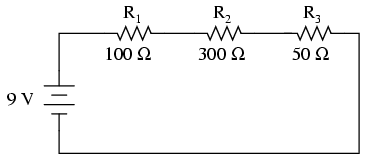
The equivalent resistance of the following circuit is...
9.23 Ω
90 Ω
60 Ω
70 Ω


What slows down the flow of electricity in a circuit?
Current (A)
Voltage (V)
Resistance (Ω)

What happens to the current as the resistance increases?
Current increases
Current decreases
Current stays the same.
What happens to the current as the voltage increases?
Current increases
Current decreases
Current stays the same.
Where does voltage come from?
Conductor
Power Source
Output Device (Load)

Which switch or switches must be closed to make the lamps light?
Only switch 1
Switches 1 and 2
Switches 2 and 3
Switches 1, 2 and 3


Which of the following is NOT a formula for calculating the electrical power dissipated by a resistor in a circuit?
P = VI
P = RV2
P = RI2
P = I2R

Calculate the current (I) going through this circuit when the voltage (V) is 9.0 volts and the resistance (R) of the resistor is 3 ohms.
Use the formula I = V/R. I = 9.0 volts / 3 ohms = ??? amps or amperes
1 amp
2 amps
3 amps
4 ampls
Calculate the current (I) going through this circuit when the voltage (V) is 9.0 volts and the resistance (R) of the resistor is 3 ohms.
Use the formula I = V/R. I = 9.O volts / 3 ohms = ??? amps or amperes
1 amp
3 amps
5 amps
7 ampls
Calculate the current (I) going through this circuit when the voltage (V) is 8.0 volts and the resistance (R) of the resistor is 2 ohms.
Use the formula I = V/R. I = 8.0 volts / 2 ohms = ??? amps or amperes
1 amp
4 amps
5 amps
7 ampls
Calculate the current (I) going through this circuit when the voltage (V) is 12.0 volts and the resistance (R) of the resistor is 6 ohms.
Use the formula I = V/R. I = 12.0 volts / 6 ohms = ??? amps or amperes
1 amp
2 amps
3 amps
4 ampls
Calculate the voltage (V) going through this circuit when the current (I) is 2 amps and the resistance (R) of the resistor is 6 ohms.
Use the formula V = IR. I = 2.0 amps x 6 ohms = ??? volts
6 volts
8 volts
10 volts
12 volts
Calculate the voltage (V) going through this circuit when the current (I) is 2 amps and the resistance (R) of the resistor is 5 ohms.
Use the formula V = IR. I = 2.0 amps x 5 ohms = ??? volts
6 volts
8 volts
10 volts
12 volts
Calculate the voltage (V) going through this circuit when the current (I) is 2 amps and the resistance (R) of the resistor is 5 ohms.
Use the formula V = IR. I = 2.0 amps x 5 ohms = ??? volts
6 volts
8 volts
10 volts
12 volts
Calculate the voltage (V) going through this circuit when the current (I) is 1 amp and the resistance (R) of the resistor is 5 ohms.
Use the formula V = IR. I = 1.0 amp x 8 ohms = ??? volts
6 volts
8 volts
10 volts
12 volts
Calculate the voltage (V) going through this circuit when the current (I) is 1.5 amps and the resistance (R) of the resistor is 4 ohms.
Use the formula V = IR. I = 1.5 amps x 4 ohms = ??? volts
6 volts
8 volts
10 volts
12 volts

