
Font size
 Worksheets
Lesson 1 – What is democracy?
Total questions: 82
Worksheet time: 41mins
What is democracy?
Democracy is a system of government in which the people have the power to make decisions, usually through elected representatives.
Democracy is a system where only one person rules for life.
Democracy is a type of government where military leaders make all decisions.
Democracy is a system in which kings and queens inherit power.
What is the democratic system in Australia?
Australia has a representative democracy, where citizens elect representatives to make decisions on their behalf.
Australia is a direct democracy, where all citizens vote on every law.
Australia is a monarchy with no elected officials.
Australia is governed by military rule.
Democracy in Australia means:
A system where the government is elected by the people
A monarchy ruled by a king or queen
A government controlled by the military
A dictatorship with one leader
How did you make decisions when there were four Decision Makers in the class?
By voting as a group
By letting one person decide
By random selection
By following the teacher's instructions
How did you feel about yourself and other class members when making decisions as one of the four Decision Makers in class?
Confident and able to represent others
Unsure and hesitant
Indifferent
Overwhelmed
For the last couple of hours/days we have had four Decision Makers in our class. Did you mainly consider yourself, your friends, or everybody?
Myself
My friends
Everybody
Making decisions with the help of everyone in the class would feel:
The same as having four Decision Makers
Different from having four Decision Makers
More challenging
Easier
Did you like having four Decision Makers in our class for the last couple of hours/days?
Yes, I liked it
No, I did not like it
Did you like the decisions being made for you?
Yes
No
They ‘represented’ you.
Yes
No
The decision makers made me feel:
Confident
Uncertain
Inspired
Ignored
What did you think about the way the decision makers made their decisions?
They made decisions thoughtfully.
They made decisions quickly.
They made decisions without enough information.
They made decisions fairly.
Would you have felt any different if there were a different group of decision makers?
Yes
No
Who are decision makers in a group?
Leaders
Observers
Participants
Supporters
Organising the decision making in the class in this way was:
Fair
Unfair
Class discussion: What did you like or dislike about it?
I liked the class discussion.
I disliked the class discussion.
I had no strong feelings about the class discussion.
I did not participate in the class discussion.
Class discussion: Which of the following could have made it fairer?
Giving everyone a chance to speak
Letting only one person decide
Ignoring some opinions
Not following any rules
Class discussion: You can have your say by:
Listening quietly
Sharing your thoughts and opinions
Ignoring the topic
Leaving the room
What does the word 'democracy' mean?
'Democracy' means 'people power'.
'Democracy' means 'rule by the king'.
'Democracy' means 'military rule'.
'Democracy' means 'religious authority'.
The word 'democracy' comes from two Greek words: demos meaning 'the people' and kratos meaning 'power'.
True
False
The decision making experiment done in class is considered not a very fair way to make decisions on behalf of people because:
it does not consider everyone's opinions equally.
it is the fastest way to decide.
it always leads to the best outcome.
it is the most popular method.
What is democracy?
A) A type of government where the power is in the hands of the people.
B) A type of government where the power is in the hands of one person.
C) A type of government where the power is in the hands of the military.
D) A type of government where the power is in the hands of the king.
In a democracy, the power is in the hands of the _______.
people
king
army
president
How can people use their power in a democracy?
Directly
Through people who represent them
Both A and B
None of the above
According to Lesson 1 - What is democracy?, what is meant by power? Fill in the blank: The power to have _______.
a voice
a crown
a weapon
a throne
According to Lesson 1 - What is democracy?, what is meant by power? Fill in the blank: The power to _______ your opinion.
express
ignore
hide
suppress
According to Lesson 1 - What is democracy?, what is meant by power? Fill in the blank: The power to be part of _______ making.
decision
money
law
group
According to Lesson 1 - What is democracy?, what is meant by power? Fill in the blank: The power to be treated _______.
fairly
quickly
richly
differently
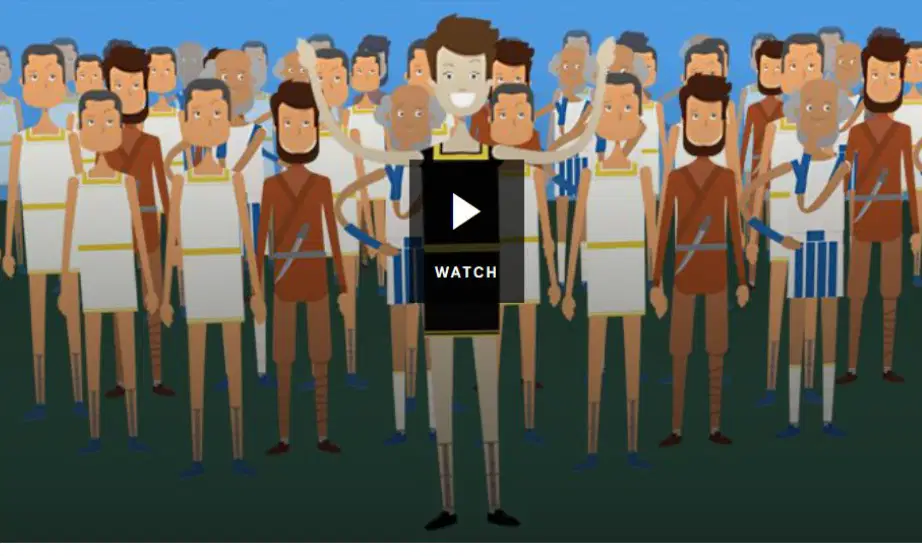
Democracy is:
A form of government by the people
A type of economic system
A religious belief
A scientific theory
Australia is a representative democracy. What does that mean?
People vote directly on all laws.
Citizens elect representatives to make decisions on their behalf.
The government is run by a monarch.
Only the wealthy can vote.
In Australia we choose ________ to make decisions on our behalf, similar to how we choose School Captains and House Captains. (Fill in the blank)
representatives
teachers
students
coaches
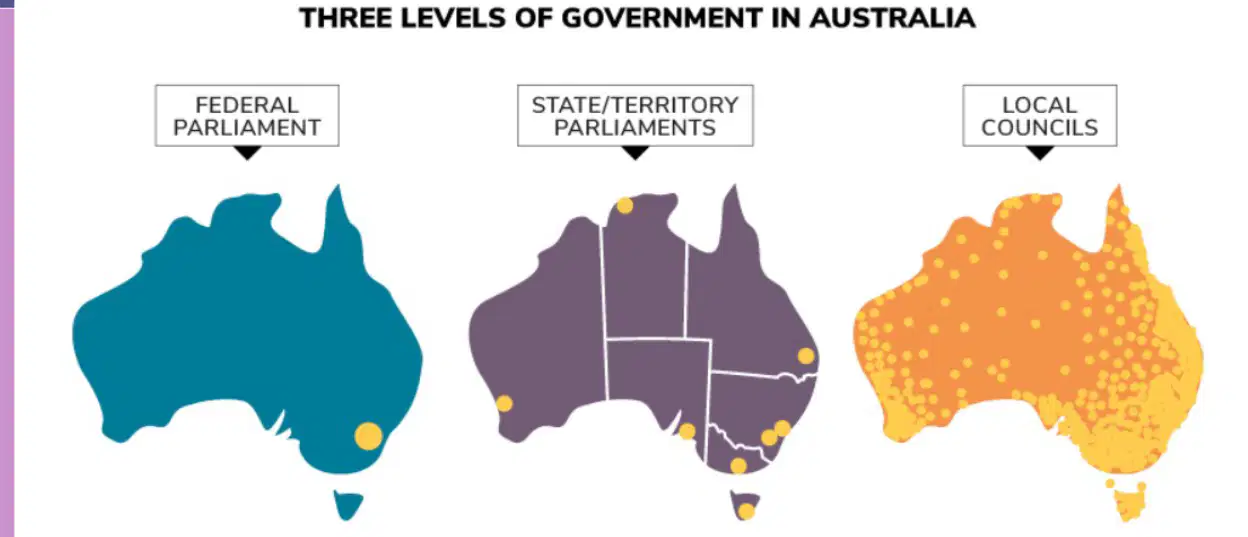
According to the lesson, how many levels of government does Australia have?
One
Two
Three
Four
Fill in the blank: Australia has ______ levels of government with different responsibilities and law-making powers.
three
two
four
five
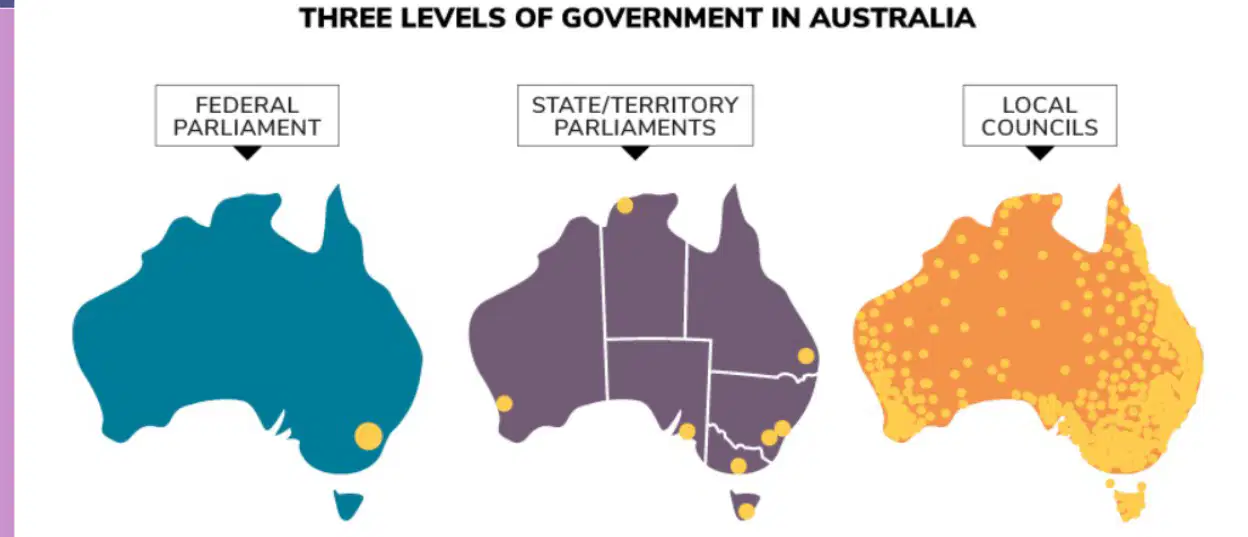
Which of the following is NOT one of the three levels of government in Australia?
Federal Parliament
State/Territory Parliaments
Local Councils
Supreme Court
The citizens of Australia have chosen representatives in both houses of parliament to make the laws that govern.
True
False

Which level of government makes laws for the whole of Australia?
State/Territory Parliaments
Local Councils
Federal Parliament
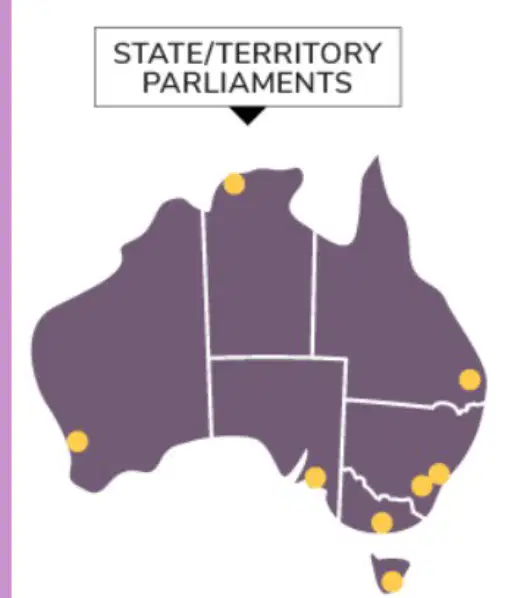
How many state and territory parliaments make laws for their state or territory in Australia?
4 state and 2 territory parliaments
6 state and 2 territory parliaments
8 state and 1 territory parliament
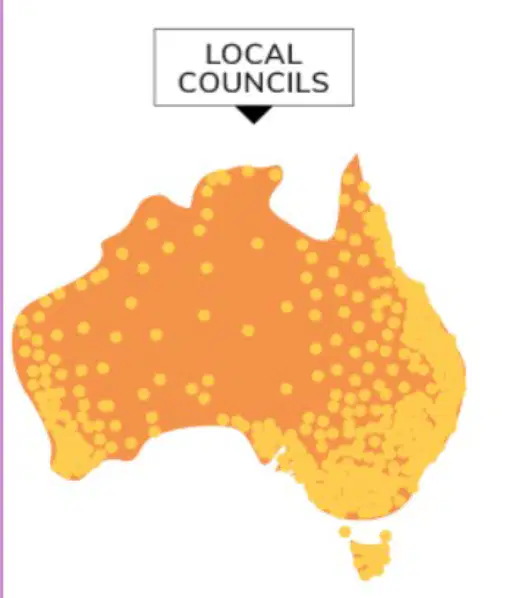
Over how many local councils make local laws (by-laws) for their region or district in Australia?
100
500
1000
The Federal Government raises money through taxing incomes, spending and businesses. What are some matters the Federal Government makes laws about?
Medicare, Defence, Immigration, Foreign Policy
Roads, Housing, Prisons
Town Planning, Sewerage, Local Roads, Rubbish Collection
The State Government receives more than half their money from the Federal Government and also collects taxes. What are some matters the State Government makes laws about?
Roads, Housing, Prisons, Public Transport, Police and Ambulance Services
Medicare, Defence, Immigration, Foreign Policy
Town Planning, Sewerage, Local Roads, Rubbish Collection
Local Councils collect taxes from all local property owners and receive money from the Federal and State governments. What are some matters Local Councils make laws about?
Town Planning, Sewerage, Local Roads, Rubbish Collection
Roads, Housing, Prisons, Public Transport, Police and Ambulance Services
Medicare, Defence, Immigration, Foreign Policy
Fill in the blank: The Federal Government raises money through ________, spending and businesses.
taxing incomes
printing money
borrowing from citizens
selling land
Fill in the blank: The State Government receives more than half their money from the ________ and also collects taxes.
Federal Government
Local Businesses
State Lottery
Foreign Aid
Fill in the blank: Local Councils collect taxes from all local ________ and receive money from the Federal and State governments.
property owners
businesses
employees
students
Democracy is:
A form of government by the people
A type of monarchy
A system ruled by a dictator
A religious government
Which of the following symbols best represents democracy?
A crown
A ballot box
A sword
A pyramid
Australia has three levels of Government. Paste the symbols and information about laws in the correct boxes. Federal Government | State and Territory Government | Local Councils
Federal Government: National laws, defense, immigration. State and Territory Government: Schools, hospitals, police. Local Councils: Local roads, rubbish collection, parks.
Federal Government: Local roads, rubbish collection, parks. State and Territory Government: National laws, defense, immigration. Local Councils: Schools, hospitals, police.
Federal Government: Schools, hospitals, police. State and Territory Government: Local roads, rubbish collection, parks. Local Councils: National laws, defense, immigration.
Federal Government: Rubbish collection, parks, schools. State and Territory Government: Immigration, defense, local roads. Local Councils: Hospitals, police, national laws.
Values are:
Principles or standards of behavior; one's judgment of what is important in life.
A type of mathematical variable.
A physical object.
A scientific law.
The democratic values of our country are:
Liberty, equality, justice, and fraternity
Monarchy and dictatorship
Casteism and inequality
Colonialism and imperialism
The value of freedom of speech, expression, and religious belief means:
The right to express opinions and beliefs without fear of government censorship or punishment.
The obligation to follow only one religion.
The restriction of speech in all public places.
The prohibition of expressing personal views.
My core personal values are:
Honesty, respect, responsibility
Creativity, humor, flexibility
Ambition, independence, loyalty
Kindness, patience, courage
Which of the following best demonstrates an understanding of Australia’s core democratic values and the value of freedom of speech, expression, and religious belief?
Respecting others' rights to express their opinions and practice their religion freely
Limiting speech to only government-approved topics
Punishing people for expressing different beliefs
Restricting religious practices to one official religion
What is democracy? Fill in the blank: Democracy is a type of government where the ______ is in the hands of the _______.
power, people
money, government
law, president
army, king
What is respect? Fill in the blank: Respect is ______ enough to consider how words and actions ______ others.
caring, impact
brave, ignore
selfish, benefit
careless, amuse
What does having respect mean? Fill in the blank: Having respect is when you feel ______ about someone because of how they act.
good
angry
bored
confused
What does showing respect mean? Fill in the blank: Showing respect is when you ______ how your actions impact others.
care
ignore
forget
deny
What are values? Fill in the blank: Values are a person's or society’s beliefs about ________ and what things are important.
good behaviour
fashion trends
physical strength
mathematical skills
How do our values influence us?
Our values influence the choices and decisions we make about what is right or wrong, good or bad.
Our values determine our physical appearance.
Our values decide the weather conditions.
Our values control the laws of physics.
We put our values into action on a daily basis.
True
False
The image with the signpost and the caption 'Making Good Decisions' represents which concept in the context of values?
Following rules
Making good decisions based on values
Ignoring values
Seeking approval from others
When we are young, we learn our values from our ______ and the people around us.
family
school
pets
television
As we grow, our personal values can ______.
change
disappear
multiply
vanish
Our values might change for different ______.
situations
colors
animals
numbers
Which of the following is a value shown in the image?
Empathy
Speed
Anger
Laziness
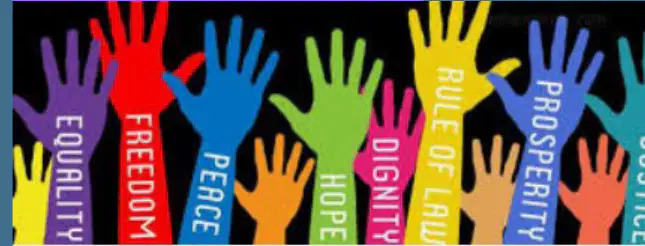
Which of the following is NOT a value mentioned in the worksheet?
Dignity
Prosperity
Dishonesty
Equality
Name two values mentioned in the worksheet.
Honesty and Respect
Courage and Laziness
Anger and Dishonesty
Fear and Greed
'Acceptance' means:
Refusing something
Agreeing to receive or approve something
Ignoring something
Questioning something
Health means:
Being wealthy
Being physically and mentally well
Having many friends
Owning a house
'Trust' means:
Believing someone is honest and reliable
Being afraid of someone
Ignoring someone
Disliking someone
'Compassion' means:
Feeling happy for others' success
Feeling sympathy and concern for others' suffering
Ignoring others' problems
Being competitive with others
Fairness means:
Treating everyone equally and justly
Being the fastest
Having the most money
Always winning
Honesty means:
Telling the truth
Telling lies
Cheating others
Hiding facts
Freedom means:
The power or right to act, speak, or think as one wants
A type of government
A kind of food
A holiday
Friendship means:
A type of food
A kind of relationship between people
A place to visit
A type of animal
Courage means:
Being afraid of everything
Bravery in facing danger or difficulty
Running away from problems
Ignoring others' feelings
'Gratitude' means:
Being thankful
Being angry
Being confused
Being bored
'Love' means:
Hatred
Affection
Anger
Fear
Respect means:
Being rude to others
Valuing and honoring others
Ignoring others
Making fun of others
Happiness means:
A feeling of sadness
A state of well-being and contentment
A type of food
A form of exercise
'Responsibility' means:
Doing what you are supposed to do
Having fun all the time
Ignoring your duties
Blaming others for your mistakes
Education means:
The process of receiving or giving systematic instruction
A type of food
A form of exercise
A musical instrument
Which of the following is an instruction given in the question?
Choose two values from the list and explain why you chose them.
List all the values that are important to you.
Ignore the values in the list.
Create your own list of values.

