
 Worksheets
Đề Cương Kinh Tế II
Total questions: 101
Worksheet time: 51mins
A double coincidence of wants?
is required when there is no widely accepted item in the economy for the exchange of goods and services.
is required in an economy that relies on barter.
is a hindrance to the allocation of resources when it is required for trade.
All of the above answers are correct.

Consider four survivors on an island.
Rupert with Amber, and Rob with Tom
Amber with Tom
Rupert with Rob
None of the above are correct
You pay for cheese and bread from the store with currency. Which function of money is best illustrate?
medium of exchange
unit of account
store of value
liquidity
If the travel check were $500 higher and the savings deposit were $1,000 higher, M1what would be?
$500 higher and M2 would be higher than $1,000
$500 higher and M2 would be $1,500 higher
M2 and M1 would be $1,500 higher
None of the above are correct
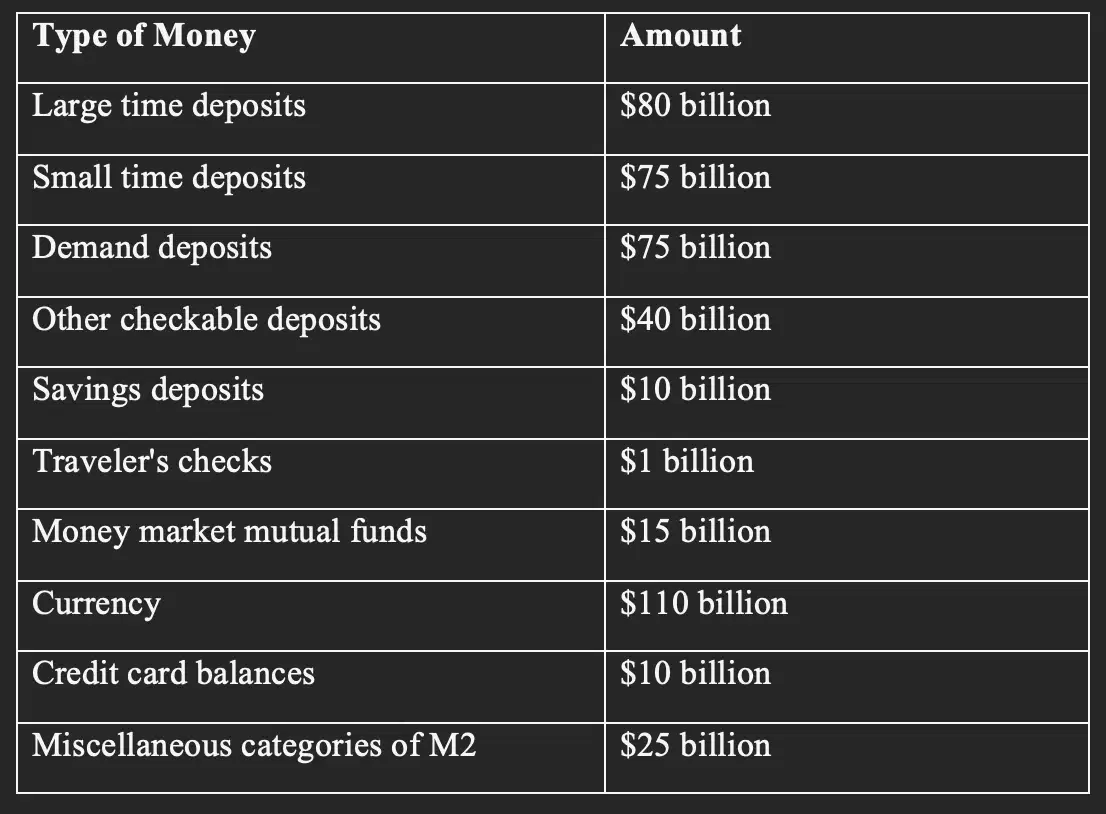
What is M1 money supply?
$215 billion
$216 billion
$226 billion
$301 billion
Which of the following institutions is a central bank?
the Bank of Japan
the Bank of England
the Federal Reserve System
All of the above answers are correct.
In a system of 100-percent-reserve banking
banks do not accept deposits.
banks do not influence the supply of money
loans are the only asset item for banks
All of the above answers are correct.
A bank which must hold 100 percent reserves opens in an economy that had no banks and a currency of $100. If customers deposit $50 into the bank, what is the value of the money supply?
$50
$100
$150
$200
If a bank has a reserve ratio of 8 percent, then
government regulations require the bank to use at least 8 percent of its deposits to make loans
the bank’s ratio of loans to deposits is 8 percent.
the bank keeps 8 percent of its deposits as reserves and loans out the rest.
the bank keeps 8 percent of its assets as reserves and loans out the rest.
A bank’s reserve ratio is 10 percent and the bank has $2,000 in deposits. Its reserves amount to
$20.
$200.
$400.
$1,800.
On a bank's T-account, which are part of the banks assets?
both deposits made by its customers and reserves
deposits made by its customers but not reserves
reserves but no deposits made by its customers
neither deposits made by its customers nor reserves
Which of the following is a liability of a bank and an asset of its customers?
deposits of its customers and loans to it customers
deposits of its customers but not loans to its customers
loans of its customers but not the deposits of its customers
neither the deposits of its customers nor the loans to its customers
13. A bank loans Greg’s Ice Cream $250,000 to remodel a building near campus to use as a new store. On their respective balance sheets, this loan is
a liability for the bank and an asset for Greg's Ice Cream. The loan increases the money supply.
a liability for the bank and an asset for Greg's Ice Cream. The loan does not increase the money supply.
an asset for the bank and a liability for Greg's Ice Cream. The loan increases the money supply.
an asset for the bank and a liability for Greg's Ice Cream. The loan does not increase the money supply.
If the reserve ratio is 12.5 percent, then $5,600 of money can be generated by
$64 of new reserves.
$448 of new reserves.
$700 of new reserves.
$800 of new reserves.
.If the money multiplier is 2 and the Fed buys $50,000 worth of bonds, what happens to the money supply?
it increases to $100,000
it increases to $150,000
it decreases to $100,000
it decreases to $150,000
The discount rate is the interest rate that
banks charge one another for loans.
banks charge the Fed for loans
the Fed charges banks for loans
the Fed charges Congress for loans
When the Fed decreases the discount rate, banks will
borrow more from the Fed and lend more to the public. Money supply increases.
borrow more from the Fed and lend less to the public. Money supply decreases.
borrow less from the Fed and lend more to the public. Money supply increases.
borrow less from the Fed and lend less to the public. Money supply decreases.
Which of the following can banks use to borrow from the Federal Reserve?
the discount window or the term auction facility
the discount window but not the term auction facility
the term auction facility but not the discount window
Banks can not borrow from the Federal Reserve, only the government can.
If the Federal Reserve increases the interest rate on bank deposits at the Fed, banks will want to hold
fewer reserves, so the reserve ratio will fall.
fewer reserves, so the reserve ratio will rise.
more reserves, so the reserve ratio will fall.
more reserves, so the reserve ratio will rise.
20. The money supply increases when the Fed
lowers the discount rate. The increase will be larger the smaller the reserve ratio is.
b.
lowers the discount rate. The increase will be larger the larger the reserve ratio is.
raises the discount rate. The increase will be larger the smaller the reserve ratio is.
raises the discount rate. The increase will be larger the larger the reserve ratio is.
If the price increases from 120 to 126, then what was the inflation rate?
3 percent
5 percent
6 percent
None of the above is correct.
When prices are falling, economists say that there is
disinflation.
deflation
a contraction.
an inverted inflation.
Which of the following statements about U.S inflation is not correct?
Low inflation was viewed as a triumph of President Carter's economic policy.
There were long periods in the nineteenth century during which prices fell.
The U.S. public has viewed inflation rates of even 7 percent as a major economic problem.
The U.S. inflation rate has varied over time, but international data show even more variation.
In early 2008, the central bank of Zimbabwe announced the inflation rate in that country had reached
60 percent.
80 percent.
220 percent.
24,000 percent.
If the CPI rises, the number of dollars needed to buy a representative basket of goods
increases, and so the value of money rises.
increases, and so the value of money falls
decreases, and so the value of money rises
decreases, and so the value of money falls
The supply of money increases when
the value of money increases.
the interest rates increases
the Fed makes open-market purchases.
None of the above is correct.
When the money market is drawn with the value of money on the vertical axis, as the price level increases which of the following increases?
the quantity of money demanded and the quantity of money supplied
the quantity of money demanded but not the quantity of money supplied
the quantity of money supplied but not the quantity of money demanded
neither the quantity of money supplied nor the quantity of money demanded
When the money market is drawn with the value of money on the vertical axis, an increase in the money supply creates an excess
supply of money, causing people to spend more.
supply of money, causing people to spend less.
demand for money, causing people to spend more.
demand for money, causing people to spend less.
Which of the following statements is correct?
If the Fed purchases bonds in the open market, then the money supply curve shifts right. A change in the price level does not shift the money supply curve.
If the Fed sells bonds in the open market, then the money supply curve shifts right. A change in the price level does not shift the money supply curve.
If the Fed purchases bonds, then the money supply curve shifts right. An increase in the price level shifts the money supply curve right.
If the Fed sells bonds, then the money supply curve shifts right. A decrease in the price level shifts the money supply curve right.
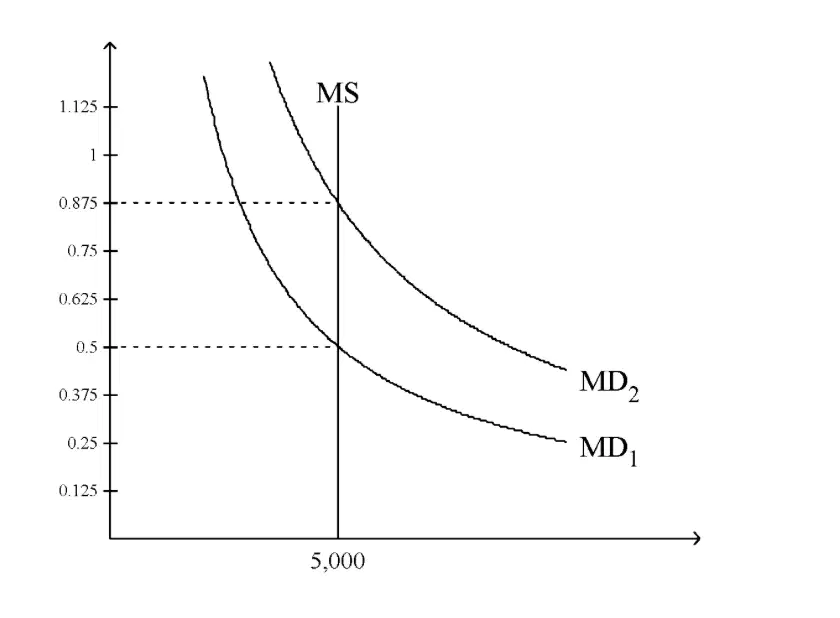
On the graph, MS represents the money supply and MD represents money demand. The usual quantities are measured along the axes.
the price level
the real interest rate
the value of money
the quantity of money
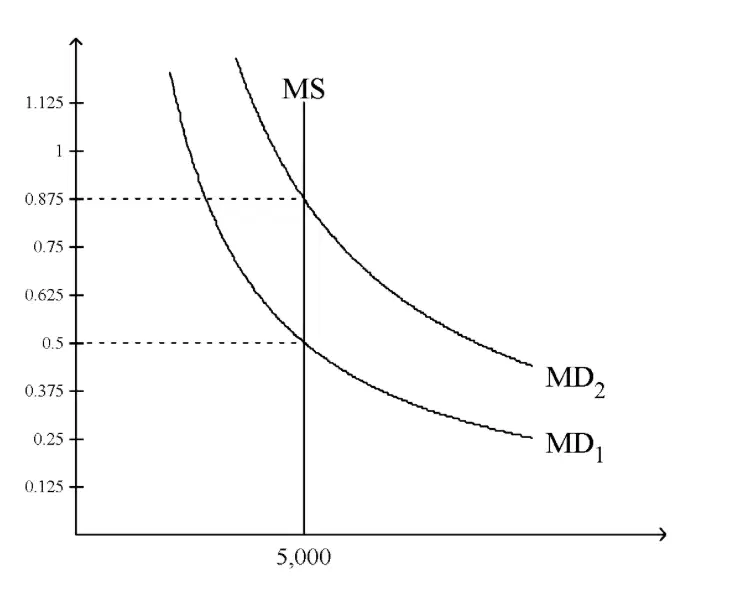
On the graph, MS represents the money supply and MD represents the money demand. The usual quantities are measured along the axes.
Refer to Figure 17-2. If the relevant money-demand curve is the one labeled MD1, then the equilibrium value of money is
0.5 and the equilibrium price level is 2.
2 and the equilibrium price level is 0.5.
0.5 and the equilibrium price level cannot be determined from the graph.
2 and the equilibrium price level cannot be determined from the graph.
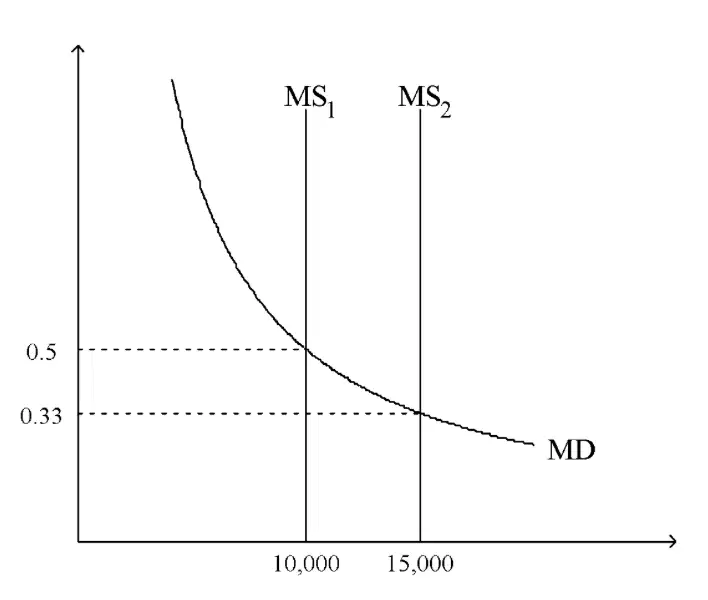
On the graph, MS represents the money supply and MD represents the money demand. The usual quantities are measured along the axes.
Refer to Figure 17-3. If the relevant money-supply curve is the one labeled MS1, then the equilibrium price level is
0.5 and the equilibrium value of money is 2.
2 and the equilibrium value of money is 0.5.
0.5 and the equilibrium value of money cannot be determined from the graph.
2 and the equilibrium value of money cannot be determined from the graph.
On a Sunday morning, Tom sold 300 cups of coffee for a total of $750.
The $750 is a nominal variable. The 300 cups of coffee is a real variable.
The $750 is a real variable. The 300 cups of coffee is a nominal variable.
Both the $750 and the 300 cups of coffee are nominal variables.
Both the $750 and the 300 cups of coffee are real variables.
Velocity is computed as
(P X Y)/M.
(P X M)/Y.
(Y X M)/P.
(Y X M)/V.
If M = 3,000, P = 2, and Y = 12,000, what is the velocity?
1/2
2
4
8
If M = 10,000, P = 2, and Y = 20,000, then velocity?
4. Velocity will rise if money changes hands more frequently.
4. Velocity will rise if money changes hands less frequently.
8. Velocity will rise if money changes hands more frequently.
8. Velocity will rise if money changes hands less frequently.
The nominal interest rate is 4.5% and the inflation rate is 0.9%. What is the real interest rate?
5.4%
5%
4.1%
3.6%
Walter puts money in a savings account at his bank earning 3.5 percent. One year later he takes his money out and notes that while his money was earning interest, prices rose 1.5 percent. Walter earned a nominal interest rate of
3.5% and the real interest rate of 5%.
3.5% and the real interest rate of 2%.
5% and the real interest rate of 3.5%.
5% and the real interest rate of 2%.
When inflation falls, people
make less frequent trips to the bank and firms make less frequent price changes.
make less frequent trips to the bank while firms make more frequent price changes.
make more frequent trips to the bank while firms make less frequent price changes.
make more frequent trips to the bank and firms make more frequent price changes.
For a given real interest rate, an increase in inflation causes the real after-tax interest rate to
decrease, which encourages saving.
decrease, which discourage saving.
increase, which encourages saving.
increase, which discourage saving.
Which type(s) of economies interact with other economies?
only closed economies.
only open economies.
closed economies and open economies
neither closed nor open economies.
When Claudia, a U.S. citizen, purchases a handbag made in France, the purchase is
both a U.S. and French import.
a U.S. export and a French import.
a U.S. import and a French export.
neither an export nor an import for either country.
Suppose that a country imports $75 million of goods and services and exports $100 million of goods and services. What is the value of net exports?
175 million dollars
75 million dollars
25 million dollars
-25 million dollars
Ivan, a Russian citizen, sells several hundred cases of caviar to a restaurant chain in the United States. By itself, this sale
a.
increases U.S. net exports and decreases Russian net exports.
increases U.S. net exports and has no effect on Russian net exports.
decreases U.S. net exports and increases Russian net exports.
decreases U.S. net exports and has no effect on Russian net exports.
5. If the U.S. has exports of $1.5 trillion and imports of $2.2 trillion, then the U.S.
sells more overseas then it buys from overseas; it has a trade deficit.
sells more overseas then it buys from overseas; it has a trade surplus.
buys more from overseas then it sells overseas; it has a trade deficit.
buys more from overseas then it sells overseas; it has a trade surplus.
Which of the following is correct? Over about the last fifty years
U.S. exports and U.S. imports each about doubled.
U.S. exports and U.S. imports each about tripled.
U.S. exports about doubled and U.S. imports about tripled.
U.S. exports about tripled and U.S. imports about doubled.
Suppose that the real return from operating factories in Ghana rises relative to the real rate of return in the United States. Other things the same,
this will increases U.S. net capital outflow and decrease Ghanan net capital outflow.
this will decreases U.S. net capital outflow and increase Ghanan net capital outflow.
this will only increase U.S. net capital outflow.
this will only increase Ghanan net capital outflow.
Stacey, a US citizen, buys a bond issued by an Italian pasta manufacturer.
This purchase is foreign direct investment. By itself increases the US net capital outflow
This purchase is foreign direct investment. By itself decreases the US net capital outflow
This purchase is foreign portfolio investment. By itself increases the US net capital outflow
This purchase is foreign portfolio investment. By itself decreases the US net capital outflow
Citizens in India buy music from the U.S. To do so they use Indian rupees to purchase U.S. dollars. If U.S. citizens hold these rupees rather than spending them, what happens to U.S. net exports and U.S. net capital outflows?
both U.S. net exports and U.S. net capital outflow rise
both U.S. net exports and U.S. net capital outflow fall
U.S. net exports rise and U.S. net capital outflow fall
U.S. net exports fall and U.S. net capita outflow rise
The price of a basket of goods and services in the U.S. is $600. In Canada the same basket of goods costs 700 Canadian dollars. If the nominal exchange rate were 1.2 Canadian dollars per U.S. dollar, what would be the real exchange rate?
700/600
600/700
700/720
None of the above is correct.
If a bushel of wheat costs $6.40 in the United States, costs 40 pesos in Mexico, and the nominal exchange rate is 10 pesos per dollar, then the real exchange rate is
1.60
1.25
.625
None of the above is correct.
12. If the real exchange rate for coal is 1.5, the price of coal in the U.S. is $50 per ton, and the price of coal in Britain is 20 British pounds per ton, what is the nominal exchange rate?
15/4
5/3
3/5
4/15
13. Consider an identical basket of goods in both the U.S. and India. For a given nominal exchange rate, in which case is it certain that the U.S. real exchange rate with India falls?
the price of the basket of goods rises in the U.S. and India.
the price of the basket of goods rises in the U.S. and falls in India.
the price of the basket of goods falls in the U.S. and rises in India.
the price of the basket of goods falls in both India and the U.S..
Other things the same, if the U.S. real exchange rate appreciates, U.S. net exports
increase and U.S. net capital outflow decreases.
decrease and U.S. net capital outflow increases.
and U.S. net capital outflow both increase.
and U.S. net capital outflow both decrease.
15. When the yen gets "stronger" relative to the dollar,
the U.S. trade deficit with Japan will rise.
the U.S. trade deficit with Japan will fall.
the U.S. trade deficit with Japan will be unchanged.
None of the above necessarily happens.
If a country had a trade surplus of $50 billion and then its exports rose by $30 billion and its imports rose by $20 billion, its net exports would now be
$0 billion.
$20 billion.
$40 billion.
$60 billion.
If a country had a trade deficit of $10 billion and then its exports rose by $20 billion and its imports rose by $10 billion, its net exports would now be
$0
$10 billion
$-10 billion
$-20 billion
18. If saving is greater than domestic investment, then
there is a trade deficit and Y > C + I + G.
there is a trade deficit and Y < C + I + G.
there is a trade surplus and Y > C + I + G.
there is a trade surplus and Y < C + I + G.
19. If Thailand has a trade surplus, then
a.
foreign countries purchase more Thai assets than Thailand purchases from them. This makes Thai saving greater than Thai domestic investment.
b.
foreign countries purchase more Thai assets than Thailand purchases from them. This makes Thai saving smaller then Thai domestic investment.
c.
foreign countries purchase fewer Thai assets than Thailand purchases from them. This makes Thai saving greater than Thai domestic investment.
d.
foreign countries purchase fewer Thai assets than Thailand purchases from them. This makes Thai saving greater than Thai domestic investment.
20. If the price of a good in the U.S. is $10 and the unit of foreign currency is the stone, in which case is the real exchange rate 4/5?
the foreign price is 4 stones and the exchange rate is 2 stones per dollar
the foreign price is 5 stones and the exchange rate is 2.5 stones per dollar
the foreign price is 4 stones and the exchange rate is 1/2 stones per dollar
the foreign price is 5 stones and the exchange rate is 2/5 stones per dollar
Câu nào trong số các câu sau giải thích tại sao sản xuất tăng trong hầu hết các năm?
tăng lực lượng lao động
tăng vốn
tiến bộ trong kiến thức công nghệ
Tất cả các câu trên đều đúng.
Which of the following explains why production rises in most years?
increases in the labor force
increases in the capital stock
advances in technological knowledge
All of the above are correct.
When we say that economic fluctuations are “irregular and unpredictable,” we mean that
the relationship between output and unemployment is erratic and difficult to characterize.
when one macroeconomic variable that measures income or spending is falling, other macroeconomic variables that measure income or spending are likely to be rising.
recessions do not occur at regular intervals.
All of the above are correct.
We depart from the assumptions of classical economics when we focus on the relationship between
the quantity of output and the price level.
the quantity of output and the unemployment rate.
the price level and the inflation rate.
inflation and the nominal interest rate.
The model of aggregate demand and aggregate supply
is different from the model of supply and demand for a particular market, in that we cannot focus on the substitution of resources between markets to explain aggregate relationships.
is different from the model of supply and demand for a particular market, in that we have to separate real and nominal variables in the aggregate model.
is a straightforward extension of the model of supply and demand for a particular market, in which substitution of resources between markets is highlighted.
is a straightforward extension of the model of supply and demand for a particular market, in which the interaction between real and nominal variables is highlighted.
Which of the following effects helps to explain the slope of the aggregate-demand curve?
the exchange-rate effect
the wealth effect
the interest-rate effect
All of the above are correct.
Which of the following rises when the U.S. price level falls?
interest rates
the value of the dollar in the market for foreign-currency exchange
real wealth
All of the above are correct.
People will buy more if the price level
rises because rising prices increase the real value of a dollar.
rises because rising prices decrease the real value of a dollar.
falls because falling prices increase the real value of a dollar.
falls because falling prices decrease the real value of a dollar.
In the context of the aggregate-demand curve, the interest-rate effect refers to the idea that, when the price level increases,
the real value of money decreases; in turn, the real value of the dollar increases in foreign exchange markets, which decreases net exports.
the real value of money decreases; in turn, interest rates increase, which decreases net exports.
households increase their holdings of money; in turn, interest rates decrease, which reduces spending on investment goods.
households increase their holdings of money; in turn, interest rates increase, which reduces spending on investment goods.
As the price level rises, the exchange rate
falls, so exports rise and imports fall.
falls, so exports fall and imports rise.
rises, so exports rise and imports fall.
rises, so exports fall and imports rise.
Other things the same, if the price level falls, people
increase foreign bond purchases, so the supply of dollars in the market for foreign-currency exchange increases.
increase foreign bond purchases, so the supply of dollars in the market for foreign-currency exchange decreases.
decrease foreign bond purchases, so the supply of dollars in market for foreign-currency exchange increases.
decrease foreign bond purchases, so the supply of dollars in the market for foreign-currency exchange decreases.
Other things the same, if the price level rises, people
increase foreign bond purchases, so the supply of dollars in the market for foreign-currency exchange increases.
increase foreign bond purchases, so the supply of dollars in the market for foreign-currency exchange decreases.
decrease foreign bond purchases, so the supply of dollars in the market for foreign-currency exchange increases.
decrease foreign bond purchases, so the supply of dollars in the market for foreign-currency exchange decreases.
Suppose a stock market crash makes people feel poorer. This decrease in wealth would induce people to
decrease consumption, which shifts aggregate supply left.
decrease consumption, which shifts aggregate demand left.
increase consumption, which shifts aggregate supply right.
increase consumption, which shifts aggregate demand right.
If countries that imported goods and services from the United States went into recession, we would expect that U.S. net exports would
rise, making aggregate demand shift right.
rise, making aggregate demand shift left.
fall, making aggregate demand shift right.
fall, making aggregate demand shift left.
Other things the same, which of the following is correct?
A decrease in the price level causes the dollar to appreciate. Aggregate demand shifts right.
A decrease in the price level causes the dollar to depreciate. Aggregate demand shifts right.
If speculators lose confidence in the American economy, the dollar appreciates. Aggregate demand shifts right.
If speculators lose confidence in the American economy, the dollar depreciates. Aggregate demand shifts right.
If speculators lost confidence in foreign economies and so wanted to buy more U.S. bonds
the dollar would appreciate which would cause aggregate demand to shift right.
the dollar would appreciate which would cause aggregate demand to shift left.
the dollar would depreciate which would cause aggregate demand to shift right.
the dollar would depreciate which would cause aggregate demand to shift left.
If banks and speculators in the U.S. decided to exchange U.S. dollars for the foreign currencies of other countries, but foreigners do not desire to increase their holdings of U.S. dollars, then U.S. net exports would
rise and aggregate demand would shift left.
rise and aggregate demand would shift right.
fall and aggregate demand would shift left.
fall and aggregate demand would shift right.
Refer to Political Instability Abroad. What would the change in the interest rate created by foreigners wanting to buy more U.S. assets do to investment spending in the U.S.?
make it rise which by itself would increase U.S. aggregate demand.
make it rise which by itself would decrease U.S. aggregate demand.
make it fall which by itself would increase U.S. aggregate demand.
make it fall which by itself would decrease U.S. aggregate demand.
The sticky-price theory of the short-run aggregate supply curve says that if the price level rises by 5% and people were expecting it to rise by 2%, then firms have
higher than desired prices which leads to an increase in the aggregate quantity of goods and services supplied.
higher than desired prices which leads to a decrease in the aggregate quantity of goods and services supplied.
lower than desired prices which leads to an increase in the aggregate quantity of goods and services supplied.
lower than desired prices which leads to a decrease in the aggregate quantity of goods and services supplied.
People had been expecting the price level to be 170 but it turns out to be 165. Diamond Power Tools increases the number of workers it employs. What could explain this?
both sticky price theory and sticky wage theory
sticky price theory but not sticky wage theory
sticky wage theory but not sticky price theory
neither sticky wage theory nor sticky price theory
When taxes decrease, consumption
decreases as shown by a movement to the left along a given aggregate-demand curve.
decreases as shown by a shift of the aggregate demand curve to the left.
increases as shown by a movement to the right along a given aggregate-demand curve.
increases as shown by a shift of the aggregate demand curve to the right.
The interest-rate effect
depends on the idea that increases in interest rates increase the quantity of money demanded.
depends on the idea that increases in interest rates increase the quantity of money supplied.
is the most important reason, in the case of the United States, for the downward slope of the aggregate-demand curve.
is the least important reason, in the case of the United States, for the downward slope of the aggregate-demand curve.
For the U.S. economy, which of the following helps explain the slope of the aggregate-demand curve?
An increase in the price level decreases the interest rate.
An increase in the price level increases the interest rate.
An increase in the money supply decreases the interest rate.
An increase in the money supply increases the interest rate.
Monetary policy
must be described in terms of interest-rate targets.
must be described in terms of money-supply targets
can be described either in terms of the money supply or in terms of the interest rate.
cannot be accurately described in terms of the interest rate or in terms of the money supply.
People choose to hold a smaller quantity of money if
the interest rate rises, which causes the opportunity cost of holding money to rise.
the interest rate falls, which causes the opportunity cost of holding money to rise.
the interest rate rises, which causes the opportunity cost of holding money to fall.
the interest rate falls, which causes the opportunity cost of holding money to fall.
According to liquidity preference theory, an increase in money demand for some reason other than a change in the price level causes
the interest rate to fall, so aggregate demand shifts right.
the interest rate to fall, so aggregate demand shifts left.
the interest rate to rise, so aggregate demand shifts right.
the interest rate to rise, so aggregate demand shifts left.
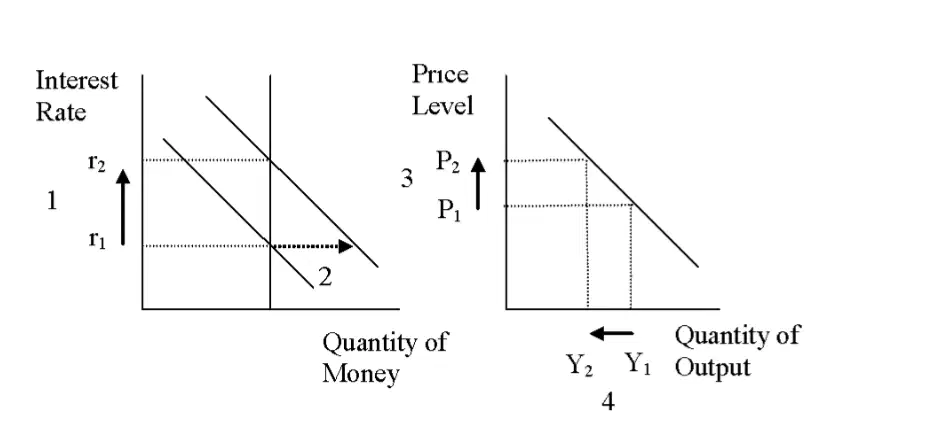
Figure 21-3.
Refer to Figure 21-3. What quantity is represented by the vertical line on the left-hand graph?
the supply of money
the demand for money
the rate of inflation
the quantity of bonds that was most recently sold or purchased by the Federal Reserve
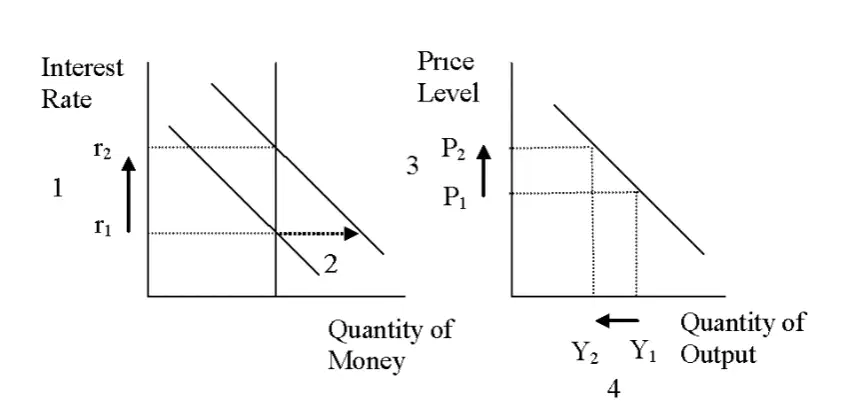
Figure 21-3.
Refer to Figure 21-3. For an economy such as the United States, what component of the demand for goods and services is most responsible for the decrease in output from Y1 to Y2?
consumption
investment
net exports
government spending
The interest rate falls if
the price level falls or the money supply falls.
the price level falls or the money supply rises.
the price level rises or the money supply falls.
the price level rises or the money supply rises.
Other things the same, as the price level rises,
the interest rate rises causing aggregate demand to shift.
the interest rate rises causing a movement along a given aggregate-demand curve.
the interest rate falls causing aggregate demand to shift.
the interest rate falls causing a movement along a given aggregate-demand curve.
If the Fed conducts open-market sales, which of the following quantities increase(s)?
interest rates, prices, and investment spending
interest rates and prices, but not investment spending
interest rates and investment, but not prices
interest rates, but not investment or prices
In the long run, fiscal policy influences
saving, investment, and growth; in the short run, fiscal policy primarily influences technology and the production function.
saving, investment, and growth; in the short run, fiscal policy primarily influences the aggregate demand for goods and services.
technology and the production function; in the short run, fiscal policy primarily influences saving, investment, and growth.
the aggregate demand for goods and services; in the short run, fiscal policy primarily influences technology and the production function.
The marginal propensity to consume (MPC) is defined as the fraction of
extra income that a household consumes rather than saves.
extra income that a household either consumes or saves.
total income that a household consumes rather than saves.
total income that a household either consumes or saves.
If the MPC = 3/5, then the government purchases multiplier is
5/3
5/2
5
15
If the multiplier is 6.25, then the MPC is
0.2
0.6
0.75
0.84
Which of the following correctly explains the crowding-out effect?
An increase in government expenditures decreases the interest rate and so increases investment spending.
An increase in government expenditures increases the interest rate and so reduces investment spending.
A decrease in government expenditures increases the interest rate and so increases investment spending.
A decrease in government expenditures decreases the interest rate and so reduces investment spending.
An increase in government spending
increases the interest rate and so investment spending increases.
increases the interest rate and so investment spending decreases.
decreases the interest rate and so increases investment spending increases.
decreases the interest rate and so investment spending decreases.
Assume there is a multiplier effect, some crowding out, and no accelerator effect. An increase in government expenditures changes aggregate demand more,
the smaller the MPC and the stronger the influence of income on money demand.
the smaller the MPC and the weaker the influence of income on money demand.
the larger the MPC and the stronger the influence of income on money demand.
the larger the MPC and the weaker the influence of income on money demand.
If a $1,000 increase in income leads to a $750 increase in consumption expenditures, then the marginal propensity to consume is
0.75 and the multiplier is 1 1/3
0.75 and the multiplier is 4.
0.25 and the multiplier is 1 1/3.
0.25 and the multiplier is 1 1/3.
Most economists believe that fiscal policy
only affects aggregate demand and not aggregate supply.
primarily affects aggregate demand.
primarily effects aggregate supply.
only affects aggregate supply and not aggregate demand.
If the government cuts the tax rate, workers get to keep
less of each additional dollar they earn, so work effort increases, and aggregate supply shifts right.
less of each additional dollar they earn, so work effort decreases, and aggregate supply shifts left.
more of each additional dollar they earn, so work effort increases, and aggregate supply shifts right.
more of each additional dollar they earn, so work effort decreases, and aggregate supply shifts left.

