
 Worksheets
Study Guide: SS Final Exam Review
Total questions: 75
Worksheet time: 38mins
What is the meaning of the term 'polytheism'?
Belief in many gods.
Belief in one god.
Belief in no gods.
Belief in spirits only.
What is the meaning of the term 'monotheism'?
Belief in one god.
Belief in many gods.
Belief in no god.
Belief in nature spirits.
What is the meaning of the term 'pilgrimage'?
A journey to a sacred place for religious reasons.
A type of traditional dance performed during festivals.
A method of preserving food for long journeys.
A ceremony to welcome new members into a community.
What is the meaning of the term 'democracy'?
A system of government by the whole population, typically through elected representatives.
A form of government where power is held by a single individual.
A system in which religious leaders control the government.
A government ruled by a small group of elites.
What is the meaning of the term 'patrician'?
A member of the noble families or class in ancient Rome.
A common soldier in the Roman army.
A type of Roman architectural column.
A festival celebrated in ancient Rome.
What is the meaning of the term 'plebeian'?
A commoner in ancient Rome.
A Roman emperor.
A type of Roman architecture.
A Roman military leader.
What is the meaning of the term 'veto'?
The power to reject a decision or proposal made by a law-making body.
A formal agreement between two countries.
A type of government tax on imports.
The process of passing a new law.
What is the meaning of the term 'triumvirate'?
A group of three men holding power in ancient Rome.
A type of Roman coin.
A Roman festival.
A Roman military formation.
What is the meaning of the term 'colony'?
A country or area under the full or partial political control of another country and occupied by settlers from that country.
A type of government where citizens rule directly.
A system of trade between two independent nations.
A group of people who share the same language and culture but live in different countries.
What is the meaning of the term 'polis'?
A city-state in ancient Greece.
A type of Greek temple.
A traditional Greek festival.
A Greek mythological creature.
What is the meaning of the term 'civil war'?
A war between citizens of the same country.
A war between two different countries.
A war fought only at sea.
A war that involves only economic sanctions.
What is the meaning of the term 'alliance'?
A union or association formed for mutual benefit, especially between countries or organizations.
A disagreement between two parties.
A type of government system.
A financial transaction between companies.
What is the meaning of the term 'Consul'?
One of the two annually elected chief magistrates who jointly ruled the republic in ancient Rome.
A Roman temple dedicated to the gods.
A type of Roman coin used during the Republic era.
A military rank in the Roman army.
What are the '12 Tables'?
The earliest code of Roman civil, criminal, and religious law.
A collection of Greek philosophical essays.
A set of Egyptian mathematical formulas.
A Roman architectural blueprint.
What is a 'Republic'?
A state in which supreme power is held by the people and their elected representatives.
A country ruled by a single monarch with absolute power.
A region governed by military leaders only.
A territory controlled by foreign powers.
What is a 'Tribune'?
An official in ancient Rome chosen by the plebeians to protect their interests.
A Roman god of war.
A type of Roman coin.
A famous Roman festival.
Who was Hammurabi?
A Babylonian king known for creating the Code of Hammurabi.
An Egyptian pharaoh who built the pyramids.
A Greek philosopher who taught Aristotle.
A Roman emperor who conquered Gaul.
Who was Hatshepsut?
A female pharaoh of ancient Egypt.
A famous Greek philosopher.
A Roman goddess of love.
A Mesopotamian king.
Who was Augustus?
The first emperor of Rome.
A famous Greek philosopher.
A legendary Egyptian pharaoh.
A renowned Chinese emperor.
A Carthaginian general.
Who was Julius Caesar?
A Roman general and dictator.
A famous Greek philosopher.
An Egyptian pharaoh.
A Chinese emperor.
Who was Abraham?
A patriarch in Judaism, Christianity, and Islam.
A famous Greek philosopher.
An Egyptian pharaoh.
A Roman emperor.
Who was Jesus?
The central figure of Christianity.
A famous Roman emperor.
A Greek philosopher.
An Egyptian pharaoh.
A legendary warrior from China.
Who was Muhammad?
The founder of Islam.
A famous Roman emperor.
A renowned scientist from the Renaissance.
A legendary Greek philosopher.
An ancient Egyptian pharaoh.
Who was Socrates?
A classical Greek philosopher.
A Roman emperor.
An Egyptian pharaoh.
A medieval knight.
Who was Aristotle?
A Greek philosopher and student of Plato.
A Roman emperor and poet.
An Egyptian pharaoh and architect.
A Chinese warrior and inventor.
Who was Alexander the Great?
A king of Macedonia who created a large empire.
A famous Roman senator.
An Egyptian pharaoh known for building pyramids.
A Chinese emperor from the Han dynasty.
Who was Mansa Musa?
King of Mali, richest man in the world, famous for his Hajj.
Explorer who discovered America.
Pharaoh of Ancient Egypt.
Founder of the Mongol Empire.
Who was Confucius?
A Chinese philosopher who believed in the golden rule.
An Egyptian pharaoh known for building pyramids.
A Roman emperor famous for his military conquests.
A Greek mathematician who invented geometry.
Who was Plato?
A Greek philosopher, student of Socrates.
A Roman emperor.
An Egyptian pharaoh.
A Persian king.
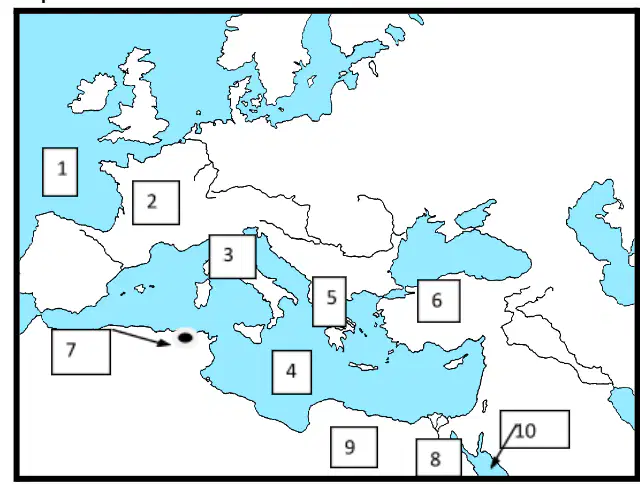
What region is labeled as number 1?
United Kingdom (Britain)
France
Germany
Italy
What was the Neolithic Revolution?
The change from hunting and gathering to farming and herding.
The invention of the steam engine.
The discovery of electricity.
The beginning of the Industrial Revolution.
What was the impact of the Code of Hammurabi?
It established the idea of 'eye for an eye' justice.
It abolished all forms of punishment.
It introduced democracy to Mesopotamia.
It promoted religious tolerance above all laws.
What are some geographic similarities among Mesopotamia and Egypt?
Both had major rivers and fertile land for farming.
Both were located in mountainous regions with little access to water.
Both were surrounded by dense forests and jungles.
Both had cold climates with frequent snowfall.
What is cuneiform?
A system of writing used in Mesopotamia.
An ancient Mesopotamian city.
A type of ancient pottery.
A traditional Mesopotamian dance.
What is a hieroglyphic?
A system of writing using symbols or pictures, used in Egypt.
A type of ancient Egyptian jewelry.
A traditional Egyptian dance.
A kind of Egyptian food.
What was the economy of Egypt based on?
Farming.
Mining.
Fishing.
Textile production.
What were major Egyptian contributions in math and medicine?
Advancements in mathematics and medicine.
Inventions in steam engines and electricity.
Development of modern computers and the internet.
Discovery of penicillin and vaccines.
How did geography impact the daily life of the Egyptians?
It influenced farming, transportation, and settlement patterns.
It prevented the Egyptians from building any cities.
It made it impossible to grow any crops.
It forced Egyptians to move constantly in search of food.
Who was Mansa Musa and why was he famous?
King of Mali, richest man in the world, famous for his Hajj and spending gold in Egypt.
Explorer who discovered America, known for his voyages across the Atlantic.
Pharaoh of Egypt, builder of the pyramids.
Chinese emperor, famous for the Great Wall.
What was the Trans Saharan Trade?
Trade routes across the Sahara Desert, made possible by camels, involving gold and salt trade.
A network of sea routes connecting Europe and Asia.
A trade system between North and South America involving spices.
A silk trade route connecting China to the Mediterranean.
Who was Shi Huangdi?
The first emperor of China, known for being a harsh ruler.
A famous Chinese philosopher and teacher.
A legendary Chinese poet from the Tang dynasty.
A renowned Chinese explorer during the Ming dynasty.
What did Confucius believe in?
The golden rule: treat others the way you want to be treated.
Reincarnation and karma.
The worship of many gods.
The pursuit of material wealth.
What was the Silk Road?
A trade route connecting China to Europe, with many positive and negative effects.
A river that flows from China to India.
An ancient wall built to protect China from invaders.
A famous Chinese festival celebrated every year.
What are the similarities between the five Pillars of Islam and the Ten Commandments?
Both are sets of religious rules or guidelines for living.
Both are only practiced during religious festivals.
Both originated in the same country.
Both require followers to fast every day.
What are the three major religions in the world?
Judaism, Christianity, Islam.
Hinduism, Buddhism, Sikhism.
Taoism, Shinto, Zoroastrianism.
Confucianism, Jainism, Baháʼí Faith.
When did Christianity begin to spread?
During the Roman Empire.
During the Industrial Revolution.
During the Renaissance period.
During the Age of Exploration.
What are people who follow the Islamic faith called?
Muslims.
Christians.
Hindus.
Buddhists.
Who is Allah according to Islam?
God.
A prophet.
An angel.
A book.
What do Christians believe about Jesus?
That he rose from the dead (resurrection).
That he never existed.
That he was only a prophet and not divine.
That he was born in Rome.
Jerusalem is an important city to all 3 major religions.
True
False
Which religion requires its followers to pray 5 times daily?
Christianity
Islam
Judaism
Hinduism
Mecca is a holy city in ________.
Islam
Christianity
Hinduism
Buddhism
Christians worship in a ________ on Sundays.
church
mosque
temple
synagogue
Christians receive communion, which includes ________ and wine.
bread
cheese
fish
meat
Greece had a strong democracy.
True
False
Which of the following is a similarity between the U.S. government and Athenian democracy?
Both have kings
Both have democratic elements
Both are monarchies
Both are empires
Sparta was a ________ society.
farming
trading
nomadic
industrial
The Delian league fell apart because Athens became too ________.
powerful
weak
isolated
democratic
Who wrote the epic poems called the Iliad and the Odyssey?
Homer
Virgil
Sophocles
Plato
The Persian Wars included 4 battles. The Persian Empire vs Greece resulted in Athens being destroyed and a defensive league being formed.
True
False
Which of the following is a similarity between the U.S. government and the Roman Republic?
Both have emperors
Both have a Senate
Both are ruled by one person
Both have no laws
The Etruscans were the early people on the ________ Peninsula.
Italian
Iberian
Balkan
Scandinavian
The Twelve Tables were the first set of laws to be made ________.
public
secret
temporary
religious
Soldiers in the Roman Legion were paid well, each soldier was strong, and legions were organized. This led to the success of the Roman Legion.
True
False
The Senate was the law making body for the ________.
patricians
plebeians
slaves
foreigners
The Assembly of Rome was the law making body for the ________.
plebeians
patricians
slaves
senators
Pax Romana was 200 years of peace brought about by ________.
Augustus
Julius Caesar
Nero
Constantine
Augustus pushed the boundaries of the empire to natural borders, making it easier to defend.
True
False
Rome vs. Carthage are known as the ________ Wars.
Punic
Gallic
Persian
Samnite
What is the process of working together to achieve the same goal called?
Conflict
Cooperation
Scarcity
Migration
The ability to influence or control the behavior of others is called ________.
Desire for Power
Empathy
Teamwork
Creativity
The state of not having enough of something is called ________.
Scarcity
Abundance
Sufficiency
Plenty
The sharing of an aspect of one’s culture with another is called ________ diffusion.
Cultural
Physical
Technological
Biological
Movement from one part of something to another is called ________.
Migration
Evaporation
Condensation
Rotation
An increase in population as a result of the Neolithic Revolution is called population ________.
growth
decline
migration
stagnation

