
 Worksheets
Year 8 KAT cycle 3 French
Total questions: 41
Worksheet time: 21mins
Name
Class
Date
1.
What is your name?
4 lines
2.
TC1-1 What is an infinitive verb?
a)
A verb that is not yet conjugated into a tense
b)
A verb that expresses a completed action
c)
A verb that expresses an ongoing action
d)
A verb that expresses future actions or events
3.
TC1-1 On peut visiter le musée - what is ‘on peut’ an example of?
a)
A modal verb
b)
A partitive article
c)
An infinitive
d)
A negative
4.
TC1-1 Translate: ‘on peut regarder la Tour Eiffel’
a)
You can see the Eiffel tower
b)
We must see the Eiffel tower
c)
You must see the Eiffel tower
d)
We are going to see the Eiffel tower
5.
TC1-1 On peut rester dans un hotel - what form of the verb is rester?
a)
Infinitive
b)
Past tense
c)
Future tense
d)
Present tense
6.
TC1-3 How do we make the sentence ‘on peut voyager en avion’ negative?
a)
On ne peut pas voyager en avion
b)
On ne pas peut voyager en avion
c)
On peut ne voyager pas en avion
d)
On ne peut voyager pas en avion
7.
TC1-1 Near future tense - How is the near future tense formed?
a)
Pronoun + aller + infinitive
b)
Pronoun + avoir + infinitive
c)
Pronoun + infinitive
d)
Pronoun + aller + past participle
8.
TC1-1 How do we conjugate the verb aller when using the pronoun ‘je’?
a)
Je vais
b)
Je alle
c)
J’alle
d)
Je vas
9.
TC1-1 How do we conjugate the verb aller when using the pronoun ‘on’?
a)
On va
b)
On vais
c)
On alle
d)
On aller
10.
TC1-1 Complete the sentence with the correct verb infinitive: Je vais ________ en train
a)
Voyager
b)
Envoyer
c)
Visiter
d)
Manger
11.
TC1-1 Which phrase do I need to use when giving opinions in the future tense?
a)
Ce sera
b)
C’était
c)
Ce serait
d)
C’est
12.
TC1-1 What is the perfect tense?
a)
A verb in the past
b)
A verb in the present
c)
A verb in the future
d)
A verb in the conditional
13.
TC1-1/1-3 How is the perfect tense formed?
a)
Pronoun + avoir + past participle of the verb
b)
Pronoun + aller + past participle of the verb
c)
Pronoun + past participle of the verb
d)
Pronoun + infinitive
14.
TC1-1 How do you conjugate the verb avoir in the present tense when using the pronoun ‘je’?
a)
J’ai
b)
Je vais
c)
Je ai
d)
J’avoir
15.
TC1-1 How do you conjugate the verb avoir in the present tense when using the pronoun ‘on’?
a)
On a
b)
On ai
c)
On avoir
d)
On va
16.
TC1-1 How do you say ‘I travelled’?
a)
J’ai voyagé
b)
Je voyagé
c)
Je vais voyagé
d)
On a voyagé
17.
TC1-1 How do you say ‘we visited’?
a)
On a visité
b)
J’ai visité
c)
On ai visité
d)
On a visite
18.
TC1-1 Which of these is not a past participle?
a)
envoyer
b)
fait
c)
découvert
d)
pris
19.
TC1-1 What is the irregular past participle of voir (to see)?
a)
vu
b)
voi
c)
voire
d)
voiré
20.
TC1-3 What is the correct word order if I want to say ‘I have NOT seen Notre Dame?’
a)
Je n’ai pas vu la cathédrale Notre Dame
b)
Je n’ai vu pas la cathédrale Notre Dame
c)
J’ai ne vu pas la cathédrale Notre Dame
d)
Je ne pas ai vu la cathédrale Notre Dame
21.
TC1-1 Which option do I need to use when giving opinions in the past tense?
a)
C’était…
b)
Ce sera…
c)
Ce serait…
d)
C’est…
22.
TC1-1 Some verbs in the past tense use être as the helper verb, which of the following verbs uses this rule?
a)
aller
b)
manger
c)
jouer
d)
écouter
23.
TC1-1/1-3 How is the perfect tense formed for verbs that use être?
a)
Pronoun + être + past participle of the verb
b)
Pronoung + être + infinitive
c)
Pronoun + past participle
d)
Pronoun + être
24.
TC1-1 How do you conjugate the verb être when using the pronoun ‘je’ to say I am
a)
Je suis
b)
Je être
c)
J’ai
d)
Je vais
25.
TC1-1/1-2 Translate: She went to Paris
a)
Elle est allée à Paris
b)
Elle est allé à Paris
c)
Elle suis allée à Paris
d)
Elle allé à Paris
26.
TC2-2 Fill in the gap with the correct word: J’ai voyagé à Paris ____ avion
a)
en
b)
à
c)
au
d)
de
27.
TC2-2 Fill in the gap with the correct word: J’ai voyagé à Paris ____ vélo
a)
à
b)
en
c)
au
d)
de
28.
TC2-2 How do you say ‘by car’ in French?
a)
en voiture
b)
en car
c)
en avion
d)
en bateau
29.
TC2-2 Which of these adjectives gives a negative opinion?
a)
nul
b)
chouette
c)
génial
d)
passionnant
30.
TC1-1 How would you say ‘it WOULD be sensational’?
a)
Ce serait sensass
b)
Ce sera sensass
c)
C’était sensass
d)
C’est sensass
31.
TC2-2 Which of these items would you NOT take in your suitcase?
a)
Un feu d’artifice
b)
Une serviette
c)
Un sèche-cheveux
d)
Des lunettes de soleil
32.
TC2-2 Translate: ‘j’ai envoyé des cartes postales’
a)
I sent postcards
b)
I bought postcards
c)
I bought souvenirs
d)
I see the monuments
33.
TC2-2 Translate: ‘Je vais loger dans une auberge de jeunesse’?
a)
I am going to stay in a youth hostel
b)
I am going to stay in a B&B
c)
I am going to stay in a hotel
d)
I am going to stay in a cottage
34.
TC2-2 Translate: ‘Je suis resté dans un camping’
a)
I stayed at a campsite
b)
I rested at a campsite
c)
I am going to stay at a campsite
d)
I am going to rest at a campsite
35.
TC2-2 Which Paris monument is being described here: ‘un musée avec une grande pyramide’
a)
Louvre
b)
Notre Dame
c)
Sacré Coeur
d)
Eiffel Tower
36.
TC2-2 Which Paris monument is being described here: ‘une très grande tour’
a)
Eiffel tower
b)
Notre Dame
c)
Sacré Coeur
d)
Louvre
37.
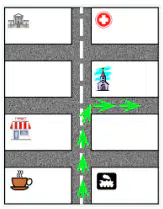
TC2-2 How would you describe to someone how to get to the church?
a)
Prenez la deuxième rue à droite
b)
Prenez la troisième rue à droite
c)
Prenez la deuxième rue à gauche
d)
Prenez la troisième rue à gauche
38.
TC2-2 What is the word we would need to use to say ‘crossroad’?
a)
le carrefour
b)
Le pont
c)
Continuez
d)
Allez tout droit
39.
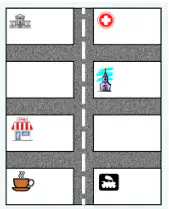
TC2-2 Where would you be going if you followed the instruction ‘prenez la première rue à droite’?
a)
La gare
b)
Le café
c)
L’hôpital
d)
L’église
40.
TC2-2 Which sentence includes a sequencer?
a)
D’abord j’ai visité la tour Eiffel puis j’ai mangé des escargots
b)
J’ai voyagé à Paris avec mes amies
c)
On a vu le musée du louvre, c’était fantastique
d)
Je pense que Paris est formidable
41.
TC1-4/2-2 Translate: On Saturday morning I am going to go to Paris:
a)
Samedi matin je vais aller à Paris
b)
Samedi soir je vais aller à paris
c)
Samedi après-midi je vais aller à Paris
d)
Samedi nuit je vais aller à Paris
100 %

