
 Worksheets
WCIIAH Summative Practice Questions
Total questions: 23
Worksheet time: 3hrs 17mins

Based on the cartoon, the Berlin Conference can best be described as:
A diplomatic success bringing peace to Africa
European powers dividing Africa without African input
African leaders negotiating with European representatives
The religious motivations behind European imperialism
The symbolism of Africa being depicted as a cake in this cartoon suggests:
European leaders saw Africa as something to be consumed and divided up
The Berlin Conference was a celebration of African independence
Europeans wanted to celebrate African culture
The division of Africa was done to benefit African peoples

The visual contrast between the two figures labeled "Barbarie" and "Civilisation" most likely represents:
The scientific accuracy of European racial theories
The hypocrisy of European claims to moral superiority
The peaceful nature of European colonial expansion
The voluntary adoption of European values by colonized peoples

This political cartoon about China demonstrates:
China's willing participation in international trade
The success of Chinese resistance to foreign influence
How imperial powers worked together to divide Chinese territory
China's technological superiority over European nations

This poster most likely promoted:
Mao's Great Leap Forward industrialization campaign
Chinese military expansion into neighboring countries
The Cultural Revolution's educational reforms
Opening diplomatic relations with Western nations

The cartoonist's perspective on Deng's economic reforms suggests:
Complete support for China's transition to capitalism
Concern that economic freedoms did not also bring political freedoms
Optimism about China's future democratic development
Support for maintaining traditional communist economic policies

The cartoonist is commenting on:
China's efforts to protect citizens from foreign cyber attacks
The government's restriction of internet access to limit political dissent
The technological advancement of Chinese internet infrastructure
The voluntary nature of internet restrictions in China
The metaphor of the "Great Firewall" connecting to China's historical Great Wall suggests:
China's tradition of openness to foreign ideas
The historical continuity of Chinese isolationist policies
The technological superiority of ancient Chinese engineering
The democratic nature of Chinese internet policies

The social hierarchy shown in this diagram demonstrates that colonial Latin America was characterized by:
Social mobility based on individual merit and achievement
Racial classification that determined social status and political power
Economic equality among all social groups
Religious affiliation as the primary determinant of social status
The positioning of Peninsulares at the top of this social pyramid indicates:
Their numerical majority in colonial society
The privileged status accorded to those born in Spain
The democratic election of colonial leadership
The successful integration of all ethnic groups

The arrows showing disease transmission in this diagram highlight:
The equal impact of diseases on all populations
The devastating effect of Old World diseases on Native American populations
The superior medical knowledge of European colonizers
The successful adaptation of Native Americans to new diseases

The relationship between globalization and life expectancy shown in this graph suggests:
No correlation exists between globalization and health outcomes
Countries with higher globalization rankings tend to have longer life expectancies
Globalization negatively impacts health in developing countries
Economic development has no relationship to health outcomes
The positioning of countries like Japan and Switzerland on this graph indicates:
High globalization and high life expectancy can coexist
Geographic location determines both variables
These countries have the world's largest populations
Military spending correlates with health outcomes

The overall pattern of military spending from 1870-1914 most likely indicates:
Rising tensions and preparation for war
The economic prosperity of all European nations
Increased colonial expansion
The decline of nationalism in Europe
The successful prevention of colonial conflicts
Based on the chart, which country showed the most dramatic increase in military spending between 1870 and 1914?
Germany
France
Great Britain
Russia

The statistics presented in this chart reveal that:
The majority of enslaved Africans survived the Middle Passage
Approximately 1.4 million enslaved people died during the ocean crossing
The slave trade was primarily conducted by African merchants
Most enslaved people were transported to North America
The data showing that 65% of enslaved people were male suggests:
Equal treatment of men and women in the slave trade
The preference for male labor in plantation economies
The voluntary nature of migration from Africa
The success of efforts to protect women and children

This map most directly illustrates the impact of:
The Industrial Revolution
The Atlantic Slave Trade
European religious mission
African political unification
The arrows on this map represent:
Development of trade routes in North Africa
Expansion of African kingdoms involved in trade
Forced migration and trade connections across the Atlantic
European exploration of new sea routes

The correlation between India's economic growth and health outcomes demonstrates:
No relationship between economic and social development
That GDP growth can contribute to improvements in public health
Life expectancy is unaffected by economic conditions
Traditional economic measures are irrelevant to human welfare

This advertisement best demonstrates which concept?
Economic competition between soap companies
The belief that Europeans should civilize other people
International trade and commerce
Scientific advances in manufacturing
The phrase "White Man's Burden" in this context refers to:
The economic costs of running colonies
The responsibility of spreading Western civilization
The challenge of international competition
The difficulty of overseas transportation
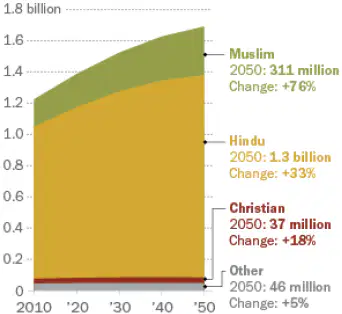

Based on the chart, which religion is projected to have the fastest rate of population growth in India?
Hindu
Muslim
Christian
Other

According to Beaulieu, European intervention in other regions was justified because:
Local peoples requested European assistance
Europeans needed to spread Christianity
Native peoples were incapable of developing their resources
Trade relationships required European oversight
This type of argument was most commonly used to justify:
Free trade agreements
Military alliances
Colonial expansion and control
International peace treaties

The dramatic change in China's GDP after 1978 most directly resulted from:
Mao Zedong's Great Leap Forward policies
Deng Xiaoping's market-based economic reforms
The Cultural Revolution's industrial programs
Increased agricultural collectivization

According to the charts, which statement about South Africa in 1991 is most accurate?
Income was distributed equally among racial groups
The largest population group controlled the smallest share of income
White South Africans made up the majority of the population
Economic inequality was not significant between racial groups

The "remarkable results" mentioned in the passage most likely refer to:
Political democratization
Rapid economic growth
Social equality improvements
Military modernization

The treaty articles shown most clearly reflect the United States' intent to:
Establish military bases in Japan
Promote Japanese cultural development
Influence Japanese trade relations
Support Japanese political independence

Based on the chart, which country most likely faces the greatest challenges in economic development?
Japan
France
Nigeria
Ireland
The data in this chart would be most useful for comparing:
Military capabilities of different nations
Quality of life and development indicators
Natural resource availability
Colonial histories of these countries

This passage suggests that British education in India had the unintended consequence of:
Converting Indians to Christianity
Creating leaders who would challenge British rule
Eliminating traditional Indian culture
Reducing literacy rates among Indians
The phrase "English became the badge of an educated man" most clearly demonstrates:
The practical benefits of learning multiple languages
British cultural influence on Indian society
The superiority of English educational methods
Indian enthusiasm for British culture

The migration patterns shown on this map were primarily caused by:
Economic opportunities in different regions
Religious divisions created by the partition
British colonial administrative policies
Natural disasters and famine
Based on the map, the partition of India most directly affected populations in:
Central and southern India
The Himalayan mountain regions
Border areas between India and Pakistan
Major urban centers like Delhi and Mumbai

