
 Worksheets
U.S. History Semester 2 Pretest
Total questions: 41
Worksheet time: 21mins
Name
Class
Date
1.
Which of the following was one of the primary causes of World War I?
a)
a complex set of alliances among Europe's nations
b)
the exile of Mexican General Victoriano Huerta
c)
the dissatisfaction of Russian peasants
2.
The event that was the "final straw" triggering the American entry into World War I was
a)
the sinking of the Lusitania
b)
the invasion of neutral Belgium
c)
Germany's resumption of unrestricted submarine warfare
3.
Both the Espionage Act and the Sedition Act of 1918 were designed to
a)
provide plans for rebuilding Germany after the war
b)
limit opposition to the war in the U.S.
c)
help the British and French during the war
4.
Which of the following technologies was first used during WWI?
a)
tanks
b)
aircraft carriers
c)
hot air balloons
5.
Why did the Senate reject the Treaty of Versailles?
a)
to keep the U.S. free from foreign entanglements
b)
to avoid dues for membership on the United Nations
c)
to reduce U.S. military forces in Europe
6.
The Red Scare in 1917 was a fear that
a)
nuclear power would result in widespread destruction
b)
Communists would seize power
c)
fore would spread quickly through overcrowded American cities
7.
The stock market crash weakened the nation's banks because
a)
banks had invested their deposits in the stock market
b)
investors no longer had money to deposit in banks
c)
banks depended on their stock for operating funds
8.
Henry Ford's contribution to manufacturing was the
a)
idea of mass marketing
b)
expansion of petroleum industry
c)
adoption of the assembly line
9.
The change in American's ideas about what resulted in more spending on what had once been luxury goods?
a)
mass production
b)
consumer credit
c)
advertising
10.
What was the principal reason for rapid economic growth on the U.S. during the 1920's?
a)
prosperity of American agriculture
b)
development of many new consumer goods
c)
increased spending on defense
11.
What provided work for unemployed young men who planted trees and built reservoirs
a)
Public Works Administration
b)
Civilian Conservation Corps
c)
Federal Emergency Relief Administration
12.
Benefits for older Americans were guaranteed by the
a)
Wagner Act
b)
Works Progress Administration
c)
Social Security Act
13.
Part of the New Deal's legacy was an expansion of
a)
state power over the courts
b)
federal power over the economy
c)
state power over social safety nets
14.
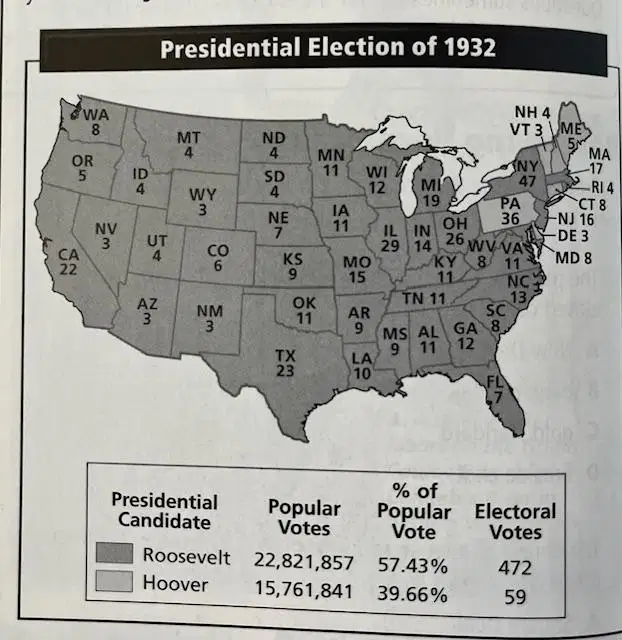
Which of the following regions remained supportive of Republican President Hoover?
a)
Midwest
b)
South
c)
Northeast
15.
According to the map above, which state gave Hoover the largest number of votes in the electoral college?
a)
Pennsylvania
b)
New York
c)
Texas
16.
What type of government considered the nation more important than the individual?
a)
monarchy
b)
fascism
c)
democracy
17.
Which factor encouraged an American policy of neutrality during the 1930's?
a)
disillusionment with WWI and its results
b)
repeal of prohibition
c)
economic prosperity of the period
18.
In the 1930's the U.S. responded to the rise of fascism in Europe by
a)
invading Germany and Italy
b)
joining the League of Nations
c)
passing a series of neutrality laws
19.
Concentration camps and extermination camps were part of what Nazis called
a)
the "final solution"
b)
population control
c)
the last straw
20.
Why did the U.S. finally enter WWII in 1941?
a)
embargo on Japan
b)
bombing of Pearl Harbor
c)
blitzkrieg over Poland
21.
Why were the British able to prevent the Germans from invading their country?
a)
France defeated Germany and pushed them back into Belgium
b)
The U.S. joined the allied forces
c)
Britain developed radar stations to detect German aircraft
22.
To aid in the war effort, American citizens accepted some items to be limited or
a)
commandeered
b)
rationed
c)
barricaded
23.
The invasion of Normandy was important because it
a)
brought the Soviet Union into the war
b)
protected the Pacific fleet
c)
forced the Germans to fight a two-front war
24.
Women were able to serve in noncombat positions in the military and in factories at home because
a)
there were not enough men so they had to let them
b)
people realized it was not fair to keep them out
c)
women organized, as they did to win the vote
25.
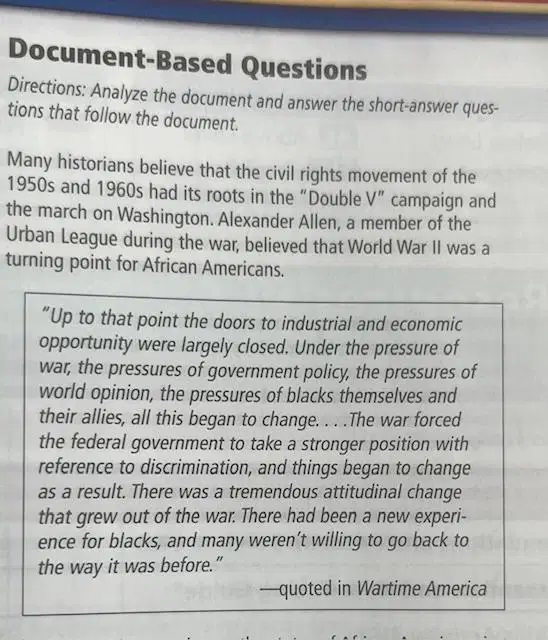
According to the text, how did the war change the status of African Americans in American Society?
a)
It reinforced economic and industrial discrimination
b)
black Americans did not want to go back to being 2nd class citizens after the war
c)
Historians feel that the war was not directly linked to the Civil Rights movement that followed
26.
After WWII, the Soviet Union wanted to establish a buffer zone of what?
a)
developing nations
b)
capitalist nations
c)
satellite nations
27.
Once the Soviet Union tested an atomic bomb, Americans began to fear the effects of
a)
nuclear fallout
b)
subversion
c)
censure
28.
Which was a major outcome of the Yalta conference?
a)
the division of Germany
b)
the establishment of NATO
c)
the terms of Germany's surrender
29.
Which of the following events set off the Korean War?
a)
the Japanese invaded South Korea
b)
the Soviet Union invaded North Korea
c)
Soviet controlled N. Korea invaded S. Korea
30.
What was the underlying goal of the Marshall Plan?
a)
to rebuild European economies and prevent the spread of communism
b)
to Americanize Western European nations
c)
to contain Soviet expansion in the Middle East and Asia
31.
One historical lesson from the McCarthy era is the realization that
a)
loyalty oaths prevent spying
b)
communism is attractive in prosperous times
c)
public fear of traitors can lead to intolerance and discrimination
32.
During the 1950's, the what grew as more people began to work in offices?
a)
computers
b)
franchises
c)
white collar jobs
33.
After WWII, Native Americans suffered from which government policy that forced them into mainstream society?
a)
urban renewal
b)
termination
c)
reservation planning
34.
One major cause of the growth of suburbs was the
a)
rise in blue collar jobs
b)
affordability of homes
c)
Korean War
35.
How did the post WWII baby boom affect American society between 1945 and 1960?
a)
it decreased the demand for housing
b)
it bankrupted the Social Security system
c)
it increased the need for educational resources
36.
The GI bill boosted the postwar economy by
a)
instituting a military draft
b)
providing veterans with generous loans
c)
providing veterans with white collar jobs
37.
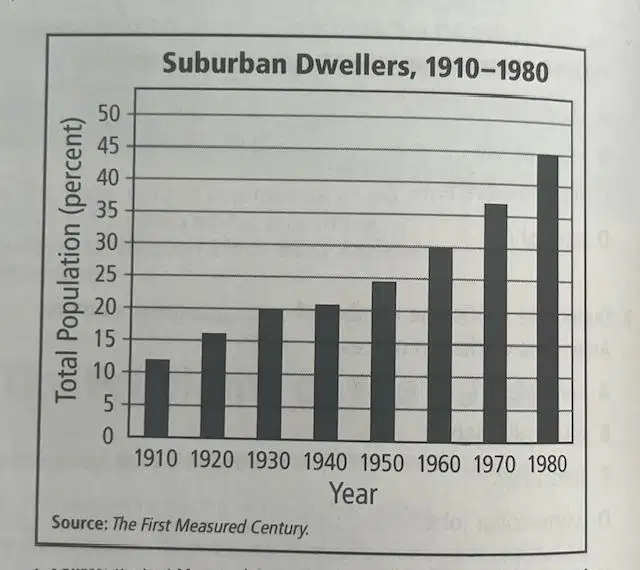
What trend in the percentage of suburban dwellers does this graph show?
a)
fewer people were moving from the cities to the suburbs each year
b)
more people lived in suburbs in 1930 than 1950
c)
more people lived in the suburbs in 1980 than 1970
38.
During the presidential election of 1960, Kennedy focused his campaign message on
a)
bridging the "missile gap" between the U.S. and the Soviet Union
b)
continuing the foreign policy of the current administration
c)
how the democrat's fiscal policies would boost inflation and harm the economy
39.
President Lyndon B. Johnson's Great Society was similar to President Franklin Roosevelt's New Deal in that both programs
a)
advocated civil rights laws to help African Americans
b)
approved efforts by states to reduce taxes for the middle class
c)
supported federal funding of programs for the poor
40.
In Brown v. Board of Education, the Supreme Court overturned what precedent (established in Plessy v. Ferguson)?
a)
separate but equal
b)
de facto segregation
c)
Jim Crow voting laws
41.
Which event led to the bus boycott in Montgomery, Alabama?
a)
a riot in Montgomery
b)
a church bombing
c)
the arrest of Rosa Parks
100 %

