
 Worksheets
Grudgeball - Science & Math Practice #5
Total questions: 100
Worksheet time: 50mins
A bug repellant is sprayed on one arm the other arm is not sprayed. The number of bug bites is recorded after 2 hours. What is the independent variable and what is the dependent variable?
Independent: Number of Bug Bites; Dependent: Bug Repellent
Independent: Bug Repellent; Dependent: Number of Bug Bites
Independent: Number of Bug Bites; Dependent: Time
Independent: Time; Dependent: Bug Repellent
One plant is given sunlight for 12 hours a day. Another plant is not given any sunlight. After 3 weeks, we compare how green each plant looks. What is the independent variable and dependent variable?
Independent: Type of soil; Dependent: Number of leaves
Independent: Sunlight; Dependent: Color/shade of green
Independent: Amount of water; Dependent: Height of plant
Independent: Color/shade of green; Dependent: Sunlight
What is a hypothesis?
A random assumption
An educated, testable, guess
A mathematical equation
A proven scientific law
What is an independent variable in science?
the result of the experiment
factor in an experiment that a scientist purposely changes; the cause
a constant factor that does not change
factor in an experiment that is measured; the effect
What is a dependent variable?
the equipment used to measure the results
the factor that changes (measured) as a result of the experiment; the effect
a constant factor that does not change during the experiment
the factor that is changed or controlled in a scientific experiment; the cause
What is the purpose of an experiment?
To confirm personal beliefs
To test a hypothesis or theory
To avoid making observations
To ignore data collection
To prove a fact without evidence
What are the 6 steps of the Scientific Method in order?
1. Research 2. Question 3. Hypothesis 4. Analysis 5. Experiment 6. Conclusion
1. Question 2. Research 3. Hypothesis 4. Experiment 5. Analysis 6. Conclusion
1. Hypothesis 2. Research 3. Question 4. Experiment 5. Analysis 6. Conclusion
1. Question 2. Hypothesis 3. Research 4. Experiment 5. Conclusion 6. Analysis
What did Alfred Wegener call the original giant landmass of Earth?
Laurasia
PANGEA
Atlantis
Gondwana
What is an element?
a compound made of two or more elements
a substance that is made entirely from one type of atom
a solution of metals and nonmetals
a mixture of different substances
What is an Atom?
a type of chemical reaction
the smallest unit of matter that retains the identity of the substance
an energy wave that travels through space
a large molecule made up of proteins
What are the 3 major parts of an atom?
Proton, Photon, Quark
Proton, Neutron, Electron
Electron, Positron, Neutrino
Neutron, Gluon, Muon
Proton, Meson, Boson
What kind of particles are Protons, Neutrons, and Electrons considered to be?
Molecules
Subatomic Particles
Compounds
Ions

Draw the location of each subatomic particle on a Bohr Model (Protons, Neutrons, Electrons)
Protons and Neutrons are located in the nucleus; Electrons are located in the electron shells around the nucleus.
All subatomic particles are located in the electron shells.
Electrons and Neutrons are in the nucleus; Protons are in the electron shells.
Protons are located in the electron shells; Neutrons and Electrons are in the nucleus.
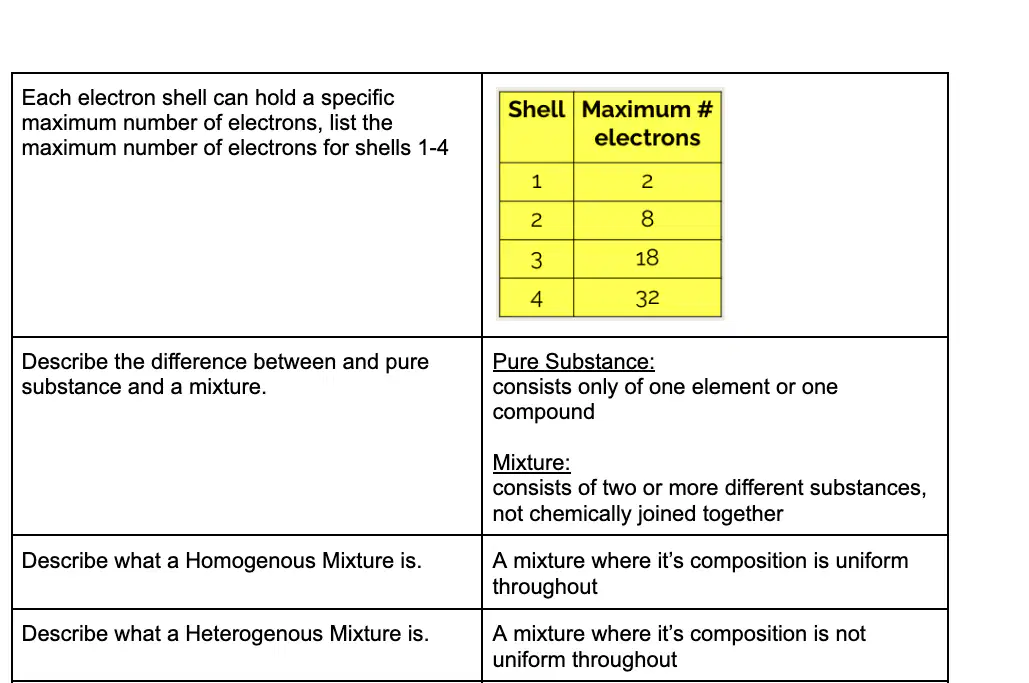
Each electron shell can hold a specific maximum number of electrons, list the maximum number of electrons for shells 1-4.
Shell 1: 2, Shell 2: 8, Shell 3: 8, Shell 4: 18
Shell 1: 2, Shell 2: 6, Shell 3: 10, Shell 4: 14
Shell 1: 2, Shell 2: 8, Shell 3: 18, Shell 4: 32
Shell 1: 2, Shell 2: 4, Shell 3: 8, Shell 4: 16
Describe the difference between a pure substance and a mixture.
Pure Substance: can be separated by physical means. Mixture: cannot be separated by physical means.
Pure Substance: consists only of one element or one compound. Mixture: consists of two or more different substances, not chemically joined together.
Pure Substance: is always a liquid. Mixture: is always a solid.
Pure Substance: consists of two or more elements. Mixture: consists of only one compound.
Describe what a Homogenous Mixture is.
A mixture where the components are easily distinguishable.
A mixture where its composition is uniform throughout.
A mixture that always contains only one substance.
A mixture that can be separated by filtration.
Describe what a Heterogenous Mixture is.
A compound formed by chemical bonding of elements.
A mixture where its composition is not uniform throughout.
A pure substance with only one type of particle.
A mixture where its composition is completely uniform throughout.
Balance this Chemical Equation: H₂ + O₂ → H₂O
H₂ + O₂ → 2H₂O
2H₂ + O₂ → 2H₂O
H₂ + 2O₂ → H₂O
2H₂ + 2O₂ → 2H₂O
How many centimeters are in 1 meter?
10 cm
100 cm
1 cm
1000 cm
How many millimeters are in 1 centimeter?
100 mm
10 mm
1 mm
1000 mm
List the steps of how to use a Triple Beam Balance.
1. Place the object on the scale. 2. Slide the large weight to the right until the arm drops below the line. Move the rider back one groove. Make sure it “locks” into place. 3. Repeat this process with the top weight. When the arm moves below the line, back it up one groove. 4. Slide the small weight on the front beam until the lines match up. 5. Add the amounts on each beam to find the total mass to the nearest tenth of a gram.
1. Place the object on the scale. 2. Slide the small weight on the front beam until the lines match up. 3. Slide the large weight to the right until the arm drops below the line. 4. Move the rider back one groove. 5. Add the amounts on each beam to find the total mass to the nearest tenth of a gram.
1. Place the object on the scale. 2. Slide the large weight to the right until the arm drops below the line. 3. Add the amounts on each beam to find the total mass. 4. Slide the small weight on the front beam until the lines match up. 5. Move the rider back one groove.
1. Place the object on the scale. 2. Slide the large weight to the right until the arm drops below the line. 3. Move the rider forward one groove. 4. Slide the small weight on the front beam until the lines match up. 5. Add the amounts on each beam to find the total mass to the nearest tenth of a gram.
What is the curved surface formed at the top of a liquid when it's in a container?
The plateau
The meniscus
The vortex
The parabola
What is the formula for finding the volume of a regular shaped object?
Length + Width + Height
Length x Width x Height
2 x (Length + Width)
Length x Width
What method do we use to find the volume of an irregular shaped object?
Measuring Tape Method
Water Displacement Method
Ruler and Scale Method
Graph Paper Method
What is Density?
the color of a substance
the degree of compactness of a substance
the speed of a moving object
the amount of heat in a substance
How many senses does the human body have?
7
5
10
3
What body system includes the organs and structures in your body that allow you to breathe? It includes your lungs, nose, mouth and the tubelike structures (airways) that connect them.
Digestive System
Respiratory System
Circulatory System
Nervous System
What body system acts as a physical barrier — protecting your body from bacteria, infection, injury and sunlight?
Digestive System
Integumentary System
Circulatory System
Respiratory System
Define Homeostasis
the process of breaking down food for energy
the body's ability to maintain a stable internal environment despite external changes
the process of cell division
the ability to move from one place to another
List 5 parts of a plant (they do not need to be in any order)
Roots, Branches, Bark, Petals, Seeds
Roots, Stem, Leaves, Flower, Fruit
Stem, Bark, Thorns, Petals, Buds
Leaves, Roots, Soil, Water, Sunlight
What do the roots of the plant do?
release oxygen into the air
anchors the plant in soil and absorbs water and nutrients from soil
produce flowers and fruits
help the plant to make food through photosynthesis
Why do we need to know about plant structure & function? (give 3 reasons)
Cooking, Painting, Dancing
Agriculture, Medicine, Ecology
Fashion, Architecture, Astronomy
Music, Sports, Literature
What is the name of the female reproductive system of the flower?
Stamen
Pistil
Petal
Sepal
What is the name of the male reproductive system of the flower?
Petal
Stamen
Pistil
Sepal
List all parts of the Pistil
Ovary, Anther, Sepal, Style
Stigma, Style, Ovary, Ovules
Petal, Sepal, Stamen, Filament
Anther, Filament, Petal, Sepal
List all parts of the Stamen
Petal, Sepal
Anther, Filament
Ovary, Ovule
Stigma, Style
Explain the steps of Pollination based on location of the flower
1. Stigma 2. Ovary 3. Style 4. Anther
1. Anther 2. Stigma 3. Style 4. Ovary
1. Style 2. Anther 3. Ovary 4. Stigma
1. Ovary 2. Style 3. Stigma 4. Anther
What is self-pollination?
when pollen is transferred only by wind
when pollen is transferred within the same plant (pollen is positioned to reach the stigma)
when pollen is transferred from one plant to another of a different species
when pollen is transferred by insects only
What is cross-pollination?
when roots absorb water from the soil
when pollen is transferred from one plant to another plant (by wind, water, or animal)
when a plant fertilizes itself
when seeds are dispersed by gravity
How can seeds be dispersed?
By turning into rocks
By wind, water, or animal
By growing legs and walking away
By melting in the sun
Describe what the Sepal is and what it does.
a structure that produces pollen in a flower
a leaf like structure that encloses the bud of a flower, protects the developing flower bud
a root structure that absorbs water for the plant
the part of the flower that attracts pollinators with its color
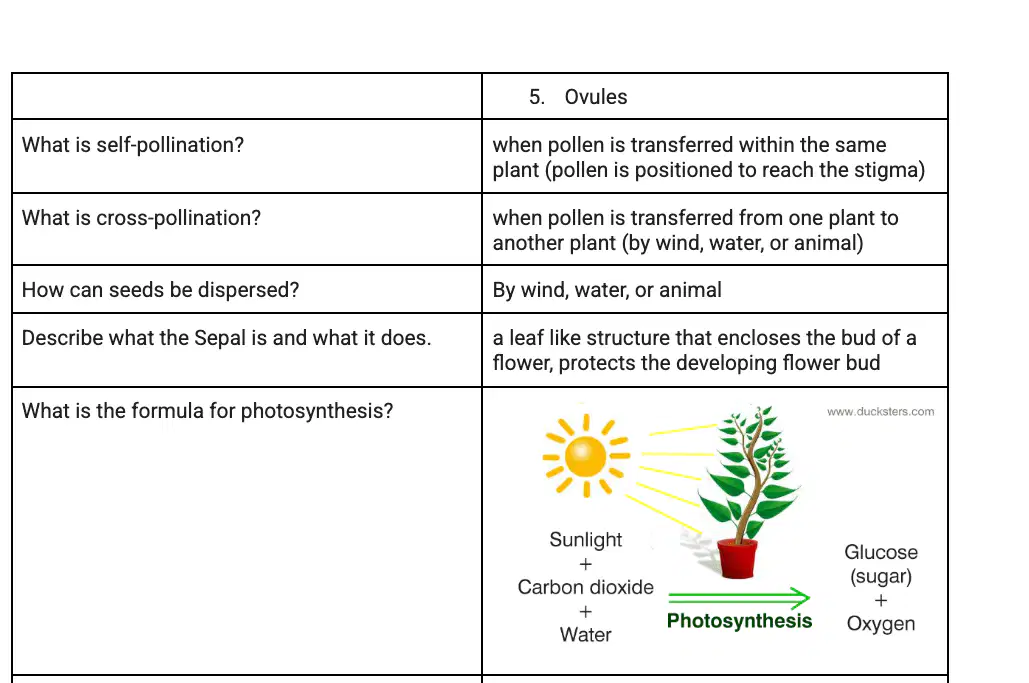
What is the formula for photosynthesis?
Glucose + Oxygen → Sunlight + Carbon dioxide + Water
Sunlight + Carbon dioxide + Water → Glucose (sugar) + Oxygen
Sunlight + Glucose → Water + Carbon dioxide + Oxygen
Water + Oxygen → Glucose (sugar) + Sunlight + Carbon dioxide
What do plants need to photosynthesize?
Oxygen, Sugar, Soil
Sunlight, Carbon Dioxide, Water
Moonlight, Sand, Oil
Nitrogen, Chlorophyll, Fruit
What are the products of photosynthesis?
Starch and Carbon monoxide
Glucose (sugar) and Oxygen
Nitrogen and Hydrogen
Carbon dioxide and Water
What is the green pigment in plants that are located in the chloroplast inside the thylakoids (where they convert sunlight into energy)?
Carotene
Chlorophyll
Anthocyanin
Xanthophyll
What do you divide by to simplify fractions?
Least common multiple (LCM)
Greatest common factor (GCF)
Difference of the denominators
Sum of the numerators
How do you convert a decimal to a percent?
Divide the decimal by 100; move the decimal point two place values to the left
Multiply the decimal by 100; move the decimal point two place values to the right
Subtract 1 from the decimal; move the decimal point three place values to the left
Add 10 to the decimal; move the decimal point one place value to the right
How do you convert a fraction to a decimal?
Multiply the numerator by the denominator
Divide the numerator by the denominator
Subtract the denominator from the numerator
Add the numerator and denominator
How do you convert a percent to a decimal?
Multiply the percent by 10; move the decimal point one place value to the right
Divide the decimal by 100; move the decimal point two place values to the left
Subtract 10 from the percent; move the decimal point one place value to the left
Add 100 to the percent; move the decimal point two place values to the right
The unit “miles per hour” is an example of a…
Unit vector
Unit rate
Unit circle
Unit fraction
Which axis on a coordinate plane runs horizontally?
X-axis
Y-axis
Z-axis
W-axis
Which axis on a coordinate plane runs vertically?
Y-axis
X-axis
Z-axis
W-axis
What is the acronym used to remember the order of operations?
PEMDAS
BODMAS
SOHCAHTOA
FOIL
What does PEMDAS stand for?
Parentheses, Exponents, Multiplication, Division, Addition, Subtraction
Please, Eat, My, Delicious, Apple, Slices
People, Everywhere, Make, Delicious, Apple, Sauce
Penguins, Eat, Many, Delicious, Arctic, Sardines
What are the 4 most frequently used operations in math?
Addition, subtraction, multiplication, and division
Exponentiation, logarithms, roots, and factorials
Integration, differentiation, limits, and series
Permutation, combination, probability, and statistics
To solve one-step equations, what do you need to do to get the variable by itself?
Use inverse operations
Multiply both sides by zero
Add random numbers to both sides
Guess the value of the variable
What does a letter represent in math?
A variable
A number only
A shape
A constant value
Which type of angle is less than 90 degrees?
Acute angle
Obtuse angle
Right angle
Reflex angle
Which type of angle is exactly 90 degrees?
Right angle
Acute angle
Obtuse angle
Reflex angle
Which type of angle is greater than 90 degrees?
Obtuse angle
Acute angle
Right angle
Straight angle
What vocabulary word describes the ratio of the amount that y increases as x increases some amount, represented by a line on a graph.
Slope
Intercept
Vertex
Origin
What is the equation for slope intercept form?
y = mx + b
y = bx + m
y = m + bx
y = b + mx
What is the formula for finding the area of a parallelogram?
A = bh (Area = base x height)
A = 2πr (Area = 2 x pi x radius)
A = 1/2 bh (Area = 1/2 x base x height)
A = s2 (Area = side squared)
What is the formula for finding the area of a triangle?
A = 1/2 bh (Area = 1/2 x base x height) OR: A = bh ÷ 2 (Area = base x height ÷ 2)
A = b + h (Area = base + height)
A = b2+h2 (Area = base squared plus height squared)
A = 2bh (Area = 2 x base x height)
What is the formula for finding the circumference of a circle?
C = πd (Circumference = pi x diameter)
C = πr2 (Circumference = pi x radius squared)
C = 2πr2 (Circumference = 2 x pi x radius squared)
C = d/π (Circumference = diameter divided by pi)
What is the difference between finding the area and perimeter (besides the formulas)?
The area represents the space the figure takes up. The perimeter calculates the length of the outside of the figure.
The area is always larger than the perimeter for any shape.
The perimeter is measured in square units, while area is measured in linear units.
Area and perimeter are always equal for regular shapes.
What is the formula for Pythagorean Theorem?
a² + b² = c²
a² - b² = c²
a² + b² = 2c
a² = b² + c
What does the numerator of a fraction represent?
The part
The whole
The divisor
The product
What does the denominator of a fraction represent?
The whole
The part
The sum
The difference
What does the phrase “Keep, Change, Flip” mean when dividing fractions?
Keep the first fraction the same, Change the division sign to a multiplication sign, Flip the second fraction
Change the first fraction, Keep the division sign, Flip the second fraction
Keep the first fraction, Change the division sign to subtraction, Flip the first fraction
Keep both fractions the same, Change the division sign to addition, Flip the second fraction
What does a number next to a letter represent?
Multiplication
Addition
Division
Subtraction
Write a ratio to describe the following statement. There are 12 dogs for every 15 cats.
12:15 OR 12/15 (fraction)
15:12 OR 15/12 (fraction)
12:27 OR 12/27 (fraction)
27:15 OR 27/15 (fraction)
What is the area formula for a trapezoid?
A = ½(b₁+b₂)h OR A = (b₁+b₂)h ÷ 2
A = b₁ × b₂ × h
A = 2(b₁+b₂)h
A = (b₁-b₂)h ÷ 2
What is the top part of a fraction called?
Numerator
Denominator
Quotient
Product
What is the bottom part of a fraction called?
Denominator
Numerator
Quotient
Product
What does it mean if two shapes are congruent?
They are the same shape and size
They have the same area but different shapes
They are mirror images of each other
They have the same perimeter but different sizes
What does it mean if two angles are congruent?
The measures of angles are the same
The angles are supplementary
The angles are adjacent
The angles are right angles
How do you find the sale price?
1. Find the percent of the subtotal 2. Subtract that price from the subtotal
1. Add the percent of the subtotal to the subtotal
1. Multiply the subtotal by 2
1. Divide the subtotal by the percent
How do you find the sales tax?
1. Find the percent of the subtotal 2. Add that price to the subtotal
1. Subtract the subtotal from the total price 2. Multiply by 100
1. Divide the subtotal by the tax rate 2. Subtract from the subtotal
1. Add a fixed amount to the subtotal regardless of the tax rate
How many digits after the decimal point is the hundredths place?
1
2
3
4
How many digits before the decimal point is the thousands place?
2
3
4
5
How many digits after the decimal point is the tenths place?
1
2
3
0
Which operation do fractions represent?
Division
Multiplication
Addition
Subtraction
What is the invisible denominator for every whole number?
1
0
2
10
What are all of the factors of 24?
1, 2, 3, 4, 6, 8, 12, 24
1, 2, 4, 6, 8, 10, 12, 24
1, 2, 3, 6, 8, 12, 24
2, 3, 4, 6, 8, 12, 24
What are all of the factors of 100?
1, 2, 4, 5, 10, 20, 25, 50, 100
1, 2, 5, 10, 25, 50, 100, 200
1, 2, 4, 5, 10, 20, 50, 100
2, 4, 5, 10, 20, 25, 50, 100
What is a prime number?
Any number that has only two factors, 1 and itself
Any number that is even
Any number that is a multiple of 10
Any number that has more than two factors
How else is multiplication represented besides an 'X'?
Dot, parentheses, variable next to a number
Division sign, equal sign, plus sign
Comma, semicolon, colon
Square brackets, curly braces, slash
What is the answer to an addition problem called?
Sum
Product
Quotient
Difference
What is the answer to a subtraction problem called?
Difference
Sum
Product
Quotient
What is the answer to a multiplication problem called?
Product
Sum
Quotient
Difference
What is the answer to a division problem called?
Quotient
Product
Sum
Difference
What do all angle measures within a triangle add up to?
180°
90°
360°
270°
What do the measures of complementary angles add up to?
90°
180°
60°
120°
What do the measures of supplementary angles add up to?
180°
90°
360°
45°
What are the three classifications of triangles by their side lengths?
Equilateral, isosceles, scalene
Right, obtuse, acute
Parallel, perpendicular, intersecting
Square, rectangle, rhombus
What do we type into a calculator for pi (without using the button)?
3.14
2.71
1.62
4.20
What is the square root of 64?
8
6
4
10
What is the label for an area problem? ________
units² (units squared)
units (units only)
units³ (units cubed)
units⁴ (units to the fourth power)
What is the label for volume?
units³ (units cubed)
units² (units squared)
units (no exponent)
units⁴ (units to the fourth power)

