
 Worksheets
Phases of the Moon and Tides
Total questions: 25
Worksheet time: 13mins

Which of the following correctly labels the phases of the moon and identifies the phases for Spring and Neap tides in a chart of moon phases around the Earth?
New Moon and Full Moon for Spring tides; First Quarter and Third Quarter for Neap tides.
First Quarter and Third Quarter for Spring tides; New Moon and Full Moon for Neap tides.
All phases are for Spring tides only.
All phases are for Neap tides only.

Which phases of the tide are associated with the greatest and least depth of average daily tides on a graph?
Spring tides have the greatest depth, Neap tides have the least depth.
Neap tides have the greatest depth, Spring tides have the least depth.
Both Spring and Neap tides have the same depth.
Tide depth does not change with phases.
What is the difference between Spring tides and Neap tides?
Spring tides are particularly deep high and low tides because the Earth, Moon, and Sun are aligned. Neap tides are particularly shallow high and low tides because the Moon and the Sun are perpendicular, pulling Earth's water in different directions.
Spring tides occur only during winter, while neap tides occur only during summer.
Spring tides are caused by wind, while neap tides are caused by earthquakes.
Spring tides happen every day, while neap tides happen only once a year.
Which moon phases are associated with Spring tides?
New Moon and Full Moon
First Quarter and Last Quarter
Waning Crescent and Waxing Gibbous
Waxing Crescent and Waning Gibbous
Which moon phases are associated with Neap tides?
First Quarter and Last Quarter
New Moon and Full Moon
Waning Crescent and Waxing Gibbous
Full Moon and First Quarter
What type of tide occurs during the First Quarter phase?
Neap
Spring
High
Low
What type of tide occurs during the Full Moon phase?
Spring
Neap
Low
High
What type of tide occurs during the Last Quarter phase?
Neap
Spring
High
Low

Label the moon phase at position A in the diagram.
New Moon
Full Moon
First Quarter
Waning Gibbous
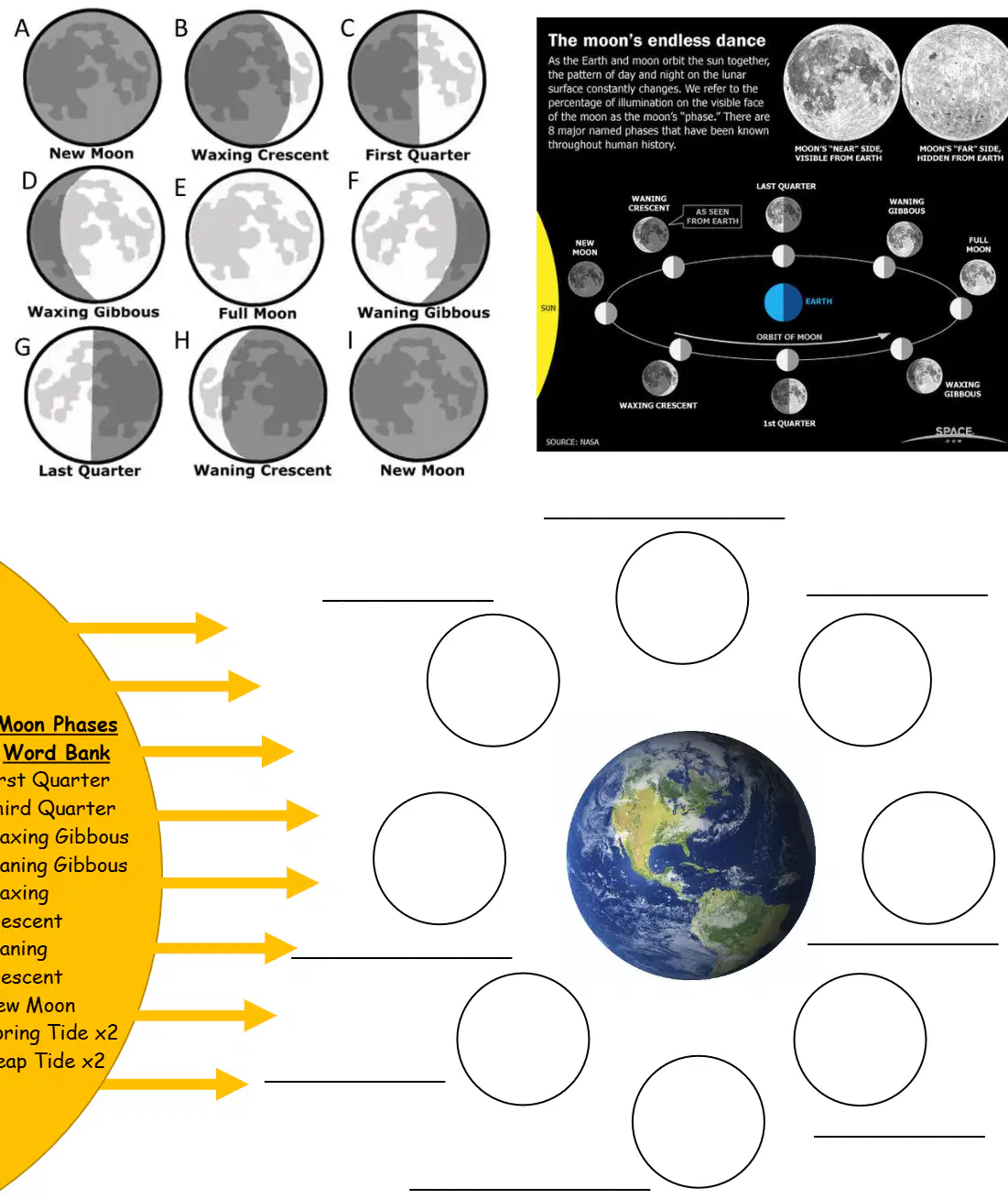
Label the moon phase at position B in the diagram.
Waxing Crescent
Full Moon
Waning Gibbous
New Moon

Label the moon phase at position C in the diagram.
First Quarter
Full Moon
New Moon
Last Quarter

Label the moon phase at position D in the diagram.
Waxing Gibbous
New Moon
Waning Crescent
First Quarter

Label the moon phase at position E in the diagram.
Full Moon
New Moon
First Quarter
Waning Crescent

Label the moon phase at position F in the diagram.
Waning Gibbous
Waxing Crescent
New Moon
First Quarter

Label the moon phase at position G in the diagram.
Last Quarter
New Moon
First Quarter
Full Moon

Label the moon phase at position H in the diagram.
Waning Crescent
Waxing Gibbous
First Quarter
Full Moon

Label the moon phase at position I in the diagram.
New Moon
Full Moon
First Quarter
Waning Gibbous
The deepest high tides and shallowest low tides are called:
Spring tides
Neap tides
King tides
Perigean tides
The shallowest high tides and deepest low tides are called:
Neap tides
Spring tides
King tides
Perigean tides
The deepest high tides are so deep and the shallowest low tides are so shallow because:
The Earth, Sun, and Moon are aligned in a straight line, increasing gravitational pull.
The Earth is closest to the Sun during these tides.
The Moon is at its farthest point from Earth.
The Sun's gravity cancels out the Moon's gravity.
The difference between “waxing” and “waning” is:
Waxing means increasing, waning means decreasing.
Waxing means decreasing, waning means increasing.
Both mean increasing.
Both mean decreasing.
The difference between “gibbous” and “crescent” is:
Gibbous means more than half of the moon is visible, while crescent means less than half is visible.
Gibbous means less than half of the moon is visible, while crescent means more than half is visible.
Both terms mean the same thing.
Gibbous refers to a new moon, while crescent refers to a full moon.
The light from the Moon comes from:
the Sun
the stars
the Moon itself
planets
Why do we not see any of the light reflected off a New Moon?
Because the side of the Moon facing Earth is not illuminated by the Sun
Because the Moon is too far from the Earth
Because the Moon is behind the Sun
Because the Moon does not reflect any light
The cycle of Moon phases starting with the New Moon is:
New Moon, Waxing Crescent, First Quarter, Waxing Gibbous, Full Moon, Waning Gibbous, Last Quarter, Waning Crescent
New Moon, Full Moon, First Quarter, Last Quarter, Waxing Crescent, Waning Crescent, Waxing Gibbous, Waning Gibbous
Full Moon, New Moon, Waxing Crescent, Waning Crescent, First Quarter, Last Quarter, Waxing Gibbous, Waning Gibbous
New Moon, First Quarter, Full Moon, Last Quarter, Waxing Crescent, Waning Crescent, Waxing Gibbous, Waning Gibbous

