
 Worksheets
IPA eng 🤪
Total questions: 23
Worksheet time: 12mins
Where in the kidneys are additional wastes (such as hydrogen ions, potassium, and creatinine) secreted into the tubule, and the final urine is formed during the process of urine formation?
Glomerulus (Bowman's capsule)
Distal tubule and Collecting duct
Neuron and distal tubule
Proximal tubule, Loop of Henle, Distal tubule
Which of the following are the types of electromagnetic waves?
Sound waves, ocean waves, and infrared raysRadio waves,
Radio waves, infrared waves, ultraviolet rays, and X-rays
Seismic waves, ocean waves, and radio waves
What is the name of the process during which blood is filtered and water, glucose, amino acids, and waste products (such as urea) enter the nephron tubule as filtrate in the process of urine formation?
Filtration
B. Absorption
C. Reabsorption
D. Augmentation
What is the organ that produces the primary waste product excreted in Carbon dioxide (CO₂) and water vapor?
Kidneys
Lungs
Liver
Skin
What is the organ that produces the primary waste product excreted in urine?
Kidneys🙏
Lungs😡
Liver
skin😘😘😘
What is the primary waste product excreted by the kidneys?
Urea
Carbon dioxide
Sweat🥺
Urineee
What is the speed of a wave with a wavelength of 0.4 m and a frequency of 800 Hz? Apa hayooo
80 M/s🤑🤑🤑🤑
160 m/s
240 m/s🎀
320 m/s
What is the name of the process during which useful substances such as glucose, salts, and water are reabsorbed back into the bloodstream in the process of urine formation?
(a)
What is the organ that produces the primary waste product excreted in urea?
(a)
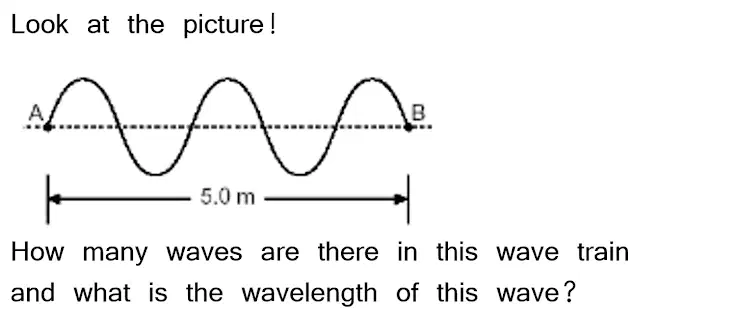
Good luck guys 🐇
1 wavesss, 150cm
1.5 waves,100cm
2 waves,250 cm
2.5 waves, 200 cm
What is the name of the process during which additional wastes (such as hydrogen ions, potassium, and creatinine) are secreted into the tubule, resulting in the formation of the final urine during the process of urine formation?
Filtration
absorption
Reabsorption
Augmentation
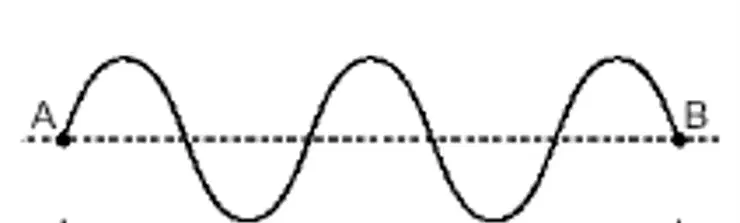
In the diagram below, the distance between points A and B on a wave is 10 meters. What Is the wavelength of this wave?
2 meters
4 meters
6 meters
8 meters
Which organ is labeled as part “C” in the diagram of the human excretory system?
Urethra
Ureter
Bladder
Kidney
Which of the following best defines a wave?
wave is a flow of water that carries matter along with it.
B. A wave is a vibration or disturbance in space.
C. A wave is a large movement of air that carries energy.
D. A wave is a fixed position of particles in matter.
What is the primary waste product excreted by the skins?
Sweat
Urine
Carbon dioxide
Urea
Where in the kidneys are useful substances such as glucose, salts, and water reabsorbed back into the bloodstream during the process of urine formation?
(a)
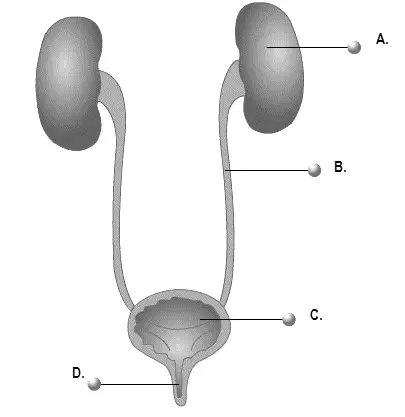
Which organ is labeled as part “D” in the diagram of the human excretory system?
(a)
Where in the kidneys does blood filtration occur, and water, glucose, amino acids, and waste products (such as urea) enter the nephron tubule as filtrate during the process of urine formation?
(a)
What is the speed of a wave with a wavelength of 0.2 m and a frequency of 400 Hz?
80m/s
87 m/s
160 m/s
320 m/s
What is the organ that produces the primary waste product excreted in sweat?
Skin
Lungs
Liver
😝
What is the primary waste product excreted by the liver?
Sweat
Carbon dioxide
Urine
Urea
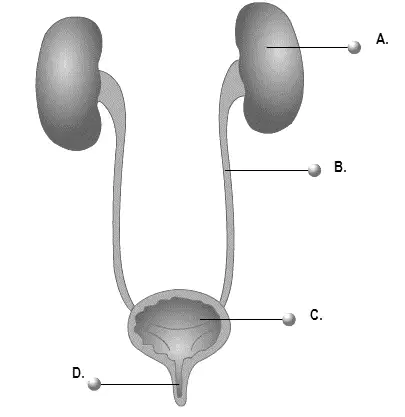
Which organ is labeled as part “B” in the diagram of the human excretory system?
Urethra
Ureter
Bladder
Kidney

Which organ is labeled as part “A” in the diagram of the human excretory system?
Urethra
Ureter
Kidney
Bladder

