
 Worksheets
Aztec Civilization and Legends Quiz
Total questions: 98
Worksheet time: 49mins
What sign did the god of the sun tell the Aztec people to look for when searching for a place to build their city?
An eagle with a snake in its beak perched on a cactus
A jaguar sleeping under a tree
A river flowing through a mountain
A rainbow over a valley
According to the passage, what does the name Tenochtitlán mean?
The land of the rising sun
The place of the prickly pear
The city of gold
The home of the eagle
Why did the Aztec people wander from place to place before settling down?
They were searching for gold
They were a nomadic tribe looking for food and a sign from their god
They were escaping from enemies
They wanted to explore new lands
What event marked the end of the Aztec people's wandering and the beginning of their city-building?
The discovery of gold
The appearance of an eagle on a swampy island in Lake Texcoco
The defeat of their enemies
The arrival of Spanish explorers
How is the legend of the eagle and the serpent remembered in Mexico today?
Through traditional dances
By building pyramids
By showing the eagle and serpent on the flag of Mexico
By celebrating a special holiday
Based on the vocabulary provided, what does the word "nomadic" mean?
Building large cities
Moving around often in search of food; not settled in one place
Worshipping the sun
Living near lakes
Why do you think the Aztec people considered the sign from their god important enough to settle and build a city where they saw it? (DoK Level 3)
Because they liked the location
Because following the god’s sign showed their faith and trust in their beliefs
Because it was the only land available
Because they wanted to be near water
When was Tenochtitlán established by the Aztec?
1200
1325
1500
1800
What is an empire?
A single city
A group of countries or territories under one government or ruler
A type of food
A kind of animal
Who ruled the Aztec Empire?
President
Emperor
Mayor
Governor
Why did the Aztec warriors conquer neighboring city-states?
To make friends
To gain wealth
To build houses
To learn new languages
Which of the following items might people living by the ocean send to Tenochtitlán?
Corn
Seashells
Pottery
Animal skins
Explain how the Aztec Empire was able to grow so large and wealthy. Use evidence from the passage to support your answer.
By trading with other empires only
By conquering neighboring city-states and forcing them to send valuables and goods to Tenochtitlán
By building tall buildings
By making peace treaties with everyone
What did victorious Aztec warriors send back to Tenochtitlán besides food and precious metals?
Books and scrolls
Captured soldiers
Horses and cattle
Spices and herbs
According to Aztec beliefs, what was the one thing people could count on about the world?
The world would last forever
The world would one day come to a terrible, violent end
The world would become peaceful
The world would be ruled by giants
What important religious ritual did the Aztec people practice using captured soldiers?
Storytelling
Human sacrifice
Building temples
Planting crops
How many times did the Aztecs believe the world and the sun had been created and destroyed before their time?
Two times
Three times
Four times
Five times
What caused the end of the world under the first sun, according to Aztec legend?
A great flood
A jaguar devoured the giants
Fire and ash from volcanoes
A great wind
Which of the following best explains why the Aztec people planned their lives according to predictions about the sun?
They wanted to become rich
They believed the sun’s fate would affect their own survival
They wanted to travel to other lands
They wanted to build more temples
What does the word "empire" mean as used in the vocabulary section?
A small village
A group of countries or territories under one government or ruler
A type of animal
A religious ceremony
What is the role of an emperor in an empire?
The person who writes laws
The ruler of an empire
The chief priest
The main warrior
What did the Aztec believe happened each night?
The sun god battled the forces of darkness.
The moon god created stars.
The rain god made it rain.
The wind god blew away the clouds.
Why did the Aztec offer human sacrifices in their temples?
To help their god make the sun rise again.
To celebrate the harvest.
To honor their ancestors.
To win wars against other tribes.
Who did the Aztec prefer to sacrifice?
Foreign soldiers captured in war
Their own friends and family
Farmers from their villages
Merchants from other cities
According to Aztec priests, what was the most important thing to sacrifice?
The heart
The head
The hand
The foot
How did the Aztec beliefs about the end of the world lead them to make human sacrifices?
They believed sacrifices gave the sun god strength to continue the world.
They thought sacrifices would bring rain.
They wanted to please their ancestors.
They believed sacrifices would make them rich.
Imagine you are an Aztec priest. Explain why you would choose a strong soldier’s heart for sacrifice instead of someone from your own family.
Because the heart of a strong soldier was believed to be the most powerful and valuable to the sun god.
Because soldiers were easier to find than family members.
Because family members were not allowed in the temple.
Because soldiers were friends of the priests.
What is the definition of the word "empire"?
A group of countries or territories under the control of one government or one ruler
A small village ruled by a chief
A single city with no ruler
A group of friends living together
Who is an emperor?
The ruler of an empire
The leader of a village
The chief of a tribe
The mayor of a city
Where did the Aztec hold their sacrifices?
On top of pyramids
In underground caves
In the middle of forests
At the riverbanks
What did the Aztec priest do to the victim during a sacrifice?
Removed the victim's heart
Gave the victim a potion
Tied the victim to a tree
Buried the victim alive
Why did the Aztec believe human sacrifices were necessary?
To keep the sun rising and moving across the sky
To make the soil fertile
To please their emperor
To scare away enemies
What event convinced the Aztec that sacrifices worked, according to the passage?
Rain came after sacrifices were made during a drought
The emperor became stronger
The pyramids grew taller
The sun became brighter
What does the word "empire" mean?
A group of countries or territories under one government or ruler
A small village
A type of pyramid
A religious ceremony
How did the Aztec treat their offerings to the gods?
They were regular and generous
They were rare and small
They were only during festivals
They were only for the emperor
What is the meaning of the word "emperor"?
The ruler of an empire
A type of priest
A kind of pyramid
A religious festival
Why did the Aztec repeat the sacrifice process for each victim?
They believed it was necessary for the gods
They wanted to build more pyramids
They needed more food
They wanted to impress other tribes
If you were an Aztec priest and a drought threatened the corn harvest, what would you likely do based on the beliefs described?
Offer human sacrifices to ask for rain
Plant more corn
Move to another city
Ask the emperor for help
What evidence did the Aztec use to support their belief in the power of human sacrifice?
Events like rain coming after sacrifices
Stories from other tribes
Writings from the emperor
The size of their pyramids
What role did priests play in Aztec society?
They led the army in battle.
They used human sacrifice to please the gods.
They built the capital city.
They were responsible for farming.
How could an Aztec person improve their social status?
By becoming a farmer
By joining the army and succeeding in battle
By building temples
By trading goods
Why was war such a central part of Aztec life?
It was the only way to get food.
It provided victims for religious sacrifices and a way for people to advance socially.
It was required by law.
It was a form of entertainment.
What did the Aztec people believe was the greatest honor?
Becoming a priest
Building a house
Dying in battle
Growing crops
How did the Aztec army help create a rich empire?
By trading with other nations
By building large temples
By being skilled at warfare and fighting
By making new laws
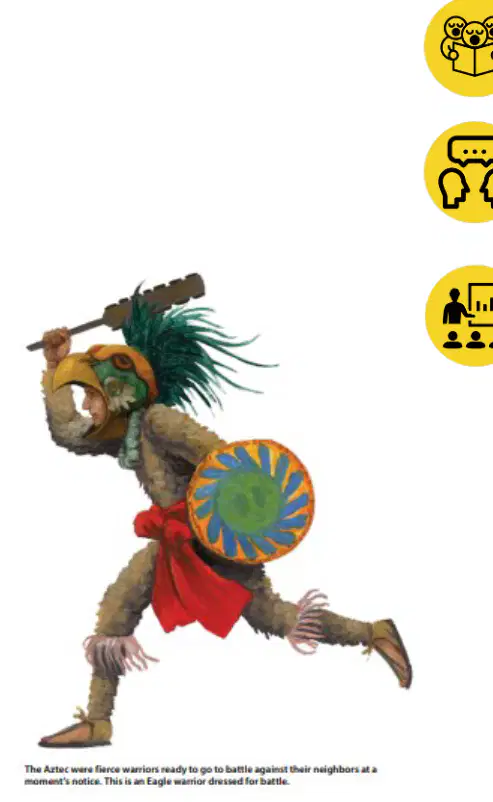
What does the image on the page show?
An Aztec farmer planting crops
An Aztec Eagle warrior ready for battle
An Aztec priest performing a ceremony
The capital city of Tenochtitlán
What was the ancient capital of the Aztec empire?
Tenochtitlán
Machu Picchu
Chichen Itza
Copán
Where is the site of ancient Tenochtitlán located in modern times?
Lima, Peru
Mexico City, Mexico
Rio de Janeiro, Brazil
Buenos Aires, Argentina
Which ancient civilization had its capital at Tenochtitlán?
Inca
Maya
Aztec
Olmec
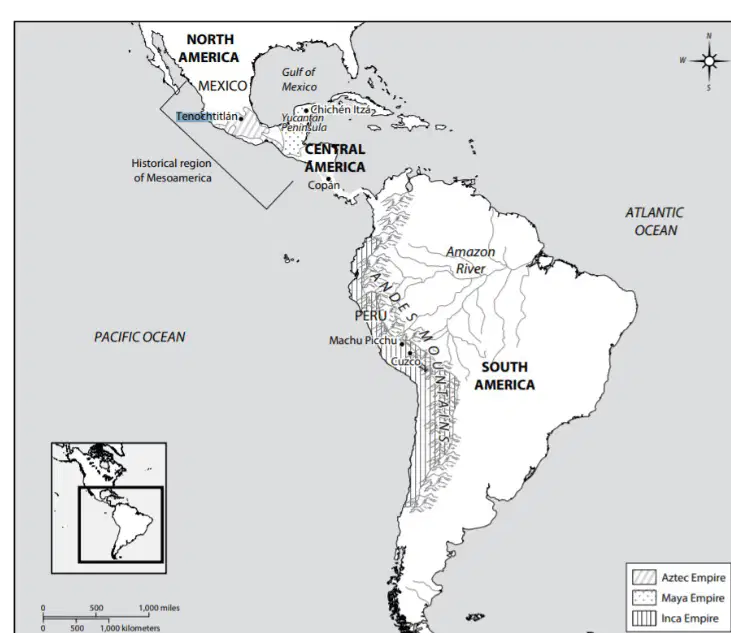
Based on the map, which region is Tenochtitlán located in?
South America
Central America
North America
Europe
What made the city of Tenochtitlán so unusual to the first Europeans that visited the city?
It was built in the middle of a lake and people traveled around in canoes.
It was located in a desert and had no water sources.
It was a small village with only a few people.
It was made entirely of wood and had no stone buildings.
What is a causeway?
A raised road built over water to connect islands to a mainland
A type of boat used for fishing
A tall building used for ceremonies
A bridge made of wood and rope
How did the Aztec people travel around their capital city of Tenochtitlán?
By riding horses
By walking on footpaths
By traveling in canoes
By using bicycles
Why were the first Europeans surprised when they found Tenochtitlán?
They did not expect to find a great civilization with large pyramids and a big population.
They thought the city would be empty and abandoned.
They expected to find only forests and animals.
They believed the city would be underground.
Which of the following best describes a canal, according to the vocabulary provided?
A channel dug by people, used by boats or for irrigation
A natural river that flows through a city
A mountain path used for travel
A tunnel under the ground
Why was Tenochtitlán considered unlike anything the Europeans had ever seen? (DoK Level 2)
It was built on an island in the middle of a lake and had a network of canals and causeways.
It was the only city with tall buildings.
It was surrounded by forests and mountains.
It was famous for its gold mines.
Imagine you are a European explorer seeing Tenochtitlán for the first time. What features of the city would you find most impressive, and why? (DoK Level 3)
The city's location on an island, its large population, and the use of canals and causeways would be impressive because they show advanced planning and engineering.
The city's small size and lack of buildings would be impressive.
The city's forests and animals would be the most impressive.
The city's underground tunnels would be the most impressive.
What did the Aztec do to create their gardens on Lake Texcoco?
They planted seeds directly in the water.
They dug up mud from the lake and piled it in shallow areas.
They built wooden platforms on the lake.
They used sand from the desert.
Why did the Aztec gardens stay moist?
They were watered every day by hand.
They were surrounded by water.
They used special irrigation pipes.
They only grew plants during the rainy season.
Which crops were mentioned as being grown in the Aztec gardens?
Wheat, rice, and potatoes
Corn, squash, and beans
Apples, oranges, and grapes
Tomatoes, peppers, and lettuce
How did the Aztec keep the soil in their gardens fertile each year?
By adding fertilizer from animals
By scooping new mud onto the gardens every year
By rotating crops every month
By using chemical sprays
Why might the first Europeans have been surprised to see a city like Tenochtitlán?
They thought the Americas were empty.
They did not expect people in the Americas to build such a great city.
They believed only small villages existed in the Americas.
They had already seen many similar cities in Europe.
Explain why the Aztec method of gardening was effective for growing crops like corn, squash, and beans. Use evidence from the passage to support your answer.
The gardens were dry and sandy, which is good for these crops.
The gardens were surrounded by water and had rich, moist soil from the lake mud, which helped the crops grow well.
The gardens were built on hills, which protected the crops from floods.
The gardens were covered with stones to keep the soil warm.
What type of clothing did Aztec men typically wear?
Loincloths and cloaks
Long skirts and blouses
Suits and ties
Shorts and t-shirts
What activity was a girl learning from her mother inside one of the Aztec houses?
Cooking
Weaving
Painting
Dancing
What was the symbolic act performed during an Aztec wedding ceremony?
The bride and groom exchanged rings
The bride’s blouse was tied to the groom’s cloak
The couple danced together
The couple shared a meal
Why do you think the Aztecs built gardens, according to the text?
For decoration
To grow needed food for the large population
To have a place to play
To raise animals
How does the tying together of the bride’s blouse and the groom’s cloak during the wedding ceremony represent their relationship?
It shows they are friends
It is a symbol of the connection between husband and wife
It means they will live in the same house
It is a way to show their wealth
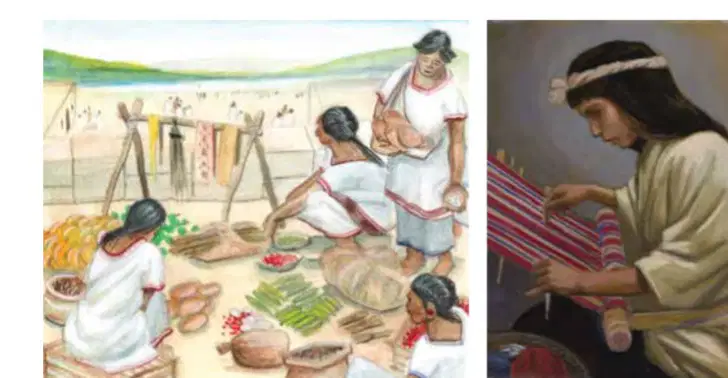
Based on the passage, what can you infer about the roles of women in Aztec society?
Women only worked outside the home
Women were involved in weaving, preparing for ceremonies, and household tasks
Women were warriors
Women were not important in society
What kind of moral instruction did boys receive at an Aztec school?
Rules about the right and wrong way to behave
How to build houses
How to cook food
How to plant crops
What special skills did students learn to become priests or scribes in Aztec schools?
Aztec religion, astronomy, and reading and writing Aztec hieroglyphs
Farming and fishing
Cooking and weaving
Building and painting
What is a codex in the context of Aztec schools?
A long strip of tree bark that folds up like an accordion and is covered with pictures and pictograms
A type of musical instrument
A special kind of clothing
A type of food made from corn
Why did Aztec priests use codices?
To keep lists of rulers, record payments, and track religious holidays
To cook food
To build houses
To make jewelry
Compare the training of noble sons in Aztec schools to that of ordinary boys. What was a key difference?
Noble sons were trained to be priests or scribes, while ordinary boys learned military drills and moral instruction
Noble sons learned only farming, while ordinary boys learned astronomy
Noble sons did not go to school, while ordinary boys did
Noble sons learned to cook, while ordinary boys learned to paint
Imagine you are a student in an Aztec school for nobles. What might your daily lessons include, and why would these skills be important for your future role?
Studying religion, astronomy, and hieroglyphs to prepare for roles as priests or scribes
Practicing fishing and hunting for food
Learning to sew and make pottery
Training to be a merchant
What made the city of Tenochtitlán unusual to the first Europeans who visited it?
It was built on a mountain.
It was built in the middle of a lake and people traveled around in canoes.
It was located in a desert.
It was made entirely of wood.
What is a causeway?
A bridge made of wood.
A tunnel under a river.
A raised road built over water to connect islands to a mainland.
A path through a forest.
How did the Aztecs travel around their capital city of Tenochtitlán?
By horse-drawn carriages.
By walking only.
By canoes.
By bicycles.
Why were the first Europeans surprised when they saw Tenochtitlán?
Because it was a small village.
Because it had no buildings.
Because it was a large city with pyramids and a big population.
Because it was in the mountains.
Which of the following best describes the location of Tenochtitlán?
On a mountain peak.
In the middle of a forest.
On an island in the middle of a lake.
On the seashore.
How were different parts of Tenochtitlán connected?
By underground tunnels.
By a network of canals.
By bridges made of rope.
By roads through the forest.
What does the word "causeway" mean as used in the passage?
A type of boat.
A raised road built over water.
A stone wall.
A wooden bridge.
Why was Tenochtitlán considered the heart of a great civilization?
Because it was the only city in the area.
Because it had a small population.
Because it had towering pyramids and a large population.
Because it was built in a desert.
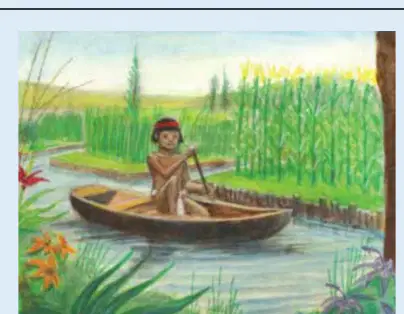
What does the image most likely show about life in Tenochtitlán?
People traveled by car.
People used canoes to move around the city.
People walked everywhere.
People rode horses in the city.
What were some of the items traded at the Aztec central market?
Cacao beans, cotton blankets, pottery, sandals, feathers, and honeycombs
Cars, televisions, computers, and cell phones
Gold coins, diamonds, and silver bars
Ice cream, pizza, and hamburgers
What was one section of the Aztec market specifically set aside for?
Trading fruits and vegetables
Trading enslaved people
Trading jewelry and gold
Trading musical instruments
According to the text, what role did enslaved people have in Aztec society besides being used in human sacrifices?
They were kept as slaves to serve noble families
They were teachers in schools
They were market inspectors
They were artists and musicians
Why might the Aztec market have been a noisy place?
Because thousands of people were trading and making deals
Because there were many wild animals running loose
Because there were concerts held every day
Because it was next to a waterfall
Imagine you are visiting the Aztec market. What evidence from the text suggests that the market was an important place for the community?
Many different goods and people were present, and even noblemen visited to inspect enslaved people.
Only a few people visited, and there were not many goods.
The market was closed most of the time.
People only traded one type of item.
What is the main purpose of the ceremonial centre in the heart of the city?
To serve as a marketplace only
To be the religious ceremonial centre with many temples
To be a place for sports and games
To be the home for all commoners
How wide is the base of the Great Temple in the ceremonial centre?
50 yards (46m)
100 yards (92m)
200 yards (184m)
75 yards (69m)
What is one unique feature of the top steps of the Great Temple?
They are made of gold
They are stained with the blood of human sacrifices
They are covered in flowers
They are painted blue
What can you infer about the importance of religion in the city based on the description of the ceremonial centre?
Religion was not important in the city
Religion played a central role, as there were many temples and religious ceremonies
Only a few people practiced religion
Religion was only for the emperor
What does the presence of a thriving market in the ceremonial centre suggest about Tenochtitlán?
The city was isolated and did not trade
The city was a major trading hub where people exchanged goods from around the empire
The city only traded with nearby villages
The market was only for religious items
Who was Moctezuma II?
The Aztec emperor in the early 1500s
A famous Spanish explorer
The leader of the Mayan civilization
An Incan warrior
What was one way people showed respect to Moctezuma II in his court?
They gave him gifts every day
No one was allowed to look him in the eye
They sang songs for him
They danced in his honor
What is a "litter" as described in the passage?
A type of golden sandal
A chair attached to two beams and carried on the shoulders of several people
A mat laid on the ground
A royal crown
Why did nobles lay mats on the ground when Moctezuma II wanted to walk?
To decorate the palace
So he would not dirty his golden sandals
To show off their wealth
To make the floor softer
Based on the passage, explain why Moctezuma II was seen as a powerful leader.
He was very tall and strong
People never looked him in the eye and made sure he would not dirty his golden sandals
He built many palaces
He was friendly to everyone

