
 Worksheets
The Continents and Oceans Worksheet
Total questions: 80
Worksheet time: 40mins
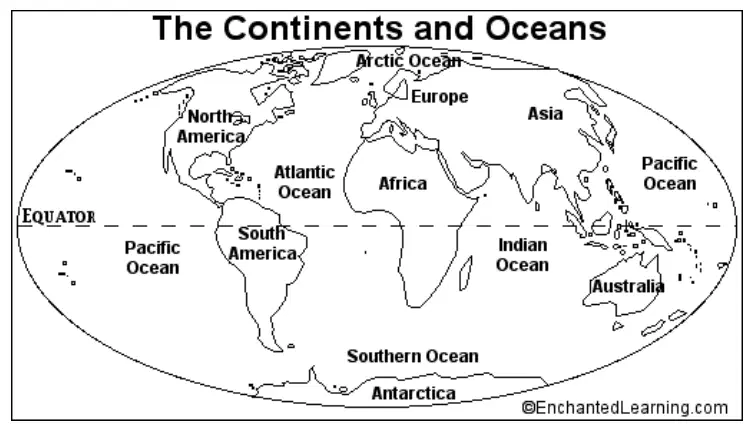
What hemisphere is our continent on? Pick all that apply.
Northern
Southern
Eastern
Western
What hemisphere is Asia located in?
Southern
Western
Eastern
South Eastern
Which term means imaginary lines that run horizontally. These lines measure how far north or south you are from the Equator.
latitude
longitude
vertical
meridians
What is the imaginary line that separates the Earth into the Eastern and Western Hemispheres and is located at 0° longitude?
latitude
longitude
Equator
Prime Meridian
Which term means imaginary lines that run vertically? These lines measure how far east or west you are from the Prime Meridian.
latitude
longitude
vertical
meridians
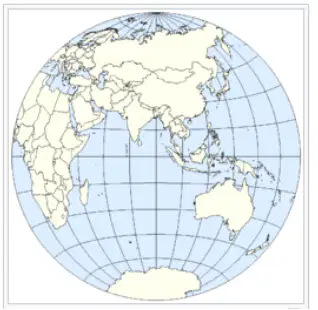
What hemisphere is shown on the map above?
Southern Hemisphere
Eastern Hemisphere
Northern Hemisphere
Western Hemisphere
What word matches this definition: land extending from the mainland and surrounded by water on three sides?
Delta
Peninsula
Island
Isthmus
What is a delta?
lowland between hills or mountains
broad, flat region, higher than its surroundings on at least one side
a narrow passage (channel) of water connecting two larger bodies of water
a mass of mud and silt deposited by a river at its mouth
What is the role of a historian?
Study animals and behavior
Study maps
Study customs of humans long ago
Study written records of different cultures
What is a man made object made and used by people long ago?
Archeology
Geography
Artifact
Domesticate
What is the study of past cultures through artifacts (tools, pottery, etc.)?
Artifact
Biology
Geography
Archeology
To only have one job that you are skilled at is called…
specialize
surplus
city
barter
Why did people live in small groups during the Paleolithic time?
They didn't want to get along with lots of other people
It was hard to find enough food in one area.
They did not want to build a town.
It was easier to celebrate together.
During the Paleolithic time period people survived by:
Trade
Hunting and gathering
Farming
Job specialization
What types of food did hunters and gatherers search for?
Small animals
Plants and insects
Fruits, seeds, nuts
All of the above
During the Old Stone Age tools were mainly made of:
Metal
Wood and stone
Iron and copper
Gold and lead
Which time period did people live as nomads (moved from place to place and never settled)?
Paleolithic
Neolithic
Which time period did people discover agriculture and domesticating animals?
Paleolithic
Neolithic
Which time period came first?
Paleolithic
Neolithic
A surplus of food in the Neolithic Era was caused by:
Domestication of animals
Planting of crops
Migration
BOTH A and B
What was the term used during Neolithic time to signal a major change in their way of life (shift to agriculture and domestication of animals instead of hunting/gathering):
Chaos
Immortal
Revolution
Irrigation
What civilization…. Write either next to each major river(s):
Mesopotamia
Ancient Egypt
Ancient Egypt
Mesopotamia
Ancient China
Ancient China
Ancient India
Ancient India
The Sumerians are important to world history because they gave us:
phonics
polytheism
cuneiform
mud shelters
Sumerians were __________ or believed in many gods and goddesses.
b.) polytheistic
a.) monotheistic
c.) atheistic
d.) agnostic
Who was the greatest king in the Babylon Empire?
Sargon
Phillip
Hammurabi
Moses
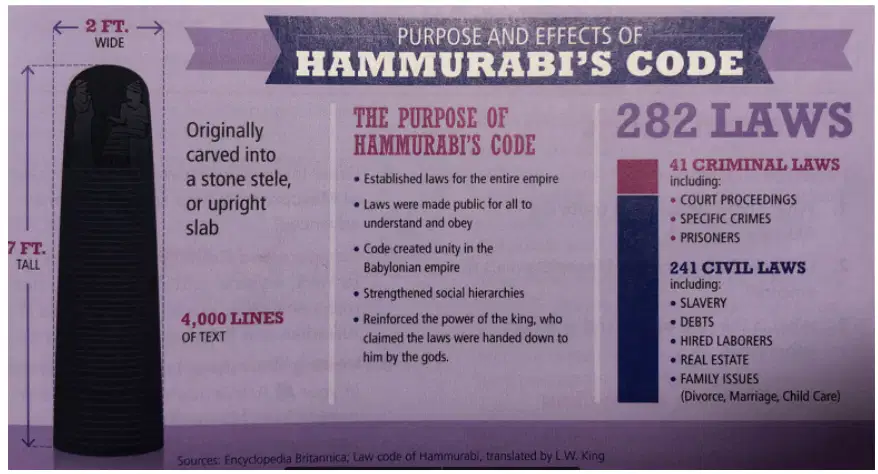
Use the picture above: Who was expected to follow Hammurabi’s Code?
slaves
priests
farmers
all people
Judaism was different from other religions practiced in Mesopotamia. This was because Judaism followed…
polytheism-worshiped many gods
did not have a religion or practices
monotheism-worshiped one god and had rules to live by
The soil of the Nile River valley was:
dry
fertile
rocky
none of the above
What were pyramids?
temples to the gods
prisons
tombs for pharaohs
tombs for nobles
What is Egyptian writing called?
cuneiform
hieroglyphics
characters
Sanskrit
What was the most common form of religious practice in Ancient Egypt?
hieroglyphics
polytheism
mythology
monotheism
What vocabulary word means “Egyptian paper made from plants (reeds)?”
hieroglyphics
dynasty
papyrus
cuneiform
What is the system used in Ancient India that determined your place in society (social class) called?
monsoon system
caste system
standardization
civil service
Which level of the caste system was the lowest and they were treated differently?
priests
untouchables
merchants
farmers
Which statement about the Hindu caste system in India is true?
Different castes shared the same rules for governing their behavior.
People were required to stay in the same caste they were born into.
Castes were encouraged to interact with one another.
Where did the first Indian civilization develop?
along the Nile River
in the Indus River Valley
between the Tigris and Euphrates Rivers
Which religion founded by Siddhartha Gautama followed the Four Noble Truths, Eightfold Path and believed in non-violence?
Christianity
Buddhism
Hinduism
Karma
This is the third largest religion in the world. Followers believe in a caste system, the book of Vedas and the belief in many Gods especially Braham, Shiva, Vishnu?
Christianity
Buddhism
Hinduism
Karma
What is a dynasty?
total disorder and confusion
a sequence of powerful leaders in the same family
art of beautiful writing
What does standardization mean?
to work for the government, you need to take a test and score high
animal bone or shells that are used to predict the future
set of rules that make all things the same
What was the land trade route that connected China (Asia) to Europe called?
Nile River
Silk Road
The Great Wall of China
What were two things that Emperor Qin standardized?
medicine and trade
religion and education
money and written language
The Great Wall of China was built to keep out invaders.
True
False
Confucius developed the idea of civil service. A person must take a test to get a government job.
True
False
How did the sea affect life in ancient Greece?
It had no effect on the people of Greece
It allowed people to travel.
It allowed people to trade.
It isolated people from the rest of the world.
BOTH B and C
Who was the god of sky/thunder and known as “King of the Gods?”
Zeus
Nike
Hades
Poseidon
The three most well known Greek philosophers were:
Socrates, Plato, and Aristotle
Homer, Herodotus, and Thucydides
Pythagoras, Euclid, and Archimedes
Alexander, Pericles, and Leonidas
Who was the famous Greek poet that wrote the Iliad and the Odyssey?
Hammurabi
Hades
Homer
The first Olympics in Athens, Greece were to honor which god?
Apollo
Plato
Zeus
Hera
Alexander the Great from Macedonia, or Northern Greece, was a well trained general. He conquered many areas around Greece. After his death, the era was known as this word meaning “like the Greeks:”
Macedonia
Golden Age
Black Plague
Hellenistic Era
What was the Pax Romana?
time of peace
time of war
time of great famine
time of drought
In Ancient Rome, Romans followed this type of government:
monarchy-king rules
republic-leaders voted into office
What was used to bring in water to the city of Ancient Rome?
arches
levees
aqueducts
columns
Which religion became the most common religion in Ancient Rome?
Christianity
Islam
Polytheism
Which river valley civilization is known for its pyramids and pharaohs?
Mesopotamia
Ancient China
Indus Valley
Ancient Egypt
What writing system did the Sumerians develop?
Pictographs
Cuneiform
Hieroglyphics
Alphabet
Who was the ruler of the Maurya Empire who promoted Buddhism?
Chandragupta
Pericles
Asoka
Ramses II
Which ancient civilization is credited with building the pyramids?
Ancient Greece
Mesopotamia
Ancient India
Ancient Egypt
What is the name of the writing system developed by the Sumerians?
Hieroglyphics
Cuneiform
Alphabet
Sanskrit
Who was the famous Chinese philosopher known for his teachings on ethics and proper behavior?
Socrates
Hammurabi
Aristotle
Confucius
Which ancient civilization is credited with inventing the first system of writing called cuneiform?
Greeks
Egyptians
Sumerians
Romans
What was the main purpose of the Great Wall of China?
To mark the border with India
To protect against invasions
To control flooding
To serve as a trade route
Which river valley was home to the earliest Indian civilization?
Tigris-Euphrates Valley
Nile River Valley
Yellow River Valley
Indus River Valley
Which ancient civilization is known for building ziggurats as religious temples?
Ancient Egypt
Indus Valley
Sumerians
Ancient Greece
What was the main purpose of the Silk Road?
To spread religion
To defend against invaders
To connect cities within China
To facilitate trade between Asia and Europe
Which material was NOT commonly used for tool-making during the Old Stone Age?
Bone
Iron
Wood
Stone
Which ancient civilization is credited with inventing the earliest known system of writing?
Greeks
Sumerians
Egyptians
Romans
What was a major difference between the Paleolithic and Neolithic eras?
Invention of writing
Development of agriculture
Creation of cities
Use of metal tools
Which river valley was home to the earliest Indian civilization?
Indus River Valley
Tigris-Euphrates Valley
Yellow River Valley
Nile River Valley
Which ancient civilization is known for building ziggurats as religious temples?
India
Greece
Egypt
Mesopotamia
Which river was essential to the development of Ancient Egyptian civilization?
Mississippi
Yangtze
Amazon
Nile
Which river valley civilization is known for developing one of the earliest writing systems called cuneiform?
India
China
Egypt
Mesopotamia
What was the main purpose of the pyramids built in Ancient Egypt?
To hold government meetings
To store grain
To be tombs for the pharaohs
To serve as palaces for the pharaohs
Which ancient civilization is credited with the creation of the first code of laws, known as Hammurabi's Code?
Babylonian
Greek
Roman
Persian
Which river was central to the development of ancient Egyptian civilization?
Yangtze River
Mississippi River
Amazon River
Nile River
What is the main purpose of the caste system in ancient India?
To organize society into different social groups
To promote trade with other countries
To encourage people to travel
To teach people how to write
Who is known for creating a code of laws in ancient Mesopotamia?
Confucius
Hammurabi
Zeus
Qin Shi Huang
Which of the following best describes the main achievement of the Neolithic Revolution?
Invention of the wheel
Discovery of fire
Shift from hunting and gathering to farming
Development of written language
Which ancient civilization is known for building pyramids as tombs for their rulers?
Egypt
Mesopotamia
India
Greece
What is the term for a government ruled by a king or queen?
Monarchy
Republic
Democracy
Oligarchy

