
Font size
 Worksheets
Human Body Unit Review
Total questions: 40
Worksheet time: 22mins
Describe the structure of the human body (hierarchy/levels of organization).
Cell - Tissue - Organ - Organ System
Organ - Tissue - Cell - Organ System
Tissue - Cell - Organ System - Organ
Organ System - Organ - Tissue - Cell
Which of the following is an example of the body maintaining a stable internal environment?
The body maintains a stable internal environment by shivering when cold and sweating when hot.
The body maintains a stable internal environment by only eating when hungry.
The body maintains a stable internal environment by sleeping more during the day.
The body maintains a stable internal environment by increasing heart rate when resting.
Which is the following is a good example in the human body of the structure linked to its function?
The thin walled, capillary entwined, alveoli at the ends of the bronchioles increase the surface area to maximize gas exchange.
The thick, rigid walls of arteries slow down blood flow to allow for nutrient absorption.
The flat, smooth surface of the stomach lining increases friction for food breakdown.
The solid, inflexible structure of the lungs prevents expansion during breathing.
Which is the following is a good example in the human body of the structure linked to its function?
The small intestine lined by small fingerlike projections greatly increasing the surface area of the organ whose main function is nutrient absorption.
The stomach has a smooth inner lining to prevent absorption of nutrients.
The esophagus is covered in villi to increase enzyme production.
The large intestine is lined with cilia to aid in protein digestion.
What are the major parts of the skeletal system?
Bones, joints (where two joints meet), cartilage (connective tissue that lines bones for shock absorption and reducing friction), ligaments (connect bone to bone)
Muscles, tendons, nerves, blood vessels
Skin, hair, nails, sweat glands
Heart, lungs, liver, kidneys
Which group below contains organs that are part of the digestive track:
Mouth, Esophagus, Stomach, Small intestine, Large intestine, Rectum, Anus
Heart, Lungs, Liver, Kidneys, Pancreas, Spleen
Brain, Spinal cord, Nerves, Eyes, Ears, Nose
Bones, Muscles, Joints, Tendons, Ligaments, Cartilage
Which group lists accessory organs of the digestive system:
Tongue, Teeth, Salivary glands, Liver, Gall Bladder, Pancreas
Stomach, Esophagus, Large intestine, Small intestine
Heart, Lungs, Kidneys, Spleen
Skin, Bones, Muscles, Joints
Which of the descriptions matches SKELETAL MUSCLE?
Function: Body movement Location: Attached to bones Involuntary/Voluntary: Voluntary
Function: Pumping blood Location: Heart Involuntary/Voluntary: Involuntary
Function: Moving food through digestive tract Location: Walls of internal organs Involuntary/Voluntary: Involuntary
Function: Producing hormones Location: Endocrine glands Involuntary/Voluntary: Involuntary
Which description matches SMOOTH MUSCLE?
Function: Muscles used by body systems to complete tasks Location: Lining digestive tract, Lining blood vessels, etc. Involuntary/Voluntary: Involuntary
Function: Responsible for conscious movement Location: Attached to bones Involuntary/Voluntary: Voluntary
Function: Pumps blood throughout the body Location: Heart Involuntary/Voluntary: Involuntary
Function: Produces hormones Location: Endocrine glands Involuntary/Voluntary: Voluntary
Which correctly describes CARDIAC MUSCLE?
Function: Muscle that makes up the heart pump Location: The heart Involuntary/Voluntary: Involuntary
Function: Muscle that moves bones Location: Attached to bones Involuntary/Voluntary: Voluntary
Function: Muscle that lines the digestive tract Location: Walls of internal organs Involuntary/Voluntary: Involuntary
Function: Muscle that controls eye movement Location: Around the eyes Involuntary/Voluntary: Voluntary
Which choice below would describe ingestion and identify the organ where it occurs?
Description: Taking food into the body Organ: Mouth
Description: Breaking down food into nutrients Organ: Stomach
Description: Absorbing water and forming feces Organ: Large Intestine
Description: Transporting nutrients to cells Organ: Blood
Which choice below would describe elimination and identify the organ where it occurs?
Description: Clearing undigested waste from the body Organ: Rectum and Anus
Description: Absorbing nutrients into the bloodstream Organ: Small Intestine
Description: Breaking down food with enzymes Organ: Stomach
Description: Filtering toxins from the blood Organ: Liver
Where is the difference between pulmonary and systemic circulation?
The pulmonary circuit is the blood flow from the heart to the lungs and back to the heart. The systemic circuit is the blood flow from the heart to the body and back to the heart.
The pulmonary circuit is the blood flow from the heart to the body and back to the heart. The systemic circuit is the blood flow from the heart to the lungs and back to the heart.
Both pulmonary and systemic circuits carry blood only to the lungs.
Both pulmonary and systemic circuits carry blood only to the body.
What happens to your heart rate as you exercise?
When you exercise your body requires energy. You need oxygen to produce energy and your body makes carbon dioxide as waste in this process. The blood and heart are responsible for moving these gases to and from the lungs. Your heart rate increases when you exercise to keep up with the increasing demands for oxygen and to rid the body of the increasing amount of CO2 produced.
Your heart rate decreases when you exercise because your body needs less oxygen and produces less carbon dioxide.
Your heart rate remains the same during exercise because your body does not require any changes in oxygen or carbon dioxide levels.
Your heart rate stops temporarily during exercise to allow your body to rest.
What gas does the respiratory and cardiovascular systems work together to supply to all the cells in the body?
Oxygen
Carbon Dioxide
Nitrogen
Hydrogen
This muscle plays a major role in inhaling and exhaling:
The diaphragm
The biceps
The quadriceps
The deltoid
Does the respiratory eliminate waste? Explain
Yes the respiratory system is responsible for eliminating carbon dioxide which is cellular waste produced during cellular respiration.
No, the respiratory system only supplies oxygen and does not eliminate any waste.
No, the respiratory system eliminates only water vapor, not any waste products.
No, the respiratory system is responsible for digesting food, not eliminating waste.
Which choice below correctly describes the organization of the nervous system
CNS = Brain and spinal cord. Organize and analyze information.
PNS = All the nerves outside of the CNS and sensory organs. Connect rest of body to CNS
CNS = All the nerves in the body. PNS = Only the brain and spinal cord. Both function to control only voluntary actions.
CNS = Sensory organs and spinal cord. PNS = Only the brain. Both function to transmit signals to muscles only.
CNS = Brain, spinal cord, and all peripheral nerves. PNS = Only sensory organs. Both function to regulate blood pressure only.
What are the parts of the integumentary system?
Skin, Hair and Nails
Bones, Muscles and Tendons
Heart, Lungs and Brain
Stomach, Liver and Intestines
Which system works with the skeletal system to allow for movement?
Muscular
Digestive
Respiratory
Nervous
How do the skeletal and muscular systems work together to complete a task?
Skeletal muscles attach to bones to allow for movement
Bones produce energy for muscles to contract
Muscles create bones during movement
The skeletal system controls the nervous system
How does the cardiovascular system work with the muscular system?
Your heart rate increases when you exercise
The muscular system controls blood pressure directly
Muscles produce red blood cells for the heart
The cardiovascular system digests food for muscles
How does the nervous system work with the muscular system?
Muscles will respond to protect body when stimuli are received
The nervous system produces hormones for muscle growth
Muscles control the release of neurotransmitters in the brain
The nervous system digests nutrients for muscle energy
How do the cardiovascular and digestive systems work together?
Nutrients from food enters the blood stream from the small intestines
The heart pumps enzymes to digest food
The stomach supplies oxygen to the blood
The intestines control the heartbeat
Which systems work with the digestive system?
Muscular, Cardiovascular
Nervous, Skeletal
Respiratory, Integumentary
Endocrine, Lymphatic
How do the digestive and cardiovascular systems work together?
Digested nutrients transported to body cells by blood
Blood breaks down food in the stomach
Digestive enzymes circulate in the bloodstream to provide oxygen
The heart pumps digestive juices to the intestines
Which systems work with the respiratory system?
Nervous, Muscular
Digestive, Excretory
Skeletal, Integumentary
Endocrine, Lymphatic
How do the nervous and cardiovascular systems work together?
Your heartbeat can increase and decrease in response to stimuli. Your vessels can dilate and contract based on temperature stimuli.
The nervous system controls only the digestive system, not the cardiovascular system.
The cardiovascular system sends signals to the brain to control movement.
The nervous system and cardiovascular system do not interact at all.
How does the cardiovascular system work with the integumentary system?
Blood vessels enlarge to help lower the body temperature
The skin produces red blood cells for the heart
The heart pumps sweat through the pores
The integumentary system controls the heartbeat
How does the muscular system work with the integumentary system?
Muscles contract to raise hair on skin to trap heat
Muscles produce melanin to protect the skin from UV rays
Muscles secrete oils to keep the skin moisturized
Muscles form the outermost protective layer of the body


Which of the following lists these levels in the correct order of organization from the simplest to the most complex?
cells, tissues, organs, organ systems, organisms
organisms, organ systems, organs, tissues, cells
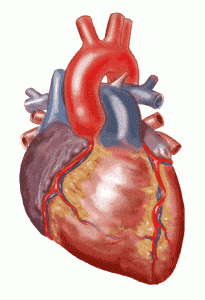
Which organ system is primarily responsible for transporting nutrients, gases, and wastes throughout the body?
Digestive system
Cardiovascular system
Muscular system
Integumentary system
What is the main function of the small intestine in the digestive process?
Storing undigested food
Filtering toxins from the blood
Producing digestive enzymes
Absorbing nutrients into the bloodstream
How does the nervous system interact with the muscular system to produce movement?
Muscles control the growth of nerve cells
Nerves send signals to muscles, causing them to contract
The nervous system digests nutrients for muscle energy
Muscles produce hormones that control nerve impulses
Chewing is an example of:
Mechanical digestion
Chemical digestion
Digestion begins in the (a) .
Which two choices work with closely with capillaries?
Villi of small intestine
Alveoli of the lung
Cerebellum of the brain
Cartilage on the end of bones
The alveoli and villi are similar in some ways. Which is NOT a true similarity?
They are found in the same organ.
They increase the surface area of their organ.
They function in getting things into the blood.
They work closely with the capillaries.

