Wayground logo

Free Printable Worksheets

Font size

S
M
L
XL
Worksheets

Chemical Reaction and Equation

Total questions: 40

Worksheet time: 37mins

Name
Class
Date
1.

Which of the following processes involve chemical reactions

a)

Storing of oxygen gas under pressure in a gas cylinder

b)

Liquification of air

c)

Keeping petrol in a china dish in open

d)

Heating copper wire in the presence of air at high temperature

2.

What is the formula of magnesium nitride?

a)

MgN3

b)

Mg2N3

c)

Mg3N2

d)

Mg2N

3.

What are the products of decomposition of PbCO3

a)

PbO + CO2

b)

Pb + CO2 + O2

c)

PbO + C

d)

Pb + C + O2

4.

A metal 'M' reacts with an acid according to the equation :

M + H+ --------> M3+ + H2

The metal can be

a)

Potassium

b)

Magnesium

c)

Aluminium

d)

Barium

5.

When dil. sulphuric acid is added to pieces of iron sulphie, hydrogen sulphide gas is produced and soluble ferrous sulphate is produced. The type of chemical reaction involved is :

a)

Decomposition reaction

b)

Combination reaction

c)

Displacement Reaction

d)

Double displacement reaction

6.

When ethane reacts with oxygen present in air it produces CO2 and water. In this reaction how many moles of oxygen is used?

a)

3

b)

5/2

c)

2

d)

7/2

7.

A powdered salt X was heated in a dry test tube and evolution of brown fumes of nitrogen dioxide and a yellow residue of lead oxide is formed. The salt X is :

a)

Magnesium Carbonate

b)

Lead nitrate

c)

Ammonium Sulphate

d)

Calcium carbonate

8.

Which of the following is not a type of reduction

a)

Gain of hydrogen

b)

loss of electron

c)

loss of oxygen

d)

gain of electron

9.

Reaction of Na and H2O gives a very strong base , NaOH and another product, a gas. How do you test for this gas ?

a)

Pass it through lime water, turns milky.

b)

Rotten egg smell

c)

Burns with a dazzling flame

d)

Burns with a pop sound

10.

Which of the following is endothermic reaction?

a)

Dissolution of ammonium chloride in water

b)

Dilution of sulphuric acid

c)

Dissolution of sodium hydroxide in water

d)

Reaction of zinc with HCl

11.
When a scientist mixed two chemicals, an exothermic reaction takes place. Which of the following would be proof that the reaction was exothermic?
a)
a change of color
b)
a change of state
c)
a temperature decrease
d)
a temperature increase
12.
In the reaction methane + oxygen turns into carbon dioxide + water, the methane and oxygen are called _______________.
a)
reactants
b)
products
c)
neutrals
d)
energizers
13.
Which is an example of an endothermic reaction?
a)
burning wood
b)
airplane using fuel
c)
plant leaves using photosynthesis
d)
digesting food
14.
What is the arrow in a chemical equation...
H2 + O --> H2O
a)
Reactants
b)
Products 
c)
Yields 
d)
Chemical Equation 
15.
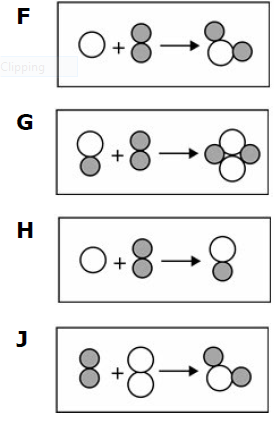
Which of the following models best demonstrates a balanced chemical equation?
a)
F
b)
G
c)
H
d)
J
16.
Which of the following is NOT evidence that that a chemical reaction has occurred?
a)
produces light/heat
b)
production of a gas
c)
formation of a precipitate
d)
melting
17.

When starting material X is treated with water ,it produces Y solution , which is used in white washing is Y , identify the X & Y from the following

a)

X is quick lime, Y is washing soda

b)

X is quick lime, Y is slaked lime

c)

X is slaked lime, Y is washing soda

d)

X is quick lime, Y is slow lime

18.

Which of the following is correct gas evolved when a marble powder is heated in a dry test tube?

a)

SO3

b)

H2

c)

CO2

d)

NO2

19.

which of the following is correct balanced chemical equation? When barium chloride reacts with aluminium sulphate produces barium sulphate and aluminium chloride

a)

4BaCl2 + Al2(SO4)3 gives 3BaSO4 + AlCl3

b)

4BaCl2 + 2Al2(SO4)3 gives 5BaSO4 + 2AlCl

c)

3BaCl2 + Al2(SO4)3 gives 3BaSO4 + 2AlCl3

d)

3BaCl2 + Al(SO3)4 gives 3BaSO4 + 2AlCl2

20.
Which of the following answers will balance the equation below?
__K + __Br2 --> __KBr
a)
2, 1, 1
b)
2, 3, 2
c)
2, 1, 2
d)
1, 2, 3
21.
Which of the following is not a physical change?
a)
Boiling of water to give water vapour
b)
Melting of ice to give water
c)
Dissolution of salt in water
d)
Combustion of Liquefied Petroleum Gas (LPG)
22.
The following reaction is an example of a 4NH3(g) + 5O2(g) → 4NO(g) + 6H2O(g)(i) displacement reaction (ii) combination reaction (iii) redox reaction (iv) neutralisation reaction
a)
(i) and (iv)
b)
(ii) and (iii)
c)
(i) and (iii)
d)
(iii) and (iv)
23.
Which of the following statements about the given reaction are correct?3Fe(s) + 4H2O(g) → Fe3O4(s) + 4H2(g)(i) Iron metal is getting oxidised (ii) Water is getting reduced (iii) Water is acting as reducing agent (iv) Water is acting as oxidising agent
a)
(i), (ii) and (iii)
b)
(iii) and (iv)
c)
(i), (ii) and (iv)
d)
(ii) and (iv)
24.
Which of the following are exothermic processes? (i) Reaction of water with quick lime (ii) Dilution of an acid(iii) Evaporation of water (iv) Sublimation of camphor (crystals)
a)
(i) and (ii)
b)
(ii) and (iii)
c)
(i) and (iv)
d)
(iii) and (iv)
25.
Three beakers labelled as A, B and C each containing 25 mL of water were taken. A small amount of NaOH, anhydrous CuSO4 and NaCl were added to the beakers A, B and C respectively. It was observed that there was an increase in the temperature of the solutions contained in beakers A and B, whereas in case of beaker C, the temperature of the solution falls. Which one of the following statement(s) is(are) correct?(i) In beakers A and B, exothermic process has occurred. (ii) In beakers A and B, endothermic process has occurred. (iii) In beaker C exothermic process has occurred. (iv) In beaker C endothermic process has occurred.
a)
(i) only
b)
(ii) only
c)
(i) and (iv)
d)
(ii) and (iii)
26.
A dilute ferrous sulphate solution was gradually added to the beaker containing acidified permanganate solution. The light purple colour of the solution fades and finally disappears. Which of the following is the correct explanation for the observation?
a)
KMnO4 is an oxidising agent, it oxidises FeSO4
b)
FeSO4 acts as an oxidising agent and oxidises KMnO4
c)
The colour disappears due to dilution; no reaction is involved
d)
KMnO4 is an unstable compound and decomposes in presence of FeSO4 to a colourless compound.
27.
Which among the following is(are) double displacement reaction(s)?(i) Pb + CuCl2 → PbCl2 + Cu (ii) Na2SO4 + BaCl2 → BaSO4 + 2NaCl (iii) C + O2 → CO2 (iv) CH4 + 2O2 → CO2 + 2H2O
a)
(i) and (iv)
b)
(ii) only
c)
(i) and (ii)
d)
(iii) and (iv)
28.
Which among the following statement(s) is(are) true? Exposure of silver chloride to sunlight for a long duration turns grey due to(i) the formation of silver by decomposition of silver chloride (ii) sublimation of silver chloride(iii) decomposition of chlorine gas from silver chloride (iv) oxidation of silver chloride
a)
(a) (i) only
b)
(i) and (iii)
c)
(c) (ii) and (iii)
d)
(d) (iv) only
29.
Solid calcium oxide reacts vigorously with water to form calcium hydroxide accompanied by liberation of heat. This process is called slaking of lime. Calcium hydroxide dissolves in water to form its solution called lime water. Which among the following is (are) true about slaking of lime and the solution formed?(i) It is an endothermic reaction (ii) It is an exothermic reaction (iii) The pH of the resulting solution will be more than seven (iv) The pH of the resulting solution will be less than seven
a)
(a) (i) and (ii)
b)
(b) (ii) and (iii)
c)
(c) (i) and (iv)
d)
(d) (iii) and (iv)
30.
Barium chloride on reacting with ammonium sulphate forms barium sulphate and ammonium chloride. Which of the following correctly represents the type of the reaction involved?(i) Displacement reaction (ii) Precipitation reaction (iii) Combination reaction (iv) Double displacement reaction
a)
(a) (i) only
b)
(b) (ii) only
c)
(c) (iv) only
d)
(d) (ii) and (iv)
31.
Electrolysis of water is a decomposition reaction. The mole ratio of hydrogen and oxygen gases liberated during electrolysis of water is
a)
(a) 1:1
b)
(b) 2:1
c)
(c) 4:1
d)
(d) 1:2
32.
Which of the following is(are) an endothermic process(es)? (i) Dilution of sulphuric acid(ii) Sublimation of dry ice (iii) Condensation of water vapours (iv) Evaporation of water
a)
(a) (i) and (iii)
b)
(b) (ii) only
c)
(c) (iii) only
d)
(d) (ii) and (iv)
33.
In the double displacement reaction between aqueous potassium iodide and aqueous lead nitrate, a yellow precipitate of lead iodide is formed. While performing the activity if lead nitrate is not available, which of the following can be used in place of lead nitrate?
a)
(a) Lead sulphate (insoluble)
b)
(b) Lead acetate
c)
(c) Ammonium nitrate
d)
(d) Potassium sulphate
34.
14. Which of the following gases can be used for storage of fresh sample of an oil for a long time?
a)
(a) Carbon dioxide or oxygen
b)
(b) Nitrogen or oxygen
c)
(c) Carbon dioxide or helium
d)
(d) Helium or nitrogen
35.
Potassium Chlorate is heated in presence of catalyst to produce oxygen and potassium chloride.Which of the following statement(s) is(are) correct about the reaction?
a)
(a) It is a decomposition reaction and endothermic in nature
b)
(b) It is a combination reaction
c)
It is a decomposition reaction and accompanied by release of heat
d)
(d) It is a photochemical decomposition reaction and exothermic in nature
36.
Which one of the following processes involve chemical reactions?
a)
Storing of oxygen gas under pressure in a gas cylinder
b)
(b) Liquefaction of air
c)
(c) Keeping petrol in a china dish in the open
d)
(d) Heating copper wire in presence of air at high temperature
37.
In which of the following chemical equations, the abbreviations represent the correct states of the reactants and products involved at reaction temperature?
a)
(a) 2H2(l) + O2(l) → 2H2O(g)
b)
(b) 2H2(g) + O2(l) → 2H2O(l)
c)
(c) 2H2(g) + O2(g) → 2H2O(l)
d)
(d) 2H2(g) + O2(g) → 2H2O(g)
38.
Which of the following are combination reactions?(i) 2KClO3⎯Heat⎯→ 2KCl + 3O2 (ii) MgO + H2O ⎯→ Mg(OH)2 (iii) 4Al + 3O2 ⎯→ 2Al2 O3 (iv) Zn + FeSO4 → ZnSO4 + Fe
a)
(a) (i) and (iii)
b)
(b) (iii) and (iv)
c)
(c) (ii) and (iv)
d)
(d) (ii) and (iii)
39.

Rancidity is a process in which fat/oils smell due to the change process of

a)

oxidation

b)

reduction

c)

displacement

d)

neutralization

40.

Colour of which metal changes to greem due to corrosion?

a)

Cu

b)

Al

c)

Fe

d)

Ag