
 Worksheets
Final Exam
Total questions: 89
Worksheet time: 45mins
Name
Class
Date
1.
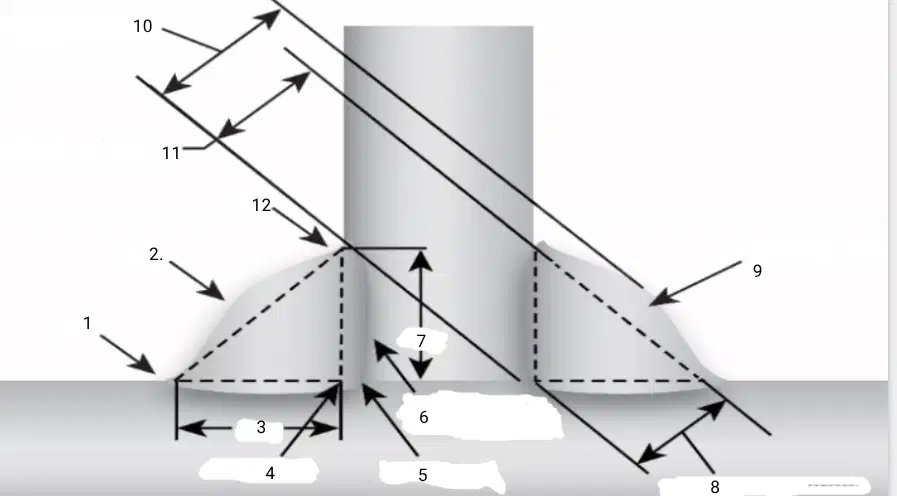
Identify the part of the weld that is the number 1 in the diagram.
a)
Toe
b)
Effective Throat
c)
Actual Throat
d)
Theoretical Throat
e)
Leg
2.
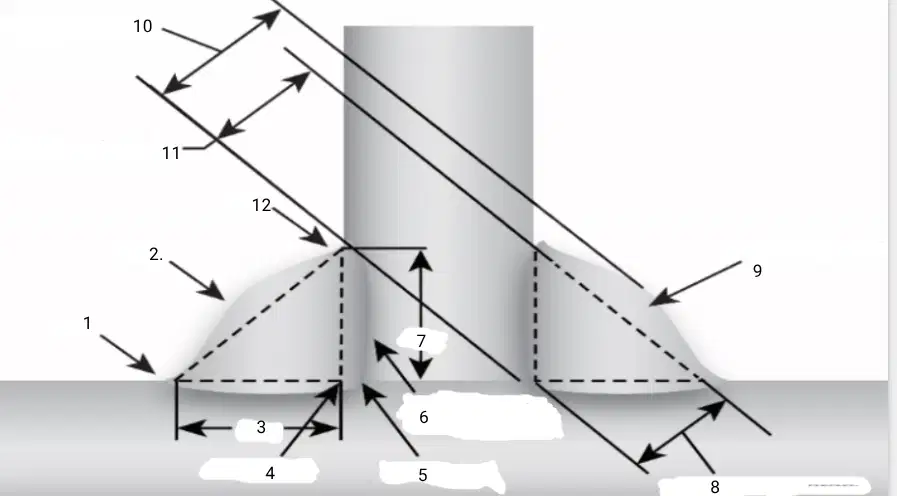
Identify the part of the weld that is the number 2 in the diagram.
a)
Face
b)
Effective Throat
c)
Actual Throat
d)
Theoretical Throat
e)
Leg
3.
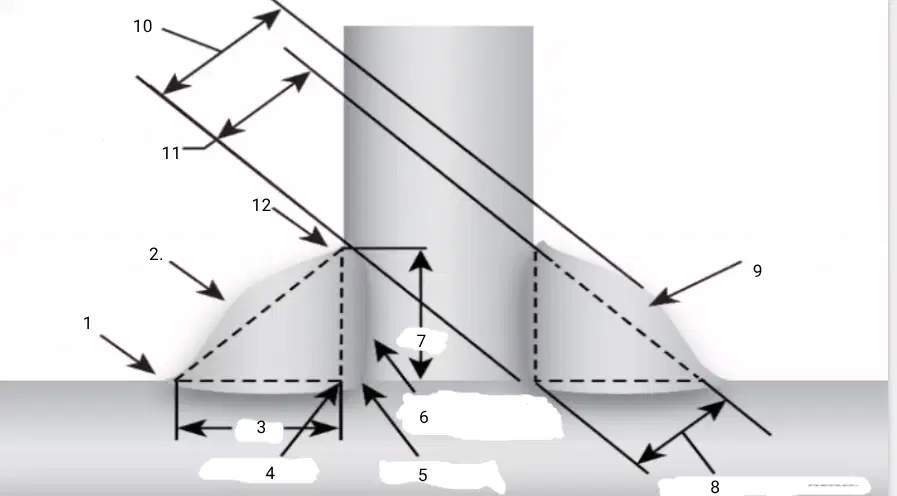
Identify the part of the weld that is the number 3 in the diagram.
a)
Leg
b)
Effective Throat
c)
Actual Throat
d)
Theoretical Throat
e)
Toe
4.
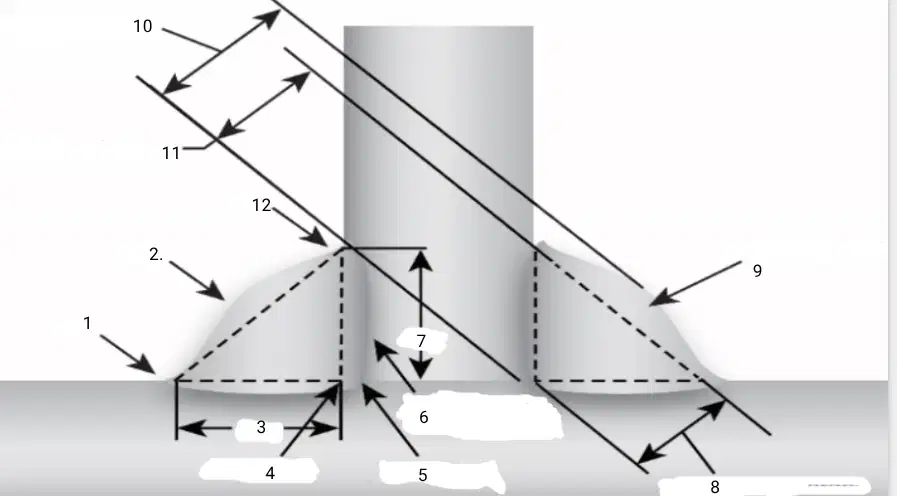
Identify the part of the weld that is the number 4 in the diagram.
a)
Joint Root
b)
Effective Throat
c)
Actual Throat
d)
Theoretical Throat
e)
Leg
5.
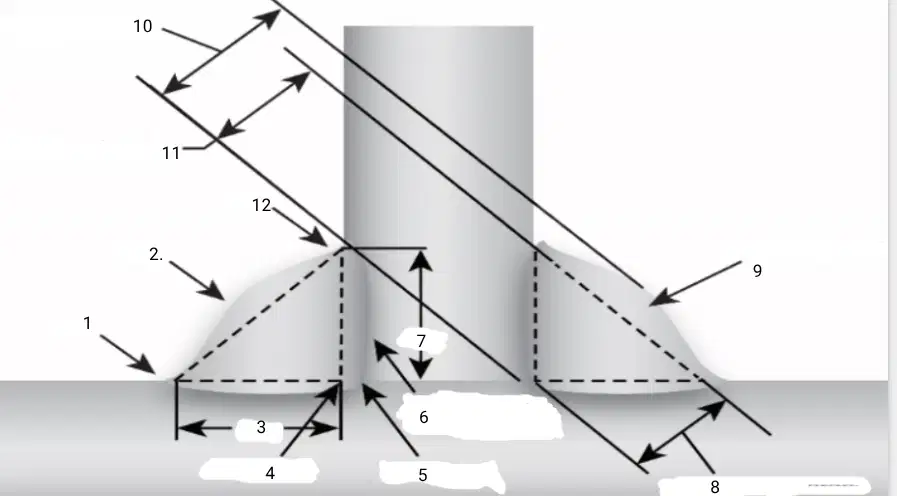
Identify the part of the weld that is the number 5 in the diagram.
a)
Weld Root
b)
Effective Throat
c)
Actual Throat
d)
Theoretical Throat
e)
Leg
6.
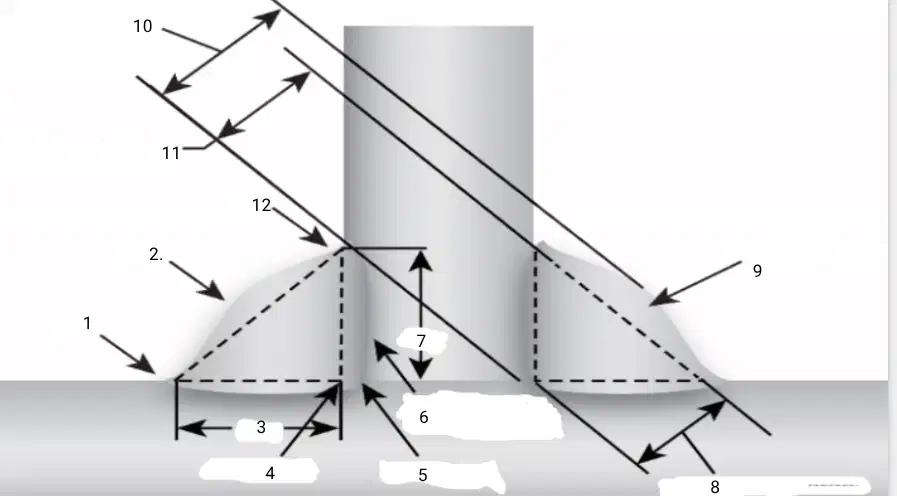
Identify the part of the weld that is the number 6 in the diagram.
a)
Heat Affect Zone
b)
Effective Throat
c)
Actual Throat
d)
Theoretical Throat
e)
Leg
7.
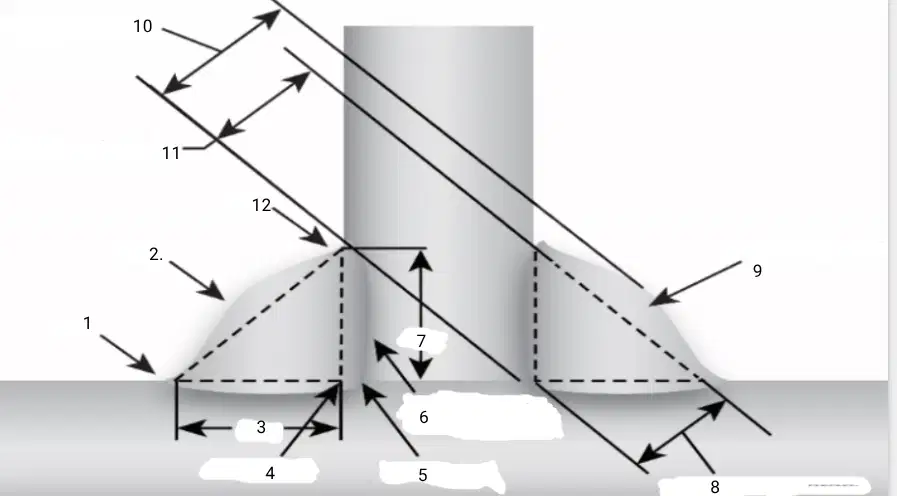
Identify the part of the weld that is the number 7 in the diagram.
a)
Leg
b)
Effective Throat
c)
Actual Throat
d)
Theoretical Throat
e)
Toe
8.
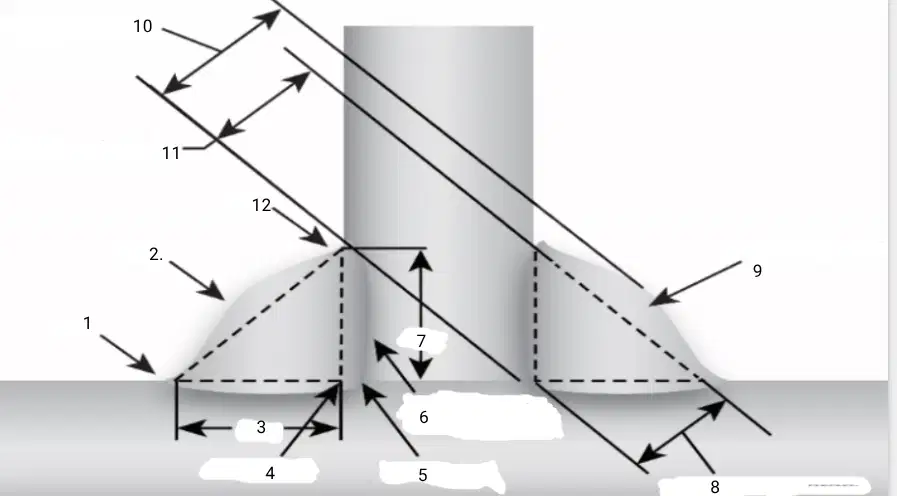
Identify the part of the weld that is the number 8 in the diagram.
a)
Theoretical Throat
b)
Effective Throat
c)
Actual Throat
d)
Leg
e)
Toe
9.
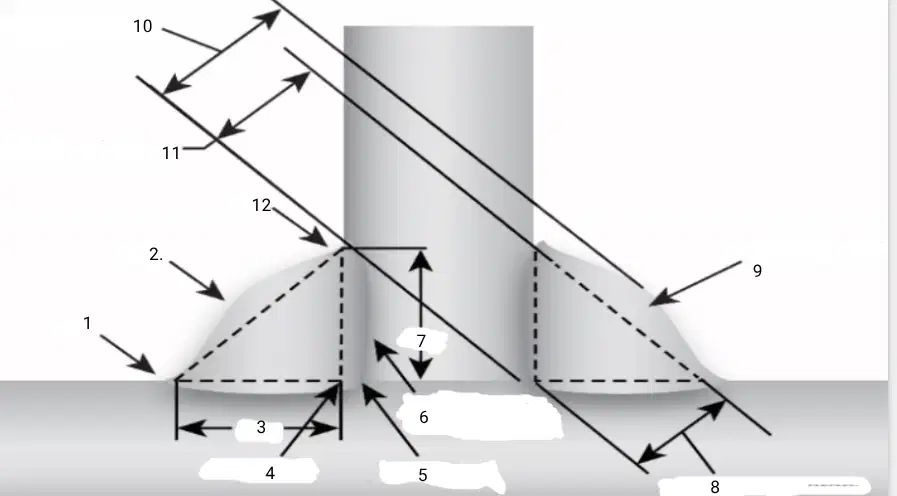
Identify the part of the weld that is the number 9 in the diagram.
a)
Reinforcement
b)
Effective Throat
c)
Actual Throat
d)
Theoretical Throat
e)
Leg
10.
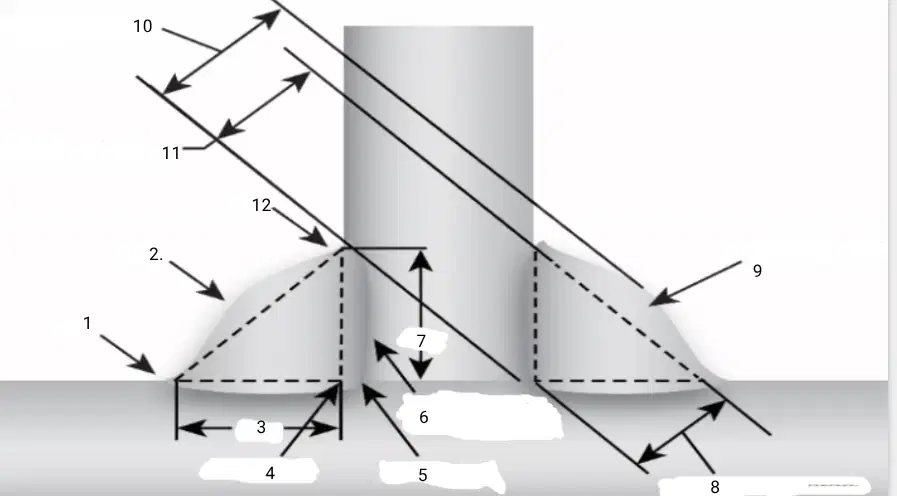
Identify the part of the weld that is the number 10 in the diagram.
a)
Actual Throat
b)
Effective Throat
c)
Theoretical Throat
d)
Leg
e)
Toe
11.
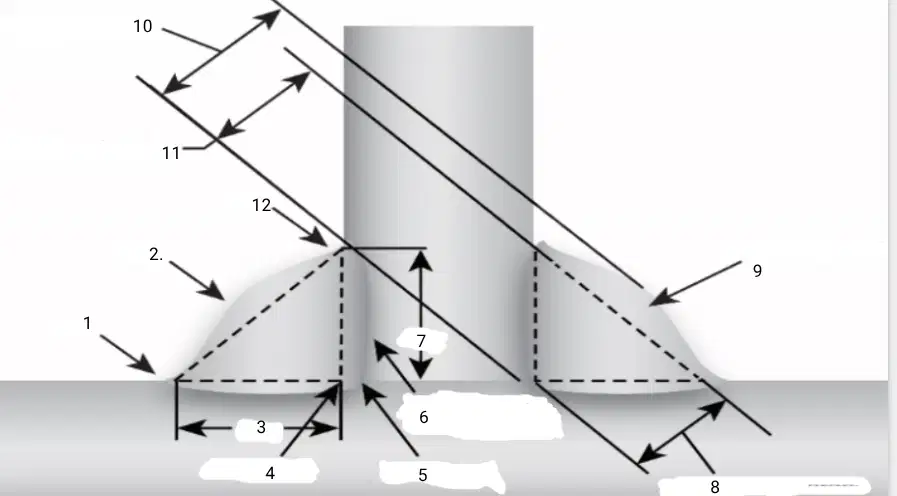
Identify the part of the weld that is the number 11 in the diagram.
a)
Effective Throat
b)
Actual Throat
c)
Theoretical Throat
d)
Leg
e)
Toe
12.
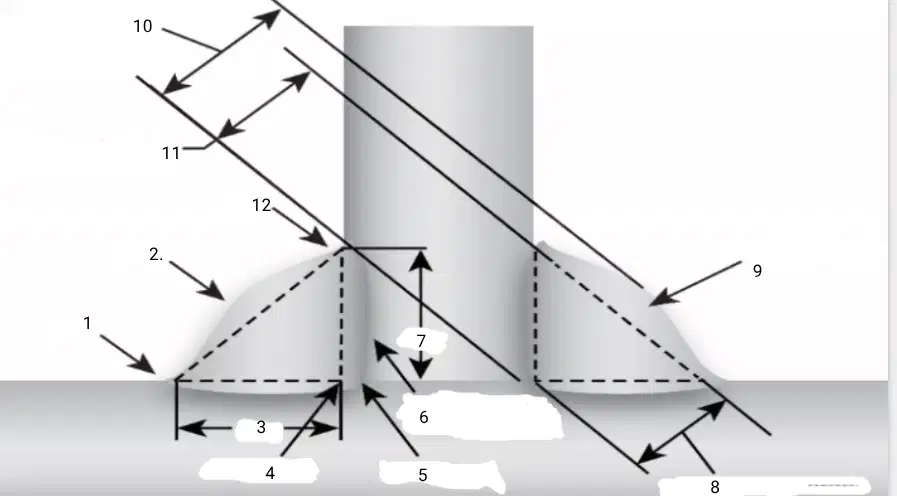
Identify the part of the weld that is the number 12 in the diagram.
a)
Toe
b)
Effective Throat
c)
Actual Throat
d)
Theoretical Throat
e)
Leg
13.
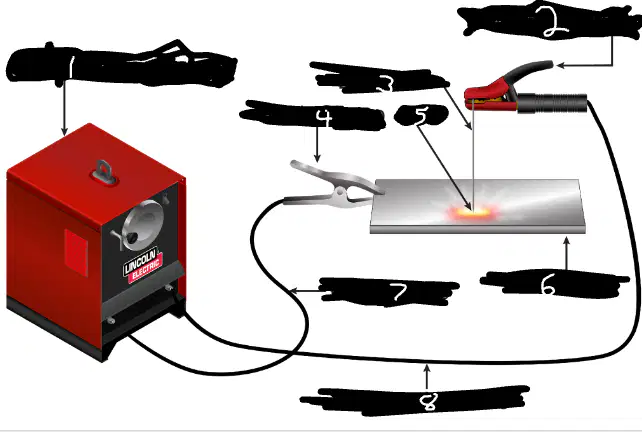
In the SMAW welding circuit the part that is number 1.
a)
Power Source
b)
Base Metal
c)
Work Cable
d)
Electrode Holder
e)
Electrode
14.
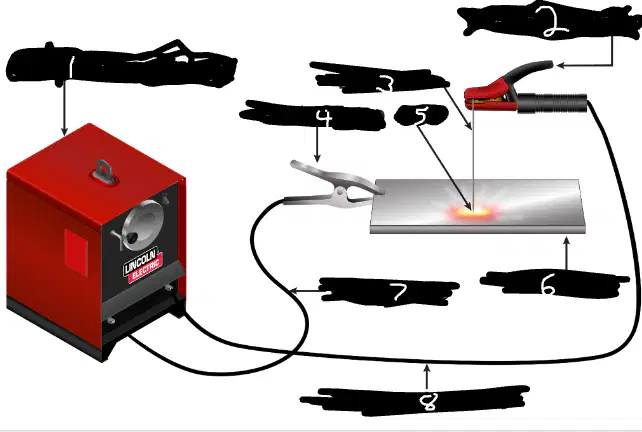
In the SMAW welding circuit the part that is number 2.
a)
Electrode Holder
b)
Base Metal
c)
Work Cable
d)
Power Source
e)
Electrode
15.
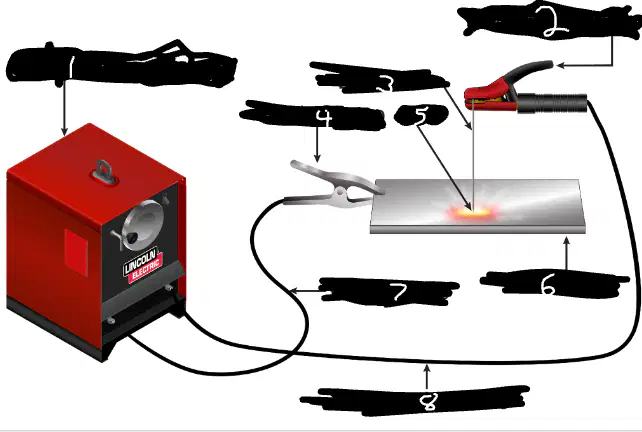
In the SMAW welding circuit the part that is number 3.
a)
Electrode
b)
Base Metal
c)
Work Cable
d)
Electrode Holder
e)
Power Source
16.
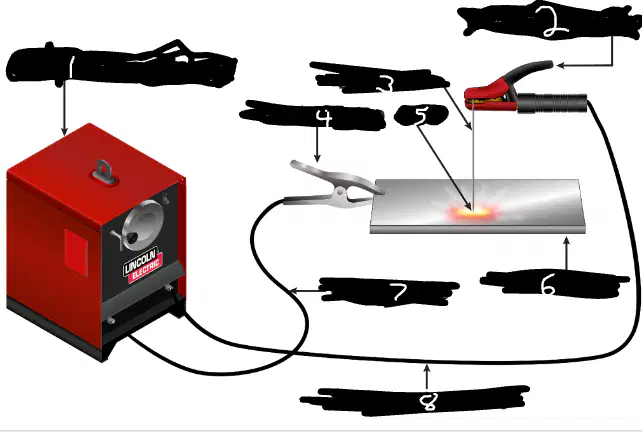
In the SMAW welding circuit the part that is number 4.
a)
Work Clamp
b)
Base Metal
c)
Work Cable
d)
Electrode Holder
e)
Power Source
17.
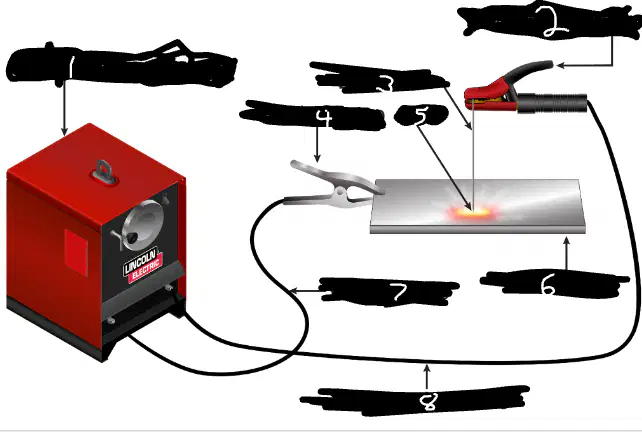
In the SMAW welding circuit the part that is number 5.
a)
Weld Pool
b)
Base Metal
c)
Work Cable
d)
Electrode Holder
e)
Power Source
18.
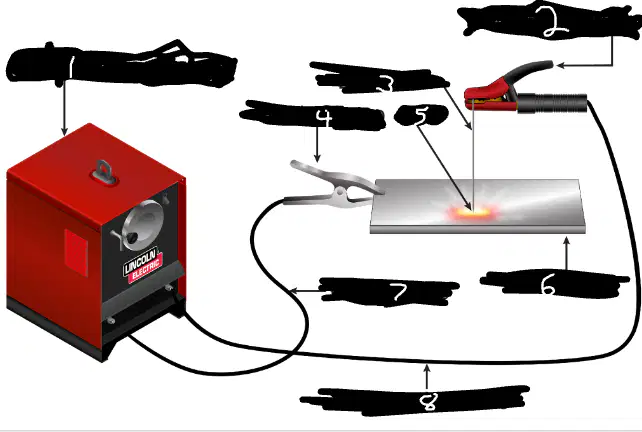
In the SMAW welding circuit the part that is number 6.
a)
Base Metal
b)
Work Cable
c)
Electrode Holder
d)
Power Source
e)
Electrode
19.
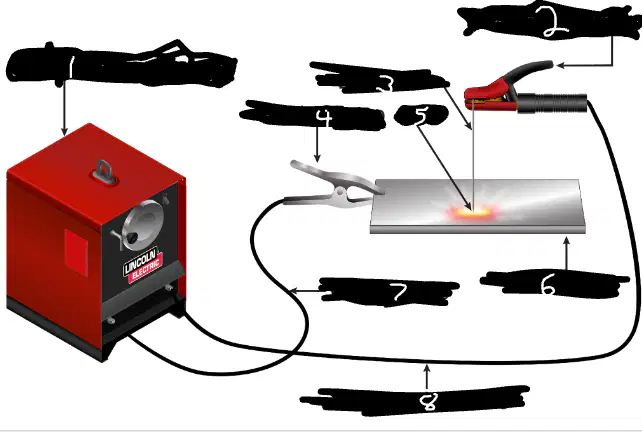
In the SMAW welding circuit the part that is number 7.
a)
Work Cable
b)
Base Metal
c)
Electrode Holder
d)
Power Source
e)
Electrode
20.
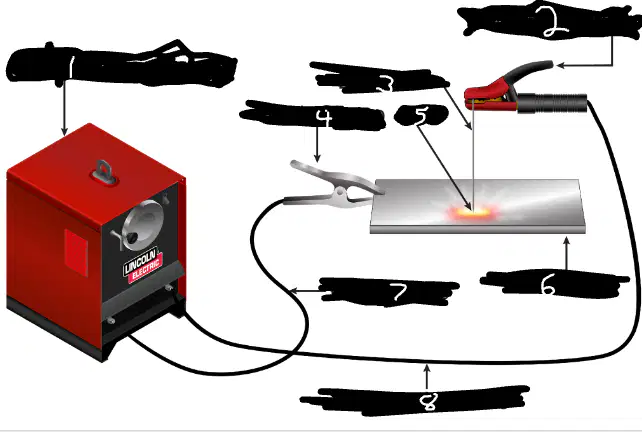
In the SMAW welding circuit the part that is number 8.
a)
Electrode Cable
b)
Base Metal
c)
Work Cable
d)
Electrode Holder
e)
Power Source
21.

In the GMAW welding circuit the part that is number 1.
a)
Nozzle
b)
Weld Metal
c)
Gas Diffusor
d)
Contact Tip
e)
Shielding Gas
22.
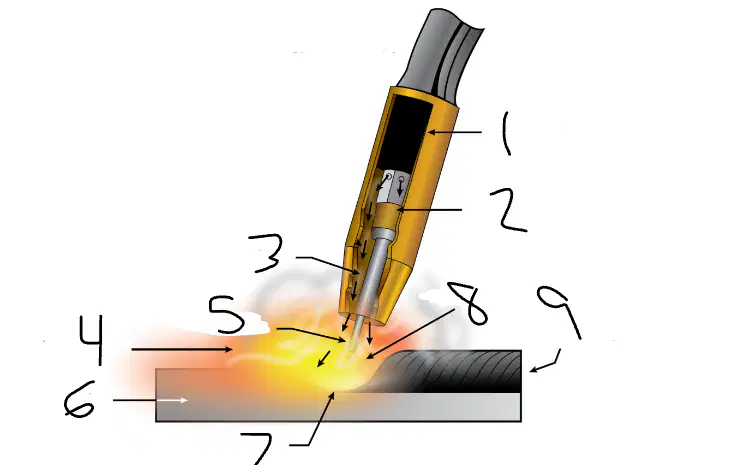
In the GMAW welding circuit the part that is number 2.
a)
Gas Diffusor
b)
Weld Metal
c)
Contact Tip
d)
Shielding Gas
e)
Welding Arc
23.
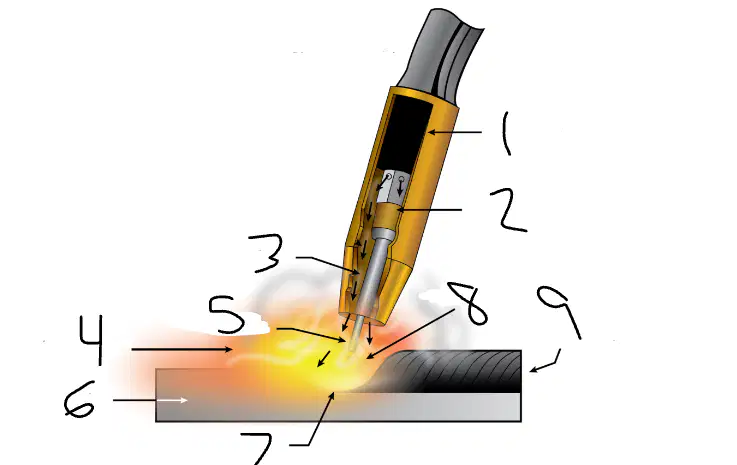
In the GMAW welding circuit the part that is number 3.
a)
Contact Tip
b)
Weld Metal
c)
Gas Diffusor
d)
Shielding Gas
e)
Welding Arc
24.
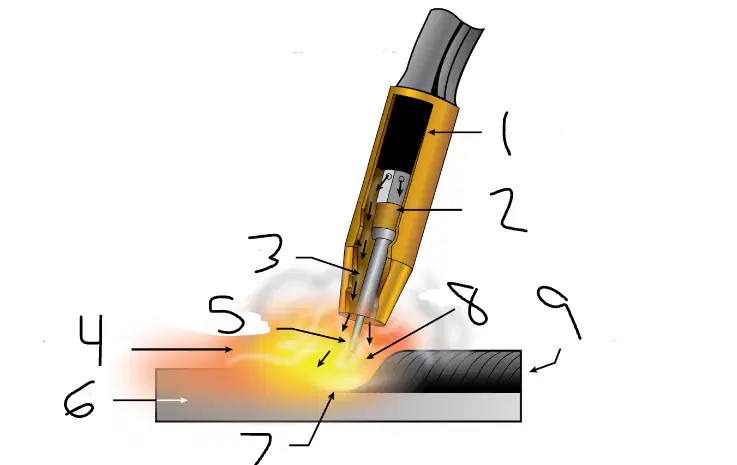
In the GMAW welding circuit the part that is number 4.
a)
Shielding Gas
b)
Weld Metal
c)
Gas Diffusor
d)
Contact Tip
e)
Welding Arc
25.
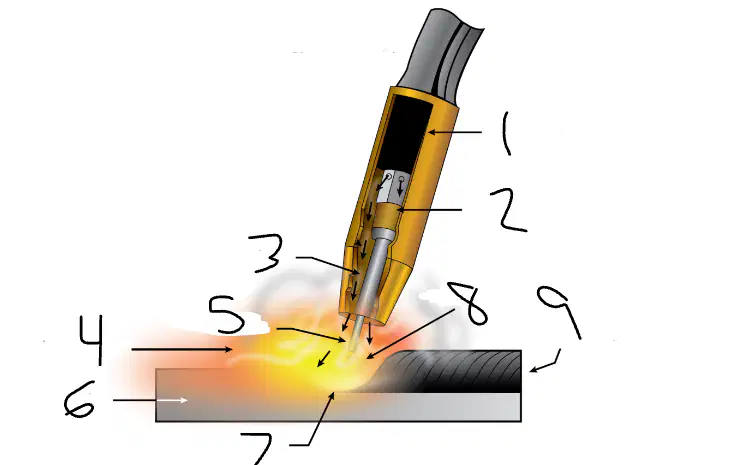
In the GMAW welding circuit the part that is number 5.
a)
Electrode
b)
Weld Metal
c)
Gas Diffusor
d)
Contact Tip
e)
Shielding Gas
26.
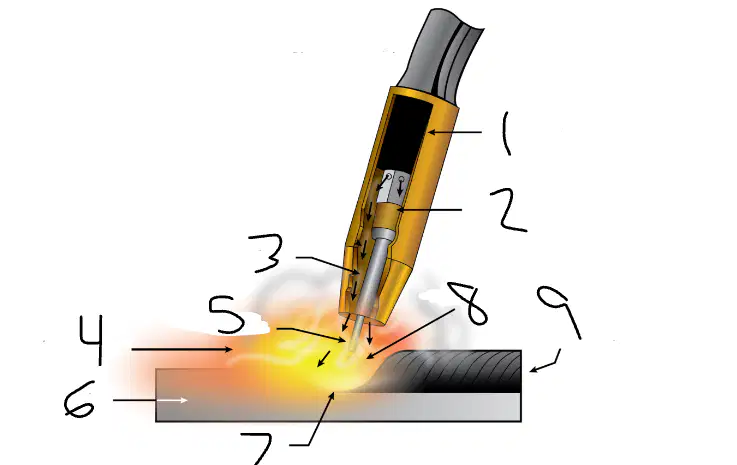
In the GMAW welding circuit the part that is number 6.
a)
Base Metal
b)
Weld Metal
c)
Gas Diffusor
d)
Contact Tip
e)
Shielding Gas
27.
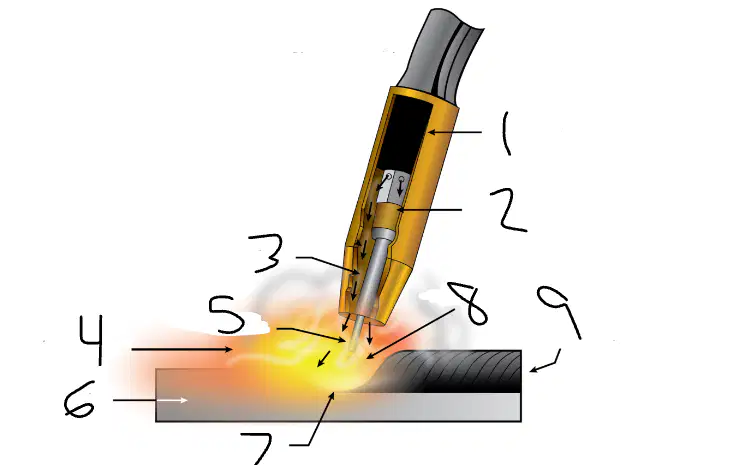
In the GMAW welding circuit the part that is number 7.
a)
Weld Pool
b)
Weld Metal
c)
Gas Diffusor
d)
Contact Tip
e)
Shielding Gas
28.
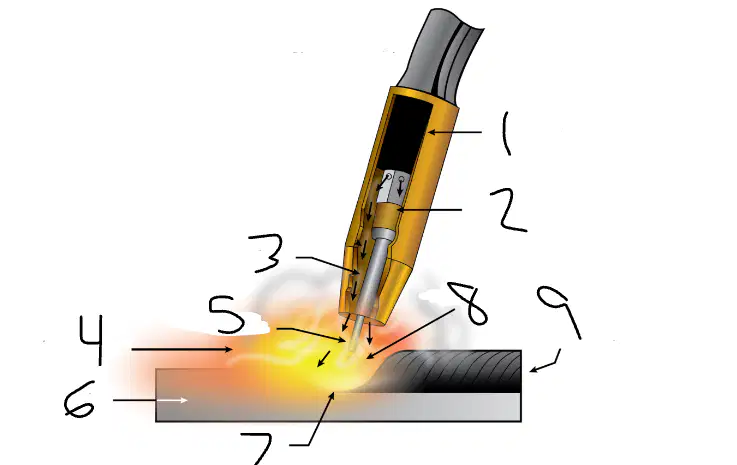
In the GMAW welding circuit the part that is number 8.
a)
Welding Arc
b)
Weld Metal
c)
Gas Diffusor
d)
Contact Tip
e)
Shielding Gas
29.
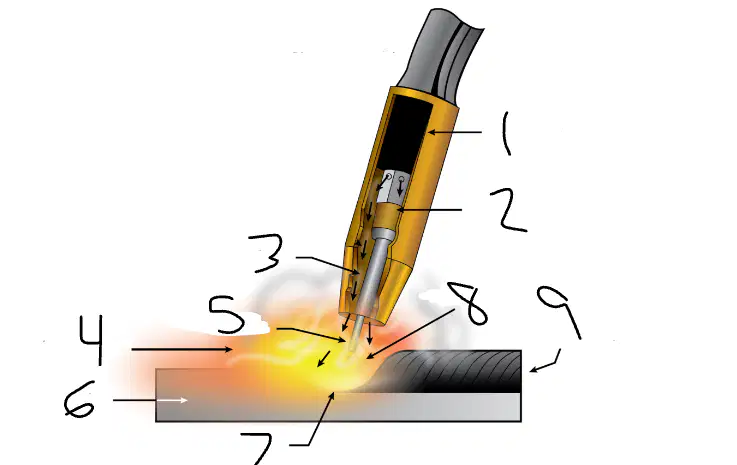
In the GMAW welding circuit the part that is number 9.
a)
Weld Metal
b)
Gas Diffusor
c)
Contact Tip
d)
Shielding Gas
e)
Welding Arc
30.
Welder completes the circuit by striking electrode on base material, then creating a gap in the welding circuit by holding the tip of the electrode 1/16" - 1/8" away from base metal.
a)
Travel Angle
b)
Arc Length
c)
Contact Tip to Work Distance
d)
Travel Speed
31.
The angle that the electrode is tilted either in or against direction of travel.
a)
Travel Angle
b)
Arc Length
c)
Contact Tip to Work Distance
d)
Travel Speed
32.
Used to provide adequate penetration into joint.
a)
Travel Angle
b)
Arc Length
c)
Work Angle
d)
Travel Speed
33.
This form of striking an arc is similar to striking a match on a match box.
a)
Scratching
b)
Tapping
34.
This form of striking an arc touches metal, electrode is withdrawn momentarily to form an excessively long arc and then returned to normal arc length.
a)
Scratching
b)
Tapping
35.
True or False: An advantage of SMAW welding over GMAW welding is that the user does not have to worry about electrode sticking to base material as much.
a)
True
b)
False
36.
When running a bead with excessive arc length, what welding defect may occur?
a)
Undercut
b)
Overlap
c)
Spatter
d)
Slag Inclusion
37.
When using the SMAW welding process, the welder has a constant _____________ source.
a)
Voltage
b)
Wattage
c)
Amperage
d)
Current
38.
When using the GMAW welding process, the welder has a constant _____________ source.
a)
Voltage
b)
Wattage
c)
Amperage
d)
Current
39.
What pair of safety equipment is required at all times when in the metal shop?
a)
Pants
b)
Close-toed shoes
c)
Gloves
d)
Safety Glasses
40.
True or False You can weld in the metal shop with the fume collection on.
a)
True
b)
False
41.
True or False: Welding gloves provide a protective barrier from welded metal, so much so you can pick up welded pieces of metal and be safe from potential burns.
a)
True
b)
False
42.
A systematized catalogue or list of information regarding chemicals, chemical compounds, and chemical mixtures, including instruction for safe use and potential hazards.
a)
Duty Cycle
b)
Safety Data Sheet
c)
Invertor
d)
Transformer
43.
True or False: You should report any broken tool or machine to the instructor right away.
a)
True
b)
False
44.
A metal rod covered with flux provides a shield to the arc and weld puddle.
a)
Gas Tungsten Arc Welding
b)
Flux-Core Arc Welding
c)
Shielded Metal Arc Welding
d)
Gas Metal Arc Welding
45.
Which polarity of the welder provides deep penetration?
a)
DCEP
b)
DCEN
c)
AC
46.
Welding term that is determined by electrode, amperage, and desired bead profile.
a)
Travel Speed
b)
Work Angle
c)
Travel Angle
d)
Arc Length
47.
True or False: One advantage SMAW Welding when compared to GMAW Welding is it is portable.
a)
True
b)
False
48.
When you see the classification for an electrode (E70XX-H4R) what does the E stand for?
a)
Tensile stregth
b)
Welding position
c)
Electrode
d)
Meets requirements of absorbed moisture test
49.
When you see the classification for an electrode (E70XX-H4R) what does the 70 stand for?
a)
Tensile stregth
b)
Welding position
c)
Electrode
d)
Meets requirements of absorbed moisture test
50.
When you see the classification for an electrode (E70XX-H4R) what does the the 1st X stand for?
a)
Tensile stregth
b)
Welding position
c)
Electrode
d)
Meets requirements of absorbed moisture test
51.
True or False: A characteristic of a Fast Freeze rod is that they provide deep penetration.
a)
True
b)
False
52.
What type of electrode is 6010 categorized under?
a)
Fast Fill
b)
Fast Freeze
c)
Low Hydrogen
d)
Fill Freeze
53.
What type of electrode is 6013 categorized under?
a)
Fast Fill
b)
Fast Freeze
c)
Low Hydrogen
d)
Fill Freeze
54.
What type of electrode is 7018 categorized under?
a)
Fast Fill
b)
Fast Freeze
c)
Low Hydrogen
d)
Fill Freeze
55.
True or False: A fast fill welding rod is the perfect rod to use when overhead welding.
a)
True
b)
False
56.
Manganese and Silicon are added into the flux for what purpose?
a)
Form protective slag
b)
Increase strength
c)
Increase ductility
d)
Remove oxygen and nitrogen
57.
True or False: 7018 electrodes can stored as the same as 6010 or 6013 electrodes.
a)
True
b)
False
58.
Uses a continuous fed consumable metal wire electrode fed through a semi-automatic gun.
a)
Gas Tungsten Arc Welding
b)
Flux-Core Arc Welding
c)
Shielded Metal Arc Welding
d)
Gas Metal Arc Welding
59.
Uses a continuous fed consumable tubular metal wire electrode that contains a flux core.
a)
Gas Tungsten Arc Welding
b)
Flux-Core Arc Welding
c)
Shielded Metal Arc Welding
d)
Gas Metal Arc Welding
60.
Defined in applied terms as the flow of electrons.
a)
Electricity
b)
Voltage
c)
Amperage
d)
Wattage
61.
Electromotive force, in applied terms it can be described as electrical pressure.
a)
Electricity
b)
Voltage
c)
Amperage
d)
Wattage
62.
Is the amount of electricity, the actual number of electrons flowing.
a)
Electricity
b)
Voltage
c)
Amperage
d)
Wattage
63.
Is a measure of electrical power.
a)
Electricity
b)
Voltage
c)
Amperage
d)
Wattage
64.
True or False: When stick welding the direction of travel should be pulling the puddle (Drag).
a)
True
b)
False
65.
The top of the weld is called what?
a)
Toe
b)
Root
c)
Leg
d)
Face
66.
The edges of the weld are called what?
a)
Toe
b)
Root
c)
Leg
d)
Face
67.
The depth of penetration is called?
a)
Toe
b)
Root
c)
Leg
d)
Face
68.
A joint between two pieces of material that are aligned edge to edge in the same plane.
a)
Butt Joint
b)
Outside Corner Joints
c)
Edge Joints
d)
T Joints
e)
Lap Joints
69.
A joint where two pieces of material are joined to form a right angle.
a)
Butt Joint
b)
Outside Corner Joints
c)
Edge Joints
d)
T Joints
e)
Lap Joints
70.
A joint where two pieces of material are beside each other, the edges are aligned beside each other.
a)
Butt Joint
b)
Outside Corner Joints
c)
Edge Joints
d)
T Joints
e)
Lap Joints
71.
A joint between two overlapping materials, plates are aligned face to face, the edges create fillet welds.
a)
Butt Joint
b)
Outside Corner Joints
c)
Edge Joints
d)
T Joints
e)
Lap Joints
72.
A joint between two pieces of material put together at right (90 degree) angles, edge is placed on a plate face creating fillet welds.
a)
Butt Joint
b)
Outside Corner Joints
c)
Edge Joints
d)
T Joints
e)
Lap Joints
73.
The electrode position is pointing down, the weld joint is placed flat, the electrode is positioned above the joint.
a)
Flat Position
b)
Horizontal Position
c)
Vertical Position
d)
Overhead Position
74.
•The electrode position is horizontal, pointed upward slightly, the weld joint is positioned sideways, horizontally.
a)
Flat Position
b)
Horizontal Position
c)
Vertical Position
d)
Overhead Position
75.
The electrode position is horizontal, pointing upward slightly, the weld joint is positioned vertically
a)
Flat Position
b)
Horizontal Position
c)
Vertical Position
d)
Overhead Position
76.
•The electrode is positioned up, the weld joint is flat underneath, facing downward, overhead of the welder
a)
Flat Position
b)
Horizontal Position
c)
Vertical Position
d)
Overhead Position
77.
Which welding position is indicated by the number 1?
a)
Flat Position
b)
Horizontal Position
c)
Vertical Position
d)
Overhead Position
78.
Which welding position is indicated by the number 2?
a)
Flat Position
b)
Horizontal Position
c)
Vertical Position
d)
Overhead Position
79.
Which welding position is indicated by the number 3?
a)
Flat Position
b)
Horizontal Position
c)
Vertical Position
d)
Overhead Position
80.
Which welding position is indicated by the number 4?
a)
Flat Position
b)
Horizontal Position
c)
Vertical Position
d)
Overhead Position
81.
When a groove weld melts into the base metal next to the weld toe or weld root is not filled by the weld metal. A depression, cut, in the base metal. Often found on fillet and horizontal welds.
a)
Undercut
b)
Porosity
c)
Excessive Spatter
d)
Slag Inclusion
e)
Overlap
82.
Similar to an undercut, more of a factor of lack of sufficient filler metal, rather than a molten undercut. Often appears along with lack of sufficient weld penetration
a)
Underfill
b)
Porosity
c)
Excessive Spatter
d)
Slag Inclusion
e)
Overlap
83.
When the weld face extends over the weld toe, excessive weld reinforcement filler.
a)
Overlap
b)
Porosity
c)
Excessive Spatter
d)
Slag Inclusion
e)
Underfill
84.
Pockets of slag in the welds, holes are created around slag particles, can be caused by low heat input, improper technique or motion.
a)
Slag Inclusion
b)
Porosity
c)
Excessive Spatter
d)
Overlap
e)
Underfill
85.
Spots of weld material on the base metal, often caused by too high heat input, amperage, poor technique with too long or inconsistent arc length.
a)
Excessive Spatter
b)
Porosity
c)
Slag Inclusion
d)
Overlap
e)
Underfill
86.
Holes in the weld, can be caused by lack of molten metal shielding, poor technique, mismatched filler metals.
a)
Porosity
b)
Excessive Spatter
c)
Slag Inclusion
d)
Overlap
e)
Underfill
87.
True or False: You should NEVER transport shielding gasses without the caps.
a)
True
b)
False
88.
Select all advantages of GMAW Welding.
a)
Produces high quality welds on a variety of materials
b)
Various thicknesses of materials
c)
Quality of Welds
d)
Low Spatter
e)
All position welding depending on one mode
89.
Check all the limitations of GMAW Welding
a)
Less portable
b)
Can routinely weld outdoors
c)
Cleaning base materials
d)
Cold lap
e)
high skill level
100 %

