
 Worksheets
Classifying Triangles by Side Lengths
Total questions: 10
Worksheet time: 5mins
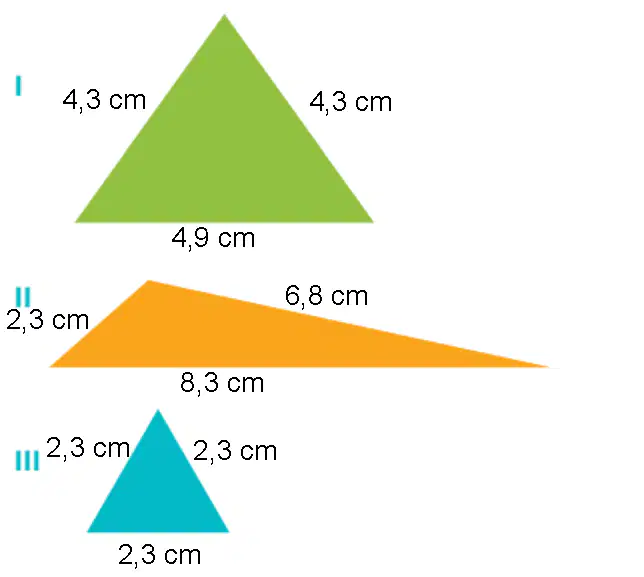
Which triangle is classified as equilateral?
Triangle I
Triangle II
Triangle III
None of the above
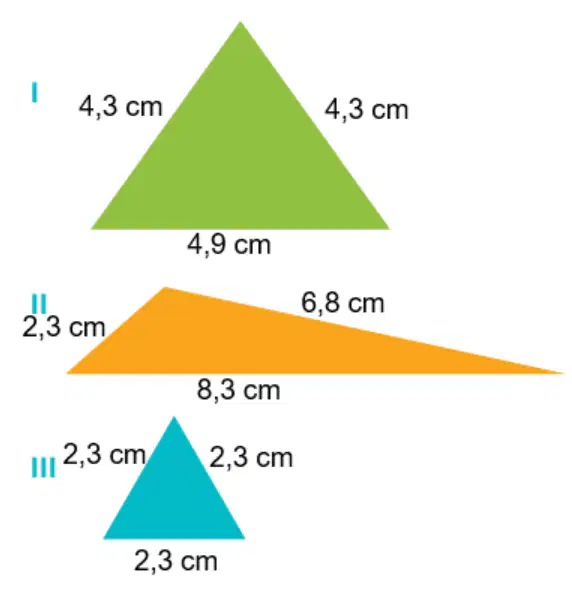
Which triangle is classified as scalene?
Triangle I
Triangle II
Triangle III
None of the above
How can a traffic sign triangle also be classified as an isosceles triangle?
Because it has two sides with the same length.
Because it has all sides with different lengths.
Because it has four equal sides.
Because it has no equal sides.

According to the image, what type of triangle is AED?
Triangle AED is an isosceles triangle, but not equilateral.
Triangle AED is a scalene triangle.
Triangle AED is an equilateral triangle.
Triangle AED is a right triangle.
Triangle AED is which type of triangle?
Isosceles, but not equilateral
Equilateral
Scalene
Right
Is it true or false that triangle ABC is equilateral but not isosceles?
False
True
Cannot be determined
Only if all sides are equal
Is triangle AED an equilateral triangle?
No, it is not equilateral
Yes, it is equilateral
Only if all angles are equal
Only if all sides are different
Why is it important to classify triangles based on their sides and angles?
It helps in understanding their properties and solving geometric problems.
It makes them easier to color.
It allows you to use a ruler more efficiently.
It helps in drawing circles.
Which of the following is a type of angle that can be found in triangles?
Acute
Parallel
Curved
Circular
Why is it important to observe different types of triangles in geometric figures?
To understand that a single geometric figure can have many variations and be used to create complex and expressive images
To memorize the names of triangles only
To ignore the differences between shapes
To focus only on squares and rectangles

