wayground logo

Free Printable Worksheets

Font size

S
M
L
XL
Worksheets

Final Exam Review

Total questions: 122

Worksheet time: 3hrs 19mins

Name
Class
Date
1.
Removing heat energy to get a gas to turn into a liquid:
a)
freezing point
b)
melting point
c)
vaporization point
d)
condensation point
2.
The amount of heat needed to heat up substances is called the substances:
a)
pressure
b)
conduction
c)
humidity
d)
specific heat
3.
Substances that have a high specific heat means that:
a)
Option 1 & 3
b)
they heat up slower
c)
they heat up faster
d)
they can hold more heat
e)
they can hold less heat
4.
Waxing means to:
a)
Gain light on the moon
b)
Lose light on the moon
c)
The moon is changing phases
d)
The moon is rotating
5.
Waning means to:
a)
Gain light on the moon
b)
Lose light on the moon
c)
The moon is changing phases
d)
The moon is rotating
6.
This moon phase is:
a)
Waxing crescent
b)
Waxing gibbous
c)
Waning crescent
d)
Waning gibbous
7.
This moon phase is:
a)
Waxing crescent
b)
Waxing gibbous
c)
Waning crescent
d)
Waning gibbous
8.
The time it takes for the moon to complete all of its moon phases is:
a)
1 day
b)
1 month
c)
1 year
d)
1 decade
9.
When the moon passes in front of the sun and blocks it, this is known as:
a)
solar flare
b)
lunar flare
c)
solar eclipse
d)
lunar eclipse
10.
When the moon passes into the shadow of the Earth, this is known as:
a)
solar flare
b)
lunar flare
c)
solar eclipse
d)
lunar eclipse
11.
When the Earth spins on it's axis, this is known as a _________________________. When the Earth moves around the sun, this is known as a ____________________.
a)
rotation; ellipse
b)
revolution; rotation
c)
revolution; ellipse
d)
rotation, revolution
12.
The time it takes for the Earth to complete one rotation is ___________________. This causes ____________________ on Earth.
a)
1 year; day & night
b)
1 month; seasons
c)
1 day; day & night
d)
1 year; seasons
13.
The time it takes for the Earth to complete one revolution is _________________. This causes ___________________ on Earth.
a)
1 year; day & night
b)
1 month; seasons
c)
1 day; day & night
d)
1 year; seasons
14.
The trapping of heat close to the Earth's surface is called ________________________. This is mostly caused by ___________________.
a)
global warming; nitrogen
b)
greenhouse effect; methane
c)
greenhouse effect; carbon dioxide
d)
global warming; methane
15.
The overall rise of the Earth's temperature is called:
a)
greenhouse effect
b)
global warming
c)
humidity
d)
conduction
16.
Which examples below is a result of global warming?
a)
glaciers melting
b)
flooding
c)
worsening storms
d)
All of the above
e)
None of the above
17.
The energy of motion is called:
a)
kinetic
b)
potential
c)
nuclear
d)
mechanical
18.
Stored energy based on the result of shape/position is called:
a)
kinetic
b)
nuclear
c)
potential
d)
thermal
19.
The ability to do work is called:
a)
energy
b)
mass
c)
reactions
d)
solubility
20.
What is the big bang theory of universe creation?
a)
there was a big explosion
b)
gravity pulled materials together that created high temperatures and pressures
c)
it just appeared one day
d)
the sun pulled all rock toward it
21.
An evenly distributed solute in a solvent is known as:
a)
suspension
b)
colloid
c)
solution
d)
solubility
22.
What is the difference between the terrestrial and the gaseous planets?
a)
terrestrial are smaller and made of rock
b)
terrestrial are larger and made of gas
c)
gaseous are smaller and made of rock
d)
gaseous are larger and made of rock
23.
Why is the sun the center of the Milky Way?
a)
it is the smallest celestial body
b)
it has the most gravitational pull
c)
It is the largest body
d)
it has the least amount of gravitational pull
24.
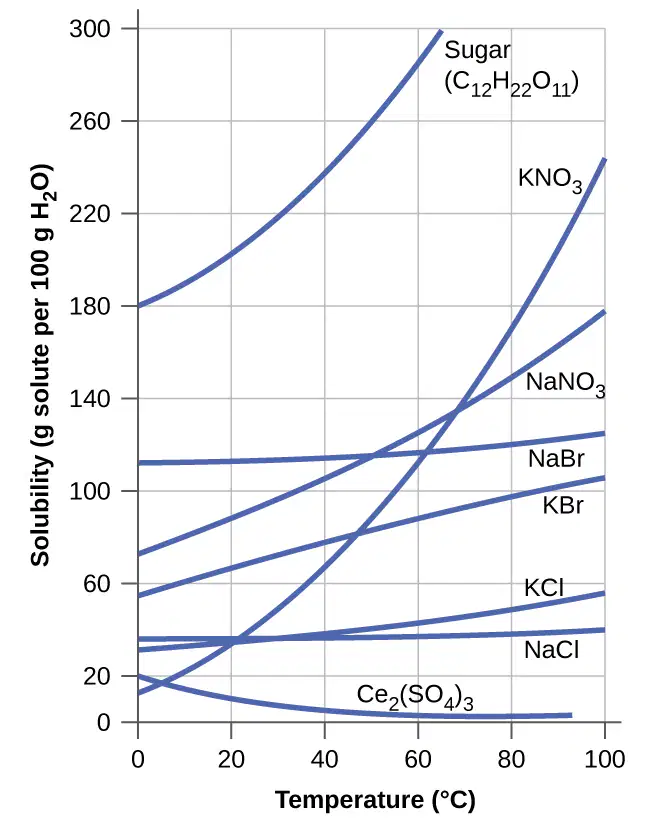
Which substance below can have more grams of solute dissolve at 60 degrees Celsius?
a)
NaCl
b)
KCl
c)
KBr
d)
NaBr
25.
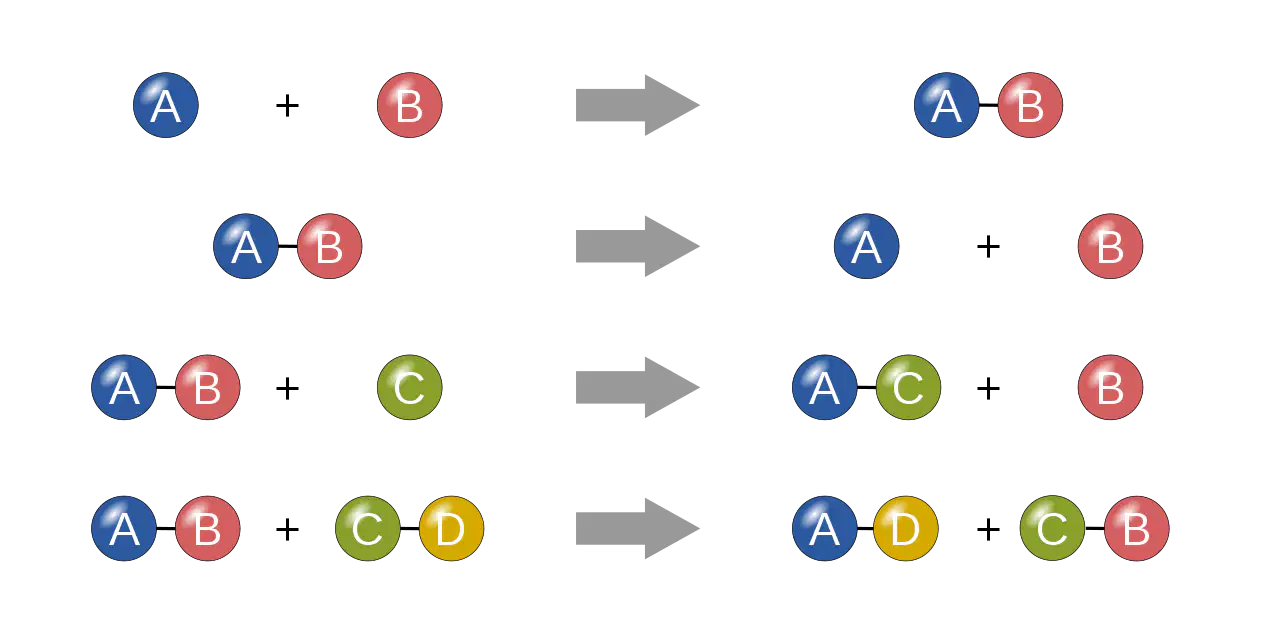
The diagram below is showing 4 different types of:
a)
physical changes
b)
chemical reactions
c)
physical reactions
d)
chemical synopsis
26.
The items on the left hand side of the reaction are known as this; while the items on the right hand side of the reactions are known as this:
a)
physical; chemical
b)
reactants; products
c)
products; reactants
d)
chemical; physical
27.
When heat is taken into a reaction, like when ice melts, this is known as what type of reaction?
a)
endothermic
b)
exothermic
c)
single displacment
d)
double displacement
28.
When heat is released from a reaction, like when you strike a match, this is known as what type of reaction?
a)
endothermic
b)
exothermic
c)
single displacment
d)
double displacement
29.
Which choice below correctly pairs the charge of the particle with the name of the particle found in atoms?
a)
proton: negative charge; neutron: no charge; electron: positive charge
b)
proton: positive charge; neutron: negative charge; electron: no charge
c)
proton: no charge; neutron: positive charge; electron: negative charge
d)
proton: positive charge; neutron: no charge; electron: negative charge
30.
Atoms can be found in many forms. When an atom of an element contains more neutrons than the regular form of the atom, this is known as an:
a)
ion
b)
isotope
c)
coefficient
d)
subscript
31.
Atoms can be found in many forms. When an atom of an element contains a different number of electrons than the regular atom, this is known as an:
a)
ion
b)
isotope
c)
coefficient
d)
subscript
32.
The arrangement of elements by atomic number is called the:
a)
atomic table
b)
chemical table
c)
periodic table
d)
elemental table
33.
The type of bond that holds a metal to a non-metal and involves the loss/gain of electrons between elements:
a)
metallic
b)
covalent
c)
ionic
d)
subatomic
34.
The type of bond that holds two non-metals together and involves the sharing of electrons between elements:
a)
metallic
b)
covalent
c)
ionic
d)
subatomic
35.
The force of attraction that pulls two bodies together is known as:
a)
inertia
b)
mass
c)
chemical energy
d)
gravity
36.
Resistance to a change in motion is called:
a)
inertia
b)
mass
c)
chemical energy
d)
gravity
37.
Elements in groups 1 & 2 on the periodic table are reactive because:
a)
They have a full outer shell of electrons.
b)
They have a half full outer shells of electrons.
c)
They have only 1 or 2 electrons on the outer shell.
d)
They are not reactive.
38.
The elements that don't react at all are called:
a)
Transition metals
b)
Carbon group
c)
Alkali earth metals
d)
Noble gases
39.
The attraction between atoms that form chemical compounds are called:
a)
chemical reactions
b)
solubility
c)
chemical bonding
d)
chemical gravity
40.
The difference between a polar and nonpolar covalent bond is:
a)
Polar is unequal sharing of electrons.
b)
Polar has no overall charge.
c)
Nonpolar has an overall charge.
d)
Nonpolar makes a salt.
41.

What is a hypothesis?

a)

A hypothesis is the right answer to an experiment.

b)

A hypothesis is the wrong answer to an experiment.

c)

A hypothesis is an scientific or educated guess, at answering your question/problem.

d)

A hypothesis explains what happened in the experiment.

42.
What step does every scientific experiment begin with?
a)
hypothesis
b)
question/problem
c)
procedures
d)
conclusion
43.
A list of everything you will need to conduct an experiment..
a)
procedures
b)
materials
c)
observations
d)
question/problem
44.

The factor being measured or observed.

a)

dependent variable

b)

independent variable

c)

controlled variabe

d)

not this one.

45.

The first step of the scientific procedure is to ask a question or state a ________________.

a)

hypothesis

b)

observation

c)

conclusion

d)

problem

46.

An investigation in which a scientist changes one variable in order to find the effect on the dependent variables, while keeping all others variables constant.

a)

controlled experiment

b)

independent experiment

c)

controlled variables

d)

independent variables

47.

This states what you have learned, from the experiment and should answer your question/ problem.

a)

experiment

b)

conclusion

c)

data

d)

observations

48.

_________________ variable is the one that is changed by the scientist.

a)

controlled

b)

dependent

c)

independent

d)

materials

49.

The independent variable goes on the:

a)

x-axis

b)

y-axis

50.

The dependent variable goes on the:

a)

x-axis

b)

y-axis

51.
What is the name of this line at 0 degrees latitude?
a)

Equator

b)

Prime Meridian

c)

International Date Line

d)

North Pole

52.

Latitude measures.......

a)

East and West, up to 95 degrees

b)

East and North, up to 180 degrees

c)

North and South, up to 90 degrees

d)

South and West, up to 45 degrees

53.

Longitude measures.....

a)

East and West, up to 180 degrees

b)

North and South, up to 150 degrees

c)

East and South, up to 30 degrees

d)

North and West, up to 200 degrees

54.
Climate is ______.
a)
what the air is like outside
b)
the temperature of a day
c)
pattern of weather in a place over many years.
55.
The condition of the atmosphere, such as temperature, cloud cover, wind speed and rainfall
a)
climate
b)
weather
c)
trend
d)
season
56.
The location where warm air mass is replacing a cooler air mass
a)
cold front
b)
warm front
c)
icy front
d)
storm front
57.
The location where cold air mass is replacing a warm air mass
a)
storm front
b)
hot front
c)
warm front
d)
cold front
58.
_______ affects weather because the further north or south you go from the Equator, the less solar energy (heat).
a)
altitude
b)
latitude
c)
sunlight
d)
atmosphere
59.
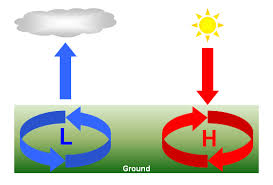
Which system results in drier, fairer weather?
a)
high pressure
b)
low pressure
c)
hurricane
d)
weather system
60.

The main human activity that releases greenhouse gases is

a)

using public transportation and there by reduce the affects of greenhouse gases.

b)

burning fossil fuels

c)

texting on cellphones

d)

eating meat

61.
How does the concentration of carbon dioxide in the atmosphere affect climate?
a)
As carbon dioxide concentrations increase, temperatures increase
b)
As carbon dioxide concentration increase, temperatures decrease.
c)
Carbon dioxide concentrations have no affect on climate
d)
As carbon dioxide concentrations increase, temperatures become more random.
62.

The amount of water vapor in the air.

a)

warm front

b)

humidity

c)

precipitation

d)

air pressure

63.

Rain, snow, sleet, or hail that falls from the clouds in the sky.

a)

humidity

b)

liquid

c)

precipitation

d)

weather

64.

Differences in air pressure cause wind

a)

true

b)

false

65.

Weather travels across the U.S. in what direction?

a)

north to south

b)

west to east

c)

south to north

d)

east to west

66.

Warm air rising at the equator and cold air sinking at the poles is one reason for which event?

a)

hurricanes

b)

earth's rotation

c)

Coriolis Effect

d)

convection currents

67.

Phase change going from Liquid to Solid...

a)

Melting

b)

Freezing

c)

Condensation

d)

Sublimation

68.

Phase change going from a Solid to a Liquid...

a)

Freezing

b)

Condensation

c)

Melting

d)

Sublimation

69.
7. All phase changes (changing states) requires energy to be added or taken away.
a)
True
b)
False
70.
What happens to particles when they are heated?
a)
They speed up and spread out
b)
They slow down and compress
c)
They stop moving
d)
They move closer together and speed up
71.
How are solids different from liquids?
a)
particles in solids are moving freely around each other.
b)
particles in solids have no motion.
c)
particles in solids are vibrating in place.
d)
particles in solids have more motion than in liquids
72.
A gas
a)
has a definite shape but no definite volume
b)
has a definite volume but no definite shape
c)
has fast-moving particles
73.

A change of state is a(n) ___________ process

a)

reversible

b)

irreversible

c)

fun

d)

chemical

74.

As a change of state, from solid to liquid, takes place heat _____ and temperature _______.

a)

increases, stays the same

b)

stays the same, stays the same

c)

stays the same, changes

d)

increases, increases

75.

Rank the states of matter from slowest to fastest particle speed.

a)

gas, solid, liquid

b)

solid, liquid, gas

c)

gas, liquid solid

d)

solid, gas liquid

76.

Which description defines heat?

a)

total thermal energy of an object or substance

b)

change in the temperature of a substance in degrees Celsius

c)

energy transferred between objects at different temperatures

d)

average kinetic energy of the particles that make up a substance

77.
The faster molecules move, 
a)
the higher the temperature
b)
the less temperature
c)
the same temperature
d)
I don't know
78.

When you heat a pot on a stove, the handle gets warm. Which type of heat transfer is responsible?

a)

Conduction

b)

Radiation

c)

Convection

d)

All of the above

79.

Heat from the Sun reaches Earth through which type of heat transfer?

a)

Conduction

b)

Radiation

c)

Convection

d)

All of the above

80.

What is the transfer of heat by circulation of the heated parts of a liquid or gas?

a)

Conduction

b)

Convection

c)

Coriolis Effect

d)

Radiation

81.

The measure of the average kinetic energy of a substance is called:

a)

Heat

b)

Temperature

c)

Condensation

d)

Conduction

82.

Substances that have a definite volume but the shape is whatever the container it is in:

a)

Solid

b)

Liquid

c)

Gas

d)

Plasma

83.

This is the term for an area where no matter exists.

a)

Medium

b)

Loop hole

c)

Vacuum

d)

Black hole

84.

Electromagnetic waves travel around 300,000 kilometers per second. This is known as the speed of ______.

a)

Rays

b)

Light

c)

Sound

d)

Traveling

85.

As frequency increases on the electromagnetic spectrum, what happens to the wavelength?

a)

It stays the same

b)

It decreases

c)

It increases

d)

It doubles

86.

As wavelength shrinks on the electromagnetic spectrum, the frequency...

a)

Increases

b)

Decreases

c)

Stays the same

d)

Disappears

87.

Which of the following is not in the electromagnetic spectrum?

a)

Light waves

b)

Sound waves

c)

Radio Waves

d)

X-rays

88.

Which color has the longest wavelength?

a)

Yellow

b)

Red

c)

Green

d)

Purple

89.

In which list are forms of electromagnetic energy arranged in order from longest to shortest wavelength?

a)

Microwave -> Radio wave -> Infrared rays

b)

Visible light -> x-ray -> radio wave

c)

Microwave -> infrared -> visibile light

d)

Infrared -> radio wave -> ultraviolet

90.

Which electromagnetic radiation has the greatest frequency?

a)

Radio waves

b)

Visibile light

c)

Infrared

d)

X-rays

91.

What do all waves transfer?

a)

Matter

b)

Heat

c)

Electricity

d)

Energy

92.

Which of the following can waves transfer energy through?

a)

solid

b)

liquid

c)

gas

d)

empty space

e)

all of the above

93.

What are the two types of waves?

a)

longitudinal and transverse

b)

sound and light

94.

What is the number of complete waves passing a fixed point in a given amount of time?

a)

Amplitude

b)

Intensity

c)

Wavelength

d)

Frequency

95.

What is frequency measured in?

a)

Milliseconds

b)

Miles

c)

Hertz

d)

Kilograms

96.

What is the distance between the calm sea and the highest wave called?

a)

Wave

b)

Frequency

c)

Amplitude

d)

Magnitude

97.

What does #1 represent?

a)

Period

b)

Frequency

c)

Wavelength

d)

Amplitude

98.

What does #2 represent?

a)

Period

b)

Frequency

c)

Wavelength

d)

Amplitude

99.

What does #3 represent?

a)

Period

b)

Frequency

c)

Wavelength

d)

Amplitude

100.
Distance from 'y' to 'y' is a _______
a)
Wavelength
b)
Amplitude
c)
Compression
d)
Rarefaction
101.
Distance from an 'x' to an 'x' is a________
a)
wavelength
b)
amplitude
c)
rarefaction
d)
compression
102.
What is represented by the  letter 'y'?
a)
Compression
b)
Rarefaction
c)
Wavelength
d)
Amplitude
103.
What is represented by the letter 'x'?
a)
Crest
b)
Compression
c)
Rarefaction
d)
Wavelength
104.
What part is the arrow pointing to?
a)
Crest
b)
Trough
c)
Amplitude
d)
Wavelength
105.
What part is the arrow pointing to?
a)
Crest
b)
Trough
c)
Amplitude
d)
Wavelength
106.
Which answer best explains what causes a wave?
a)
Shaking
b)
Potential energy
c)
Light
d)
Vibrations
107.
What two factors effect the amount of energy a wave has?
a)
Frequency and wavelength
b)
Frequency and amplitude
c)
Amplitude and rest
d)
Wavelength and crest
108.

Which section of the spectrum is the ONLY one we can see?

a)

Ultraviolet Rays

b)

Gamma Rays

c)

X-Rays

d)

Visible Light

109.

What are electromagnetic waves?

a)

sound waves

b)

electric & magnetic fields (energy) that travel through empty space very quickly

c)

ocean waves

d)

things like longitudinal waves

110.

Compared to its speed in air, the speed of light in water is

a)

slower

b)

the same

c)

faster

111.

Light does not pass through what kind of materials?

a)

transparent

b)

opaque

c)

both of those

d)

none of those

112.

Compared to the speed of light, sound travels

a)

slower

b)

faster

c)

the same

113.

Sound waves are produced by

a)

radio stations.

b)

vibrating objects.

c)

soft objects.

d)

objects under pressure.

114.

Sound waves cannot travel in

a)

steel

b)

concrete

c)

water

d)

a vacuum

115.

Light changes direction when it bounces off a shiny, smooth surface like water, a mirror, or even metal

a)

transparent

b)

echo

c)

reflection

d)

vibration

116.

A form of energy that we detect with our eyes

a)

light

b)

sound

c)

heat

d)

vibrations

117.

Light that is taken in and not reflected or transmitted

a)

absorbed

b)

reflection

c)

refraction

d)

translucent

118.

Light that is bent as it passes from one substance to another

a)

reflection

b)

mirrored

c)

bounces

d)

refraction

119.

Types of objects that allow light to clearly pass through them

a)

opaque

b)

translucent

c)

transparent

d)

mirrors

120.

An object that separates light into the colors that make it up is a _________.

a)

light bulb

b)

prism

c)

sun

d)

star

121.

Which of the following would reflect light?

a)

a small lens

b)

a shiny mirror

c)

a dull black paper

d)

a magnifying glass

122.

The __________ is produced when light passes through a prism.

a)

visible spectrum

b)

invisible spectrum

c)

wavelength

d)

prism