
 Worksheets
Wound closure in Wound Healing- Practice Quiz
Total questions: 75
Worksheet time: 38mins
Which of the following best describes primary intention in wound healing?
Wound is made surgically with little tissue loss and skin edges are close together.
Wound is left open to heal naturally with significant tissue loss.
Wound is infected and requires antibiotics for healing.
Wound is closed with staples after a long delay.
What is a characteristic result of primary intention wound healing?
Significant scarring
Minimal scarring
No scarring at all
Excessive bleeding
During which phase of healing does primary intention begin?
Proliferative phase
Maturation phase
Inflammatory phase
Remodeling phase
Why are skin edges close together in primary intention wound healing?
To allow for more tissue loss
To promote minimal scarring and faster healing
To increase the risk of infection
To delay the healing process
What is a characteristic of secondary intention wound healing?
Healing occurs when skin edges are not close together or when pus has formed.
Healing occurs when skin edges are tightly closed.
Healing occurs without the formation of granulation tissue.
Healing occurs only in the absence of infection.
During secondary intention wound healing, what does the surgeon do if the wound has purulent exudates?
Provides a means for its release via drainage system or by packing the wound.
Covers the wound with a sterile bandage only.
Applies antibiotics directly to the wound surface.
Closes the wound with sutures immediately.
Which of the following best describes what happens to necrotized tissue during secondary intention wound healing?
It decomposes and escapes.
It is absorbed into the bloodstream.
It forms a hard scab over the wound.
It remains in the wound and delays healing.
Why is scarring generally greater in wounds that heal by secondary intention?
Because the amount of granulation tissue required depends on the size of the wound.
Because the wound is always infected.
Because the wound is closed with sutures.
Because the wound is exposed to air.
Explain why the cavity of a wound healing by secondary intention begins to fill with granulation tissue, and discuss the implications for wound size and scarring.
Granulation tissue fills the cavity to replace lost tissue, and larger wounds require more granulation tissue, leading to greater scarring.
Granulation tissue prevents infection, and smaller wounds heal faster with less scarring.
Granulation tissue forms only in the presence of pus, and scarring is unrelated to wound size.
Granulation tissue is unnecessary for healing, and scarring is always minimal.
What is the basic process of healing in all wounds?
It is the same in all wounds.
It differs greatly between wounds.
It only occurs in minor wounds.
It is unique to each individual.
Which of the following is true about wounds healing by secondary intention compared to primary intention?
They require less time to close.
They require more time to close because the edges are far apart.
They heal without any inflammatory reaction.
They do not form granulation tissue.
Which characteristic is more prominent in wounds healing by secondary intention?
Less granulation tissue is formed.
A more prominent inflammatory reaction occurs in and around the wound.
The wound edges are closer together.
Healing is faster than primary intention.
Which of the following types of wounds typically heal by secondary intention?
Small, clean surgical incisions
Large, gaping wounds
Superficial abrasions
Minor paper cuts
Which characteristic is commonly found in wounds that heal by secondary intention?
Wounds that are closed with sutures
Wounds that are infected
Wounds that are superficial and dry
Wounds that heal without any foreign material
A wound that contains foreign material is most likely to heal by which process?
Primary intention
Tertiary intention
Secondary intention
Immediate closure
Explain why wounds containing foreign material are more likely to heal by secondary intention rather than primary intention.
Because foreign material promotes rapid closure
Because foreign material prevents the wound edges from closing easily
Because foreign material sterilizes the wound
Because foreign material increases blood flow
Which of the following best describes wound healing by tertiary intention?
The wound is immediately sutured closed after injury.
The wound is left open and sutured closed after infection is controlled or after granulation tissue forms.
The wound is allowed to heal without any suturing.
The wound is covered with a skin graft immediately.
A patient has a contaminated wound that is left open and later sutured after infection is controlled. Which type of wound healing is this?
Primary intention
Secondary intention
Tertiary intention
Quaternary intention
Explain why a wound might be left open before being sutured in tertiary intention healing. Use evidence from the wound healing process to support your answer.
To allow the wound to become more contaminated
To allow infection to be controlled and granulation tissue to form before closure
To speed up the healing process by immediate closure
To avoid the use of sutures altogether
Which type of wound healing is characterized by the use of sutures and results in a fine scar?
Primary intention
Secondary intention
Third intention
Tertiary intention

What is the main difference between secondary intention and primary intention wound healing?
Secondary intention involves sutures, while primary intention does not
Secondary intention results in a fine scar, while primary intention results in a large scar
Secondary intention involves healing by epithelial cells and scar tissue without sutures, while primary intention uses sutures
Secondary intention occurs only in the epidermis, while primary intention occurs in the dermis
What is typically used to close the edges of a clean wound in primary intention?
Sutures, staples, steri-strips, or glue
Only bandages
Antibiotic ointment
Cotton swabs
Which statement best describes secondary intention in wound healing?
The wound is left open and heals over time.
The wound is immediately closed with sutures.
The wound is covered with a skin graft.
The wound is closed after a delay.
A patient’s wound is healing by granulation, epithelialization, and contraction. Which type of wound closure is most likely occurring?
Secondary intention
Primary intention
Tertiary intention
Immediate closure
Why might a healthcare provider choose tertiary intention (delayed primary closure) for wound management?
To allow time for proper wound care before closure
To immediately close the wound and prevent infection
To avoid using any closure materials
To ensure the wound heals only by scarring
What is the term for the new seam or patch that forms after a wound heals?
Scar
Blister
Callus
Bruise
Which type of tissue primarily makes up scars?
Muscle tissue
Connective tissue
Nervous tissue
Epithelial tissue
Why can't scars replicate the specialized functions of the original injured tissue?
Scars are made of muscle tissue
Scars are mainly connective tissue
Scars are made of fat tissue
Scars are made of bone tissue
In the skin, what covers scars?
A layer of dermis
A layer of muscle
A layer of epidermis
A layer of fat
Explain why few wounds heal seamlessly in the human body, based on your knowledge of tissues.
Because the body cannot heal at all
Because scars are mainly connective tissue and cannot replicate the specialized functions of the original tissue
Because wounds always get infected
Because the body replaces wounds with bone
What are scars in the context of wound healing?
Imperfect replacements for damaged tissue and a natural result of healthy healing.
Perfect replacements for damaged tissue.
Signs of infection in the tissue.
Indicators that the wound has not healed at all.
Which type of wounds are most likely to heal with large scars?
Small wounds that heal quickly.
Large wounds, wounds that heal slowly, and wounds involving extensive destruction of surrounding tissues.
Superficial wounds with minimal tissue damage.
Wounds that do not bleed.
Why are scars considered imperfect replacements for damaged tissue?
Because they restore the tissue to its original state.
Because they are a sign of infection.
Because they do not fully replicate the structure and function of the original tissue.
Because they prevent any further healing.
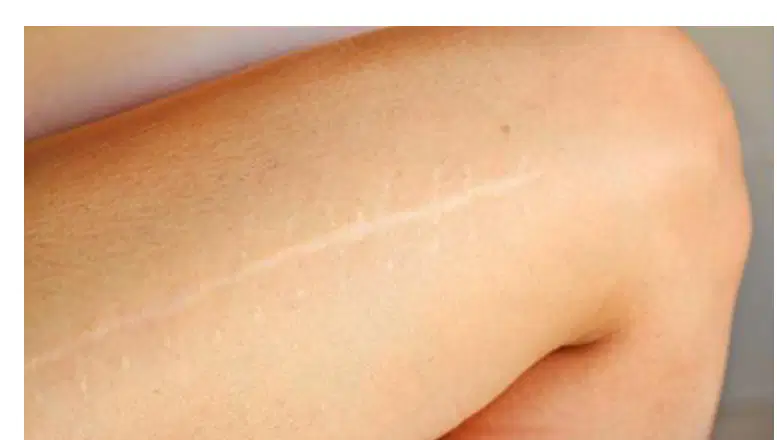
What does the image most likely represent in the context of wound healing?
A normal scar formed after tissue damage.
A fungal infection.
A birthmark.
A bruise.
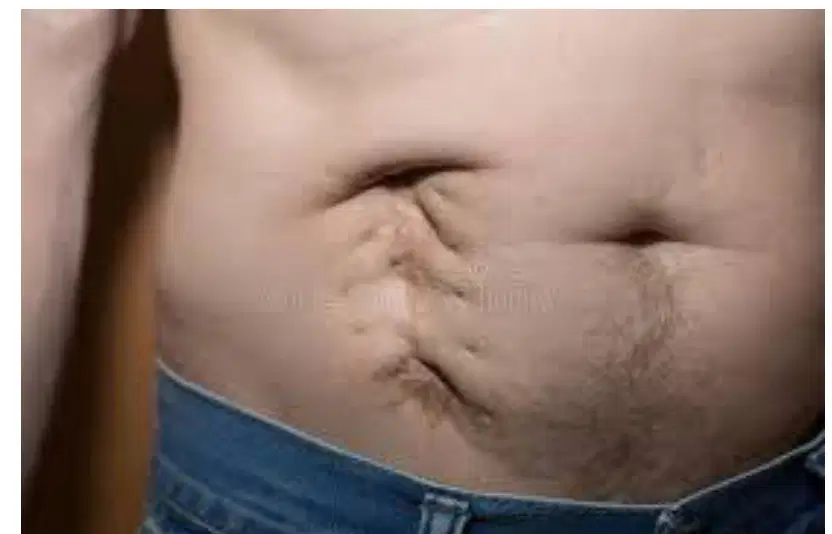
Which of the following is a potential problem associated with normal scars after wound healing?
They always heal without any issues.
They can interfere with the movement of the skin and underlying tissue.
They improve the appearance of the skin.
They prevent any further injury to the area.
Why might some normal scars be considered problematic, even under the best healing conditions?
They always become infected.
They may interfere with movement and can be unsightly.
They never fully form.
They always disappear over time.
When the healing situation is not ideal, what is more likely to become a problem?
Scars
Bruises
Rashes
Blisters
Which of the following can result from poor wound healing?
Scars that are unnecessarily large or weak
Faster recovery
Reduced risk of infection
Stronger skin than before
Which of the following is NOT mentioned as a factor that can lead to larger than normal scars?
Infections
Tissue necrosis
Proper wound closure
Wounds perpendicular to natural lines of minimal skin tension
Explain why wounds that are perpendicular to natural lines of minimal skin tension may result in larger scars. Use evidence from the provided information.
Because they disrupt the natural alignment of skin fibers, increasing tension and scar size
Because they heal faster and leave no scars
Because they are less likely to get infected
Because they are always treated with antibiotics
What is the term used when a wound reopens before it is effectively sealed?
Ischemia
Dehiscence
Ulceration
Hemorrhage
What is likely to happen to the scar if a wound reopens before it is sealed?
The scar will be narrower and stronger
The scar will be wider and weaker
The scar will heal faster
The scar will not change
If too few capillaries grow into the forming scar tissue, what condition may develop due to weak scar tissue?
Hematoma
Ulcer
Abscess
Keloid
Explain why ischemia in the forming scar tissue can lead to the development of an ulcer.
Ischemia increases blood flow, strengthening the scar.
Ischemia reduces oxygen supply, weakening the scar and making it prone to ulceration.
Ischemia causes rapid cell division, preventing ulcer formation.
Ischemia has no effect on scar tissue.
What is a common result when the wound patching process generates too much collagen in the scar?
The scar will shrink and disappear
The scar will enlarge and bulge from the wound
The wound will remain open
The scar will turn blue
What are scars built of too many cells (mainly fibroblasts) called?
Keloids
Desmoids or aggressive fibromatoses
Hematomas
Ulcers
Which cell type is mainly responsible for the formation of scars with too many cells?
Erythrocytes
Fibroblasts
Neurons
Osteocytes
Explain why the wound patching process might result in a bulging scar, using evidence from wound healing mechanisms.
Because the wound is not cleaned properly
Because too many new cells or too much collagen is generated, causing the scar to enlarge and bulge
Because the wound is exposed to sunlight
Because the wound is bandaged too tightly
Scars built from too much collagen are known as which of the following?
Hypertrophic scars or keloids
Atrophic scars or ulcers
Lacerations or abrasions
Fissures or erosions
What are contractures in the context of wound healing?
Scars that are flat and pale
Excessive scars that form tight ridges and interfere with normal movement
Scars that heal without any complications
Scars that are only found on the face
A patient develops tight ridges of scar tissue along their skin after a burn, which limits their ability to move their arm. What is the most likely diagnosis?
Keloid
Contracture
Ulcer
Abrasion
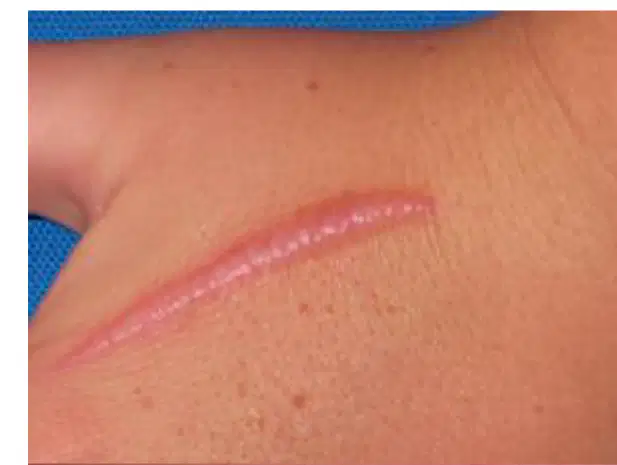
What causes hypertrophic scars during wound healing?
Excess deposition of collagen fibers in a healing wound
Lack of blood supply to the wound
Insufficient cleaning of the wound
Exposure to sunlight during healing
Which phase is usually prolonged, triggering the overactive scar-making process in hypertrophic scars?
Proliferative (regrowth) phase
Inflammatory phase
Remodeling phase
Hemostasis phase
In which of the following situations are hypertrophic scars most likely to occur?
Burns, infected wounds, and wounds healing under tension
Clean surgical incisions with no complications
Minor paper cuts
Superficial abrasions
Explain why hypertrophic scars are more likely to develop in wounds healing under tension, using your understanding of the wound healing process.
Tension increases collagen deposition, leading to overactive scar formation.
Tension reduces blood flow, preventing healing.
Tension causes the wound to remain open, allowing infection.
Tension decreases the inflammatory response.
In hypertrophic scars, what usually happens to the excessive formation of collagen?
It continues indefinitely
It stops within a few weeks
It never forms
It expands beyond the wound
Which of the following best describes a hypertrophic scar compared to a keloid?
It expands out beyond the actual wound
It is thinner than normal skin
It is thicker than normal and raised above the skin, but does not expand beyond the wound
It never gets smaller spontaneously
Where on the body can hypertrophic scars occur?
Only on the face
Only on the hands
Only on the legs
Anywhere on the body
Explain why hypertrophic scars are different from keloids in terms of their growth pattern.
Hypertrophic scars expand beyond the wound, while keloids do not.
Both hypertrophic scars and keloids expand beyond the wound.
Hypertrophic scars do not expand beyond the wound, while keloids do.
Neither hypertrophic scars nor keloids expand beyond the wound.
A patient develops a scar that is raised above the skin and thicker than normal, but it does not grow beyond the original wound area. After a few weeks, the scar begins to get smaller on its own. What type of scar is this most likely to be?
Atrophic scar
Keloid
Hypertrophic scar
Contracture scar
What is the primary cause of keloids in wound healing?
Excess deposition of collagen in a healing wound
Lack of blood supply to the wound
Infection at the wound site
Deficiency of vitamins in the body
Which of the following statements about keloids is TRUE?
Keloids are malignant tumors.
Keloids are caused by a deficiency of collagen.
Keloids are benign tumors and the tendency to develop them is inherited.
Keloids only occur in people with light skin.
Patients with which characteristic are particularly susceptible to developing keloids?
Fair skin
Darkly pigmented skin
Blue eyes
Red hair
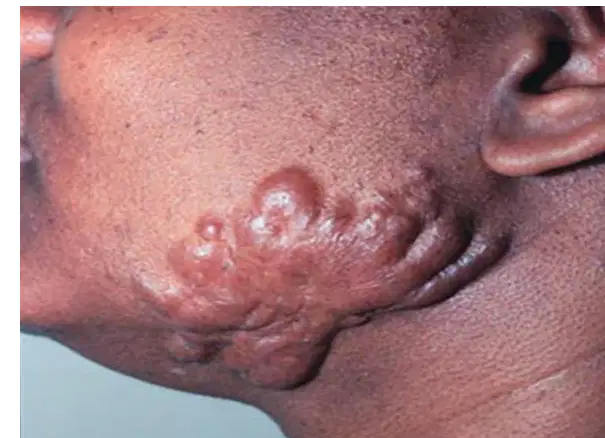
Why might a family history be important in assessing a patient's risk for keloids?
Because keloids are contagious
Because the tendency to develop keloids is inherited
Because keloids are caused by environmental factors only
Because keloids are related to diet
Which of the following statements best describes when keloids typically develop in the healing process?
Keloids develop early in the healing process, similar to hypertrophic scars.
Keloids develop late in the healing process and can appear months or years after the injury.
Keloids develop only during the initial injury.
Keloids develop only after the wound has completely healed and disappeared.
What is a distinguishing feature of keloids compared to hypertrophic scars?
Keloids remain within the boundaries of the wound.
Keloids bulge out beyond the edges of the wound.
Keloids always regress spontaneously.
Keloids are only found on the lower half of the body.
A patient presents with a scar that has grown beyond the original wound edges and has not regressed over time. Based on the information provided, what is the most likely diagnosis?
Hypertrophic scar
Atrophic scar
Keloid
Contracture scar
What is the process that all scars go through during wound healing?
Shrinking or contracting
Expanding or stretching
Bleeding or swelling
Hardening or calcifying
What are contractures in the context of wound healing?
Ridges of connective tissue that contract excessively, causing disability or disfigurement
Areas of skin that become red and inflamed
Open wounds that do not heal
Scars that fade quickly over time
Why can contractures over joints be particularly problematic?
They can make bending difficult or impossible
They cause excessive bleeding
They increase the risk of infection
They always result in complete healing
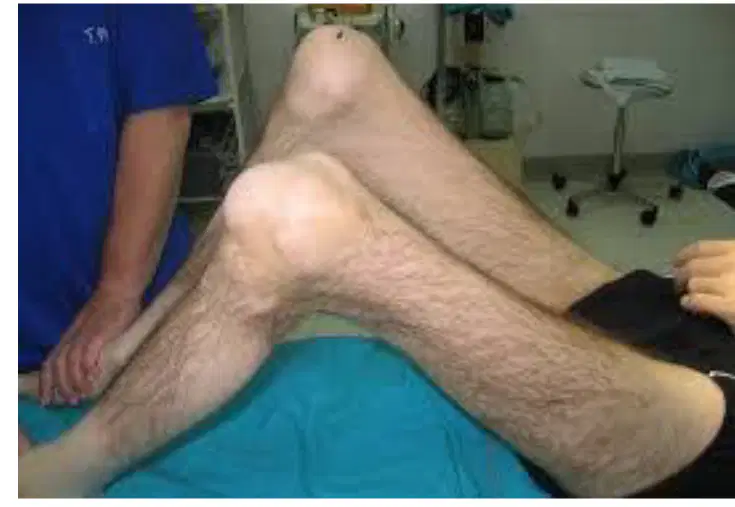
A patient develops a large scar over their knee joint after an injury. Over time, the scar tissue contracts and the patient finds it difficult to bend their knee. Based on your understanding of wound healing, what complication has likely occurred?
Contracture formation
Infection
Hematoma
Ulceration
Where do disabling contractures most commonly form?
Across finger joints, along the neck, across the axilla, and across the antecubital fossa.
On the back, legs, and feet.
On the scalp, ears, and nose.
On the chest, abdomen, and lower back.
What is a contracture in the context of wound healing?
A temporary swelling of the skin.
A permanent fixture of the skin that cannot be repaired by stretching, massaging, or applying ointments, lotions, or creams.
A type of skin infection.
A reversible muscle spasm.
Which of the following is the most successful treatment for a contracture?
Applying ointments and lotions.
Massaging the affected area.
Surgical excision of the contracture.
Stretching exercises alone.
After surgically excising a contracture in Liam's hand, why might his physician order physical therapy?
To speed up the healing of the surgical wound.
To prevent another contracture from forming.
To reduce the need for medication.
To avoid the use of stitches.